When an Inbound AI SDR Delivers Better Results
An inbound AI SDR delivers the greatest impact when your business already generates buyer interest but struggles to convert that interest into qualified pipeline.
In these situations, the challenge isn't creating more demand. It's responding faster, qualifying buyers more effectively, and ensuring high-intent opportunities don't slip away before sales engages them.
An inbound AI SDR is often the better investment if you already have:
- Consistent inbound website traffic but low visitor-to-opportunity conversion.
- A steady flow of demo requests that overwhelm your SDR team.
- Buyers discovering your business through AI search but leaving before speaking with sales.
- Paid marketing campaigns generating leads that aren't converting into pipeline.
- Prospects engaging on LinkedIn through content, comments, or direct messages.
- Email replies from existing marketing campaigns that require qualification.
- Partner referrals that need immediate follow-up.
- Community engagement from Slack groups, Discord communities, Reddit, or industry forums.
- Organic search visibility that brings high-intent buyers to your business.
- An SDR team spending more time qualifying leads than selling.
These are all signals that demand already exists.
The opportunity isn't sending more cold emails or increasing outbound activity. It's ensuring every buyer who has already expressed interest receives immediate, meaningful engagement while their intent is highest.
An inbound AI SDR helps by identifying buyers, answering questions, qualifying conversations, enriching company data, routing opportunities intelligently, and connecting sales with buyers who are genuinely ready to move forward.
If demand already exists, don't spend more money creating it. Convert it better.
For many B2B SaaS companies, improving inbound conversion delivers a faster return than expanding outbound prospecting because every incremental improvement directly impacts buyers who are already evaluating a solution.
When an Outbound AI SDR Delivers Better Results
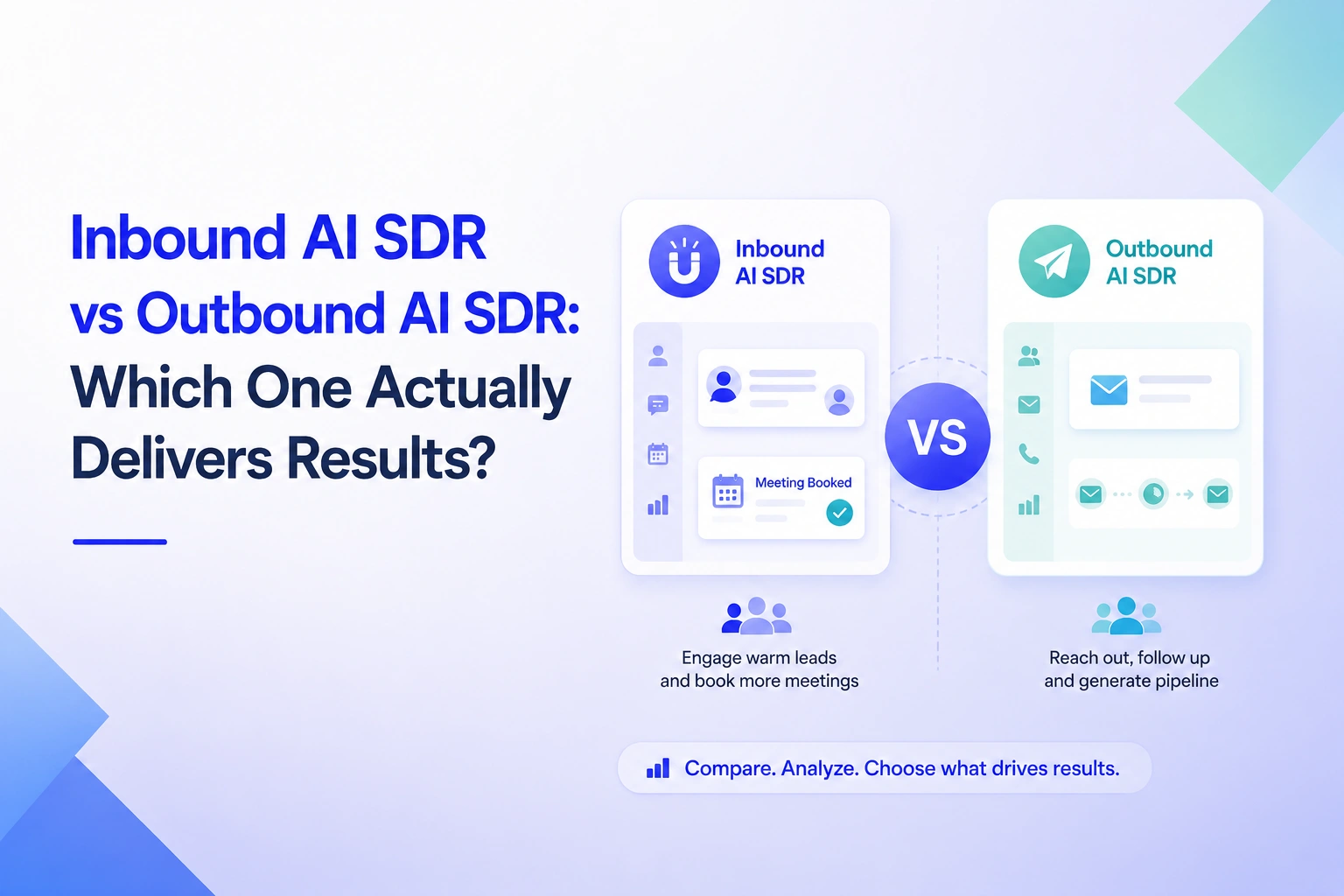
An outbound AI SDR is designed to create opportunities where little or no buying intent exists. Instead of waiting for prospects to engage with your business, it proactively identifies potential buyers, starts conversations, and builds pipelines through personalized outreach.
This makes outbound AI SDRs particularly valuable when your biggest challenge is generating demand, not converting it.
An outbound AI SDR is often the better investment if you need to:
- Build a pipeline in a new market where your brand has little awareness.
- Target a new ideal customer profile (ICP) that isn't yet finding you organically.
- Run account-based marketing (ABM) campaigns against a defined list of target accounts.
- Prospect into enterprise organizations with long buying cycles and multiple decision-makers.
- Expand into new territories or regions where you don't yet have inbound demand.
- Launch a new product or service that requires proactive market education.
- Increase outbound sales capacity without hiring a large SDR team.
- Generate opportunities when inbound traffic is limited or marketing hasn't yet built a predictable demand engine.
In these scenarios, an outbound AI SDR can automate prospect research, personalize outreach, manage follow-up sequences, engage prospects across email and LinkedIn, and help sales teams initiate more conversations with qualified accounts.
The trade-off is that outbound starts with unknown intent. Prospects haven't actively expressed interest in your solution, so AI must first earn attention before it can qualify opportunities and schedule meetings. As a result, outbound programs often take longer to generate measurable pipeline than inbound conversion initiatives.
If your business needs more demand, an outbound AI SDR is the right investment. If your business already has demand but struggles to convert it into revenue, improving inbound conversion usually delivers faster returns.
Why Comparing Reply Rates Misses the Bigger Picture
One of the biggest mistakes companies make when evaluating an inbound AI SDR or outbound AI SDR is measuring success with the wrong metrics.
Outbound sales has traditionally focused on activity metrics because the goal is to create demand. Teams measure how many prospects were contacted, how many opened an email, how many replied, and how many meetings were booked.
Those numbers are useful, but they don't necessarily tell you whether your AI SDR is generating revenue.
Inbound AI SDRs operate much closer to the point of purchase. Buyers have already shown interest, so the question isn't whether they replied to an email, it's whether they became qualified opportunities.
| Outbound AI SDR KPIs |
Inbound AI SDR KPIs |
| Emails sent |
Qualified conversations |
| Open rate |
Buyer qualification rate |
| Reply rate |
SQL conversion rate |
| Positive reply rate |
Qualified pipeline created |
| Meetings booked |
Sales acceptance rate |
| Pipeline sourced |
Opportunity creation rate |
| Revenue generated |
Revenue influenced and closed revenue |
The difference is subtle but important.
An outbound AI SDR might generate hundreds of replies, but if most conversations never progress beyond an initial response, activity increases without producing meaningful business outcomes.
An inbound AI SDR may generate fewer conversations overall, yet if a higher percentage become qualified opportunities, sales-accepted leads, and closed deals, it delivers significantly greater business value.
That's why leading revenue teams are shifting away from activity metrics and toward revenue KPIs.
Instead of asking:
- How many emails did the AI send?
- How many people replied?
- How many meetings were booked?
They ask:
- How many conversations became qualified pipeline?
- How many opportunities were accepted by sales?
- How much pipeline did the AI influence?
- How much revenue did those opportunities generate?
- How quickly did high-intent buyers become customers?
The best AI SDR isn't the one that generates the most replies. It's the one that turns the highest percentage of buying intent into qualified pipeline and revenue.
Inbound AI SDRs Don't Just Answer Questions Anymore
The first generation of inbound AI tools functioned much like chatbots. They answered frequently asked questions, collected contact information, and directed buyers to a demo request form.
Modern inbound AI SDRs do much more.
Instead of simply reacting to conversations, they help orchestrate the entire inbound buying journey.
Today's leading inbound AI SDRs can:
- Identify buyers by revealing verified contact and company information.
- Detect buying intent to distinguish sales opportunities from support requests, partnerships, recruiting inquiries, or spam.
- Qualify buyers through natural conversations instead of lengthy forms.
- Enrich conversations with CRM history, company insights, role, seniority, and engagement signals before sales joins.
- Route conversations intelligently to sales, support, customer success, partnerships, or recruiting based on buyer intent.
- Book meetings only when prospects are qualified and sales-ready.
- Synchronize qualified opportunities with the CRM while helping reduce low-quality records and duplicate contacts.
- Maintain conversation continuity before, during, and after meetings so buyers don't lose context or have to repeat themselves.
This shift has transformed the role of inbound AI.
Rather than acting as a chatbot, it becomes an intelligent revenue layer that helps identify buyers, understand their intent, qualify opportunities, and move them through the buying journey with less friction.
Modern inbound AI SDRs don't just answer questions. They convert buying intent into qualified pipeline.
Outbound AI SDRs Don't Just Send Emails Anymore
Outbound AI SDRs have also evolved significantly.
Early sales automation tools focused on sending large volumes of emails using predefined templates. Today's outbound AI platforms are designed to help sales teams build targeted prospecting programs that feel more relevant and personalized.
Modern outbound AI SDRs can:
- Research target accounts based on your ideal customer profile.
- Identify decision-makers and buying committees within organizations.
- Personalize outreach using company news, technology stacks, hiring trends, funding events, and other buying signals.
- Manage multi-step outbound sequences across email and LinkedIn.
- Automate follow-up based on prospect engagement.
- Prioritize interested prospects for human sales representatives.
- Schedule meetings once buyers indicate interest.
These capabilities help sales teams scale outbound prospecting while reducing repetitive manual work.
However, outbound AI SDRs still begin with unknown buyer intent. Their primary objective is to create interest where none previously existed, making outreach quality, personalization, and persistence critical to success.
Modern outbound AI SDRs don't just automate cold emails. They help revenue teams identify the right prospects, personalize outreach at scale, and create new buying opportunities that can become future pipeline.
Best Inbound AI SDR Platforms
Not all inbound AI SDRs solve the same problem. Some focus on website conversations, others specialize in customer messaging, while a new generation of platforms orchestrates the entire inbound buying journey, from identifying anonymous buyers to qualifying conversations and creating pipeline.
The best choice depends on where your biggest conversion bottleneck exists.
Knock AI
Best for: End-to-end inbound conversion and a formless revenue funnel
Knock AI is designed for revenue teams that want to convert buying intent into qualified pipeline instead of simply collecting leads. Rather than relying on forms or website chat alone, it orchestrates the entire inbound buying journey across multiple channels.
Key strengths
- Reveal anonymous buyers with real-time buyer and company identification
- Detect and prioritize buying intent
- AI-powered conversations that qualify buyers naturally
- Intelligent routing based on intent and account ownership
- Real-time enrichment with CRM and company context
- Meeting scheduling only when buyers are sales-ready
- CRM synchronization for qualified opportunities only
- Continuous conversations before, during, and after meetings
- Multi-channel engagement across LinkedIn, email, WhatsApp, AI search, organic search, paid campaigns, communities, and your website
Ideal for
- B2B SaaS companies
- Revenue and RevOps teams
- Organizations with high inbound demand
- Businesses using HubSpot or Salesforce
- Enterprise and mid-market sales teams looking to improve inbound conversion
Qualified
Best for: Converting website visitors into meetings
Qualified helps sales teams engage website visitors through AI-powered conversations and live chat, making it easier to qualify visitors and book meetings while they're actively browsing your website.
Key strengths
- AI-powered website conversations
- Piper AI SDR
- Website visitor engagement
- Meeting booking
- CRM integrations
Best suited for
Organizations with significant website traffic that want to increase visitor-to-meeting conversion.
Considerations
Qualified is primarily website-first, so conversations generally begin only after buyers reach your website. Businesses looking to engage buyers across additional channels may require complementary tools.
Related: Qualified Pricing
Drift
Best for: Conversational marketing and website engagement
Drift is one of the pioneers of conversational marketing, helping marketing and sales teams replace static forms with live chat and automated website conversations.
Key strengths
- Website chat
- Conversational marketing
- Live conversations
- Lead capture and qualification
- Meeting booking
Best suited for
Marketing-led organizations focused on improving website engagement and lead capture.
Considerations
Drift is optimized primarily for conversations that originate on your website rather than across the broader buying journey.
Related: Drift Pricing
Intercom
Best for: Customer conversations and support
Intercom combines messaging, customer support, automation, and AI to help businesses communicate with prospects and existing customers throughout the customer lifecycle.
Key strengths
- Customer messaging
- AI-powered support
- Live chat
- Knowledge base integration
- Customer onboarding
Best suited for
Companies that prioritize customer support, onboarding, and lifecycle communication alongside inbound messaging.
Related: Intercom Pricing
HubSpot AI
Best for: Existing HubSpot customers
HubSpot includes AI capabilities that help sales and marketing teams automate repetitive tasks, assist with prospecting, lead routing, and improve productivity without leaving the HubSpot ecosystem.
Key strengths
- Native HubSpot integration
- Chatbot
- HubSpot Breeze
- AI-powered sales assistance
- Email and content generation
- CRM automation
- Workflow support
Best suited for
Organizations already invested in HubSpot that want to extend their existing CRM with built-in AI capabilities.
No single platform is universally "best." Each one is built to solve a different part of the inbound revenue journey.
- Knock AI focuses on end-to-end inbound conversion through a formless revenue funnel.
- Qualified specializes in converting website visitors into meetings.
- Drift is built for conversational marketing on your website.
- Intercom excels at customer messaging and support.
- HubSpot AI enhances productivity for teams already using HubSpot.
The right inbound AI SDR isn't the one with the longest feature list. It's the one that solves the specific bottleneck preventing your buyers from becoming qualified pipeline.
Best Outbound AI SDR Platforms
Outbound AI SDR platforms are built to help revenue teams generate pipeline by proactively engaging prospects who haven't yet expressed buying intent. While they all automate parts of the outbound sales process, each platform focuses on a different aspect of prospecting, personalization, or sales engagement.
The best choice depends on your outbound strategy, target market, and sales motion.
Artisan
Best for: AI-powered outbound prospecting
Artisan helps automate outbound prospecting by combining AI with prospect research, personalized outreach, and multi-channel engagement. Its goal is to reduce manual prospecting while helping sales teams generate more qualified conversations.
Key strengths
- AI-driven prospect research
- Personalized outbound campaigns
- Email and LinkedIn outreach
- Automated follow-up
- Meeting booking
Ideal for
Companies looking to scale outbound prospecting without significantly increasing SDR headcount.
11x
Best for: AI SDR replacement
11x positions itself as an AI-powered digital SDR that can automate many of the repetitive tasks traditionally handled by human SDRs, including prospecting, outreach, follow-ups, and qualification.
Key strengths
- Autonomous outbound prospecting
- AI-powered qualification
- Multi-touch outreach
- Meeting scheduling
- Sales workflow automation
Ideal for
Revenue teams looking to automate large portions of their outbound sales process.
AiSDR
Best for: Cold outreach automation
AiSDR focuses on helping businesses automate personalized cold outreach campaigns while maintaining conversational follow-ups designed to convert prospects into meetings.
Key strengths
- Cold email automation
- Personalized messaging
- Automated follow-ups
- Lead qualification
- Meeting booking
Ideal for
Organizations building predictable outbound prospecting programs.
Regie.ai
Best for: AI-powered sales engagement
Regie.ai combines AI content generation with outbound sales execution, helping sales teams create personalized messaging while optimizing outreach sequences across multiple channels.
Key strengths
- AI-generated outbound messaging
- Sales sequence optimization
- Personalization at scale
- Sales engagement workflows
- Revenue team collaboration
Ideal for
Sales organizations focused on improving outbound messaging quality and campaign performance.
Common Room
Best for: Signal-based outbound
Rather than relying solely on static prospect lists, Common Room helps sales teams identify buying signals from product usage, social engagement, communities, hiring activity, and other behavioral indicators before initiating outreach.
Key strengths
- Intent and behavioral signals
- Account prioritization
- Community engagement insights
- Sales signal monitoring
- Outbound targeting
Ideal for
Companies that want outbound sales driven by real buying signals instead of broad cold prospecting.
Clay + AI
Best for: Custom outbound workflows
Clay combines data enrichment, prospect research, and AI automation to help teams build highly customized outbound workflows tailored to their own sales process.
Key strengths
- Data enrichment
- Prospect research
- AI-assisted personalization
- Workflow automation
- Extensive integrations
Ideal for
Revenue operations teams and advanced outbound organizations that want maximum flexibility when building personalized outbound campaigns.
The outbound AI SDR ecosystem has evolved well beyond simple cold email automation.
Modern platforms now combine prospect research, data enrichment, personalization, buying signals, multi-channel outreach, automated follow-ups, qualification, and scheduling to help sales teams generate new pipeline more efficiently.
However, they all share the same objective: creating demand by initiating conversations with prospects who haven't yet entered your buying journey.
If your primary challenge is finding new customers, an outbound AI SDR can help create opportunities. If your primary challenge is converting the buyers already engaging with your business, an inbound AI SDR is often the more effective investment.
Why Most Companies Need Both, But Not at the Same Time
One of the most common questions revenue leaders ask is:
"Should we invest in an inbound AI SDR or an outbound AI SDR first?"
The answer depends on where your biggest growth bottleneck exists.
Think of it as a sequence rather than a choice.
If you don't have enough buying opportunities, create demand first.
If you already have buying opportunities, convert them better first.
The decision is surprisingly practical:
Little or no inbound demand
↓
Outbound AI SDR
↓
Generate conversations
↓
Create pipeline
Consistent inbound demand
↓
Inbound AI SDR
↓
Qualify buyers
↓
Convert more pipeline
Many companies make the mistake of investing heavily in outbound while existing buyers are already slipping through the cracks. Marketing generates traffic, demo requests, AI search visibility, referrals, and LinkedIn engagement, yet buyers wait hours for a response, conversations aren't qualified, and low-quality leads fill the CRM.
In those situations, creating more demand simply increases the number of opportunities that never become revenue.
The highest-performing revenue teams eventually use both.
Outbound AI SDRs create new buying opportunities.
Inbound AI SDRs ensure every buying opportunity is engaged, qualified, routed, and converted into pipeline before buyer intent disappears.
Create demand when demand is missing. Convert demand when demand already exists. Most growing SaaS companies discover that fixing inbound conversion produces faster returns than increasing outbound activity alone.
How to Decide Which AI SDR to Buy First
Before evaluating AI SDR vendors, identify where your current revenue process is breaking down.
If you answer "Yes" to most of the questions in the left column, you're likely to benefit more from an inbound AI SDR. If you answer "Yes" to the right column, an outbound AI SDR should probably come first.
| Ask yourself... |
If "Yes", prioritize... |
| Do you already generate consistent inbound traffic or demo requests? |
Inbound AI SDR |
| Are high-intent buyers waiting too long for a response? |
Inbound AI SDR |
| Are your SDRs overwhelmed with manual qualification? |
Inbound AI SDR |
| Is your CRM filled with duplicate, spam, or low-fit leads? |
Inbound AI SDR |
| Do buyers engage through LinkedIn, AI search, referrals, communities, or email before speaking with sales? |
Inbound AI SDR |
| Are lots of meetings being booked but few becoming opportunities? |
Inbound AI SDR |
| Is your outbound pipeline too small to hit revenue targets? |
Outbound AI SDR |
| Are you entering a new market or targeting a new ICP? |
Outbound AI SDR |
| Do you need to proactively reach enterprise accounts? |
Outbound AI SDR |
| Is your marketing team generating very little inbound demand today? |
Outbound AI SDR |
There's no universal winner because the two platforms solve different revenue problems.
The better question isn't "Which AI SDR is better?"
It's "Which problem is costing us more revenue today?"
Buy the AI SDR that fixes your biggest bottleneck, not the one with the longest feature list. If your pipeline is empty, create demand. If your buyers are already knocking, convert them better.
Why a Formless Revenue Funnel Changes the Economics of Inbound Sales
For years, inbound sales has followed the same playbook.
Drive traffic to your website.
Ask buyers to fill out a form.
Create a CRM record.
Assign an SDR.
Book a meeting.
The traditional workflow looks like this:
Traffic → Form → CRM → SDR → Meeting
The problem is that modern buyers don't behave this way anymore.
They research products on ChatGPT, Perplexity, and Google AI Overviews. They engage with companies on LinkedIn, reply to emails, ask questions on WhatsApp, participate in Slack and Discord communities, click through paid campaigns, discover solutions through organic search, and sometimes never visit a website until they're already close to making a decision.
Yet most inbound funnels still expect one thing:
Fill out a form first.
Every additional field creates friction. Every delayed response gives buyers time to lose interest or evaluate another vendor. By the time an SDR reaches out, the buying moment may already be gone.
A formless revenue funnel takes a different approach.
Instead of forcing every buyer through a form, it starts with a conversation wherever buying intent appears.
The modern inbound journey looks like this:
Traffic → Conversation → Qualification → Intelligent Routing → CRM → Meeting
Rather than waiting for buyers to identify themselves, AI engages them immediately, understands why they're reaching out, qualifies them naturally, enriches their information in real time, and routes them to the right destination before creating a CRM record.
More importantly, conversations are no longer limited to your website.
A buyer might discover your business through:
- LinkedIn
- Email
- AI Search (ChatGPT, Perplexity, Gemini)
- WhatsApp
- Slack and Discord communities
- Organic search
- Paid campaigns
- Referral links
- Your website
In a traditional funnel, these interactions are often disconnected, and many never become opportunities.
In a formless revenue funnel, they're part of one continuous buying journey that follows the buyer instead of forcing the buyer to follow your process.
The result is less friction, faster engagement, cleaner CRM data, and more qualified pipeline from the demand you're already generating.
The future of inbound sales isn't getting more people to fill out forms. It's engaging buyers wherever intent exists and turning conversations, not forms, into qualified pipeline.
How Knock AI Helps Revenue Teams Convert More Buying Intent Into Pipeline
Generating buying intent is only half the challenge. The bigger challenge is converting that intent into qualified pipeline before buyers lose momentum.
Knock AI is built around a formless revenue funnel that replaces fragmented handoffs with continuous buyer conversations. Instead of waiting for someone to complete a form, every interaction becomes an opportunity to identify, qualify, and route buyers while their intent is highest.
Reveal Buyers Before They Introduce Themselves
Many high-intent buyers remain anonymous during the early stages of their research. Knock Reveal capability helps identify buyers and buying accounts by enriching conversations with verified contact and company information, giving revenue teams valuable context before sales ever joins the conversation.
Understand Buying Intent in Real Time
Not every inbound conversation belongs in the sales queue. Knock Intent continuously analyzes intent to distinguish buyers from support requests, partnership inquiries, hiring conversations, researchers, and low-quality interactions. This allows revenue teams to prioritize the conversations most likely to generate pipeline.
Qualify Buyers Through AI Conversations
Instead of asking buyers to complete lengthy forms, Knock AI Agent starts natural conversations immediately. It answers product questions, explains pricing, recommends resources, collects qualification information, and determines whether a buyer is ready to speak with sales, all while creating a more conversational buying experience.
Route Every Conversation to the Right Destination
Qualified buyers reach sales. Existing customers can be routed to support or customer success. Partnership requests go to business development, while recruiting inquiries reach hiring teams. Low-intent conversations can continue with AI or be filtered before consuming valuable sales resources.
Schedule Meetings Only When Buyers Are Ready
Meeting scheduling becomes the result of a successful qualification process, not the beginning of one. By ensuring buyers are engaged and qualified before booking time with sales, Knock AI helps improve calendar quality and increase the likelihood that meetings become real opportunities.
Keep Your CRM Focused on Qualified Opportunities
Instead of creating CRM records for every inquiry, Knock CRM synchronizes only qualified buyers with your CRM. This helps reduce CRM pollution, improves forecasting accuracy, and allows sales teams to spend more time selling instead of cleaning data or disqualifying leads.
Preserve Buyer Momentum Throughout the Journey
The buying journey doesn't stop once a meeting is booked. Knock AI keeps conversations moving with seamless AI-to-human handoffs, conversation continuity, automated meeting reminders to reduce no-shows, and AI-powered follow-ups that keep buyers engaged before and after sales interactions.
By combining buyer identification, intent detection, AI qualification, intelligent routing, scheduling, CRM synchronization, and continuous engagement into one workflow, Knock AI helps revenue teams convert more buying intent into qualified pipeline without relying on traditional forms.
Rather than asking buyers to adapt to your sales process, Knock AI adapts the buying journey around your buyers, turning conversations into qualified pipeline through a formless revenue funnel.
Common Mistakes Companies Make When Choosing an AI SDR
Investing in an AI SDR can significantly improve revenue performance, but only if it solves the right problem. Many companies evaluate platforms based on features or automation capabilities without first identifying where their sales process is actually breaking down.
Here are some of the most common mistakes.
Buying an Outbound AI SDR Before Fixing Inbound Conversion
If your business already generates inbound traffic, demo requests, referrals, or AI search visibility, your biggest opportunity may be improving conversion rather than creating more demand. Generating additional leads won't increase revenue if existing buyers aren't being engaged or qualified effectively.
Optimizing Meetings Instead of Qualified Pipeline
More meetings don't always translate into more revenue. The goal should be increasing qualified pipeline, sales-accepted opportunities, and closed business, not simply filling calendars.
Using AI Only for Email Automation
Modern AI SDRs can do much more than send emails. They can identify buyers, detect intent, qualify prospects, enrich conversations, route inquiries intelligently, and preserve buyer context throughout the sales journey. Limiting AI to outreach alone leaves significant value on the table.
Ignoring Buyer Intent
Treating every inquiry the same often overwhelms sales teams and slows response times for genuine buyers. Understanding why someone is engaging helps determine whether they should speak with sales, customer success, support, recruiting, or continue with AI.
Ignoring CRM Hygiene
Automatically pushing every conversation into your CRM creates duplicate contacts, low-quality records, and unreliable forecasting. High-performing revenue teams focus on ensuring only qualified buying opportunities enter their CRM.
Measuring Reply Rates Instead of Revenue
Reply rates, email opens, and meetings booked are useful activity metrics, but they don't necessarily reflect business impact. The most valuable KPIs are qualified pipeline, sales acceptance rate, opportunity creation, and revenue generated.
The best AI SDR isn't the one with the most features. It's the one that removes the biggest bottleneck between buyer intent and revenue.
Which AI SDR Is Right for Your Business?
Choosing the right AI SDR starts with understanding your primary growth objective. Some businesses need to generate more demand, while others need to convert the demand they already have more effectively.
| If your goal is... |
Best Choice |
| Generate demand in a new market |
Outbound AI SDR |
| Prospect enterprise accounts |
Outbound AI SDR |
| Increase cold outreach capacity |
Outbound AI SDR |
| Build predictable outbound pipeline |
Outbound AI SDR |
| Convert existing website traffic |
Inbound AI SDR |
| Improve demo request conversion |
Inbound AI SDR |
| Qualify inbound leads automatically |
Inbound AI SDR |
| Improve visitor-to-opportunity conversion |
Inbound AI SDR |
| Reduce CRM pollution |
Inbound AI SDR |
| Prioritize buyers based on intent |
Inbound AI SDR |
| Create a formless revenue funnel |
Knock AI |
| Engage buyers across LinkedIn, email, AI search, WhatsApp, communities, paid campaigns, and your website |
Knock AI |
| Build a complete inbound conversion workflow |
Knock AI |
| Turn buying intent into qualified pipeline before it reaches your CRM |
Knock AI |
There's no universal winner because inbound AI SDRs and outbound AI SDRs solve different business problems.
If your challenge is creating demand, an outbound AI SDR is often the right place to start.
If your challenge is converting the demand you already generate, an inbound AI SDR will typically deliver faster returns.
And if your goal is to build a formless revenue funnel that identifies buyers, detects intent, qualifies conversations, routes them intelligently, preserves buyer momentum, and turns buying intent into qualified pipeline, a dedicated inbound conversion platform like Knock AI is designed for that purpose.
Choose the AI SDR that solves your biggest revenue constraint today, not the one that simply automates the most tasks.
Frequently Asked Questions
What is an inbound AI SDR?
An inbound AI SDR is an AI-powered sales assistant that engages buyers after they express interest in your business. It can answer questions, qualify prospects, identify buyer intent, enrich contact information, route conversations, and schedule meetings, helping revenue teams convert existing demand into qualified pipeline.
What is an outbound AI SDR?
An outbound AI SDR helps generate new demand by identifying target accounts, researching prospects, personalizing outreach, managing follow-up sequences, and initiating conversations through channels like email and LinkedIn. Its primary goal is to create pipeline from prospects who haven't yet engaged with your business.
Which AI SDR delivers better ROI?
It depends on your current bottleneck. If your company already generates inbound traffic, demo requests, referrals, or AI search visibility, an inbound AI SDR often delivers faster ROI by converting existing buying intent into qualified pipeline. If your challenge is generating new opportunities, an outbound AI SDR is typically the better investment.
Should I buy an inbound or outbound AI SDR first?
Start with the problem you're trying to solve. If you lack pipeline, invest in an outbound AI SDR to create demand. If buyers are already engaging with your business but aren't becoming qualified opportunities, an inbound AI SDR will usually produce faster business results.
Can AI SDRs replace human SDRs?
AI SDRs can automate repetitive tasks such as prospect research, qualification, answering common questions, routing conversations, and scheduling meetings. However, human sales representatives remain essential for enterprise negotiations, procurement discussions, complex buying decisions, executive conversations, and strategic consulting. For most organizations, AI works best by augmenting SDRs rather than replacing them.
What's the difference between inbound and outbound AI sales?
Inbound AI sales focuses on converting buyers who have already shown interest, while outbound AI sales focuses on creating new interest through proactive outreach. One converts demand, while the other creates it.
Can an inbound AI SDR qualify leads automatically?
Yes. Modern inbound AI SDRs can qualify buyers through natural conversations, collect qualification information, identify buying intent, enrich company and contact data, and determine whether a prospect is ready to speak with sales before creating a CRM opportunity.
Can outbound AI SDRs personalize outreach?
Yes. Many outbound AI SDR platforms personalize messages using firmographic data, buying signals, company news, hiring activity, technology stacks, funding events, and other account insights to make outreach more relevant than traditional sales sequences.
Which AI SDR is best for B2B SaaS?
The best AI SDR depends on your revenue strategy. B2B SaaS companies focused on pipeline generation often benefit from outbound AI SDRs, while those with strong inbound traffic typically see greater returns from inbound AI SDRs that qualify buyers, automate conversations, and improve conversion throughout the buying journey.
Which AI SDR is best for enterprise sales?
Enterprise organizations often benefit from combining both approaches. Outbound AI SDRs help prospect strategic accounts, while inbound AI SDRs qualify high-intent buyers, preserve buyer context, and intelligently route conversations before enterprise sales representatives become involved.
Can AI SDRs book meetings?
Yes. Most modern AI SDRs can schedule meetings once buyers meet predefined qualification criteria. The most advanced platforms also ensure meetings are routed to the appropriate representative and include relevant buyer context before the conversation begins.
Do inbound AI SDRs work outside the website?
Increasingly, yes. While many inbound AI SDRs began as website chat solutions, modern platforms can engage buyers across multiple touchpoints, including LinkedIn, email, AI search, messaging apps, communities, referrals, paid campaigns, and your website, creating a more continuous buying experience.
What is a formless revenue funnel?
A formless revenue funnel replaces traditional lead capture forms with continuous AI-powered conversations. Instead of requiring buyers to submit a form before engaging with sales, conversations begin wherever buying intent appears. Buyers are identified, qualified, enriched, routed, and guided toward the next step before qualified opportunities enter the CRM.
Can I use inbound and outbound AI SDRs together?
Yes. Many high-performing revenue teams use both. Outbound AI SDRs generate new demand by initiating conversations with potential buyers, while inbound AI SDRs ensure existing demand is engaged, qualified, and converted into qualified pipeline. Together, they create a more complete and efficient revenue engine.


.svg)


.svg)
.svg)
.svg)


.svg)
.svg)


.svg)


