Why your first leads are research, not pipeline
This is the part that breaks most early startup lead generation.
Standard lead generation assumes you know who to target and optimizes for volume against a defined ideal customer profile. Every tactic, every tool and every metric in the standard playbook rests on that assumption.
A startup does not have it. You are doing two jobs at once, and they want opposite things.
Lead generation wants volume. ICP discovery wants depth. Two hundred leads from an unfocused campaign teach you less than twenty structured conversations with a narrow segment, because the signal is buried in variance you cannot resolve at that sample size. You end up with a spreadsheet full of people who did not buy and no idea which of eleven differences between them mattered.
The practical consequence: before you know your ICP, narrow deliberately even though it feels like leaving money on the table. Pick a segment specific enough that ten conversations tell you something. If those ten do not convert, you have learned something real. If you talk to ten companies with nothing in common, you have learned nothing and spent the same time.
Narrowing is not a limit on growth. It is what makes the next stage possible, because a pattern only becomes visible against a controlled background.
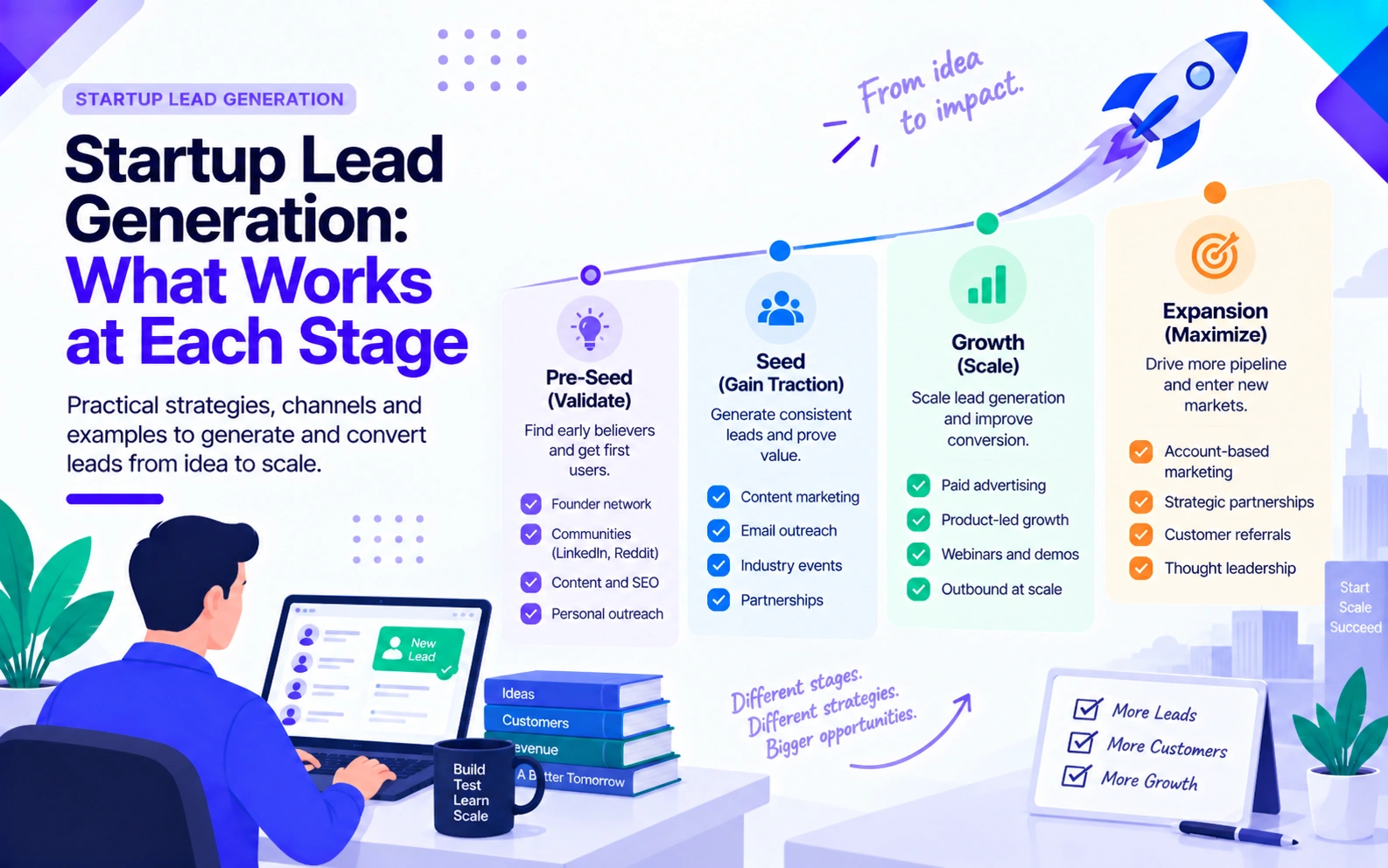
Stage 1: startup lead generation for your first 10 customers
At this stage there is no startup lead generation system. There is you, a list, and a calendar.
Start with the network you have. Not because it scales but because it is the fastest route to a real conversation with someone who will tell you the truth. Former colleagues, investors, advisors, people who have the problem.
Pick a painfully narrow buyer. One role, one company type, one situation. Broad targeting at this stage produces conversations that all feel slightly wrong and teach you nothing.
Win design partners by hand. Early customers who shape the product in exchange for access and attention are worth more than revenue. They become references, and references are the asset that unlocks stage 2.
Go where your buyers already gather. Communities, meetups, forums, the places practitioners in your category talk. Lenny Rachitsky's account of how startups won their first 10 B2B customers documents this repeatedly, including Snyk launching a freemium beta promoted through open-source maintainers and developer communities, with no paid version for nearly a year.
Sell before the product is ready. If nobody will commit to a product that does not exist yet, more polish rarely changes that.
Do things that do not scale, and know that is the point. Manual outreach, hand-written messages, doing part of the work for the customer. At ten customers the goal is learning, not efficiency.
What not to do in stage 1 startup lead generation: build a content engine, hire an SDR, buy a lead list, run paid acquisition, or optimize a funnel. Every one of those assumes knowledge you do not have yet.
Stage 2: finding what repeats, customers 10 to 50
This is the stage almost nobody writes about and where most startups stall.
You have customers. Some of them look nothing like each other. Sales still feel bespoke. The founder is still on every call. And the question that decides the next two years is: which of these wins can happen again without me?
Look for the pattern in how you won, not who you won. The useful grouping is rarely industry or company size. It is usually a situation: they had just hired for a role, lost someone who did the job manually, failed an audit, hit a scale threshold, or changed a system. That situation is your real ICP.
Kill what does not repeat. A logo you won through a personal connection is revenue, not a channel. If you cannot describe how you would find ten more like it, it is not part of your engine.
Write down the qualification criteria. Stage 1 taught you who is not a fit. Turning that into written qualification is what lets someone other than the founder run a call.
Start one compounding channel now. Usually inbound, community presence, or founder-led distribution. It will not produce for two or three quarters, which is exactly why it has to start at stage 2 rather than stage 3. Whatever you begin here is what carries stage 3.
Turn customers into proof. Named references, a case study with real numbers, a quote you can put on a page. Published pricing belongs here too, since it filters poor-fit conversations before they cost you a call. This is the single highest-return activity at stage 2 and founders consistently defer it.
Keep the founder on calls, but start recording why deals are won and lost. The pattern you are looking for is in that record.
The stage 2 failure mode is scaling too early. A channel that produced three customers has not been validated, it has been sampled. Hiring two SDRs against an unproven motion is how startups turn a runway problem into a crisis.
Stage 3: building the lead generation engine, 50+ customers
Now standard B2B lead generation advice finally applies to your startup lead generation, because you have the things it assumes: a known ICP, references, proof and some brand.
Build the compounding channel you started at stage 2. Content and search, community presence, or whatever your buyers actually use. This is the only motion that keeps working after you stop funding it.
Fix conversion before adding channels. Most startups at this stage have more demand than they realize and lose it to slow follow-up, bad routing or a form nobody wants to fill in. Adding traffic to a leaky process buys more of the same problem. Diagnosing where demand disappears is cheaper than generating more of it.
Systematize the handoff. Who responds, how fast, what happens after hours. Response time becomes a real number that can be managed rather than an accident of who was online.
Get the founder off routine deals. Founder-led sales is a stage 1 and 2 asset and a stage 3 bottleneck. The transition is uncomfortable and usually happens later than it should.
Layer in the fast channels deliberately. Paid, outbound and ABM produce pipeline now and stop when you stop. At stage 3 they are a supplement to the engine, not a substitute for it.
The sequencing problem every startup has
Here is the constraint that makes startup lead generation genuinely hard, and it is arithmetic rather than strategy.
| Channel type |
Time to first leads |
What happens when you stop |
Startup problem |
| Content and search |
4 to 9 months |
Keeps working |
Payback lands after the runway you are budgeting against |
| Community and peer presence |
2 to 6 months |
Mostly keeps working |
Requires consistent time you do not have |
| Founder-led social |
2 to 6 months |
Decays slowly |
Only works if the founder actually does it |
| Partnerships |
1 to 2 quarters |
Keeps working |
Requires something to offer a partner |
| Outbound |
2 to 6 weeks |
Stops immediately |
Burns list and domain if run badly |
| Paid |
Days |
Stops immediately |
Expensive, and CAC rises as you scale |
Read the two columns together. The channels that survive a budget cut take longer than most startups plan for. The channels that work this month evaporate the moment you stop paying.
The resolution is not choosing. Effective lead generation for startups runs one of each, deliberately, with different expectations.
Start the compounding channel the quarter before you need it, which in practice means now, and accept it contributes nothing to this quarter's number. Fund the immediate channel from the revenue you need this quarter, and treat its cost as rent rather than investment.
The failure mode is running only fast channels, hitting the number every quarter, and arriving at Series B with a CAC that has doubled and no owned demand. The opposite failure, running only slow channels, is rarer because companies doing it run out of money first.
What founders should stop doing, and when
Founder-led sales is a real advantage and it has an expiry date.
| Activity |
Founder does it |
Hand it off around |
| First discovery calls |
Always, stages 1 and 2 |
Customer 30 to 50, once qualification is written down |
| Writing the pitch |
Always |
Never fully. The founder keeps owning the narrative |
| Outbound prospecting |
Stage 1 only |
As soon as a pattern exists to target |
| Demos |
Stages 1 and 2 |
Once the demo is repeatable without product decisions mid-call |
| Closing |
Stages 1 and 2 |
Customer 50+, and keep founder involvement on strategic deals |
| Content and category voice |
Always |
Never. This is the asset a competitor cannot copy |
| Customer conversations after a loss |
Always |
Never |
The two rows to notice are the ones that say never. A founder's voice in the market and a founder's understanding of why deals are lost are the two things that do not transfer, and they are usually the first things delegated.
Is it bad lead generation or no product-market fit?
Every founder asks this and almost nobody writes about how to tell. From inside the company the two look identical: not enough customers, deals stalling, activity not converting.
They have opposite fixes, so getting this wrong is the costliest mistake in startup lead generation.
| Signal |
Points to lead generation |
Points to product-market fit |
| People who try it |
Keep using it, ask about pricing |
Try once, go quiet |
| Lost deals |
Lost to a named competitor |
Lost to "we will revisit later" |
| Existing customers |
Would be annoyed if you shut down |
Would be mildly inconvenienced |
| Referrals |
Customers introduce you unprompted |
Customers are positive but never refer |
| Sales conversations |
Buyer explains their problem back to you |
You explain their problem to them |
| Churn |
Low, or explainable |
Steady, with vague reasons |
The pattern on the right means more lead generation makes things worse, not better. You would be spending money to show more people a product that does not yet solve a problem they feel urgently.
The pattern on the left means you have a real product and a distribution problem, which is the good problem and the one this article is about.
Startup lead generation channels by stage
| Channel |
Stage 1 |
Stage 2 |
Stage 3 |
| Founder network and referrals |
Primary |
Still significant |
Ongoing, not a system |
| Communities where buyers gather |
Primary |
Primary |
Sustaining |
| Manual, researched outbound |
Primary |
Narrowing to a pattern |
Systematized or dropped |
| Design partners and pilots |
Primary |
Converting to references |
Enterprise only |
| Founder-led social |
Start now |
Compounding |
Compounding |
| Content and search |
Do not start |
Start now |
Primary |
| Partnerships |
Opportunistic |
Deliberate |
Primary |
| Review sites and marketplaces |
Too early |
Start collecting reviews |
Meaningful |
| Removing the form at high intent |
Too early |
Worth testing |
Yes |
| Website conversion |
Minimal |
Worth fixing |
Critical |
| Paid acquisition |
Avoid |
Test small |
Supplement |
| SDR hiring |
No |
Not until the motion repeats |
Yes |
How to measure startup lead generation at each stage
The startup lead generation metric that matters changes completely by stage, and carrying a stage 3 metric into stage 1 produces false confidence.
| Stage |
Measure this |
Ignore this |
| 0 to 10 |
Conversations with a target buyer per week. What you learned from each |
Lead volume, conversion rate, CAC |
| 10 to 50 |
How many wins share a common situation. Time from first contact to close |
MQLs, traffic, impressions |
| 50+ |
Qualified conversations, pipeline by source, response time, CAC by channel |
Raw lead count |
At stage 1, conversion rate is meaningless because the denominator is too small and the population is not yet defined. At stage 3, "conversations had" is an activity metric that hides whether anything is working.
One number worth tracking from day one regardless of stage: how each closed-won customer first heard of you. Not last touch. First contact. It costs nothing, it is impossible to reconstruct later, and at stage 2 it is the single most useful dataset you own. Most startups start recording it around customer 60 and permanently lose the first 59 data points.
Where tools fit in startup lead generation
At stage 1, almost nowhere. Startup lead generation tools are a common form of productive-feeling procrastination at this stage, and a spreadsheet, a calendar and an email account are sufficient.
At stage 2, a CRM that someone actually updates, and whatever records why deals were won and lost.
At stage 3, the constraint usually shifts from generating demand to not losing it. That is when identification, intent signals and faster conversion start to matter, because you finally have enough traffic for those things to have something to work with.
Knock AI sits at that stage 3 constraint: identifying engaged accounts, scoring what they do, and letting a buyer start a conversation instead of filling in a form and waiting. It is the wrong purchase at stage 1 and usually at stage 2, because the problem there is not conversion, it is that not enough people have heard of you. That budget belongs in the founder's time and the compounding channel.
FAQs
What is startup lead generation?
Startup lead generation is the process of finding, qualifying and converting customers for a company with no established brand, no reference customers and often no proven ICP. It differs from standard B2B lead generation because most standard advice assumes assets a startup does not yet have.
How do startups get their first customers?
Manually. The founder's network, communities where the buyer already gathers, and researched one-to-one outreach to a painfully narrow segment. Design partners who shape the product in exchange for access are worth more than early revenue, because they become the references that unlock everything after.
How many leads does a startup need?
At stage 1 this is the wrong question, because the goal is learning rather than volume. Ten structured conversations with one narrow segment produce more usable information than two hundred unfocused leads. From stage 3 onward, work backwards from your pipeline target, average deal size and conversion rates.
When should a startup start doing content marketing?
Around stage 2, roughly 10 to 50 customers. It takes four to nine months to produce meaningful volume, which means starting at stage 3 is starting two quarters too late. Starting at stage 1 is premature because you do not yet know who you are writing for.
Should a startup hire an SDR?
Not until a motion repeats without the founder. A channel that produced three customers has been sampled, not validated. Hiring against an unproven motion converts a runway problem into a crisis, and the SDR usually leaves before the process that would have made them successful exists.
Is outbound or inbound better for startups?
Outbound produces conversations in weeks and stops when you stop. Inbound takes quarters and keeps working. Most startups need outbound to survive the present and inbound to survive the future, running simultaneously with different expectations.
How do I know if my lead generation is broken or I just do not have product-market fit?
Look at what happens after someone tries the product. If they keep using it, ask about pricing, and occasionally refer you, you have a distribution problem. If they try once and go quiet, and losses are to "we will revisit later" rather than a named competitor, more leads will make things worse rather than better.
How much should a startup spend on lead generation?
Less than most founders assume at stage 1, where the binding constraint is founder time rather than budget. The more useful framing is runway: any channel whose payback period is longer than your remaining runway is a bet on the next raise, and should be recognized as one.
What is the cheapest way for a startup to generate leads?
Founder time spent in communities where the buyer already gathers, and direct conversations with the network you already have. Both cost nothing but hours, both work at stage 1, and neither scales, which is why they stop being the answer around customer 30.
When should the founder stop selling?
Routine deals, around customer 30 to 50, once qualification criteria are written down and the demo is repeatable. Never fully for two things: the company's voice in the market, and conversations with customers after a loss. Those are the two things that do not transfer, and they are usually the first delegated.
Do lead generation agencies work for startups?
Rarely at stage 1, because the agency cannot discover your ICP for you and that is the actual job. They can work at stage 3 when the motion is proven and you need coverage faster than you can hire. Between those, an agency will scale whatever you hand them, including a motion that does not repeat.
What should a startup track from day one?
How each closed-won customer first heard of you. Not last touch, first contact. It costs nothing to record and is impossible to reconstruct later. Most founders start around customer 60 and permanently lose the data from the period they most need to understand.


.svg)


.svg)
.svg)
.svg)


.svg)
.svg)


.svg)


