What Are the Best Inbound Lead Generation Strategies?
So, what actually works?
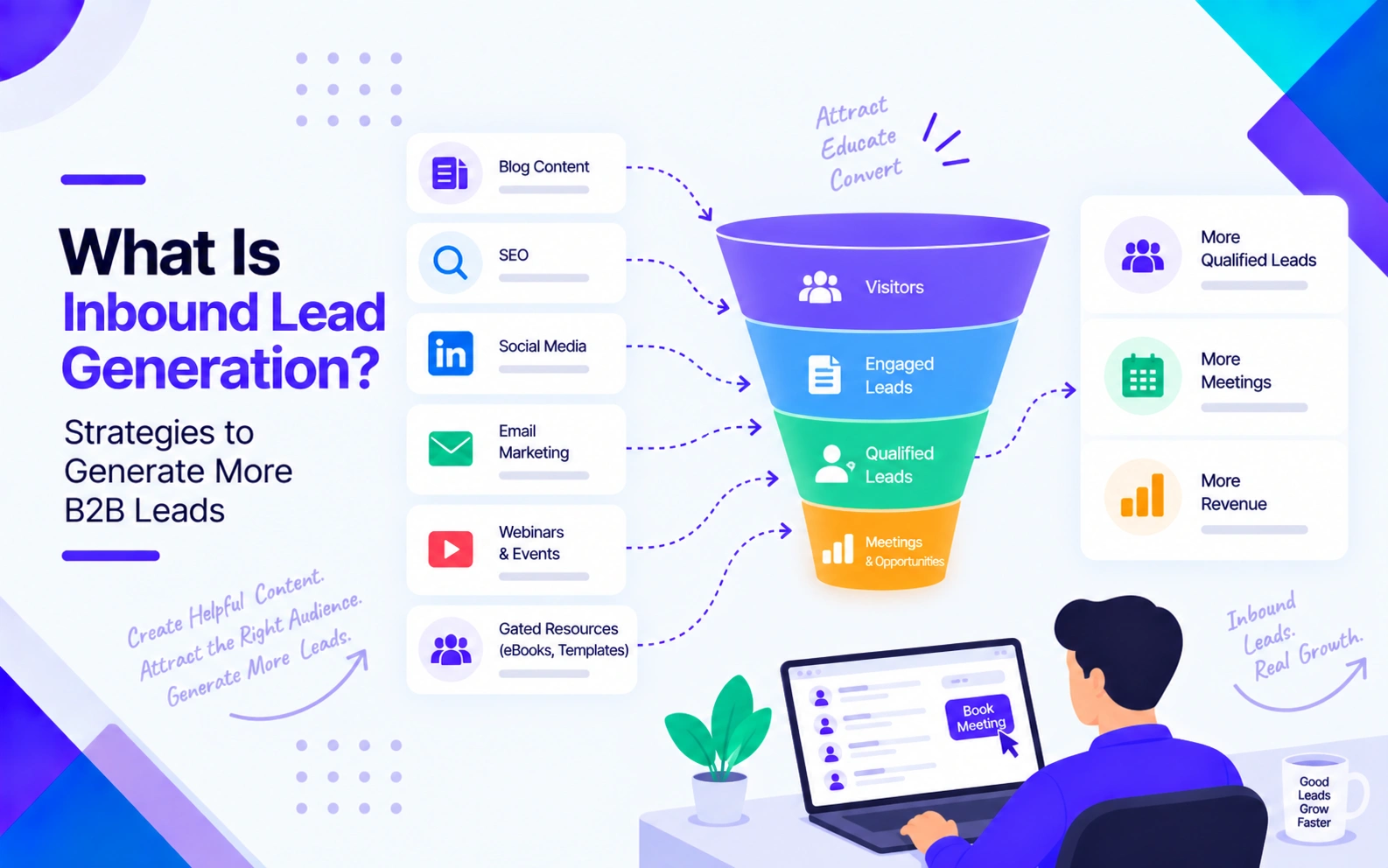
There's no shortage of advice on inbound marketing. Create a blog. Post on LinkedIn. Host webinars. Send emails. Optimize your website.
All good advice.
But there's a problem with treating those as isolated tactics.
The best inbound lead generation strategies work together. Your content attracts the right people. Your website gives them somewhere to go. Your conversion paths capture their interest. Your follow-up keeps the conversation moving.
And the numbers back up the importance of getting this mix right. Website, blog, and SEO are used by 48.4% of B2B marketers, making them the most widely used B2B marketing channel. They're also the top channel for reported ROI, at 30.2%. (Source)
But inbound isn't just an SEO game. So instead of giving you a random list of tactics, let's look at the strategies that work at different points of the inbound journey.
1. Build SEO and Search-Driven Content Around Real Buyer Questions
When someone searches Google for a problem, they're telling you something.
They have a question. Maybe they're comparing solutions. Maybe they're trying to understand a problem they just discovered. Or maybe they're already looking for a product and are deciding which one to buy.
Your job is to meet them at that moment.
That's why good SEO for inbound lead generation isn't about publishing hundreds of generic articles. It's about creating useful pages around the questions your potential buyers actually ask.
For example, someone searching “what is inbound lead generation?” is probably still learning. Someone searching “best inbound lead generation software” has moved much closer to a buying decision.
Those are very different search intentions, even though both can bring inbound traffic.
Build content around the full journey:
- Informational questions
- Problem-focused searches
- How-to queries
- Comparison searches
- Commercial investigations
- Product and solution searches
And don't stop at the blog.
Create comparison pages, use-case pages, industry pages, templates, calculators, and other assets that give high-intent visitors somewhere useful to go next.
The goal isn't more organic traffic. It's more of the right organic traffic.
2. Create High-Value B2B Content
A blog post can attract someone.
A genuinely useful resource can give them a reason to come back.
That's why strong B2B inbound lead generation usually needs more than blog articles. Think guides, original research, reports, case studies, templates, comparison pages, playbooks, and practical frameworks.
Ask yourself:
If I were the buyer, would I actually bookmark this?
If the answer is no, you probably have a content problem.
The best content also gives you multiple opportunities to generate inbound leads. A research report can attract search traffic, fuel LinkedIn posts, become a webinar topic, provide sales enablement material, and create an email nurture sequence.
One good asset can do a lot of work.
3. Use Webinars and Virtual Events to Create Deeper Engagement
Some topics are better explained live.
That's where webinars, workshops, demos, and virtual events can become powerful inbound channels.
Someone who spends 45 minutes in a webinar is giving you a much stronger engagement signal than someone who glanced at a blog post for 30 seconds.
But don't make the mistake of treating registration as the end goal.
Look at what happens before, during, and after the event.
Did they attend? Which sessions did they join? Did they ask a question? Did they visit your website afterward?
Those signals can help you understand which attendees are simply learning and which ones might be moving toward a buying conversation.
If you're interested in how virtual events fit into the broader engagement journey, see our guide to virtual events.
4. Give Buyers Something Useful With Lead Magnets and Interactive Resources
Want someone to exchange their email address for something?
Give them a reason.
A generic “Subscribe to our newsletter” CTA isn't going to convince most B2B buyers.
A useful template might.
So might a calculator, benchmark report, assessment, checklist, ROI tool, or industry-specific guide.
The best lead magnets solve a problem the buyer already has.
And there's another benefit: the resource itself can tell you something about the prospect.
Someone downloading an introductory guide may still be researching. Someone using your ROI calculator might be much further along.
That context can become useful when you're deciding how to follow up.
5. Turn Social Media Into a Discovery Channel, Not Just a Distribution Channel
For B2B companies, LinkedIn can do much more than distribute links.
It can create demand before someone ever searches for your company.
Share useful insights. Break down customer problems. Publish original research. Show how your team thinks. Answer questions your buyers are already asking.
And don't assume every social interaction needs to drive someone immediately to a landing page.
Sometimes the goal is simply to become familiar.
That familiarity matters later when the same person searches for a solution, visits your website, or starts evaluating vendors.
6. Use Email Nurturing to Keep Existing Interest Alive
Here's a common inbound problem:
Someone downloads your report.
Marketing marks them as a lead.
Sales doesn't think they're ready.
And then... nothing happens.
That's a missed opportunity.
Not every inbound lead is ready for a sales conversation today. Email nurturing gives you a way to stay useful while that buyer continues researching.
Send relevant content based on what they actually care about rather than throwing everyone into the same five-email sequence.
Someone researching a problem needs different content from someone comparing vendors.
Good nurturing keeps the conversation going without forcing the conversation too early.
7. Optimize Your Website for the Next Step
Getting someone to your website is only half the job.
What happens when they arrive?
Can they quickly understand what you do? Find the information they're looking for? See proof? Ask a question? Book a meeting?
Small changes can matter here.
Small changes can make a real difference here. In one recent B2B homepage experiment, a CTA test increased conversion rates by 11.8%. (Source)
The lesson isn't that every CTA test will produce 11.8%.
It's that you shouldn't assume your current conversion path is good enough.
Test your headlines. CTAs. Forms. Page structure. Social proof. Navigation. Meeting flows.
Your website shouldn't just explain your product.
It should make the next step obvious.
8. Personalize the Experience Around the Buyer
Here's another question worth asking:
Should every visitor see exactly the same website experience?
Probably not.
A developer evaluating your API doesn't have the same needs as a VP of Marketing evaluating your platform.
You can use information such as industry, company size, account, behavior, previous interactions, and intent to make the experience more relevant.
Even simple personalization can help remove friction.
Instead of:
“Learn more about our platform.”
You might show a returning visitor:
“See how teams like yours use [product] to improve inbound conversion.”
The closer the experience matches the buyer's context, the easier it becomes to move from interest to action.
9. Build Partnerships and Referral Channels
Not all inbound demand starts with Google.
Sometimes it starts with someone else's audience.
Partner with complementary companies. Contribute guest content. Run co-marketing campaigns. Join relevant communities. Build integrations. Create joint webinars.
The advantage is simple: you're borrowing trust and distribution that someone else has already built.
And referral traffic often arrives with useful context. The buyer may already understand the problem and have some familiarity with your company before they ever reach your site.
10. Add AI-Powered Inbound Engagement
Now we get to something that's changing the traditional inbound model.
For years, the process looked something like this:
Visitor arrives → fills out form → enters CRM → gets assigned → someone follows up
That's fine when someone is willing to wait.
Modern buyers aren't always that patient.
AI can help companies respond while interest is happening. An AI agent can answer questions, understand what someone is looking for, qualify the conversation, recommend relevant resources, and help move qualified buyers toward a meeting.
The important part isn't simply using AI.
It's using AI to remove the gap between “I'm interested” and “someone helped me.”
11. Engage Visitors Based on Intent, Not Just Form Fills
This is one of the biggest opportunities in modern inbound lead generation.
What happens to the visitor who never fills out your form?
Maybe they visit your pricing page twice. Read three product pages. Check implementation details. Then leave.
Traditional inbound might count that as another anonymous visitor.
But that behavior can tell a much more interesting story.
The buyer may already be raising their hand. They're just not using your form.
Intent-based website engagement looks at those signals and helps you decide when someone deserves attention.
That's where inbound starts moving from passive lead capture to active demand conversion.
12. Repurpose Your Best Content Across Multiple Channels
Finally, don't make every inbound asset from scratch.
One strong piece of research can become:
- A blog post
- LinkedIn posts
- A webinar
- Short videos
- An email sequence
- A downloadable report
- Sales enablement content
- Industry-specific pages
Why does this matter?
Because buyers don't all discover you in the same place.
The more useful entry points you create around a strong idea, the more chances you give the right buyer to find you.
And that's really the point of an effective inbound lead generation strategy.
You don't need to be everywhere.
You need to build a connected system where the right people can discover you, engage with you, and move naturally toward a conversation.
How to Get Inbound Leads
So, how do you actually get inbound leads?
It's tempting to answer with a list of tactics: publish more content, improve SEO, run webinars, post on LinkedIn, and so on.
But that's not really a strategy.
Getting inbound leads starts with knowing who you want to attract and ends with knowing which of those leads actually turn into pipeline. Everything in between should connect those two points.
Here's a practical framework for generating inbound leads without turning your marketing into a collection of disconnected tactics.
1. Know Who You're Targeting
Before you try to generate more inbound leads, get clear on which leads you actually want.
Define your ideal customer profile, the problems they care about, the roles involved in the buying process, and the signals that suggest they're a good fit.
Why start here?
Because it's surprisingly easy to generate the wrong kind of demand. A piece of content can bring thousands of visitors and still produce very little business if the audience has no reason to buy from you.
Your goal isn't simply to increase inbound leads.
It's to attract more people who could realistically become customers.
2. Pick the Channels They Actually Use
Where does your audience go when they're trying to solve the problem you solve?
Maybe they search Google. Maybe they spend their time on LinkedIn. Maybe they learn through webinars, communities, podcasts, industry publications, or recommendations from peers.
Go there.
You don't need to be everywhere. You need to be where your potential buyers already spend time researching and learning.
For B2B companies, that often means combining search-driven content with social distribution, events, partnerships, email, and other channels that keep your company visible throughout the buying journey.
3. Create Content Around Their Problems
Now give those buyers something worth finding.
The strongest inbound marketing lead generation programs don't start with, “What can we publish this week?”
They start with:
“What is our buyer trying to figure out right now?”
That question can lead to much better content.
Create articles that answer specific questions. Build guides for complicated problems. Publish comparisons for buyers evaluating options. Create templates, reports, case studies, calculators, and other resources that help someone make progress.
And pay attention to search intent.
Someone searching “what is inbound lead generation” needs education. Someone searching “best inbound lead generation tools” is probably evaluating solutions.
Your content should meet both buyers where they are.
4. Give Them a Reason to Engage
Getting someone to read your content is great.
Getting them to take the next step is better.
What would make your ideal buyer want to engage?
Maybe it's a useful template. A benchmark report. A product demo. A free assessment. A webinar. A calculator. Or simply the ability to ask a question and get an answer immediately.
The offer should make sense in the context of what the visitor is doing.
If someone is reading a beginner's guide, asking them to book a sales call might be too much. If they're comparing products or researching pricing, that same CTA could make perfect sense.
Match the next step to the buyer's intent.
5. Make Conversion Easy
Here's a simple question:
When someone is ready to talk to you, how much work are you making them do?
Long forms, confusing navigation, buried CTAs, and slow booking processes can turn genuine interest into another lost visitor.
Make it obvious what someone can do next.
Let them book a meeting. Start a conversation. Request pricing. Sign up for a trial. Download the resource they're looking for.
And don't force every visitor through the same conversion path.
Someone who wants to talk now should be able to talk now.
6. Follow Up Quickly
This is where generating inbound leads often breaks down.
Someone finally raises their hand, and then the lead sits in a CRM queue.
By the time someone responds, the buyer might be researching a competitor, attending another meeting, or simply no longer thinking about the problem.
Speed matters because intent has a shelf life.
If someone requests a demo, asks a product question, or shows strong buying intent, the best time to respond is while that interest is still fresh.
And quick follow-up doesn't necessarily mean handing every lead to an SDR immediately. It means recognizing the signal, understanding the context, and giving the buyer an appropriate next step.
7. Measure Which Sources Create Qualified Pipeline
Finally, stop measuring inbound success purely by lead volume.
You can generate 1,000 inbound leads and still have a terrible inbound program.
The better question is:
Which channels are producing qualified opportunities and pipeline?
Track the journey from source to outcome:
Channel → Visitor → Lead → Qualified Lead → Meeting → Opportunity → Pipeline
That lets you see whether your SEO content, webinars, LinkedIn posts, paid campaigns, partnerships, or other inbound lead generation strategies are actually producing business.
And sometimes the answer will surprise you.
The channel sending the most leads may not be the channel generating the most revenue.
That's why the best way to get inbound leads isn't simply to do more marketing. It's to build a system that attracts the right audience, gives them useful reasons to engage, removes friction from conversion, responds while interest is high, and measures what ultimately turns into pipeline.
More inbound leads are nice. A more qualified pipeline is the goal.
How to Increase Inbound Leads
So, you've already got an inbound engine running. You're publishing content, getting traffic, generating some leads, and maybe even booking meetings.
But the numbers aren't where you want them to be.
How do you increase inbound leads without simply throwing more traffic at the problem?
That's the key question.
Sometimes you don't need a completely new inbound lead generation strategy. You need to get more from the demand you're already creating.
Here are the areas worth optimizing first.
1. Improve Search Visibility
If your potential buyers can't find you, they can't become inbound leads.
Look at the searches your target audience actually makes and identify where you're missing. You might have plenty of top-of-funnel content but very little coverage around commercial or problem-specific searches.
Improve existing pages, build content around high-intent questions, strengthen internal linking, and create pages for topics where your buyers are actively looking for solutions.
The goal isn't to rank for everything.
It's easier to find when the right buyer is looking.
2. Create More Bottom-of-Funnel Content
Here's a common inbound problem: companies create lots of educational content but very little content for people who are actually considering a purchase.
Someone searching “what is lead qualification?” is in learning mode.
Someone searching “best lead qualification software” is having a very different conversation in their head.
You need both.
Create comparison pages, alternatives pages, use-case content, implementation guides, pricing content, case studies, and solution-focused pages that help buyers move closer to a decision.
This is one of the simplest ways to turn existing search demand into more qualified inbound leads.
3. Fix Conversion Friction
What happens when someone finally decides to engage?
If the form is too long, the CTA is hard to find, the page is confusing, or booking a meeting takes five steps, you're creating friction at exactly the wrong moment.
Go through your highest-traffic pages and ask:
Where could a genuinely interested buyer get stuck?
Then remove those obstacles.
Sometimes increasing inbound leads isn't about attracting another visitor. It's about stopping the visitors you already have from leaving.
4. Add Stronger, More Relevant CTAs
“Learn More” isn't always the best next step.
Your CTA should make sense for what the visitor just read or did.
A visitor reading an introductory guide might want another educational resource. Someone reading a product comparison might want a demo. Someone checking pricing might want to talk to sales.
Give people a next step that matches their intent.
And don't assume one CTA has to work for everyone.
5. Improve Your Landing Pages
Your landing page has one job: help the visitor take the next step.
Make the value obvious. Remove unnecessary distractions. Match the page to the campaign or search intent that brought the visitor there. Use relevant proof. Make the CTA easy to understand.
And test it.
Even a relatively small change can matter. In one recent B2B homepage experiment, a CTA test increased conversion rates by 11.8%.
The point isn't to expect an 11.8% improvement from every experiment.
It's to remember that your conversion rate isn't a fixed number.
6. Personalize the Experience
Imagine two companies arrive on your website.
One is a 20-person startup.
The other is a 5,000-person enterprise account.
Should they necessarily see the same experience?
Probably not.
Use available context such as company, industry, account, previous behavior, pages visited, and intent to make the experience more relevant.
Even small changes can make a visitor feel like the website actually understands what they're looking for.
7. Expand Distribution
Publishing something doesn't mean people will find it.
Take your best-performing content and distribute it where your buyers already spend time.
Share it on LinkedIn. Turn it into a webinar. Pitch it to relevant communities. Use it in email. Build supporting content around it. Partner with companies that serve the same audience.
More distribution creates more entry points into your inbound funnel.
And you don't necessarily need more content to do it.
8. Repurpose What Already Works
Here's an easy win that gets overlooked.
If one article consistently generates qualified traffic, don't just publish another article and move on.
Turn the idea into a LinkedIn post. A short video. A webinar. A checklist. An email. A downloadable resource.
One successful topic can create several new ways for buyers to discover you.
Before asking, “What should we create next?”, ask:
“What have we already created that deserves a bigger audience?”
9. Capture Anonymous Intent
This is where modern inbound starts getting really interesting.
A large part of your website traffic won't fill out a form.
That doesn't mean those visitors have no value.
Someone might visit your pricing page, return two days later, read implementation content, and then spend time comparing your product with alternatives.
If your only definition of an inbound lead is “someone who submitted a form,” you may miss all of those signals.
The opportunity is to recognize meaningful behavior before the buyer raises their hand explicitly.
That gives your team more context and creates more opportunities to turn existing demand into conversations.
10. Reduce Response Time
Finally, look at what happens after someone actually becomes an inbound lead.
How long does it take to respond?
Five minutes? An hour? Tomorrow?
The longer you wait, the greater the chance that the buyer's attention moves somewhere else.
Speed matters particularly when someone has demonstrated strong intent, such as requesting a demo, asking a product question, or actively evaluating your solution.
More inbound leads don't help if the leads you're already generating aren't getting timely attention.
So if you're wondering how to increase inbound leads, don't automatically start by increasing your content budget.
First, look at the entire journey:
Visibility → Engagement → Conversion → Intent → Response → Pipeline
There may already be more inbound demand in your funnel than you're capturing.
B2B Inbound Lead Generation: What Changes?
B2B inbound lead generation gets complicated for one simple reason:
The person showing interest isn't necessarily the person making the decision.
A consumer might discover a product, like it, and buy it five minutes later.
B2B rarely works that way.
A buyer might discover your company through Google, read three articles, share one with their boss, attend a webinar, check your pricing, send the product page to a colleague, and finally submit a demo request.
And that demo request might come from only one person in a much larger buying group.
A person may be the one filling out the form, but the buying decision usually belongs to a group.
That's why B2B inbound lead generation needs to account for more than individual lead activity.
Multiple Stakeholders
The person researching your solution might be a practitioner.
Their manager might control the budget.
IT might need to approve the technology.
Procurement might get involved later.
Each person can interact with your company differently, while all of them are part of the same potential opportunity.
Longer Buying Cycles
B2B buyers often don't convert after one interaction.
They research, compare, revisit, ask questions, talk internally, and come back later.
That means inbound lead generation needs to preserve context across those interactions rather than treating every visit as an isolated event.
Higher Deal Values
When a single customer can represent significant revenue, lead volume isn't enough.
A hundred low-fit leads aren't necessarily better than ten accounts with genuine buying intent.
B2B teams need to optimize for qualified opportunities and pipeline, not just form fills.
Research-Heavy Buyers
Modern B2B buyers can do a remarkable amount of research before speaking to sales.
They read reviews, compare vendors, consume content, ask peers, search communities, use AI tools, and explore product websites independently.
By the time they finally contact you, they may already know quite a bit about your company.
Your inbound system needs to understand that pre-conversion journey.
Account-Level Intent
This is where the individual-lead model starts showing its limitations.
What if three people from the same company visit your website over the course of a week?
Individually, those interactions might not look extraordinary.
Together, they could tell a very different story.
The account is showing interest.
That's why effective B2B inbound lead generation increasingly looks at the relationship forming around an account, not just the person who happened to fill out a form.
Sales and Marketing Have to Work Together
Finally, inbound can't live entirely inside the marketing team.
Marketing creates and captures demand.
Sales needs to understand that demand and act on the right opportunities.
If marketing generates excellent inbound leads but sales receives them without context, qualification, or timely routing, the system breaks down.
The strongest B2B inbound programs connect the two.
Attract the right accounts. Understand the signals they create. Recognize the people involved. And give sales enough context to have the right conversation at the right time.
That's what turns inbound lead generation from a traffic strategy into a pipeline strategy.
How Do You Qualify and Manage Inbound Leads?
Getting an inbound lead is only the beginning. Now you need to figure out whether the lead is worth pursuing, what they're interested in, and who should handle them.
A simple inbound lead management process looks like this:
Identify → Enrich → Score → Qualify → Route → Engage → Nurture
First, identify the person or account behind the activity. Then enrich the record with useful context such as company, role, industry, and other relevant data.
Next, score and qualify the lead using a combination of ICP fit, behavioral signals, and buying intent. Someone who downloads one article shouldn't necessarily receive the same treatment as someone repeatedly visiting pricing and product pages.
This is also where MQLs and SQLs come into play. An MQL may show enough engagement to warrant further attention, while an SQL has met your defined criteria for direct sales engagement. For a deeper look, see our guide to Sales Qualified Leads (SQLs).
Once a lead is qualified, route it to the right person or team based on factors such as territory, account ownership, company size, or product interest. Then engage quickly while the buyer's intent is still fresh.
Leads that aren't ready yet shouldn't simply disappear. Nurture them with relevant content and follow up as their intent develops.
For a deeper look at the qualification process, see our guide to Lead Qualification, and for the routing side, see our guide to Lead Routing.
Why Do Inbound Leads Go Cold?
Here's the frustrating part.
You can spend months generating demand, only to lose the buyer after they've finally shown interest.
Why?
Sometimes the sales team responds too slowly. Sometimes the lead gets stuck waiting for manual qualification. Sometimes it goes to the wrong rep. And sometimes the sales team receives a name and email address but has no idea what the buyer actually did before submitting the form.
Other common problems include:
- Forms that create too much friction
- Leads arriving outside business hours
- Poor or incomplete data
- Manual routing and follow-up
- Treating every inbound lead the same
- Failing to recognize intent before a form submission
The result is the same: interest fades while the company is still deciding what to do with it.
That's why increasing inbound lead generation isn't always about generating more leads. Sometimes the bigger opportunity is to stop wasting the leads you're already generating.
For a deeper look at why this happens, see Why Inbound Leads Never Get Contacted.
Inbound Lead Generation Tools, Agents, and Services
What do you actually need to generate and manage inbound leads?
That depends on where the gaps are in your process.
| Type |
Best For |
| Inbound marketing software |
Content, campaigns, forms, and nurture |
| Lead generation tools |
Capturing and managing demand |
| Visitor identification tools |
Identifying anonymous companies |
| AI inbound agents |
Real-time engagement and qualification |
| Lead generation services |
Outsourcing inbound execution |
| CRM and automation platforms |
Managing the lead lifecycle |
You don't necessarily need another tool for every step. The better approach is to identify where your current inbound process breaks down and choose technology around that gap.
If you're comparing options, see our guides to 33 Best B2B Lead Generation Tools, Best Inbound Lead Generation Agents & Services, and Best AI Tools for Lead Generation.
How Do You Measure Inbound Lead Generation?
Lead volume is easy to measure.
Pipeline is what matters.
Track the journey from the original source through to revenue:
Organic Traffic → Leads → MQLs → SQLs → Meetings → Opportunities → Pipeline → Revenue
Useful metrics include:
- Organic traffic
- Visitor-to-lead conversion rate
- Inbound lead volume
- MQL rate
- SQL rate
- Lead-to-meeting rate
- Meeting-to-opportunity rate
- Pipeline generated
- Cost per qualified lead
- Revenue generated
- Speed-to-lead
The important thing is to connect these numbers. If one channel generates twice as many leads but half as many qualified opportunities, it isn't necessarily your better channel.
Inbound Lead Generation vs Outbound Lead Generation
The basic difference is pretty simple: inbound starts with the buyer, while outbound starts with the seller.
| Inbound |
Outbound |
| Buyer discovers you |
You initiate contact |
| Captures existing demand |
Creates or activates demand |
| SEO, content, webinars, website |
Cold email, calls, LinkedIn |
| Usually compounds over time |
Can produce faster initial reach |
| Buyer-led engagement |
Seller-led engagement |
You don't necessarily need another tool for every step. The better approach is to identify where your current inbound process breaks down and choose technology around that gap.
If you're comparing options, see our guides to 33 Best B2B Lead Generation Tools, Best Inbound Lead Generation Agents & Services, and Best AI Tools for Lead Generation.
How Do You Measure Inbound Lead Generation?
Lead volume is easy to measure.
Pipeline is what matters.
Track the journey from the original source through to revenue:
Organic Traffic → Leads → MQLs → SQLs → Meetings → Opportunities → Pipeline → Revenue
Useful metrics include:
- Organic traffic
- Visitor-to-lead conversion rate
- Inbound lead volume
- MQL rate
- SQL rate
- Lead-to-meeting rate
- Meeting-to-opportunity rate
- Pipeline generated
- Cost per qualified lead
- Revenue generated
- Speed-to-lead
The important thing is to connect these numbers. If one channel generates twice as many leads but half as many qualified opportunities, it isn't necessarily your better channel.
Inbound Lead Generation vs Outbound Lead Generation
The basic difference is pretty simple: inbound starts with the buyer, while outbound starts with the seller.
Inbound
Outbound
Buyer discovers you
You initiate contact
Captures existing demand
Creates or activates demand
SEO, content, webinars, website
Cold email, calls, LinkedIn
Usually compounds over time
Can produce faster initial reach
Buyer-led engagement
Seller-led engagement
But you don't have to choose one.
Strong B2B teams can use inbound and outbound lead generation together. Inbound can capture buyers already researching a problem, while outbound can proactively reach target accounts that haven't engaged yet.
The real goal is to create a connected system where both sources contribute to a qualified pipeline.
How AI Is Changing Inbound Lead Generation
Here's where inbound gets interesting in 2026.
For a long time, the model was basically:
Attract traffic → Wait for someone to fill out a form → Follow up
But buyers don't always announce themselves that neatly.
They search. Browse. Compare. Return to your site. Read product pages. Ask questions. Interact with content. And increasingly, they use AI to research vendors before they ever talk to sales.
AI can help companies make sense of those signals.
It can help with content creation, search and AI discovery, visitor identification, intent detection, enrichment, qualification, conversations, routing, meeting booking, and personalized engagement.
But the bigger change isn't any individual AI capability.
AI is changing inbound from a process where companies wait for leads to identify themselves into one where systems can recognize, understand, and respond to buying signals as they happen.
That's a much more useful way to think about AI in inbound lead generation.
The question is no longer just, “How many leads did we generate?”
It's becoming:
“Which buyers are showing intent right now, and what should we do about it?”
How Knock AI Helps Turn Inbound Demand Into Pipeline
Here's the problem with the traditional inbound model: you can spend months generating demand, only to lose the buyer after they finally show interest.
Someone visits your website. They read your content. They check your pricing. Maybe they will come back in a few days.
Then they leave.
No form. No meeting. No obvious “lead.”
Does that mean there was no opportunity?
Not necessarily.
The bigger problem is that most inbound systems are built around waiting for buyers to identify themselves. Knock AI takes a different approach by connecting the signals buyers create across the journey and helping teams act on them.
The workflow looks like this:
Signal → Identity → Enrichment → Intent → Conversation → Qualification → Routing → Meeting → Pipeline
Here's what that means in practice.
Identify relevant visitors and accounts. Knock AI helps teams understand who's behind meaningful website activity instead of treating every visitor as anonymous traffic.
Understand intent. A pricing-page visit means something different from reading an introductory blog post. Knock AI helps teams recognize the difference by connecting behavioral signals and context.
Enrich the context. Instead of sending sales a name and email address with little else, Knock AI connects relevant information around the person and account so the next interaction starts with more context.
Engage immediately. When a buyer is showing meaningful interest, waiting for a manual follow-up can mean losing the moment. Knock AI helps teams engage while that intent is still fresh.
Qualify through conversation. Not every visitor needs a sales call. Knock AI can use conversations to understand what the buyer needs, whether there's a fit, and whether they're ready for the next step.
Route to the right person. Once there's a qualified opportunity, it can be routed based on the context that matters, rather than simply dropping another lead into a generic queue.
Book the meeting. When the buyer is ready, Knock AI can help move the conversation directly toward a meeting instead of adding another round of back-and-forth.
Keep the context connected to the CRM. The goal isn't to create another isolated interaction. The information gathered along the journey should stay connected to the relationship and the systems your sales team already uses.
That's the bigger idea behind Knock AI.
Inbound lead generation creates demand. Knock AI helps teams recognize and convert the relationships forming around that demand.
If you're comparing the broader technology landscape, our guide to B2B lead generation tools covers the different categories and where they fit into the lead generation process.
Common Inbound Lead Generation Mistakes
You can have a solid inbound strategy and still lose a surprising amount of pipeline.
Usually, it's not because you're missing one magical channel. It's because something breaks between generating interest and acting on it.
Here are the mistakes worth watching:
- Optimizing for traffic instead of qualified pipeline: More visitors don't automatically mean more revenue.
- Treating every lead the same: A resource download and a high-intent pricing visitor shouldn't necessarily get the same follow-up.
- Using too many generic CTAs: “Learn More” isn't always the right next step.
- Making forms the only conversion path: Buyers can show intent without ever filling out a form.
- Ignoring anonymous buying activity: Valuable signals can happen before a visitor identifies themselves.
- Responding too slowly: Interest can disappear while a lead sits in a queue.
- Poor lead routing: A qualified lead sent to the wrong person is still a missed opportunity.
- Creating content without ICP alignment: Content can attract huge audiences that will never become customers.
- Measuring MQLs instead of revenue: A bigger MQL number doesn't necessarily mean a healthier pipeline.
- Treating inbound as marketing-only: Marketing may create the demand, but converting it requires sales, RevOps, and the systems connecting them.
FAQs
What is inbound lead generation?
Inbound lead generation is the process of attracting potential buyers through channels such as search, content, social media, webinars, and websites, then converting their interest into identifiable and qualified opportunities. The goal is not simply to generate more traffic or leads, but to turn relevant buyer interest into pipeline.
What is an inbound lead?
An inbound lead is a prospect who initiates or signals interest in a company after discovering it through an inbound channel. Examples include someone who requests a demo, books a meeting, starts a conversation, downloads a resource, requests pricing, or signs up for a trial.
What are inbound leads?
Inbound leads are prospects who have shown interest in a company's product or service through inbound channels. They can come from organic search, content, social media, webinars, referrals, website interactions, and other buyer-initiated activities.
How do you generate inbound leads?
Start by defining your ideal audience, then create useful content around their problems and distribute it through channels they already use. Give visitors relevant reasons to engage, make conversion easy, follow up quickly, and measure which sources ultimately generate qualified pipeline.
How do you get inbound leads?
You get inbound leads by attracting the right audience and giving them useful opportunities to engage. SEO, search-driven content, webinars, social content, lead magnets, referrals, email nurturing, and website conversion experiences can all contribute to inbound lead generation.
How do you increase inbound leads?
Look beyond simply increasing traffic. Improve search visibility, create more bottom-of-funnel content, optimize landing pages and CTAs, personalize experiences, expand content distribution, capture anonymous buying intent, and reduce the time it takes to respond to high-intent prospects.
What are the best inbound lead generation strategies?
The strongest strategies typically combine SEO and search-driven content, valuable B2B content, webinars, lead magnets, social and community engagement, email nurturing, website optimization, personalization, partnerships, AI-powered engagement, intent-based experiences, and content repurposing. The right mix depends on your audience, buying journey, and goals.
What is B2B inbound lead generation?
B2B inbound lead generation is the process of attracting and converting potential business buyers through inbound channels. Because B2B purchases often involve multiple stakeholders and longer research cycles, effective programs need to account for account-level intent, repeated interactions, qualification, sales coordination, and pipeline, not just individual form submissions.
What is inbound lead management?
Inbound lead management is the process of identifying, enriching, qualifying, routing, engaging, and nurturing inbound leads from their first meaningful interaction through sales conversion. Good lead management makes sure the right leads receive the right response at the right time.
What is the difference between inbound and outbound lead generation?
Inbound lead generation begins when a buyer discovers or engages with your company, while outbound lead generation begins when your company proactively contacts a prospect. Inbound typically uses channels such as SEO, content, webinars, and websites, while outbound commonly uses cold email, calling, and proactive social outreach. B2B teams can use both approaches together.
How quickly should you respond to an inbound lead?
As quickly as practical, especially when the lead shows strong buying intent. A demo request or direct product question deserves faster attention than a low-intent content download. The important thing is to recognize the signal, understand the context, and respond while the buyer is still engaged.
What are the best inbound lead generation tools?
The best tool depends on which part of your inbound process needs improvement. Teams may use inbound marketing software, lead generation platforms, visitor identification tools, AI inbound agents, CRM and automation platforms, or specialized services. You can compare the major categories in our guide to B2B lead generation tools.
What are inbound lead generation services?
Inbound lead generation services are providers that help companies attract, capture, qualify, or convert potential buyers through inbound channels. Depending on the service, they may handle content, SEO, campaigns, lead capture, qualification, or broader inbound execution. Some companies also use AI-powered inbound agents alongside internal marketing and sales teams.


.svg)


.svg)
.svg)
.svg)


.svg)
.svg)


.svg)


