The coverage ladder
Committee coverage is not binary. Teams sit on a ladder, and knowing which rung you are on tells you what to fix next.
Rung one: one champion. You have a relationship with the person who reached out. Everything you know about the account comes through them, including their read on internal politics, which is not neutral. Deals at this rung stall silently when the champion changes jobs.
Rung two: champion plus economic buyer. You have reached the person who signs. This is where most well-run ABM programs top out, and it is enough to close straightforward deals.
Rung three: the functional committee. You have relationships across the functions that will evaluate you, typically the user, the buyer, and the technical evaluator. Security and procurement remain unknown until late.
Rung four: the full committee, including blockers. You can name who is likely to object and why, before they object. Very few teams reach this rung, and the ones that do usually got there through a person layer rather than through effort.
The jump from rung two to rung three is where most programs fail, because reaching a fourth or fifth stakeholder means finding people who never filled in a form and never clicked an ad.
Layer by layer: where account resolution stops
Data and account selection
This layer decides who to pursue. Firmographics set the baseline. Technographics tell you what is already installed, and a company running Salesforce and Outreach is a materially different prospect from one running HubSpot and Apollo.
It resolves to companies well and to people badly. A list pull gives you an account and a handful of contacts, usually the ones who were easiest to find rather than the ones who decide. Our guide to data enrichment tools covers the category, and CRM cleanup covers keeping the underlying records honest.
Intent and signals
This layer tells you an account is researching. Third-party intent infers it from content consumption across publisher networks, first-party from behavior on your own properties.
Third-party intent is account-level by construction. It tells you a company is in market. It cannot tell you which of the two hundred employees generated the signal, so outreach defaults to whoever is already in the CRM. Knock Intent scores first-party signals live, and our comparison against intent data tools covers the difference.
Advertising and reach
This layer puts the message in front of the list. LinkedIn Ads earns its place when the ICP is defined by title and company, and programmatic display gives broader air cover.
It targets people, which sounds like an exception until you notice it cannot tell you who saw the ad. Reach is measured in impressions against an account, not in relationships formed. Worth reading alongside our take on the real problem with LinkedIn lead gen forms before routing paid traffic into a form.
Orchestration and engagement
This layer coordinates what happens once an account shows signal: personalized experiences, sequences, sales plays, and committee coverage.
This is where account-level thinking hurts most, because orchestration assumes you know who to orchestrate against. In practice coordination means a spreadsheet, a Slack channel, and someone remembering to tell the account executive that a VP downloaded something. Our guide to AI SDR tools covers the automation side, and Knock AI Agent plus Knock Chat hold one thread across the channels a committee actually uses.
Measurement
This layer proves progress: account engagement, deal velocity, pipeline influence.
It reports the number that looks good. Account engagement rises when one person engages repeatedly, which is indistinguishable in the data from four people engaging once. Fix funnel leakage covers diagnosing where the trail breaks.
Which tool to buy when coverage is the problem
Most ABM tool guides list categories. This is sorted by the symptom you actually have.
You can name the account but not the person
This is the core gap. Knock AI resolves individual buyers across channels and devices and maps the committee behind each account. Clearbit and RB2B handle de-anonymization at the company and session level, and Warmly is now part of HubSpot, which changes the standalone decision. Knock Reveal covers person-level resolution, and our comparison of visitor identification software covers the category.
Your contact data is wrong by the time you use it
ZoomInfo and Cognism lead on verified contact data, with Cognism stronger on European coverage and compliance. Clay handles programmatic enrichment workflows and Apollo bundles data with outbound. Knock Enrich enriches at the moment of engagement rather than on a batch schedule.
You know accounts are in market but not what to do about it
6sense and Bombora lead on third-party account intent, and Demandbase pairs intent with orchestration. Pair any of them with a person layer or the signal stays a dashboard entry.
The right rep is not getting to the right account
LeanData leads on Salesforce lead-to-account matching, and Knock Routing routes on conversation context and relationship history rather than form fields. Lead routing software compares the category.
Nobody can prove ABM is working
Dreamdata and HockeyStack lead on multi-touch account attribution, and Marketo Measure suits teams already on that stack. All of them inherit whatever identity quality sits upstream, which is why attribution arguments usually resolve into data arguments.
Scoring your own coverage
This takes an afternoon and produces a number you can put in front of a CRO.
Take your top twenty accounts. Not all of them. Twenty is enough to see the pattern and small enough to finish.
For each, list the buying group you believe exists. Roles, not names, if names are unknown. That gap is itself the finding.
Mark each person against three states. No record, record but no relationship, actual relationship. Most teams discover the middle column is the largest by a wide margin.
Divide relationships by expected committee size. That is your coverage percentage. Expect something between 15 and 30%.
Now check the closed-lost deals. Score the same way. The correlation between low coverage and losses is usually the most persuasive slide in the deck.
Ask who blocked the last three losses. If nobody can answer, you are on rung one or two regardless of what the account engagement dashboard says.
Closing the account-to-person gap
Knock AI is not an ABM platform and does not replace one.
It is the person and relationship layer underneath the ABM platform you already run.
Its Private Relationship Graph maps buying committees, relationship strength, and connection paths inside each account, so coverage becomes a number you can see rather than a guess. It resolves one buyer across website, Slack, LinkedIn, WhatsApp, Telegram, email, and phone, which matters because committee members who never fill in a form still leave traces across those channels. How Knock works covers the mechanics.
The measurable version of this is engaging more of the committee rather than more of the same person. Puzzle reported 3x more buyers engaged after adding a person layer, and Kili reported a 39% faster sales cycle, which is what tends to happen when the blocker surfaces in week two rather than week nine.
It runs alongside what you already own, with setup guides for Salesforce, HubSpot, and Marketo.
Where it is the wrong fit. If your program is genuinely one-to-one across fewer than twenty accounts, your reps can hold the relationship map in their heads. The value arrives when the list is large enough that nobody can.
When ABM is the wrong motion entirely
This section exists because ABM guides are written by ABM vendors and none of them include it.
ABM earns its cost when three things are true at once. Deals are large enough to justify per-account investment. Buying committees are big enough that one-to-one relationships cannot cover them. And the addressable market is small enough to write down as a list.
When deals are small, per-account economics do not pay back and volume inbound is more efficient. When the market runs to tens of thousands of accounts, a named list stops meaning anything and you are running segmented demand generation with a more expensive label. Most companies end up running both motions with separate metrics rather than choosing.
And if your actual problem is that inbound demand arrives and never converts, that is capture and continuity rather than targeting. Funnel leakage is the better starting point, and the marketing tech stack guide covers the demand side. For the operational layer underneath both, see the RevOps tech stack.
What goes wrong
Reporting account engagement as if it were coverage. One person engaging four times and four people engaging once produce the same chart and completely different deals.
Buying reach before validating the list. Display spend against a bad list scales the error rather than the pipeline.
Treating the CRM as the relationship map. It records commercial activity. It does not know who inside the account trusts you or who quietly killed the last deal.
Refreshing contact data annually. People change roles continuously, so an annual refresh guarantees stale committees for most of the year.
Running ABM without sales co-ownership. The most cited cause of failure, and the only one on this list that no software fixes.
Adding AI agents on top of a partial committee. An agent that knows one contact will contact that person more, which is the opposite of coverage.
FAQs
What is an ABM tech stack?
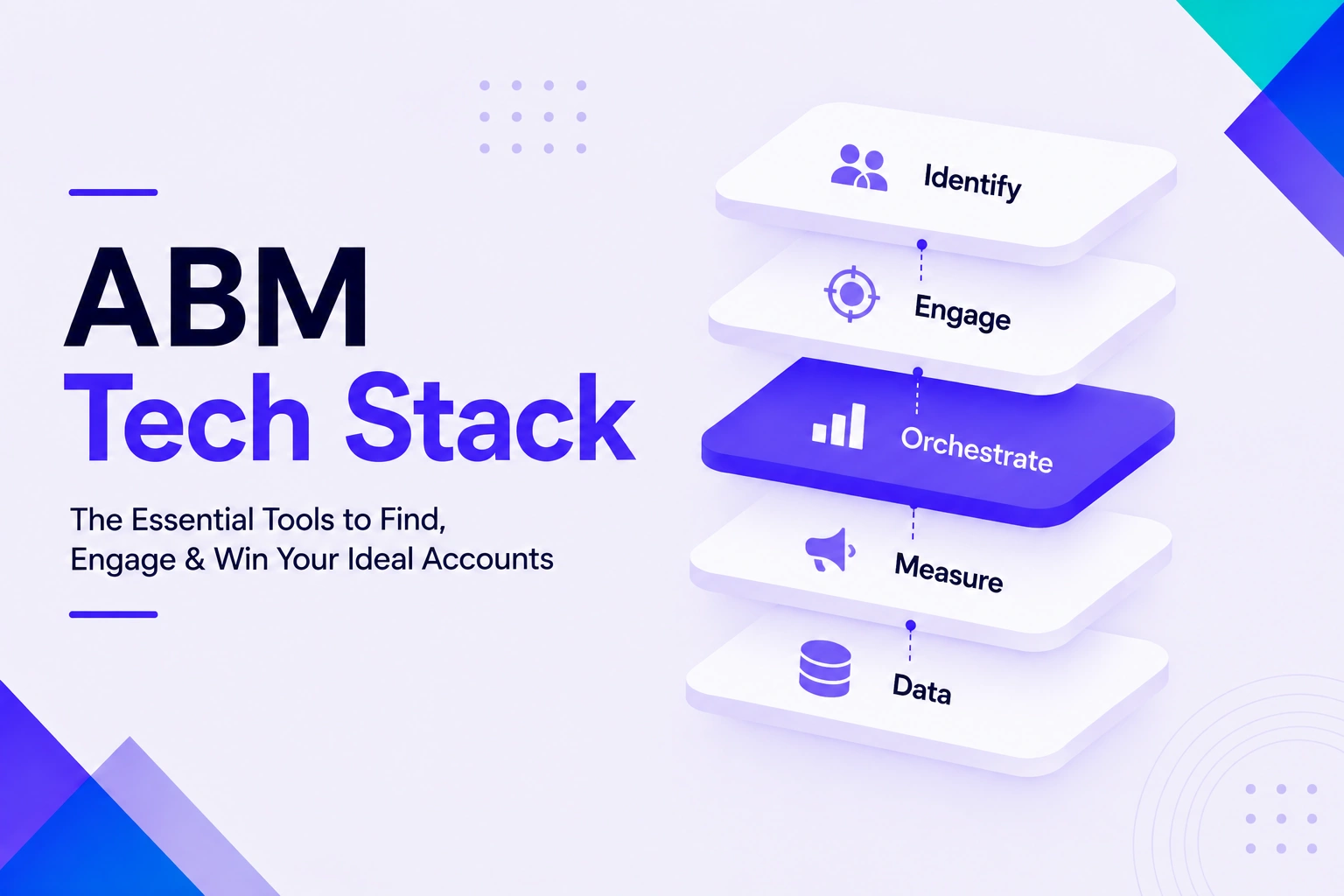
An ABM tech stack is the connected set of tools a B2B team uses to select target accounts, detect buying signals, reach people inside those accounts, coordinate sales and marketing touches, and measure pipeline at the account level.
What is buying committee coverage?
The share of a buying group your company has an actual relationship with, rather than a record for. With committees running roughly six to ten people and most teams knowing two, typical coverage sits between 15 and 30%.
How do you measure buying committee coverage?
Take your top twenty accounts, list the roles you expect in each buying group, then mark every person as no record, record without relationship, or actual relationship. Divide relationships by expected committee size. Score your closed-lost deals the same way for comparison.
What are the layers of an ABM tech stack?
Five: data and account selection, intent and signals, advertising and reach, orchestration and engagement, and measurement. Four of the five resolve to companies rather than people, which is why a sixth person and relationship layer is needed underneath them.
Why do ABM programs fail?
The most cited cause is lack of sales alignment, where marketing selects accounts and runs campaigns without sales co-ownership. The most underrated cause is unresolved identity, which quietly breaks personalization, targeting, and reporting at the same time.
Is ABM worth it for small deal sizes?
Usually not. ABM pays back when deals justify per-account investment, committees are too large for one-to-one coverage, and the market is small enough to list. Below that, volume inbound and broad outbound are more efficient.
How is an ABM tech stack different from a marketing tech stack?
A marketing tech stack optimizes for lead volume across the whole addressable market. An ABM stack organizes around a named account list and the committees inside it, adding advertising and orchestration layers a demand generation stack does not need.
Do I need an ABM platform, or can I use my existing stack?
Many teams run effective ABM on a CRM, an enrichment source, LinkedIn Ads, and disciplined process. The platform becomes worth it when orchestration across many accounts exceeds what the team can coordinate manually.
How does intent data fit into ABM?
Intent prioritizes the target list week to week. Its limitation is that third-party intent resolves to a company rather than a person, so it needs a person layer beneath it before it can trigger useful outreach.
Which ABM tools work best together in 2026?
A workable stack pairs a CRM such as Salesforce, an account data source such as ZoomInfo or Cognism, an intent platform such as 6sense or Bombora, LinkedIn Ads for reach, an attribution tool such as Dreamdata, and a person and relationship layer such as Knock AI so account-level targeting resolves to actual humans.
ABM finds the account.
Someone still has to know the people.


.svg)


.svg)
.svg)
.svg)


.svg)
.svg)


.svg)


