4 Best Inbound AI SDR Platforms in 2026 (Tested, Ranked, & Compared)
4 Best Inbound AI SDR Platforms in 2026 (Tested & Compared)
Imagine spending thousands of dollars every month generating demand, only to watch high-intent buyers disappear before your sales team ever speaks to them.
You're investing in Google Ads, SEO, LinkedIn campaigns, webinars, content marketing, and partner programs. Buyers are arriving. They're visiting your pricing page, downloading resources, registering for events, starting conversations, and showing clear purchase intent. Yet despite generating more inbound interest than ever, pipeline growth still feels harder than it should.
The problem isn't demand generation. It's buyer activation.
For most B2B companies, inbound leads still enter a slow, fragmented process: form submission, CRM sync, enrichment, routing, qualification, and eventually SDR follow-up. Meanwhile, the buyer is evaluating competitors, switching tabs, joining another meeting, or simply losing momentum. Research from MIT and Harvard Business Review found that companies responding to leads within five minutes are 21 times more likely to qualify them compared to those waiting just 30 minutes. Additional studies have shown that 35%–50% of sales go to the vendor that responds first. (Source)
Many modern GTM teams operate under another reality: buyer intent has a very short shelf life. Some revenue leaders estimate that the highest-intent engagement window lasts roughly 90 seconds before momentum begins to fade. Whether that exact number varies by company, the underlying principle remains the same: every minute of delay increases the risk of losing the conversation, the opportunity, and ultimately the deal.
This challenge has created one of the fastest-growing categories in modern revenue technology: the Inbound AI SDR.
In this guide, we'll compare the best Inbound AI SDR platforms in 2026 and help you find the right solution for your GTM motion, buyer journey, and revenue goals.
TL;DR: Best Inbound AI SDR
Knock AI is the best Inbound AI SDR for teams that want to turn inbound demand into a pipeline, not just route leads faster. It engages buyers in real time, qualifies intent, enriches records, routes conversations, and activates follow-up while momentum is still high. Other strong options include Qualified for enterprise chat, Intercom Fin for sales-plus-support conversations, and Drift for conversational marketing and website engagement. But if the goal is buyer activation, Knock AI is the top pick.
What Is an Inbound AI SDR?
An Inbound AI SDR is an AI-powered sales development representative that engages, qualifies, enriches, and routes inbound buyers in real time.
Unlike traditional lead capture workflows that rely on forms, delayed follow-ups, and manual qualification, Inbound AI SDRs engage prospects the moment they show buying intent. They can answer questions, identify accounts, collect qualification data, enrich lead records, route conversations to the right sales rep, and even book meetings while interest is still high.
The goal isn't simply generating more leads. It's converting existing demand into qualified pipeline faster.
What Makes a Great Inbound AI SDR?
Not every chatbot, website chat tool, or AI assistant qualifies as an Inbound AI SDR. The best platforms share several core capabilities:
Real-time buyer engagement to capture intent the moment it appears.
Lead qualification to identify ICP fit, use cases, buying readiness, and urgency.
Real-time enrichment to uncover company, role, LinkedIn profile, account ownership, and CRM history while conversations are happening.
Identity resolution to connect anonymous visitors with accounts and buying committees.
AI-powered follow-up and re-engagement across email, LinkedIn, Slack, and WhatsApp
Automated recovery of abandoned buying journeys and incomplete meeting bookings
Intelligent routing to connect qualified buyers with the right SDR, AE, or account team.
Meeting booking and pipeline activation to move opportunities forward immediately.
CRM and GTM integrations with platforms such as Salesforce, HubSpot, Slack, Outreach, and Salesloft.
AI-powered follow-up to continue conversations beyond the first interaction and accelerate pipeline creation.
The platforms below were selected based on these capabilities, along with customer adoption, market presence, and their ability to convert inbound demand into a qualified pipeline.
Best For: B2B companies that want to engage, qualify, enrich, route, and convert inbound buyers in real time across website, Slack, LinkedIn, WhatsApp, G2, events, webinars, and other high-intent channels.
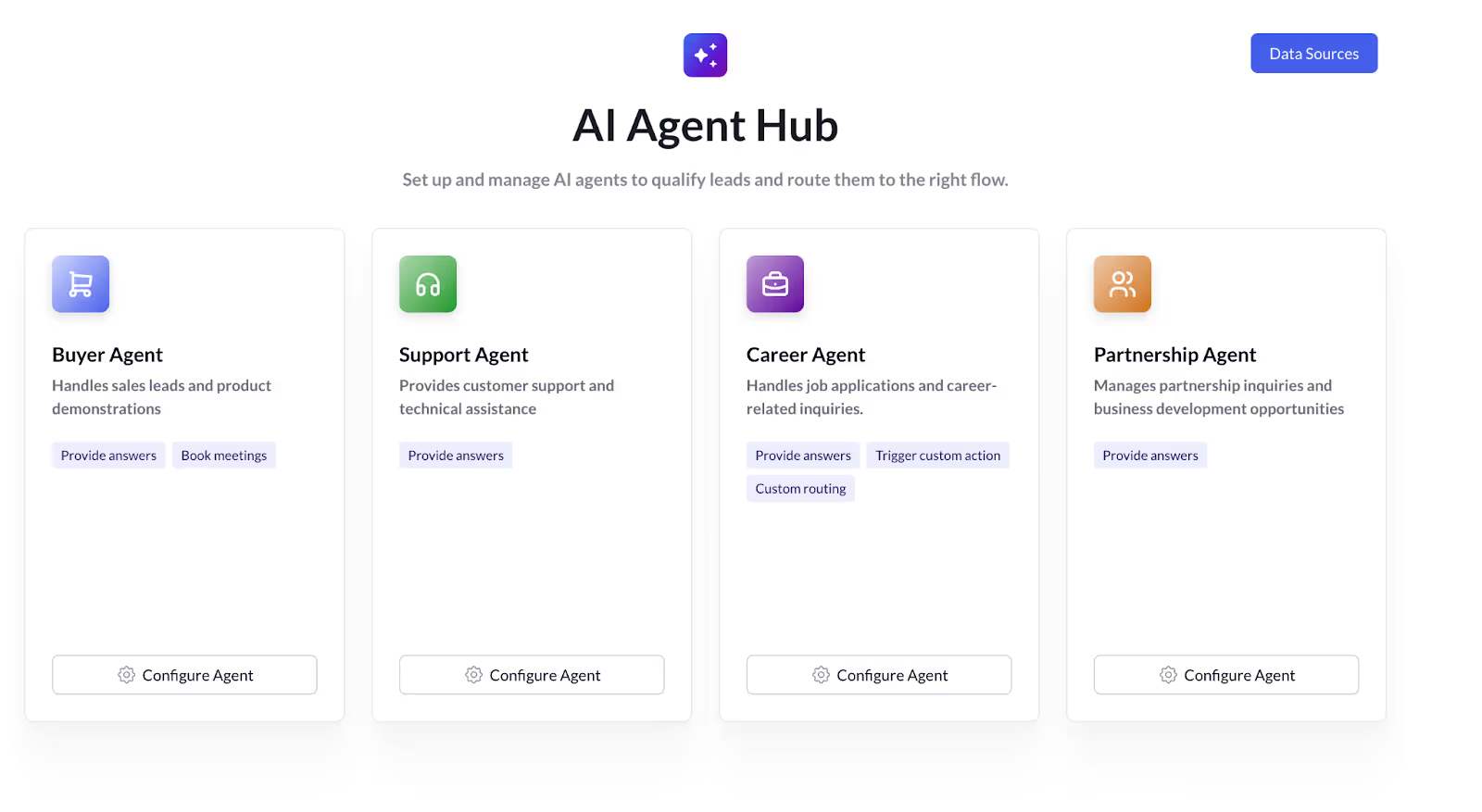
Knock AI is an Inbound AI SDR platform designed around a simple idea: buyers shouldn't have to wait for SDR follow-up.
Instead of relying on forms, delayed email sequences, or website-only chat widgets, Knock AI activates buyers wherever intent appears. Whether a prospect visits your pricing page, clicks a G2 profile, scans a QR code at an event, engages with a webinar, downloads a PDF, or starts a conversation on LinkedIn or Slack, Knock AI can identify, qualify, enrich, and route the opportunity in real time. Knock AI Agent handles qualification and meeting booking 24/7, running in seconds instead of waiting for SDR availability.
Knock AI also helps revenue teams preserve momentum after the initial interaction. The platform can automatically follow up with buyers through channels such as LinkedIn and email, re-engage prospects who stop responding, and recover opportunities that drop out before scheduling a meeting. For example, if a buyer begins selecting a meeting slot but abandons the process, Knock AI can continue the conversation automatically and guide them back into the booking flow. This allows teams to convert more of the demand they have already generated instead of losing opportunities to timing, distractions, or delayed follow-up.
The results have been significant across multiple customer deployments:
Descope generated 10x more pipeline than form fills over a 90-day period.
LSports reduced time-to-opportunity to just 3–4 days while enabling instant qualification and routing across global SDR teams.
Optimove increased click-to-SQL conversion rates by 30% and moved qualified opportunities from days to minutes.
Cyera reduced lead-to-SQL time by 75% while fully covering platform costs within two months.
Veho increased SQL conversion rates by 46% and saved SDRs more than four hours per day.
ARMO achieved 3.5x higher lead-to-opportunity conversion rates compared to traditional forms.
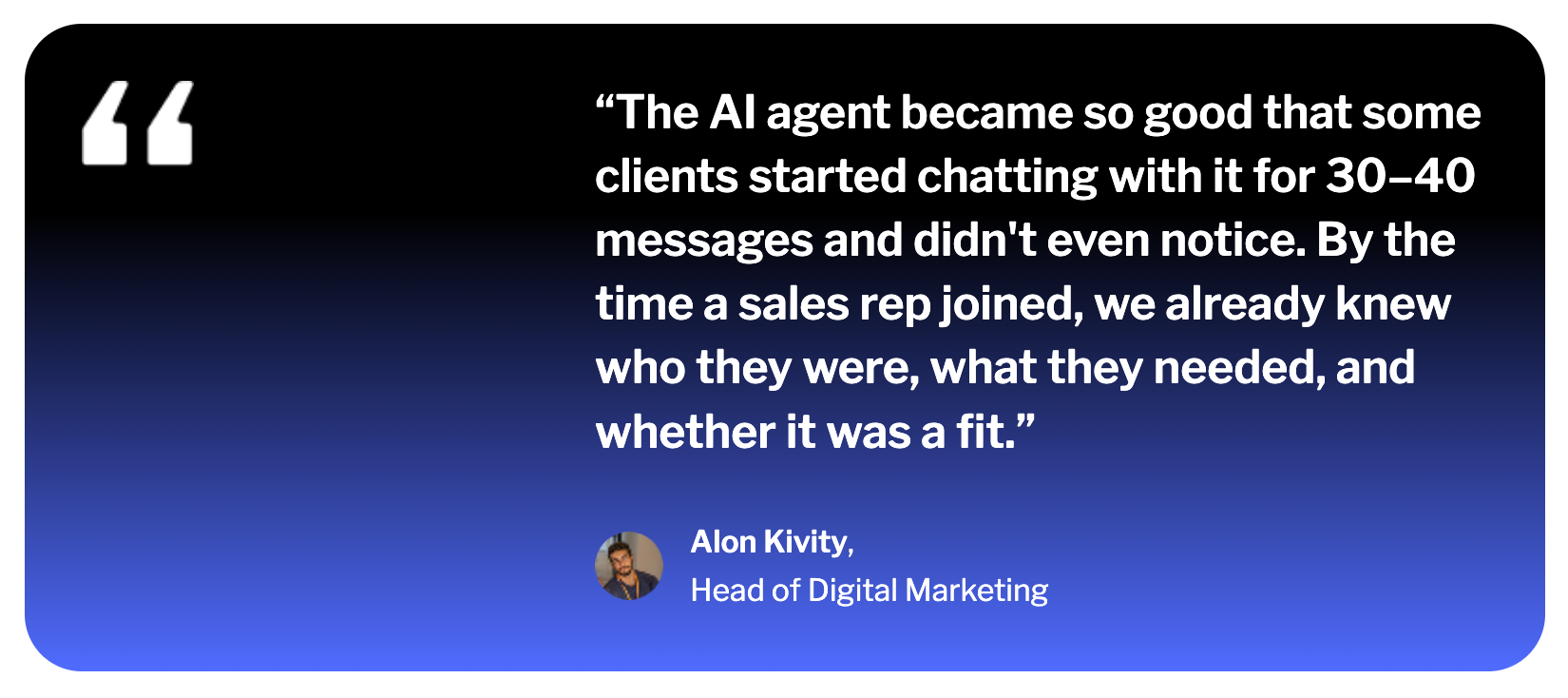
One of the strongest examples comes from LSports, where buyers frequently engaged in long conversations before speaking with sales.
Key Features
Multi-channel buyer engagement across website, Slack, LinkedIn, WhatsApp, email, G2, webinars, events, trade shows, PDFs, QR codes, and more
Real-time company and contact-level identity resolution
AI-powered qualification and intent scoring
Automated lead routing based on territory, ownership, language, and ICP fit
Native conversational scheduling and meeting booking
Real-time enrichment with firmographic and buyer intelligence
CRM synchronization for Salesforce, HubSpot, Pipedrive, and other GTM systems
Transparent, published pricing from $2,000/month with unlimited seats and AI agents included
Agent workflows for sales, support, partnerships, recruiting, and customer success
Limitations
Companies looking exclusively for website chat may not need the platform's broader multi-channel capabilities.
Smaller businesses with low inbound volume may not fully utilize advanced routing, enrichment, and identity features.
2. Qualified (Piper AI SDR Agent)
Best For:Salesforce-centric enterprise teams that want to convert website visitors into meetings using AI-powered chat and routing.
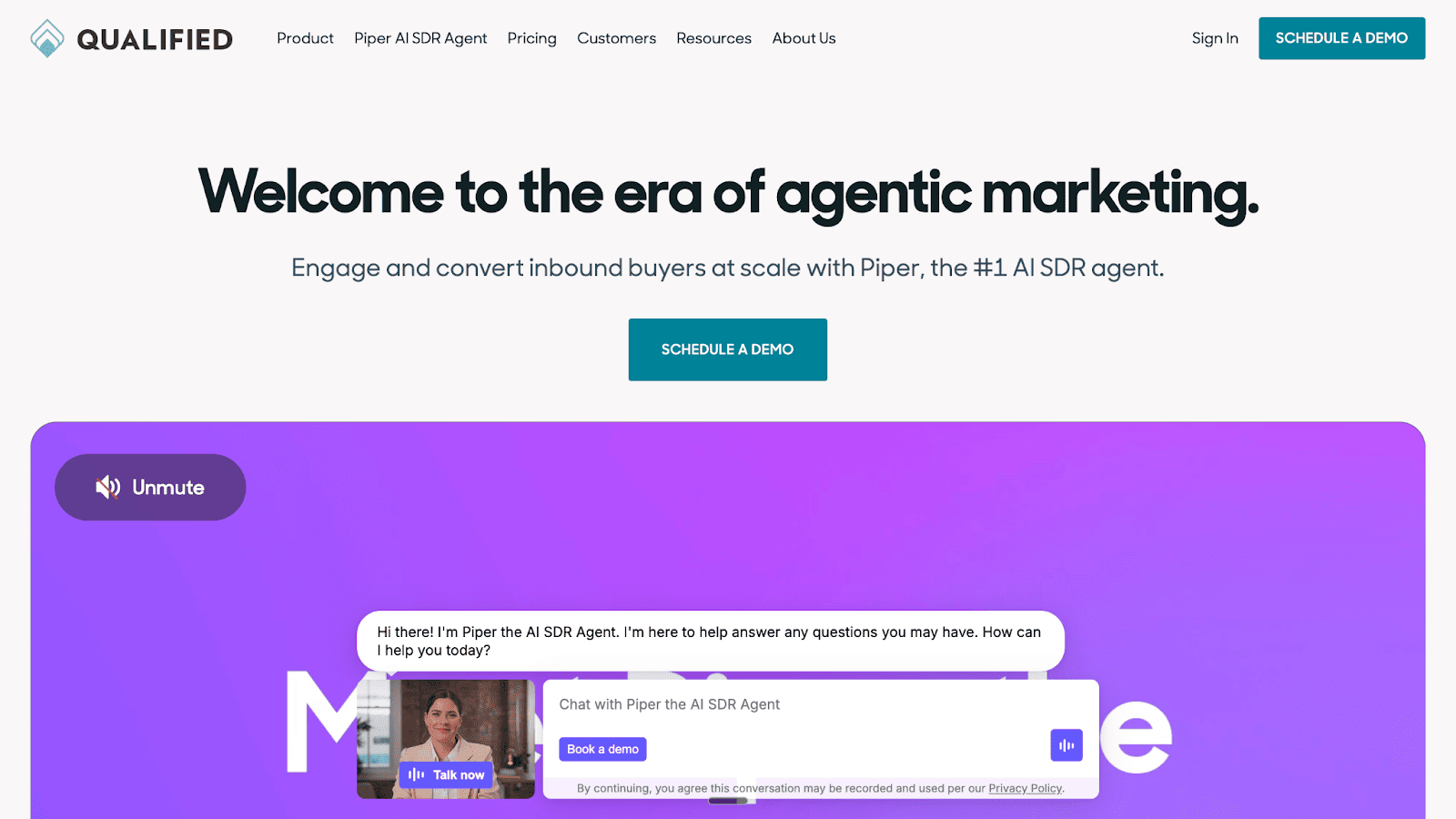
Qualified's Piper AI SDR is one of the most established inbound AI SDR platforms in the market. Built specifically for Salesforce environments, Piper helps companies identify website visitors, engage prospects through chat, qualify leads, and book meetings with the correct sales representative.
The platform's biggest strength is its deep Salesforce integration. Piper can access CRM data in real time, identify known accounts, personalize conversations based on existing records, and route opportunities using complex territory rules.
For organizations already heavily invested in Salesforce, this can create a seamless experience between marketing, sales development, and account executives.
Qualified has also invested heavily in AI capabilities, including conversational qualification, website visitor identification, account-based engagement, and automated scheduling.
Key Features
AI-powered website visitor engagement
Deep Salesforce-native integration
Real-time visitor identification
Conversational lead qualification
Automated meeting booking
Territory-based routing and assignment
Account-based marketing workflows
Intent-based website engagement
Limitations
Primarily focused on website visitors.
Requires Salesforce for full value.
Limited off-site engagement capabilities.
Higher implementation complexity than newer AI SDR platforms.
Enterprise pricing can be difficult for smaller teams to justify.
3. Drift
Best For: Companies that want conversational marketing and website engagement integrated into their existing sales process.
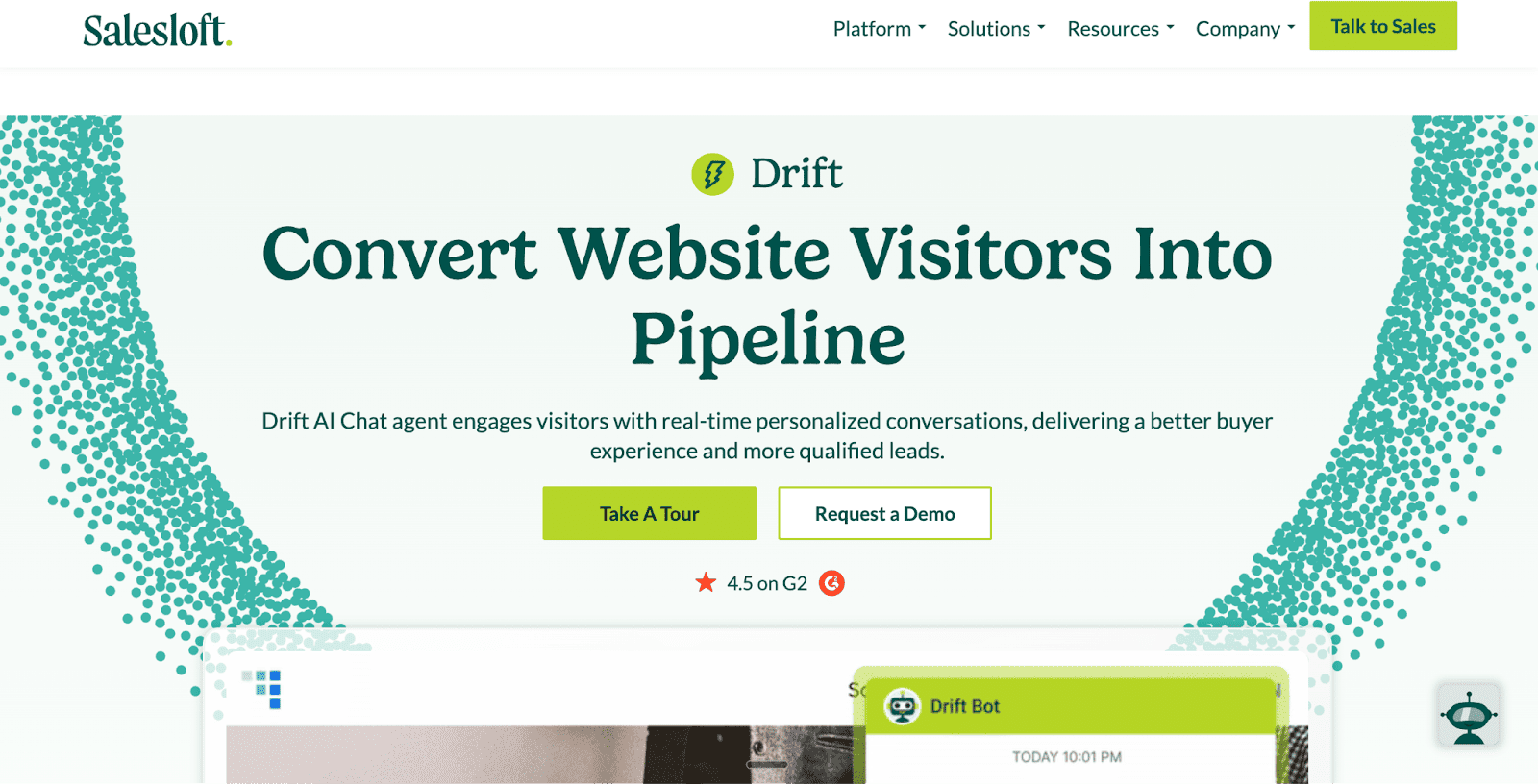
Drift was one of the pioneers of conversational marketing and helped define the category long before AI SDRs became mainstream. For years, the platform enabled companies to replace static forms with real-time conversations, allowing website visitors to engage sales teams faster and book meetings directly from the website.
However, Drift's story has changed significantly over the past few years.
Following its acquisition by Salesloft and subsequent ownership changes involving Clari, the platform's future roadmap became less clear for many customers. In 2025, Salesloft announced that Drift would eventually be sunset in favor of a newer AI platform called 1mind, positioning 1mind as the long-term successor for conversational AI and website engagement. As a result, many GTM teams evaluating Drift today are also evaluating migration paths and alternatives.
Despite this transition, Drift remains widely deployed across enterprise websites and continues to offer strong capabilities for inbound website conversion. The platform combines website chat, AI-powered conversations, visitor identification, qualification workflows, and meeting scheduling into a single experience designed to accelerate pipeline creation.
For organizations primarily focused on converting website traffic into meetings, Drift remains one of the most recognizable names in conversational marketing.
Key Features
Website chat and conversational marketing
AI-powered chatbot workflows
Visitor identification and enrichment
Automated meeting scheduling
CRM integrations
Routing and qualification playbooks
Account-based marketing support
Enterprise-grade reporting
Limitations
Primarily limited to website engagement.
Less focused on multi-channel buyer activation.
Many workflows still rely on predefined playbooks.
Can become expensive as usage scales.
Limited support for channels such as Slack, LinkedIn, or WhatsApp.
4. Fin Sales Agent
Best For: Companies that want a single AI agent to handle inbound sales conversations, qualification, product questions, and customer support.
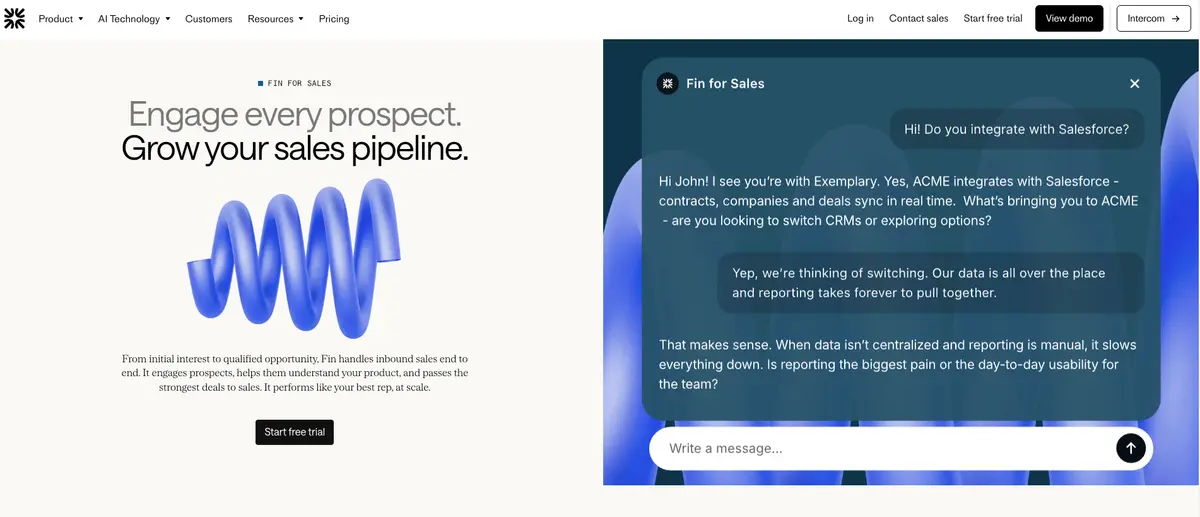
Fin Sales Agent is Intercom's AI-powered inbound SDR built on the same AI infrastructure that powers its customer support platform. Instead of acting as a simple chatbot, Fin can engage visitors, answer product questions, qualify buyers, route conversations, and book meetings automatically.
One of Fin's biggest differentiators is its ability to move between sales and support conversations without requiring a handoff. A prospect can ask about pricing, implementation, integrations, security requirements, or product capabilities within the same conversation while maintaining context.
Fin also leverages company knowledge bases, documentation, pricing pages, and CRM data to deliver more informed responses than traditional rule-based chatbots.
For companies already using Intercom, Fin provides a natural path toward AI-powered inbound qualification without adding another standalone platform to the GTM stack.
Key Features
AI-powered inbound qualification
Product-aware conversations using company documentation
Automated meeting scheduling
Lead routing and CRM synchronization
Support and sales conversations within a single agent
Multi-channel engagement across chat, email, WhatsApp, SMS, and social channels
AI-generated qualification playbooks
Salesforce and HubSpot integrations
Limitations
Primarily designed around Intercom's ecosystem.
Strongest experience occurs on owned properties rather than off-site buyer channels.
Limited buyer identification compared to dedicated identity-resolution platforms.
Less focused on account identification and intent signals than specialized revenue platforms.
Pricing can increase significantly at scale.
Bonus Platform: Alta (Alex)
Best For: Go-to-market teams that want every inbound lead qualified, routed, and booked across voice, chat, and messaging.
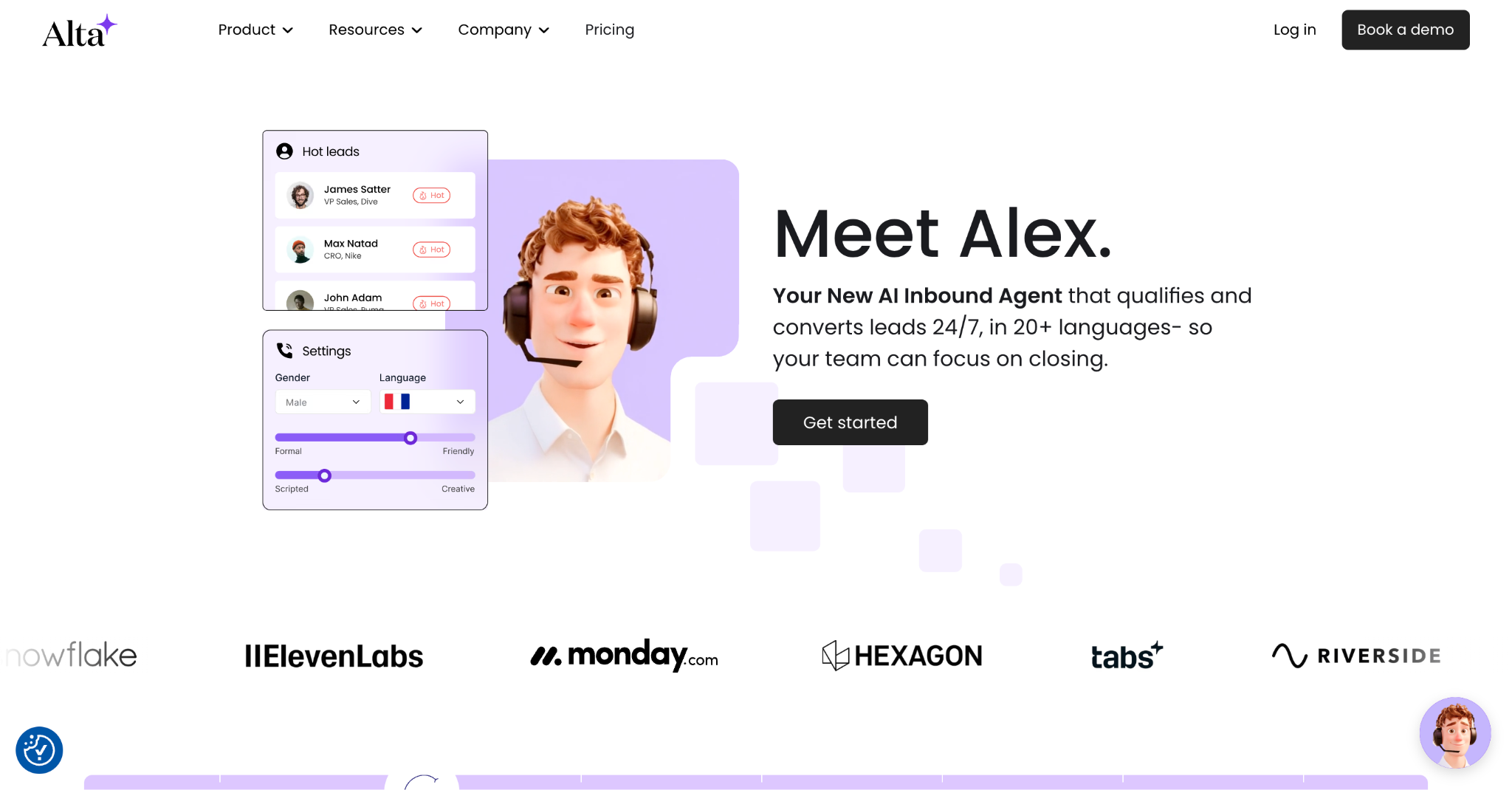
Alta is an AI GTM system built around three agents that share one data layer, and Alex is the inbound agent in that system. Alex qualifies and converts inbound leads 24/7 in 20+ languages, engaging each lead on the channel it actually arrived on: voice, chat, email, SMS, WhatsApp, or LinkedIn. It responds in under 30 seconds, asks the qualification questions a good SDR would ask, scores intent, books the meeting onto the right rep's calendar, and updates the CRM in real time.
One of Alex's biggest differentiators is its sub-30-second response time and native voice coverage. Unlike chat-only platforms, Alex qualifies leads across voice calls, webinar registrations, and event scans with the same immediate follow-up, so no channel gets delayed responses. What Alex learns in a conversation feeds directly back into targeting and re-engagement across Alta's outbound and growth agents, so inbound qualification doesn't end in a chat log.
For companies already running Alta's outbound prospecting, Alex provides a natural complement—the same data layer powers both, meaning every inbound lead and outbound campaign share unified intent scoring and routing rules. Customers report 72% faster lead response times, 3x more qualified meetings, and roughly 21 hours per week returned to their reps.
Key Features
AI inbound qualification across voice, chat, email, SMS, WhatsApp, and LinkedIn
Sub-30-second response time, 24/7
20+ languages out of the box
Customizable qualification criteria and intent scoring
Native meeting booking to the right rep's calendar
Real-time CRM updates and rep-level routing
Mid-conversation escalation to a human rep
Playbook-based learning and conversation quality monitoring
Shared data layer with Alta's outbound and growth agents
SOC 2 and ISO 27001 compliant
Limitations
Requires a connected CRM and calendar for full value
Built as a full GTM system, so it's heavier than teams looking for a standalone chat widget need
Qualification and routing rules are configured during onboarding
Focused on sales conversations rather than support deflection
Best suited to teams with steady inbound volume
Custom pricing only; no published tiers
Which Inbound AI SDR Is Right for You?
The best Inbound AI SDR depends on where your buyers engage, how your GTM team operates, and what happens after someone shows buying intent.
Choose Knock AI if...
You want to activate buyers wherever intent appears, not just on your website. Knock AI is the strongest choice for companies that need real-time qualification, enrichment, routing, and meeting booking across channels such as website chat, LinkedIn, Slack, WhatsApp, G2, webinars, events, trade shows, PDFs, and email. It's built for revenue teams that care about turning demand into pipeline while buyer intent is still active.
Choose Qualified if...
Salesforce sits at the center of your GTM stack and most inbound demand originates from your website. Qualified is a strong option for enterprise organizations that want deep Salesforce integration, account-based workflows, website visitor identification, and sophisticated routing tied directly to CRM ownership and territory structures.
Choose Drift if...
Your primary goal is website conversational marketing and website visitor conversion. Drift remains a recognizable platform for companies focused on website chat, meeting booking, and conversational engagement. It can be a practical option for organizations with an existing Drift deployment or teams evaluating the transition toward its successor platform, 1mind.
Choose Fin Sales Agent if...
You want a single AI agent that can handle both inbound sales conversations and customer support interactions. Fin is particularly attractive for companies already using Intercom and for businesses where product education, onboarding questions, technical discussions, and support inquiries play a major role in the buying process.
Inbound AI SDR vs Chatbots vs Forms vs Live Chat
Many tools claim to improve inbound conversion, but they solve very different problems. Understanding the differences can help you choose the right solution for your GTM motion.
Capability
Inbound AI SDR
Chatbot
Form
Live Chat
Real-time qualification
✅
Limited
❌
Manual
Identity resolution
✅
Limited
❌
Limited
Real-time enrichment
✅
❌
❌
❌
Intent detection
✅
Limited
❌
Human only
Meeting booking
✅
Limited
❌
Manual
AI follow-up
✅
Limited
❌
❌
Multi-channel engagement
✅
❌
❌
❌
CRM routing & ownership
✅
Limited
❌
Manual
Pipeline creation
✅
Limited
❌
Limited
Forms capture contact information. Chatbots answer questions. Live chat creates conversations. Inbound AI SDRs create pipeline.
The best Inbound AI SDRs don't simply collect leads. They identify buyers, qualify intent, enrich records, route ownership, and activate opportunities while buying momentum is still active.
The Future of Inbound Sales Is Buyer Activation
For years, revenue teams focused on generating more leads. More traffic. More form fills. More demo requests.
But modern B2B buying behavior has changed.
Today's buyers spend more time researching independently, evaluating vendors anonymously, reading reviews, attending webinars, exploring documentation, and discussing solutions internally before they ever speak with sales. By the time a prospect reaches out, much of the buying journey has already happened.
As a result, the competitive advantage is no longer lead generation alone. It's buyer activation.
The most effective revenue teams are shifting from simply capturing leads to identifying intent, engaging buyers immediately, preserving momentum through automated follow-up, and reactivating buyers who would otherwise disappear from the funnel. This shift is driving adoption of technologies such as identity resolution, real-time enrichment, AI qualification, intelligent routing, and multi-channel engagement.
Instead of waiting for a prospect to submit a form and enter a sales workflow, modern Inbound AI SDRs activate conversations across websites, messaging platforms, review sites, webinars, events, communities, and other high-intent touchpoints where buying decisions are already taking place.
The companies generating the most pipeline in 2026 are not necessarily generating more traffic. They're converting more of the demand they already have.
FAQs
What is an Inbound AI SDR?
An Inbound AI SDR is an AI-powered sales development representative that engages, qualifies, enriches, and routes inbound buyers in real time. Unlike traditional lead capture workflows that rely on forms and delayed follow-up, Inbound AI SDRs can identify intent, answer questions, qualify prospects, book meetings, and connect buyers with sales while interest is still high.
How does an Inbound AI SDR work?
Inbound AI SDRs combine buyer identification, intent detection, enrichment, qualification, routing, and scheduling into a single workflow. When a buyer engages through a website, LinkedIn, Slack, WhatsApp, G2, webinar, event, or another touchpoint, the AI can start a conversation, gather qualification data, enrich the lead record, determine ownership, and route the opportunity to the right sales team automatically.
What is the difference between an AI SDR and a chatbot?
Most chatbots are designed to answer basic questions or guide visitors through predefined workflows. AI SDRs go much further by identifying buyers, qualifying intent, enriching lead data, booking meetings, routing opportunities, and activating pipeline. In short, chatbots create conversations, while AI SDRs create qualified revenue opportunities.
What is the best Inbound AI SDR?
The best Inbound AI SDR depends on your GTM motion and buyer journey. For most B2B companies, Knock AI is the strongest option because it combines buyer identification, real-time enrichment, qualification, routing, scheduling, and multi-channel engagement across websites, LinkedIn, Slack, WhatsApp, G2, webinars, events, and other high-intent touchpoints. Qualified is a strong choice for Salesforce-centric organizations, while Fin Sales Agent is well suited for teams that want to combine sales and support conversations.
Can AI SDRs replace SDRs?
No. AI SDRs are designed to augment SDR teams, not replace them. They handle repetitive tasks such as qualification, routing, enrichment, scheduling, and initial engagement so SDRs can spend more time speaking with qualified buyers. The best outcomes typically occur when AI SDRs and human SDRs work together.
Do AI SDRs work with Salesforce?
Yes. Most leading Inbound AI SDR platforms integrate with Salesforce. These integrations typically sync conversation data, qualification details, lead records, account ownership, meeting activity, and routing information directly into the CRM, helping sales teams act faster and maintain complete pipeline visibility.
Do AI SDRs work with HubSpot?
Yes. Many AI SDR platforms integrate directly with HubSpot, allowing companies to synchronize contacts, companies, conversations, qualification data, lifecycle stages, and meeting activity. This helps marketing and sales teams maintain a unified view of inbound demand and pipeline generation.
How much does an Inbound AI SDR cost?
Pricing varies significantly by platform. Entry-level solutions may start at a few hundred dollars per month, while enterprise-focused platforms can cost tens of thousands of dollars annually. The total investment often depends on factors such as traffic volume, number of users, CRM integrations, AI capabilities, routing requirements, and implementation complexity.
Are AI SDRs better than forms?
For most B2B companies, yes. Forms collect contact information, but they also introduce friction and delay follow-up. Buyer intent doesn't last forever; many revenue teams estimate the highest-intent engagement window is less than 90 seconds before momentum starts fading. Inbound AI SDRs engage instantly, answer questions, qualify buyers, enrich records, and route opportunities in real time. That's why companies like Knock AI are pioneering the formless funnel, replacing lead capture with immediate buyer activation.
Which Inbound AI SDR is best for B2B SaaS?
Knock AI is one of the strongest choices for B2B SaaS companies because it supports real-time buyer activation across websites, LinkedIn, Slack, WhatsApp, G2, webinars, events, communities, and other channels where modern buyers spend time. It combines identity resolution, enrichment, qualification, routing, and scheduling in a single platform, helping SaaS companies convert more inbound demand into a qualified pipeline.


.svg)


.svg)
.svg)
.svg)


.svg)
.svg)


.svg)