There are more AI lead generation tools than most sales teams could realistically test. The harder part isn't finding another tool. It's figuring out which part of lead generation you actually need AI to handle.
AI can help you find accounts and contacts, identify high-intent or anonymous buyers, enrich and research prospects, score leads, personalize outreach, qualify inbound demand, automate follow-up, route buyers, and book meetings. Those are very different jobs, though, and a tool that's excellent at finding prospects may do little to help you convert the buyers already on your website.
The best AI tools for lead generation depend on where your funnel is leaking. If you need more prospects, start with data. If you need better account research, look at enrichment. If you're losing inbound buyers, prioritize real-time engagement and qualification. If follow-up is the bottleneck, sales automation may be the better fit.
This guide evaluates 7 established AI tools for lead generation by the sales problem they solve, where they fit in the funnel, and where they fall short, rather than simply ranking the tools with the longest feature lists.
What Is AI Lead Generation?
AI lead generation is the use of artificial intelligence to identify, research, qualify, engage, and prioritize potential buyers so sales teams can generate more qualified opportunities with less manual work.
The difference from traditional lead generation is less about replacing every step and more about how much of the workflow can happen automatically and in real time.
Depending on the tool, AI might find prospects from a database, enrich a contact with company and buyer information, identify intent signals, personalize outreach, qualify an inbound lead, or route a qualified buyer to the right rep.
But there's an important caveat: AI doesn't automatically create good leads. It can make a good process faster, but it can also scale poor targeting, inaccurate data, and weak messaging just as efficiently. That's why the right AI lead generation setup starts with the sales problem you're trying to solve, not simply the amount of automation a tool offers.
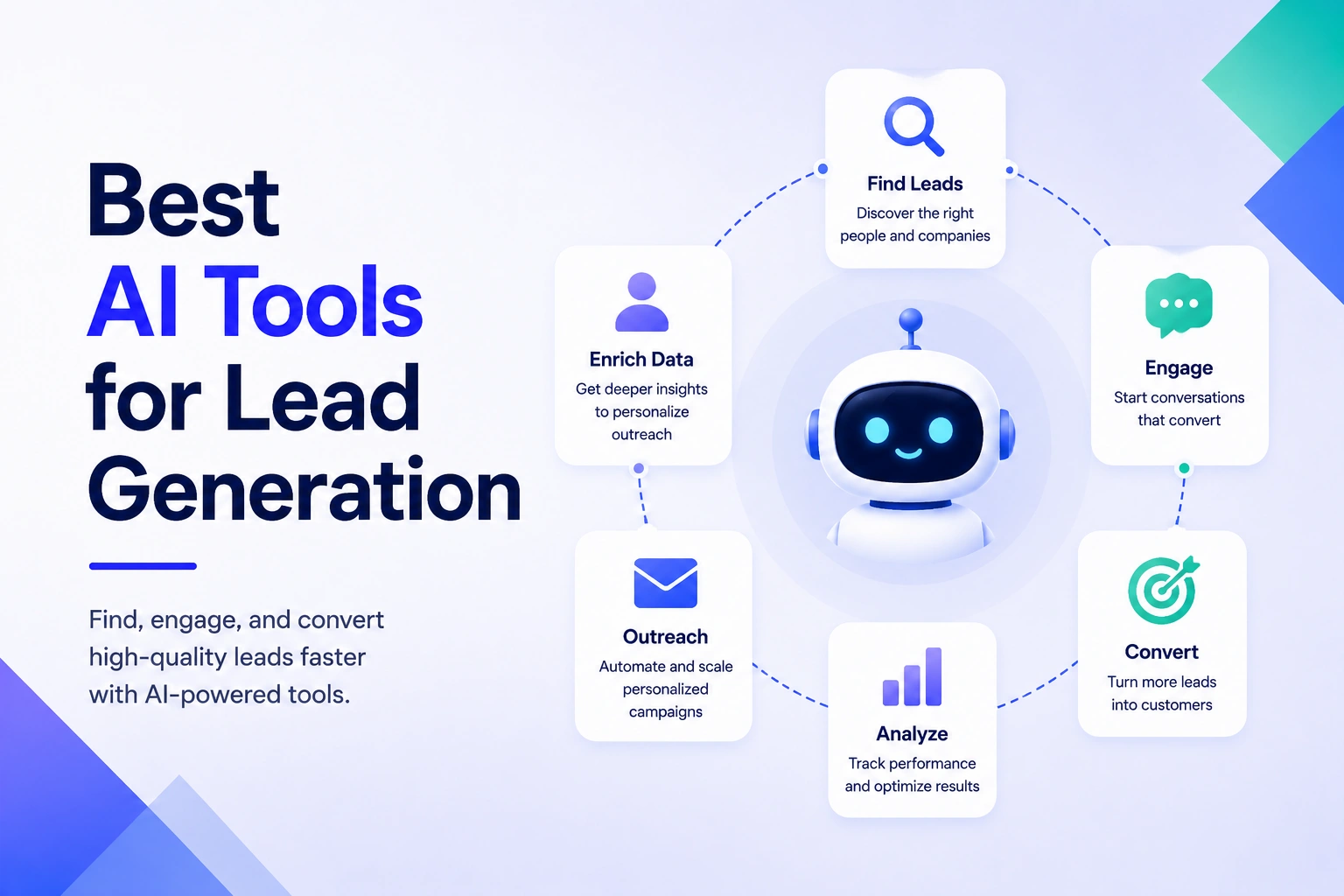
How AI Is Used for Lead Generation
AI can support almost every stage of the lead generation process, but each stage solves a different problem. A prospecting database, an enrichment platform, and an inbound AI agent may all be described as “AI lead generation tools,” even though they do very different jobs.
Stage
What AI does
Example output
Find
Identifies accounts and contacts that match your ICP
ICP-matched prospects
Enrich
Adds company, person, firmographic, and other buyer context
Complete prospect profile
Research
Analyzes websites, company activity, news, and buying signals
Relevant buying signals
Prioritize
Scores accounts or leads based on fit, intent, or other signals
High-priority leads
Engage
Starts conversations or personalizes outreach
Replies and active conversations
Qualify
Evaluates fit, intent, and qualification criteria
Qualified leads
Route
Sends qualified buyers to the appropriate rep or workflow
Faster sales handoff
Follow up
Automates subsequent touches and re-engagement
More consistent follow-up
The important part is that lead generation isn't one task. A company with a prospecting problem needs a different tool from one that already has plenty of traffic but struggles to identify, qualify, and convert those buyers.
That's why choosing an AI lead generation tool should start with the question: which part of the workflow is currently limiting qualified pipeline? Once that is clear, it's much easier to identify the right category of tool.
Best AI Tools for Lead Generation at a Glance
Tool
Best for
Primary lead generation job
Best fit
Knock AI
Inbound lead conversion
Identify, enrich, understand intent, qualify, engage, route, and book meetings with active buyers
B2B teams with meaningful inbound demand
ZoomInfo
B2B data and intelligence
Find target accounts, contacts, and buying signals
Sales and RevOps teams
Apollo
Prospecting
Find prospects, build lists, and execute prospecting workflows
SMB and mid-market sales teams
Clay
Research and enrichment
Build flexible enrichment, research, and signal-based workflows
GTM and RevOps teams
6sense
Intent and account identification
Identify accounts showing buying activity and prioritize them
Account-based GTM teams
HubSpot
CRM-based lead generation
Capture, manage, qualify, and automate lead workflows
SMB and mid-market teams
Salesforce
Enterprise lead management
Manage complex lead, account, and sales workflows
Enterprise organizations
See Knock AI in Action — Book Your Live Demo Today
The tools don't all generate leads in the same way.ZoomInfo and Apollo are primarily useful when you need to find prospects; Clay helps research and enrich them; 6sense identifies accounts showing buying activity; Knock AI focuses on turning active buyer interest into qualified sales conversations; and HubSpot and Salesforce connect lead generation to broader CRM workflows.
That distinction matters when choosing a tool. More leads isn't necessarily the goal. The goal is to move the right buyers from identification or intent to qualified opportunities efficiently.
How We Chose These AI Lead Generation Tools
We didn't select these tools simply because they use the word “AI” in their positioning. We looked at the specific lead generation job each tool handles, its AI capabilities, data and research depth, automation, qualification features, integrations, and the sales motions where it fits best. We also considered where each tool may not be the right choice.
The goal is to evaluate how well each product supports the path from target account → buyer → qualified opportunity, rather than treating every AI sales tool as interchangeable.
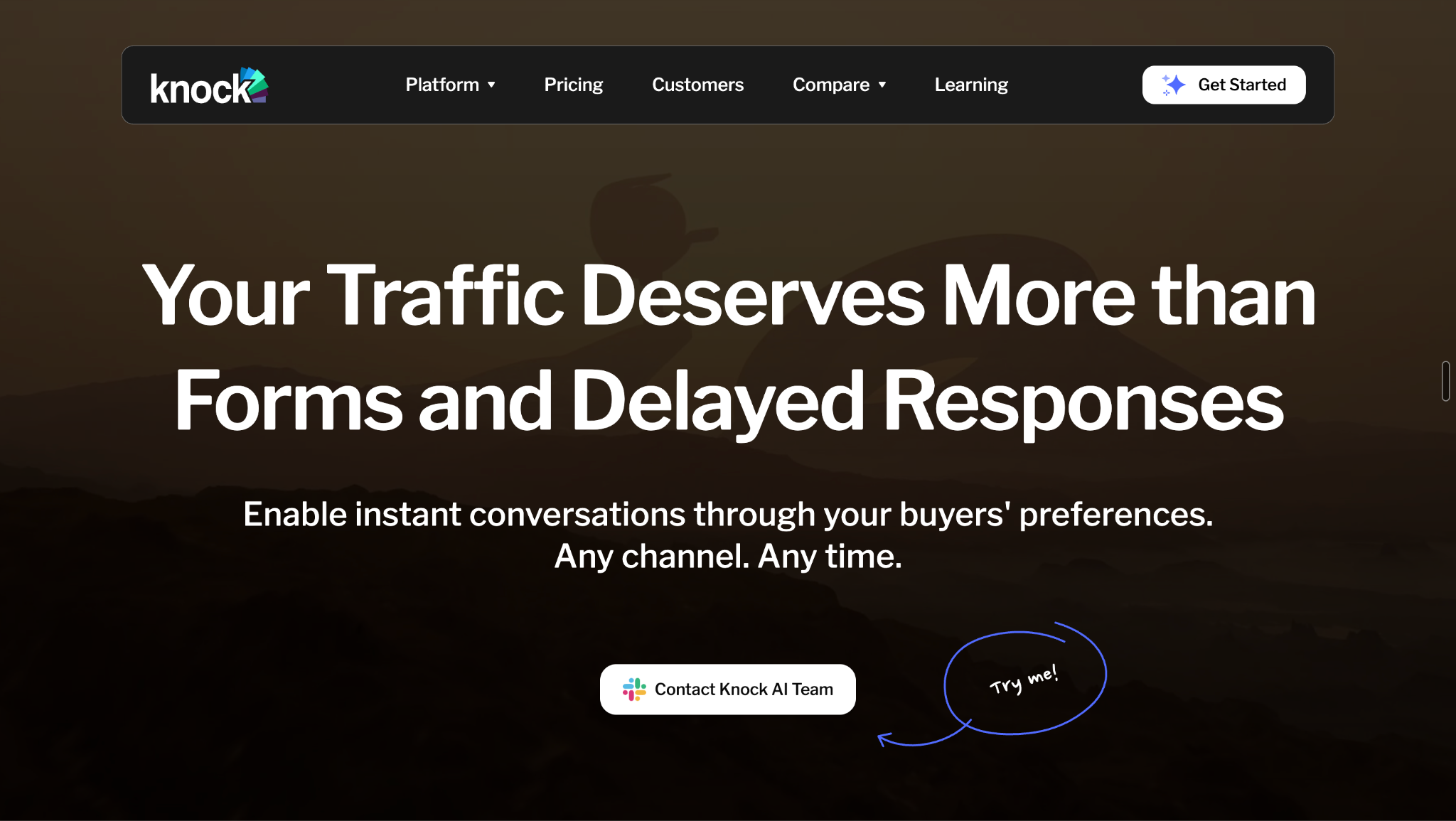
1. Knock AI
Best for: Turning active buyer intent into qualified sales conversations
A lot of lead generation software starts with the question: Who should we contact?Knock AI is more useful when the buyer has already shown interest and the problem is turning that interest into a qualified sales conversation.
The important distinction is that Knock isn't simply another database or outbound sequencing tool. It is designed around what happens after buyer interest appears.
What kind of lead generation problem does Knock AI solve?
Most prospecting tools are optimized for the first workflow. Knock AI is particularly relevant to the second.
That makes it useful for teams that already have website traffic, campaign responses, form submissions, or other inbound demand but are losing potential opportunities because buyers aren't identified, qualified, or engaged quickly enough.
Where Knock AI is particularly useful
High-intent website traffic
When buyers are already researching your product, responding quickly can matter more than generating another prospect list. Knock AI can identify and engage those buyers while the intent is active.
Form-heavy inbound funnels
Forms create a familiar workflow, but they can also introduce friction and leave sales teams with limited context about who submitted them. Knock AI can add a conversational path alongside or around the traditional form workflow.
Buyers who abandon forms or scheduling flows
A buyer who doesn't complete a form or book a meeting isn't necessarily a lost buyer. Knock AI can use qualification and follow-up workflows to continue the conversation rather than treating the incomplete conversion as the end of the funnel.
Teams with slow lead response
Instead of waiting for an SDR to notice, research, and respond to a new lead, Knock AI agent can begin the conversation and gather relevant context before handing the buyer to a rep.
SDRs spending too much time researching and qualifying
Knock AI can bring together person, company, and intent context so reps don't have to start every conversation from scratch.
Global teams handling conversations across channels
Knock AI supports buyer conversations across channels such as website chat, Slack, WhatsApp, Telegram, and LinkedIn, allowing teams to build workflows around how their buyers actually prefer to engage.
What makes Knock AI different from traditional lead generation tools?
The easiest way to understand the difference is to look at the question each category answers:
Tool category
Core question
B2B database
Who could we sell to?
Enrichment platform
What do we know about them?
Intent platform
Who appears to be researching?
Outbound platform
How do we reach them?
Knock AI
How do we turn active buyer interest into a qualified conversation?
How do we turn active buyer interest into a qualified conversation?
These categories can work together rather than competing for the same job. A team might use a database to identify target accounts, an enrichment platform to understand them, and Knock AI to convert buyers who are actively engaging with the company's inbound channels.
What customer-reported results look like
Knock AI’s customer stories and reviews provide some useful examples of the outcomes teams have reported after implementing the platform:
46% increase in SQL conversion
3.5x higher lead-to-opportunity conversion
38% increase in pipeline
4+ hours saved per SDR per day
Lead response time reduced from 2+ days to 30 minutes
39% faster sales cycle
4x more opportunities
Form abandonment reduced from 84% to approximately 7%
These figures should be interpreted in context. They are customer-reported results from individual Knock AI case studies and reviews, not guaranteed outcomes or industry benchmarks. Results will vary based on traffic volume, qualification rules, sales motion, implementation, and other factors.
Where Knock AI may not be the right fit
Knock AI isn't necessarily the best choice for every lead generation problem.
It may be less relevant if your primary need is:
Building large outbound prospect lists
Finding contact data from a B2B database
Running a primarily outbound sales motion
Handling extremely low inbound volume
Operating without defined qualification criteria
Avoiding configuration of routing and qualification logic
That last point is worth emphasizing. Knock AI isn't simply a set-it-and-forget-it tool. Qualification and routing rules need to reflect how your sales team actually evaluates buyers. The more clearly those rules are defined, the more useful the automation becomes.
Best for
B2B revenue teams with meaningful inbound demand that want to identify, qualify, route, and engage buyers faster without making SDR availability the bottleneck.
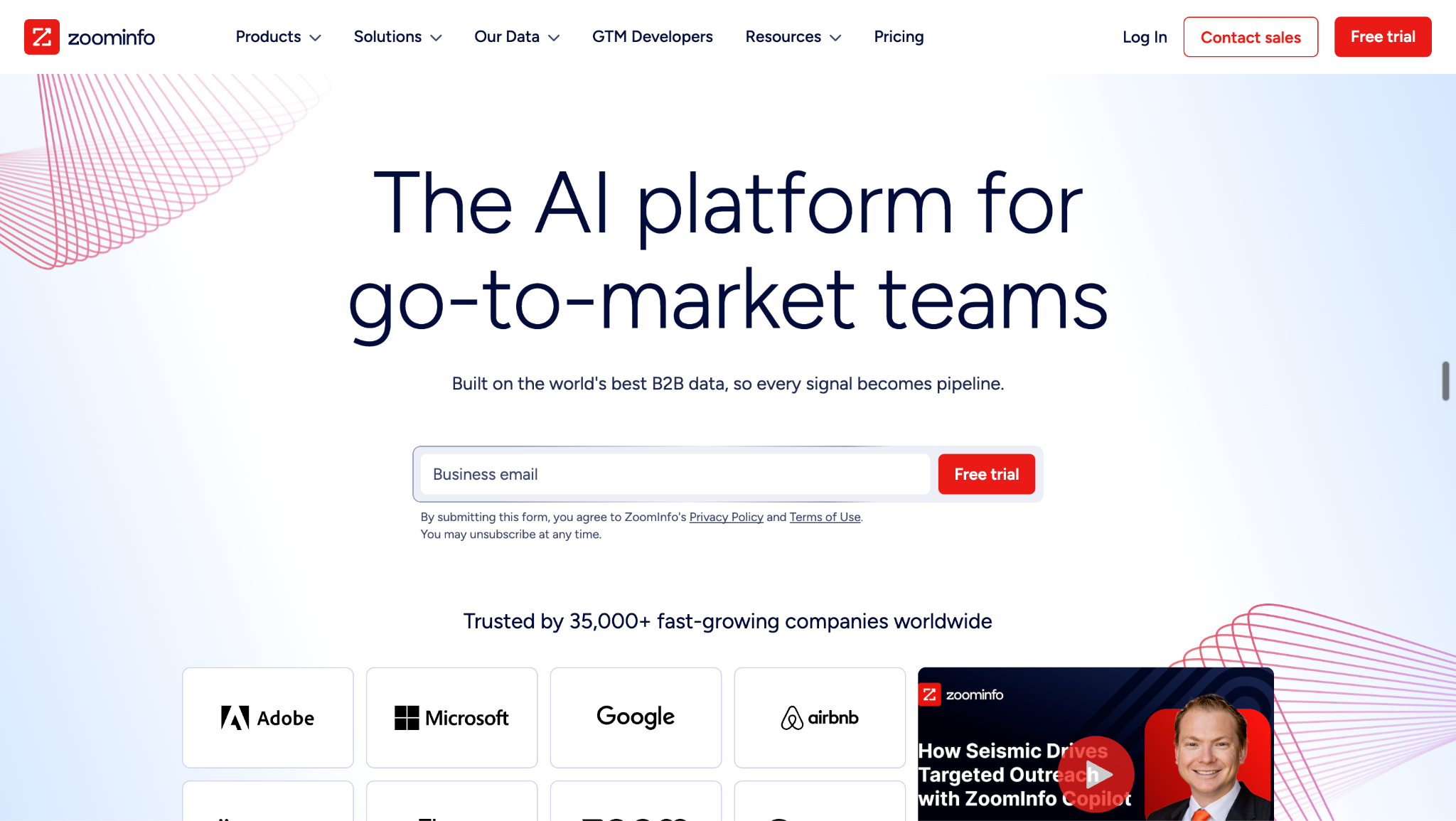
2. ZoomInfo
Best for: B2B contact, company, and buyer intelligence
ZoomInfo is most useful when the lead generation problem starts before outreach: identifying the companies worth targeting, finding the right people, and adding enough intelligence to prioritize accounts.
That makes ZoomInfo particularly useful for sales and RevOps teams that already know their ICP but need reliable data to build and prioritize a target market.
Best for
Teams whose biggest lead generation bottleneck is finding the right companies and people and understanding enough about them to decide who to pursue.
Limitation
ZoomInfo is primarily a data and intelligence layer. It can help identify and prioritize potential buyers, but that doesn't mean it solves every downstream step.
If the problem is what happens after a buyer shows active interest, engaging them, qualifying them, routing them, and moving them toward a meeting, you'll need additional sales workflows or a tool designed specifically for that stage.
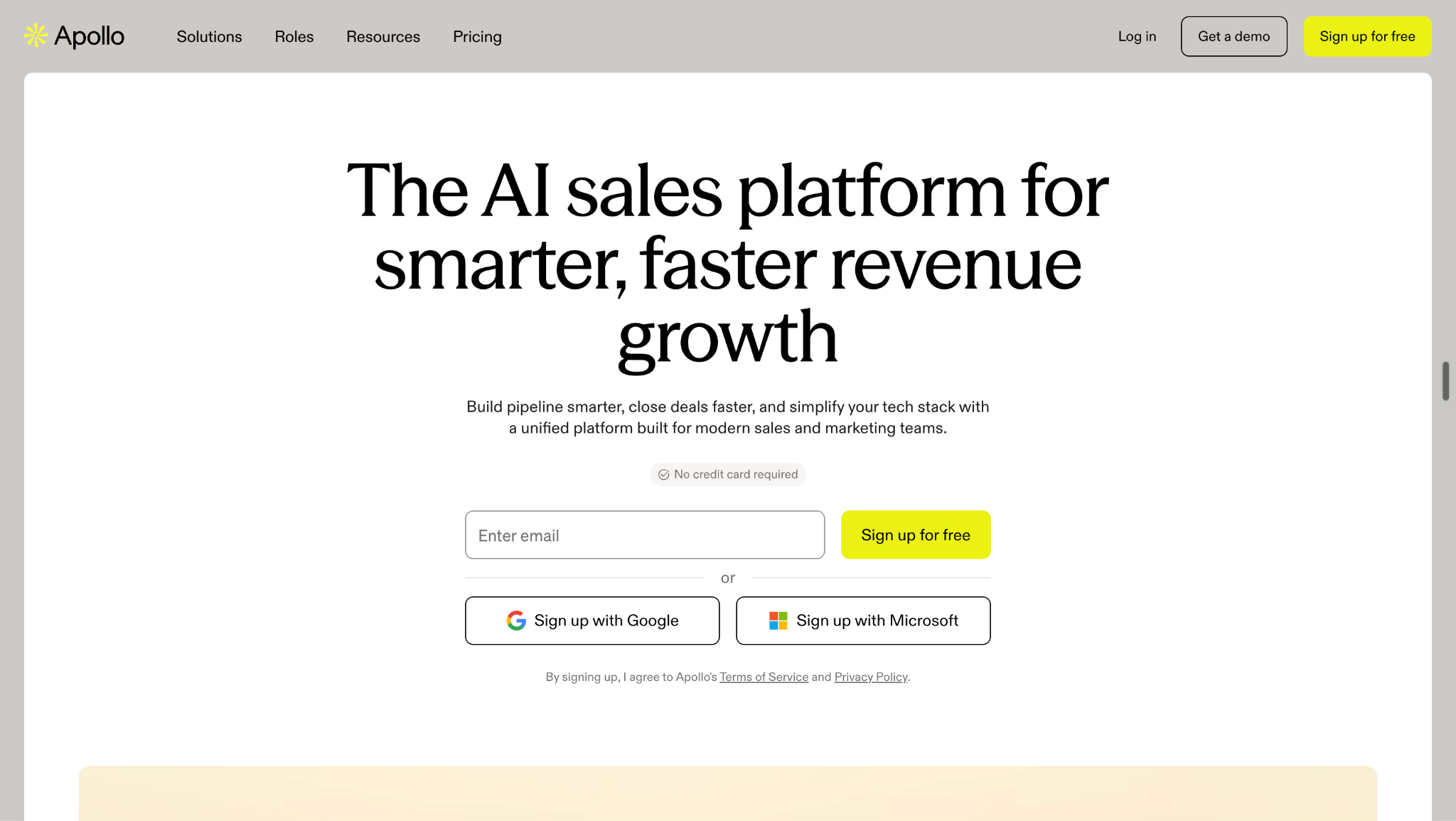
3. Apollo
Best for: Prospecting and sales engagement
Apollo combines prospect data with tools for actually reaching those prospects, making it useful for teams that want to move from building a list to executing outreach without stitching together several separate platforms.
Its lead generation capabilities include:
Contact database
List building
Prospect research
Sales sequences
Outreach
Prospect management
AI-assisted workflows
The question Apollo answers
“Who should we contact, and how do we reach them?”
Apollo is particularly useful when your lead generation process starts with identifying prospects and then systematically engaging them through outbound workflows.
Best for
SMB and mid-market sales teams that want prospecting and outbound engagement in one platform.
Limitation
Apollo is strongest around prospecting and outbound execution. Knock AI becomes more relevant when the buyer has already raised their hand and the challenge is converting that active interest into a qualified conversation.
The two can therefore complement each other rather than being direct substitutes.
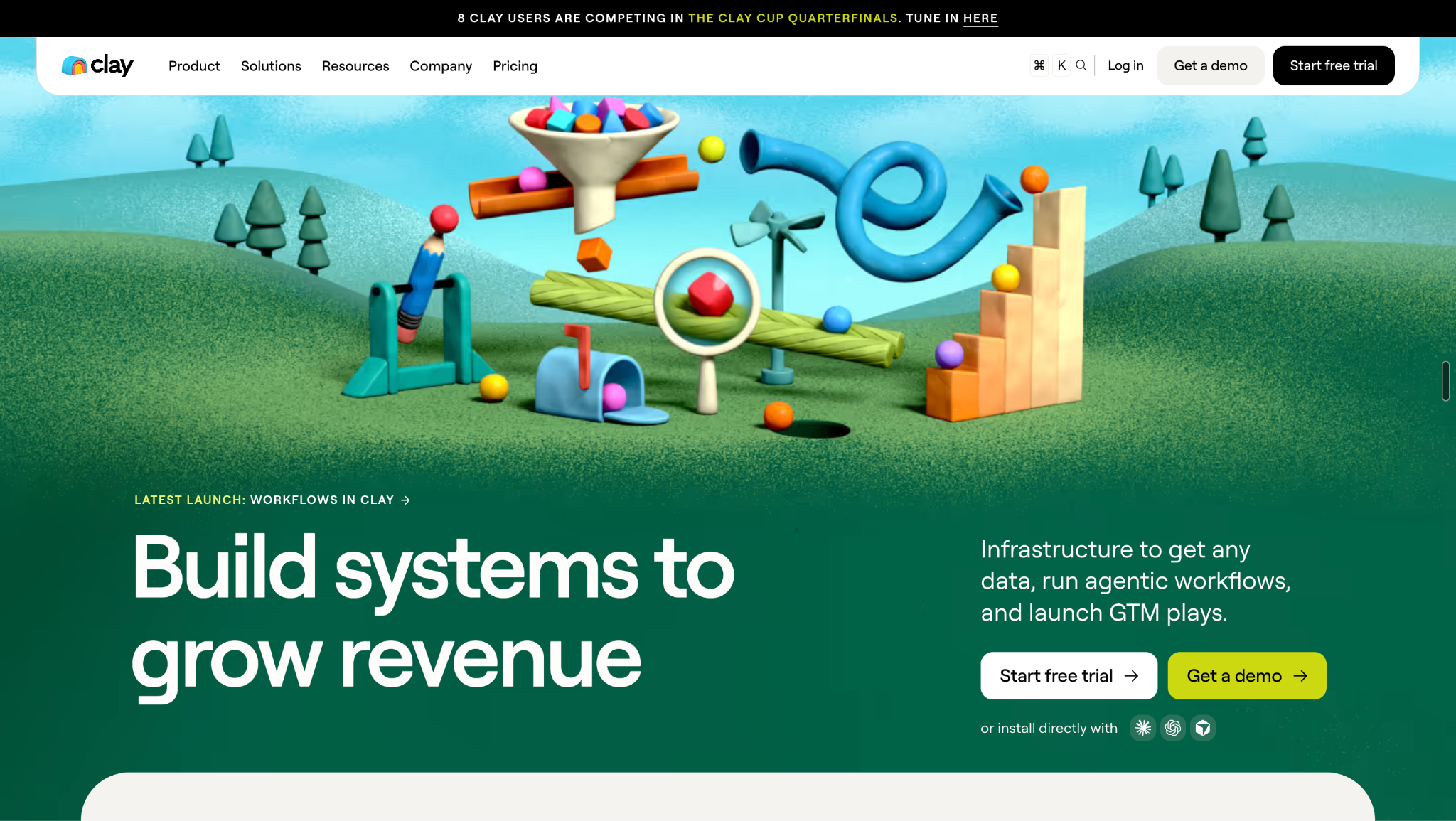
4. Clay
Best for: AI-assisted research, enrichment, and custom GTM workflows
Clay takes a more flexible approach to lead generation. Rather than relying on a single database or fixed workflow, it allows GTM teams to combine data sources, enrichment providers, research, signals, and custom logic into workflows tailored to their process.
Common use cases include:
Contact and company enrichment
Multiple data sources
Company research
People research
Buying and business signals
Custom GTM workflows
Personalization inputs
Automated research
The question Clay answers
“How can we build a better research and enrichment workflow around our prospects?”
That makes it particularly useful for teams that want more control over how prospect data is collected, enriched, researched, and transformed into sales-ready information.
Best for
RevOps and GTM teams that want to build flexible lead research and enrichment workflows rather than relying entirely on a predefined prospecting process.
Limitation
Clay's flexibility is also part of the trade-off. More control can mean more setup, workflow design, and operational complexity.
It's a strong fit when a team has the expertise and use case to take advantage of that flexibility. For teams that simply need a ready-made prospect database or straightforward lead workflow, a more packaged platform may be easier to operate.
Best for: Identifying accounts showing buying intent
6sense is particularly relevant to account-based GTM teams that don't want to treat every account in their market as equally likely to buy.
Its focus includes:
Account identification
Intent signals
Predictive intelligence
Account prioritization
Account-based workflows
Sales and marketing alignment
The question 6sense answers
“Which accounts are showing signs that they may be ready to buy?”
Instead of simply generating a larger list of potential accounts, 6sense helps teams identify and prioritize accounts based on signals associated with buying activity.
Best for
Organizations running account-based sales and marketing motions where identifying and prioritizing in-market accounts is more important than maximizing raw prospect volume.
Limitation
6sense is primarily an identification and prioritization layer. Knowing that an account is showing buying intent doesn't automatically create a sales conversation.
Teams still need downstream workflows for outreach, qualification, routing, and human engagement.
6. HubSpot
Best for: CRM-based lead capture, qualification, and automation
HubSpot approaches lead generation from the broader CRM and marketing automation side. Rather than being focused exclusively on finding new prospects, it connects lead capture, management, forms, qualification, enrichment, automation, chatbot, and reporting within the same platform.
Key capabilities include:
Forms and lead capture
CRM
Lead management
Workflow automation
AI-assisted sales and marketing features
Lead qualification
Reporting
Sales and marketing alignment
The question HubSpot answers
“How do we capture, manage, qualify, and automate our leads within one GTM system?”
That makes HubSpot useful for teams where lead generation is closely connected to their website, marketing campaigns, CRM, and sales workflows.
Best for
SMB and mid-market teams that want lead generation connected directly to their CRM and marketing automation.
Limitation
HubSpot is a broad GTM platform rather than a specialized answer to every lead generation problem.
If your specific bottleneck is, for example, building sophisticated enrichment workflows, identifying anonymous buying activity, or automatically converting high-intent inbound conversations, a specialized tool may provide deeper capabilities for that particular job.
7. Salesforce
Best for: Enterprise lead management and sales operations
Salesforce is primarily a CRM and sales operations platform, but its lead generation capabilities become particularly valuable when lead management is part of a larger, complex enterprise sales process.
It supports:
Lead and account management
CRM workflows
Sales automation
AI capabilities
Reporting and analytics
Enterprise integrations
Complex sales processes
Cross-team workflow management
The question Salesforce answers
“How do we manage leads, accounts, and sales processes across a complex enterprise organization?”
For organizations already operating deeply within Salesforce, its value comes from connecting lead management to the broader sales operation rather than treating lead generation as an isolated activity.
Best for
Large organizations with Salesforce already embedded into their sales operation, particularly those with complex processes, multiple teams, and extensive integration requirements.
Limitation
The breadth that makes Salesforce powerful can also make it more demanding to implement and administer. Configuration, process design, integrations, and ongoing administration can be significant, especially compared with more focused lead generation tools.
So while Salesforce can serve as the operational system around lead generation, teams looking for a narrowly focused solution to one specific lead generation bottleneck may find a specialized tool easier to deploy.
Which AI Lead Generation Tool Should You Choose?
The right choice depends less on how many AI features a tool has and more on where your lead generation process is breaking down.
If your problem is...
Consider...
Why
Finding prospects
ZoomInfo / Apollo
Build target lists, discover contacts, and support prospecting workflows
Researching and enriching prospects
Clay
Combine data sources, enrichment, research, and custom GTM workflows
Identifying accounts showing buying intent
6sense
Surface and prioritize accounts based on intent and predictive signals
Converting high-intent inbound demand
Knock AI
Identify, enrich, qualify, engage, route, and book buyers already showing interest
Managing leads inside your CRM
HubSpot / Salesforce
Connect lead capture, qualification, automation, and pipeline management
The important distinction is what happens before and after a buyer raises their hand. ZoomInfo, Apollo, Clay, and 6sense are particularly useful for identifying, researching, and prioritizing potential buyers. Knock AI is more focused on the conversion point, where an active buyer needs to be identified, understood, qualified, and connected with sales.
Choose the tool based on where leads are being lost, not where AI happens to be most impressive.
How to Build an AI Lead Generation Workflow
A useful AI lead generation workflow doesn't require every tool in the stack. The goal is to connect each capability to a specific stage of the buyer journey:
1. Define your ICP ↓ 2. Identify target accounts ZoomInfo / Apollo / 6sense ↓ 3. Find and enrich buyers Apollo / Clay ↓ 4. Identify buying signals 6sense / enrichment / behavioral signals ↓ 5. Engage the buyer Outbound → Apollo Inbound → Knock AI ↓ 6. Qualify Knock AI / CRM workflows ↓ 7. Route Correct rep, territory, or account owner ↓ 8. Track HubSpot / Salesforce
The important part is that the workflow should follow the sales motion, not the tool catalog. A company with strong inbound demand may get more value from improving identification, qualification, and response time than from adding another prospecting database. An outbound-heavy team may need the opposite.
And you don't necessarily need all seven tools. A lean stack is often better than seven disconnected systems. Start with the bottleneck, measure its impact, and add another capability only when it solves a measurable problem.
How to Measure AI Lead Generation Performance
Measuring AI lead generation only by the number of leads produced can be misleading. A better approach is to track performance across the funnel and connect activity to actual sales outcomes.
Stage
Metric
What it tells you
Acquisition
Leads generated
Whether the workflow is creating enough potential demand
Data quality
Enrichment accuracy
Whether the buyer and company data is reliable
Engagement
Reply rate
Whether prospects are responding to outreach or conversations
Speed
Speed-to-lead
How quickly a potential buyer receives a response
Qualification
Qualification rate
Whether generated leads actually fit your criteria
Conversion
Meeting booking rate
How effectively qualified interest turns into meetings
Pipeline
Opportunities created
Whether leads are becoming real sales opportunities
Financial
Pipeline and revenue generated
The commercial value created
Efficiency
Hours saved
How much manual SDR work is removed
Economics
CPL, CAC, CPA
Whether the additional output is financially efficient
The hierarchy matters. Leads generated and replies are useful operating metrics, but they aren't the end goal. If an AI workflow produces twice as many leads but the same number of qualified opportunities, the additional volume may not be creating much value.
Knock AI's customer examples illustrate why downstream metrics are more useful. Reported results include a 46% increase in SQL conversion, a 75% reduction in lead-to-SQL time, a 38% increase in pipeline, and 4+ hours saved per SDR per day across individual customer examples. These are customer-reported outcomes, not universal benchmarks.
The strongest AI lead generation metric isn't how many leads AI can produce. It's how many qualified opportunities those leads become at an acceptable cost.
AI Lead Generation: What It Can and Can't Automate
AI can automate many of the repetitive steps involved in lead generation, particularly when the process follows clear rules. It can handle tasks such as:
researching prospects and accounts
enriching contact and company data
monitoring buying signals
prioritizing leads
qualifying leads against defined criteria
following up with prospects
responding to initial inquiries
updating CRM records
But automation has limits. Humans still add more value when a lead requires complex discovery, nuanced qualification, strategic account planning, relationship building, negotiation, or judgment around an unusual buying situation.
The goal isn't to automate every part of lead generation. It's to remove repetitive work so salespeople can spend more time on the leads and conversations where human judgment actually matters.
FAQs
What are the best AI tools for lead generation?
The best AI tool for lead generation depends on where your sales process needs help. ZoomInfo and Apollo are suited to finding prospects, Clay to research and enrichment, 6sense to identifying buying intent, Knock AI to convert high-intent inbound buyers, and HubSpot or Salesforce to manage leads within the CRM.
How does AI generate leads?
AI can support the lead generation process by identifying prospects, researching and enriching them, prioritizing likely buyers, engaging them, qualifying interest, and routing qualified leads to the appropriate sales rep. The exact workflow depends on whether you're generating leads through outbound prospecting, inbound demand, account-based marketing, or another motion.
What is the best AI tool for B2B lead generation?
There isn't one tool that is best for every B2B team. ZoomInfo and Apollo are strong for prospect discovery, Clay for enrichment and research, and 6sense for intent-based account identification. For teams focused on converting active inbound demand into qualified sales conversations, Knock AI is specifically built around identification, enrichment, qualification, engagement, routing, and meeting booking.
Can AI generate qualified leads?
Yes, but AI does not guarantee lead quality. Results depend on the quality of your data, how clearly you've defined your ICP, the buying signals available, and how well your qualification rules reflect your actual sales process. A larger number of AI generated leads is not necessarily better if they do not become qualified opportunities.
How can I use AI for lead generation?
A practical approach is to:
Define your ICP and qualification criteria.
Identify potential buyers using data, intent, or behavioral signals.
Enrich and prioritize leads based on fit and buying intent.
Engage and qualify buyers through appropriate inbound or outbound workflows.
Route and track qualified leads through your CRM and measure their progression into opportunities and revenue.
Are AI lead generation tools worth it?
They can be, particularly when lead volume is high, SDRs spend significant time on repetitive work, response speed affects conversion, or your team has enough pipeline volume to measure the impact. The strongest business case comes from improvements in qualified opportunities, pipeline, revenue, time saved, and cost per qualified lead, rather than simply generating more contacts.
What is the difference between AI lead generation and AI sales automation?
AI lead generation focuses primarily on identifying potential buyers and creating qualified opportunities. AI sales automation can extend further into engagement, qualification, routing, follow-up, meeting booking, and CRM execution. In practice, the two overlap: a lead generation workflow may use AI automation to move a buyer from initial identification through qualification and handoff to sales.


.svg)


.svg)
.svg)
.svg)


.svg)
.svg)


.svg)