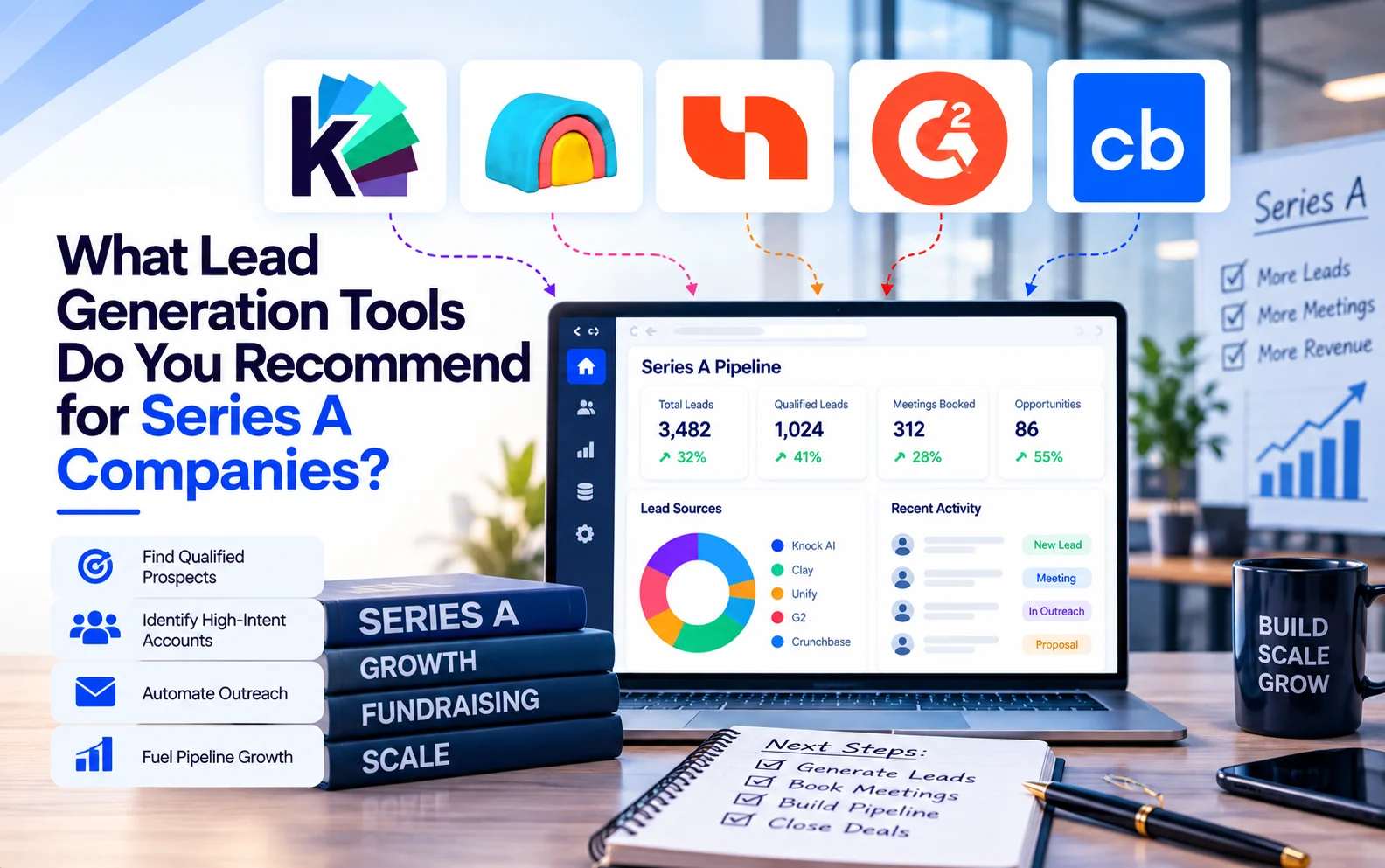
What Lead Generation Tools Do You Recommend for Series A Companies?
Series A is often the point where a company needs to move from founder-led growth to a repeatable GTM engine. Early customers may have come through founder networks, referrals, personal outreach, or a few successful campaigns. But as the company grows, that approach becomes harder to repeat.
The challenge isn't necessarily generating thousands of additional leads. It's figuring out which accounts are worth pursuing, which buyers are showing genuine interest, when to engage them, and how to turn that interest into qualified pipeline without dramatically increasing headcount.
The buying journey is also becoming harder to control. G2's 2026 Buyer Behavior Report found that more than 80% of B2B software buyers sourced software recommendations from an AI chatbot in the previous two years, while 40% now say evaluation is the longest stage of the buying journey. That means a potential customer may already have researched your category, compared competitors, and formed an initial opinion before they ever fill out a form or speak with Sales. (Source)
A strong Series A lead generation strategy therefore needs to help teams:
Define and identify the right ICP
Find accounts worth pursuing
Recognize meaningful buying signals
Reach prospects at the right moment
Convert inbound interest into conversations
Build a repeatable pipeline generation process
That's where the right GTM tools can make a difference. Knock AI, Clay, G2, Unify, and Crunchbase each address a different part of this process, from finding and researching target accounts to identifying buying signals, activating outbound, capturing buyer intent, and converting high-intent demand into pipeline.
Why Lead Generation Is Different for Series A Companies
Series A is often where a company has enough traction to start scaling its go-to-market motion, but not enough resources to operate like a mature sales and marketing organization. The challenge is moving from a few successful ways of acquiring customers to a process that can consistently produce qualified pipeline.
Founder-Led Sales Is Starting to Break
Early sales often depend heavily on the founders. They know which prospects are a good fit, which pain points resonate, how to handle objections, and when to get involved in a deal.
That works while the number of opportunities is manageable. But as the company grows, the founder can't personally research every account, handle every sales conversation, or guide every new salesperson.
The challenge becomes turning that knowledge into a repeatable process: who to target, what signals matter, what to say, how to qualify, and when to involve the right person.
This is where a Series A lead generation stack should create leverage. Instead of simply adding more activity, it should help the team consistently identify the right accounts, prioritize the right prospects, and move qualified buyers toward a sales conversation.
Your ICP Is Still Evolving
Having early customers doesn't necessarily mean you've found the exact market segment you should scale.
Some early customers may have bought because of a founder relationship, a particularly strong pain point, or a use case that isn't representative of the broader market. As more customers come in, Series A teams need to identify which characteristics consistently correlate with good customers.
That means refining questions such as:
Which companies get the most value from the product?
Which buyers convert fastest?
Which customers expand?
Which prospects consistently become opportunities?
Which segments have the shortest sales cycles?
Which objections repeatedly cause deals to stall?
Your ICP should become more precise as you learn from customers and sales conversations. That makes lead generation less about finding the largest possible audience and more about finding the accounts most likely to become valuable customers.
You Need More Pipeline, Not Just More Leads
At Series A, adding another thousand contacts to the CRM isn't necessarily progress.
The more useful question is:
How many of the accounts we're pursuing can realistically become opportunities and revenue?
This changes how marketing and sales evaluate lead generation. A campaign that generates hundreds of contacts but produces very few qualified opportunities may be less valuable than a smaller campaign that consistently creates sales pipeline.
The goal is to optimize for commercial quality, not simply lead volume.
Small Teams Can't Afford Manual Prospecting
A Series A sales team can't spend hours researching every account, checking company news, finding decision-makers, looking for buying signals, and manually deciding who deserves attention.
The team needs leverage.
That could mean using company-level triggers to identify relevant accounts, automating enrichment and research, prioritizing prospects based on intent, or automatically acting when an important signal appears.
The objective isn't to remove humans from the sales process. It's to make sure salespeople spend their limited time on accounts and conversations where human involvement can actually change the outcome.
Buyers Are Researching Before They Talk to Sales
The buyer journey has also moved beyond the traditional:
Google → Website → Demo → Sales
Buyers now use Google, AI chatbots, review platforms, communities, LinkedIn, and peer recommendations to research vendors before speaking with a salesperson.
G2's 2026 Buyer Behavior Report found that more than 80% of B2B software buyers sourced software recommendations from an AI chatbot during the previous two years, while 40% said evaluation was the longest stage of their buying journey.
For a Series A company, that creates two problems: getting discovered in the first place and understanding what happens after a buyer discovers you.
A prospect might research your category, compare alternatives, read reviews, visit your website, and discuss the product internally before anyone fills out a form. By the time Sales sees the lead, much of the buying journey may already have happened.
That makes visibility across the research and evaluation process increasingly important. The company needs to understand not only who eventually converts, but also where potential buyers are discovering and evaluating the product before they raise their hand.
Marketing and Sales Need to Work From the Same Signals
One of the most common GTM disconnects looks like this:
Marketing: “We generated 500 leads.”
Sales: “None of them are good.”
The problem is often not that either team is doing nothing. They are measuring and acting on different signals.
Marketing may be focused on traffic, content engagement, and MQLs, while Sales cares about account fit, buying intent, timing, budget, and the likelihood of creating an opportunity.
At Series A, those signals need to start coming together.
Marketing should help Sales understand which accounts are showing interest and why, while Sales feedback should help Marketing refine the ICP, messaging, content, and acquisition strategy.
The goal isn't simply to generate more activity. It's to build a GTM system where the right accounts are identified, meaningful signals are captured, and Sales knows where to focus next.
What Does the Series A Buyer Journey Look Like?
Series A buyers rarely move directly from discovering a company to booking a demo. They often research independently across multiple channels before making themselves known to Sales.
Stage
What the Buyer Is Doing
Awareness
Discovers a problem, category, or potential solution
Research
Uses Google, AI, communities, LinkedIn, reviews, and peer recommendations
Shortlist
Compares vendors and potential solutions
Evaluation
Visits websites, consumes content, requests demos, or trials products
Intent
Shows meaningful buying signals through engagement or product activity
Sales Conversation
Talks to Sales or engages with an AI or human representative
Validation
Evaluates ROI, fit, security, integrations, and customer proof
Purchase
Makes the buying decision
The challenge for Series A companies is that much of this journey happens before the company knows who the buyer is. A prospect may research the category, compare vendors, read reviews, and revisit a website multiple times before submitting a form.
That makes it important to capture the signals that appear throughout the journey, not just the final form submission.
What Should a Series A Lead Generation Strategy Actually Do?
A Series A lead generation strategy needs to help a small team identify the right market, recognize buying opportunities, and turn those signals into sales activity without creating a large manual workload.
Job
What the Team Needs to Do
Define the market
Identify the accounts most likely to become customers
Find prospects
Build targeted account and contact lists
Identify buying windows
Detect funding, hiring, product, website, and other relevant triggers
Create demand
Become discoverable while buyers are researching
Capture intent
Recognize when accounts or people are showing meaningful interest
Activate signals
Turn buying signals into timely, relevant outreach
Convert inbound
Qualify, engage, route, and book interested buyers
Measure results
Connect lead generation activity to pipeline and revenue
The right Series A stack isn't necessarily the one with the most features. It is the one that helps a small team perform these jobs with less manual work while creating more qualified pipeline.
Knock AI vs Clay vs G2 vs Unify vs Crunchbase
These tools solve different parts of the Series A GTM motion. The most useful way to compare them is by the job they perform, the signal they provide, and how directly they help a lean team turn that signal into pipeline.
Factor
Knock AI
Clay
G2
Unify
Crunchbase
Primary Job
Convert buyer interest into qualified conversations and sales action
Research, enrich, and build highly targeted prospect lists and outbound workflows
Capture software research and buyer intent
Turn buying signals into automated outbound actions
Identify companies and business events that may create buying opportunities
Core Series A Problem
Valuable inbound interest isn't being identified, qualified, or acted on quickly enough
A small team can't manually research and personalize every target account
Buyers are researching software before Sales knows who they are
The team has signals but doesn't consistently turn them into action
The team knows its ICP but doesn't know which accounts have entered a relevant buying window
Primary Funnel Position
Intent → Engagement → Qualification → Meeting
Account Discovery → Research → Prospecting → Outreach
A buyer is showing interest. What should happen next?
Clay
Who should we target, and what do we need to know about them?
G2
Who is researching our category and evaluating vendors?
Unify
Which signal should trigger sales action right now?
Crunchbase
Which companies have entered a potentially relevant buying window?
The distinction is important for a Series A company. Clay and Crunchbase help you find and understand accounts, G2 helps surface research-stage demand, Unify helps activate signals into outbound, and Knock AI helps turn active buyer interest into an actual sales conversation. These can therefore work together rather than functioning as five interchangeable lead databases.
Best Lead Generation Tools for Series A Companies
Series A teams need tools that create leverage, not simply more data. The right platform should help a small GTM team identify valuable accounts, recognize buying signals, act on them quickly, and turn buyer activity into pipeline. The five tools below solve different parts of that process, so they are better viewed as complementary solutions rather than direct substitutes.
Rather than treating every inbound interaction as a new lead, Knock AI can understand who the person is, which company they represent, why they are reaching out, whether they fit the ICP, and what should happen next. It can also determine whether an AI agent or human should handle the conversation.
How It Helps Series A Companies Generate and Convert Pipeline
For a Series A company, the challenge is often not creating interest. It's making sure valuable interest doesn't sit unanswered or require an SDR to manually research and qualify every interaction.
For example, when a potential buyer interacts with the company, Knock AI can enrich the person and account, evaluate ICP fit, understand the reason for the interaction, ask qualification questions when necessary, and route the conversation to the appropriate rep or CRM owner. Qualified buyers can also be moved directly toward a meeting.
This gives a small Series A team a way to handle more buyer activity without requiring a salesperson to manually perform every step between interest and sales action.
Best For
Series A companies with meaningful inbound traffic, account activity, high-intent visitors, or multiple buyer touchpoints that need to be converted into qualified conversations.
It is particularly relevant when the company has started generating demand but doesn't yet have the sales capacity to manually respond to and qualify every interested buyer.
What to Consider
Knock AI is most useful when there is already meaningful buyer activity to capture and act on. The team should have a clear ICP, qualification criteria, and routing logic so that the system knows which conversations deserve human attention and what should happen next.
2. Clay
What It Does
Clay combines account research, data enrichment, prospecting, AI research, intent signals, personalization, and outbound workflows. Its current platform can use 150+ data providers alongside AI web research to build account and prospect context, enrich CRM records, prioritize leads, and create personalized outreach.
It can also combine signals such as funding, hiring, website activity, social activity, and CRM data to help teams identify and prioritize accounts.
How It Helps Series A Companies
Series A teams often need highly targeted outbound without having a large research organization behind Sales.
Clay can help turn:
Small team → better account research → targeted prospecting → personalized outreach → less manual work
Instead of having an SDR manually research every company, the team can automate much of the research and enrichment process, then give reps the information they need to prioritize accounts and personalize their outreach.
Clay can also refresh account research and notify reps when relevant signals, such as website intent or job changes, occur.
Best For
Series A teams building or scaling an outbound motion without wanting to hire a large SDR or research organization.
It is particularly useful when the team has a defined ICP but needs to turn that ICP into well-researched, actionable account lists.
What to Consider
Clay can become extremely powerful, but it isn't a plug-and-play replacement for a GTM strategy. The quality of the output depends on the ICP, data sources, enrichment logic, scoring criteria, and workflows the team builds around it.
For a Series A company, the goal should be to automate good prospecting, not simply automate more prospecting.
3. G2
What It Does
G2 helps software buyers discover and evaluate products through reviews, category research, comparisons, and other software research activity. Its Buyer Intent product gives vendors visibility into companies researching their products and competitors on G2 and related software discovery platforms.
Buyer Intent signals can include actions such as viewing a product profile, comparing products, viewing alternatives, engaging with pricing information, and reading reviews. G2 categorizes buyer activity by stages such as awareness, consideration, and decision.
How It Helps Series A Companies
For a Series A software company, G2 addresses a part of the funnel that often happens before Sales knows a buyer exists.
A potential customer may already be:
Comparing competitors
Researching a software category
Looking at pricing
Reading customer reviews
Evaluating alternatives
Building a shortlist
That activity can provide an earlier view of companies that are actively researching solutions like yours.
G2's Buyer Intent data can help sales and marketing teams identify accounts showing these research behaviors and incorporate those signals into their existing workflows.
Best For
Series A software companies trying to build credibility, improve category visibility, and identify buyers during the research and evaluation stages of the software buying journey.
What to Consider
The value depends on whether your target buyers use G2 and related discovery platforms when evaluating software. Your category presence, review quality, product profile, and competitive positioning also matter.
G2 identifies the account showing research activity rather than the specific individual visitor, so teams may need other tools to identify and reach the relevant buying committee.
4. Unify
What It Does
Unify turns buyer and account signals into outbound actions. Its platform brings together first-party engagement, third-party data, and AI-discovered signals, then allows teams to create automated workflows that prospect contacts, enrich them, qualify them, and enroll them in personalized sequences.
Signals can include website activity, LinkedIn engagement, CRM changes, job changes, funding, and other account-level activity.
How It Helps Series A Companies
This is particularly useful when a company already has plenty of data but struggles to turn that data into action.
Unify's Plays allow teams to define a signal as a trigger and automatically run a series of actions when that signal occurs.
That can help a small Series A team move from reactive prospecting to signal-driven outbound.
Best For
Series A teams that already have useful first-party or third-party signals but struggle to consistently turn those signals into sales activity.
It's especially relevant when the team wants to automate the gap between “we know something interesting happened” and “Sales is doing something about it.”
What to Consider
The quality of the outcome depends heavily on the signals you choose and the workflows you build around them. A weak signal can simply create more automated noise.
The goal should be to identify signals that indicate a meaningful change in account or buyer behavior and connect them to a specific sales action.
5. Crunchbase
What It Does
Crunchbase provides company intelligence that can help sales and marketing teams identify organizations based on characteristics and business events. These include funding activity, company growth, hiring, executive changes, acquisitions, and other changes that can indicate a shift in a company's priorities.
Crunchbase also has predictive models designed to identify companies that are likely to raise funding, using proprietary data and machine learning to identify potential funding events and their expected timing.
How It Helps Series A Companies
Crunchbase becomes particularly interesting when you stop thinking only about ICP fit and start thinking about buying windows.
Instead of:
“This company matches our ICP.”
Think:
“This company matches our ICP and something just happened that could create a reason to buy.”
For example:
Target account: B2B SaaS company ICP fit: 100-500 employees Trigger: Recently raised funding Potential implication: New budget, growth targets, hiring plans, or expansion initiatives Sales action: Research the relevant buyer and tailor outreach around the company's current priorities
The trigger doesn't prove that the company is ready to buy. It simply gives Sales a more relevant reason to investigate the account now.
Best For
Outbound teams selling into companies where events such as funding, hiring, leadership changes, acquisitions, or expansion can create new budgets, priorities, or projects.
What to Consider
Company-level triggers should be combined with ICP fit and buyer-level research. A funding round or executive hire is a reason to investigate an account, not proof that the company has buying intent for your product.
The strongest workflow is:
Company trigger → ICP fit → relevant buyer → additional intent → personalized outreach
That turns company intelligence into a prospecting strategy rather than simply another database.
How These Tools Fit Into a Series A GTM Motion
GTM Stage
Typical Approach / Tool
Define ICP
CRM + customer data
Find target accounts
Clay / Crunchbase
Identify buying triggers
Crunchbase / Unify
Build market visibility
Content / G2 / SEO / AI visibility
Capture buyer intent
G2 / website / product signals
Engage high-intent buyers
Knock AI
Qualify and route
Knock AI / CRM
Activate outbound
Clay / Unify
Convert opportunities
Sales process + CRM
Measure pipeline
CRM / revenue analytics
How to Know if Your Series A Lead Generation Strategy Is Working
At Series A, lead generation needs to be measured by the business it creates, not simply by how many contacts enter the CRM. The goal is to understand whether your acquisition efforts are producing qualified pipeline efficiently and consistently.
Measure Qualified Pipeline, Not Just Leads
Lead volume can tell you how much demand you're generating, but it doesn't tell you whether that demand is commercially valuable.
Track the progression from:
Qualified Lead → Opportunity → Pipeline → Closed Revenue
If lead volume is increasing while qualified opportunities remain flat, the problem may be ICP fit, qualification, or lead quality rather than demand generation.
Track Conversion by Source
Break your funnel down by acquisition source:
Source → Qualified Lead → Opportunity → Won Revenue
This helps you understand which channels generate prospects that actually progress through the sales process. A channel producing fewer leads may still create more pipeline if those leads are better qualified.
Measure Sales Efficiency
Series A teams need to understand how much pipeline and revenue they're generating relative to the resources they're investing.
Track:
Cost per qualified lead
Cost per opportunity
Pipeline generated
Customer acquisition cost (CAC)
Pipeline velocity
Revenue generated
These metrics give you a clearer view of whether your GTM motion is becoming more efficient as the company scales.
Measure Signal-to-Revenue Performance
If you're investing in intent data, account signals, website activity, product usage, or company triggers, don't stop at measuring how many signals you collect.
Track:
Signal → Sales Action → Opportunity → Revenue
For example, you could measure how many accounts showing a particular buying signal were contacted, how many became opportunities, and how much revenue those opportunities ultimately generated.
This helps separate signals that create useful sales action from signals that simply create more data.
How Series A Companies Can Generate More Pipeline Without Building a Huge GTM Team
Series A growth doesn't necessarily require a large sales and marketing organization. The goal is to create systems that allow a small team to focus its time where it can have the greatest impact.
Narrow the ICP Before Increasing Lead Volume
Before adding more prospects to the funnel, make sure you're targeting the accounts most likely to benefit from your product.
Look at your existing customers and opportunities to identify patterns in company size, industry, use case, buyer, sales cycle, and customer value. A narrower ICP can make prospecting and messaging more efficient.
Prioritize Accounts Showing Buying Signals
Not every account that matches your ICP is equally valuable right now.
Prioritize accounts showing signals such as:
Relevant website activity
Product engagement
Software research
Funding or hiring activity
Job changes
Engagement with high-intent content
Multiple people from the same company engaging
The objective is to focus limited sales capacity on accounts where there is a reason to engage now.
Automate Research Before Hiring More Prospectors
Salespeople shouldn't have to manually research every company, find contacts, check company updates, and gather basic account information.
Use enrichment, AI research, company intelligence, and automated workflows to handle repetitive research so salespeople can spend more time on actual conversations.
Respond to High-Intent Buyers Quickly
When a buyer is actively evaluating your product, unnecessary delays can create friction.
Make the path from interest to conversation as short as possible. That could mean automated qualification, instant routing, direct scheduling, or an AI agent that can answer initial questions before handing the conversation to Sales.
Turn Existing Customer Relationships Into New Opportunities
Your existing customers can provide more than recurring revenue.
Look for opportunities to expand within current accounts, identify additional teams or use cases, and reconnect with people who already understand your product but have moved to new companies.
The advantage is that these conversations can start with existing context rather than beginning from zero.
Build Systems Around Signals, Not Spreadsheets
As the GTM motion grows, manually tracking prospects, company changes, website activity, and follow-ups becomes difficult to maintain.
Instead, create workflows where meaningful signals automatically trigger an action:
Signal → Qualification → Outreach → Conversation → Opportunity
This allows a small team to respond consistently without maintaining another manual tracking system.
Connect Marketing and Sales Around Pipeline
Marketing and Sales should work toward the same commercial outcome.
Instead of measuring marketing primarily by traffic, leads, or MQLs, connect activity to:
That creates a shared view of what is actually working and gives both teams a clearer basis for deciding where to invest their limited resources.
Frequently Asked Questions
What Are the Best Lead Generation Tools for Series A Companies?
The right tools depend on the company's GTM motion and the specific bottleneck it is trying to solve. Knock AI can help convert buyer interest into qualified conversations, Clay can support account research and targeted outbound, G2 can surface software research intent, Unify can activate buying signals into outbound workflows, and Crunchbase can help identify companies experiencing relevant business events.
How Should a Series A Startup Generate B2B Leads?
Start with a clearly defined ICP rather than trying to reach the largest possible audience. Identify target accounts, find relevant buyers, monitor meaningful buying signals, create demand through content and other channels, and build a repeatable process for turning interest into qualified conversations and opportunities.
How Do Series A Companies Build a Repeatable Sales Pipeline?
A repeatable pipeline comes from consistently targeting the right accounts, using defined qualification criteria, identifying relevant buying signals, creating repeatable outreach and inbound processes, and measuring progression from qualified lead to opportunity and revenue.
What Sales Tools Should a Series A Startup Use?
There isn't one universal stack. A Series A company should choose tools based on its GTM bottlenecks. For example, Clay can support prospect research and outbound, Crunchbase can help identify account-level triggers, Unify can activate signals, and Knock AI can help identify, engage, qualify, and route high-intent buyers.
How Can Series A Companies Find High-Intent Prospects?
Combine ICP fit with behavioral and business signals. These can include website activity, product usage, software research, repeated engagement, funding, hiring, leadership changes, or other events relevant to your product. The important distinction is that ICP fit tells you who could buy, while intent and trigger signals help indicate who may have a reason to buy now.
How Can Series A Companies Scale Outbound Without Hiring a Large SDR Team?
Automate the parts of outbound that don't require human judgment, including account research, enrichment, prospect identification, signal monitoring, and parts of personalization. Then allow salespeople to focus on accounts and conversations where their involvement can materially influence the outcome.
How Can Series A Companies Identify Companies That Are Ready to Buy?
Look for a combination of fit + trigger + intent. A company matching your ICP isn't necessarily ready to buy. A relevant business event can create a potential buying window, while direct engagement or research activity can provide stronger evidence that the account is actively evaluating a solution.
How Can Series A Companies Convert More Inbound Leads?
Reduce the time and friction between buyer interest and sales engagement. Identify the buyer and account, understand their context, qualify the opportunity, route it to the appropriate person, and make it easy to start a conversation or book a meeting.
How Can Series A Companies Measure Lead Generation ROI?
Track the complete progression from source → qualified lead → opportunity → pipeline → closed revenue. Then compare the resulting pipeline and revenue against acquisition costs using metrics such as cost per opportunity, CAC, pipeline generated, revenue generated, and CAC payback.
Can Knock AI Help Series A Companies Generate More Pipeline?
Yes. Knock AI is particularly relevant when a Series A company is already generating buyer or account activity but needs a more systematic way to turn that interest into sales conversations.
Knock AI can connect buyer and account identity → relationship context → first-party intent → engagement → qualification → routing → continued relationship, helping revenue teams reduce the manual work between buyer interest and sales action.


.svg)


.svg)
.svg)
.svg)


.svg)
.svg)


.svg)