Best Visitor Identification & Intent Tools for Cybersecurity
What Are the Best Visitor Identification and Intent Tools for Cybersecurity Companies?
The best visitor identification and intent tool for a cybersecurity company depends on what you need to accomplish. Some platforms focus primarily on identifying anonymous companies visiting your website, while others provide person-level identification, buyer intent, account intelligence, enrichment, or the workflows needed to turn those signals into sales conversations.
The key distinction is simple: visitor tracking tells you what happened, visitor identification tells you who was involved, intent tells you whether the activity matters, and activation determines what happens next.
For cybersecurity companies, the goal is therefore not simply to collect more website visitor data. It is to move from:
These platforms serve different jobs. Lead Forensics and Leadfeeder are primarily focused on identifying companies visiting your website, while RB2B focuses more heavily on person-level visitor identification. 6sense and Demandbase extend into account intelligence and intent, while ZoomInfo combines company and contact intelligence with enrichment and intent data. Factors.ai connects visitor and account activity with marketing attribution and revenue analysis. Knock AI connects visitor and buyer signals with qualification, engagement, outreach, and routing, helping cybersecurity teams turn meaningful buying activity into an actual sales action.
Visitor Tracking vs Identification vs Intent
These terms are often used interchangeably, but they describe different stages of understanding website activity. Visitor tracking tells you what someone did on your website. Visitor identification adds context about who was behind that activity, such as the company, contact, role, or account. Intent goes one step further by assessing whether that behavior indicates meaningful interest in a product or category.
For a cybersecurity company, this distinction becomes important because a single website visit rarely tells the full story. A visitor might read one technical article and leave, while another account might repeatedly return to pricing, product pages, security documentation, and integration pages. The second pattern gives a revenue team much more context.
The workflow can therefore move from simply observing activity to deciding what action should follow:
Layer
What it answers
Example
Visitor tracking
What happened?
Someone viewed your pricing page
Visitor identification
Who was involved?
A target cybersecurity company visited
Intent
How meaningful is it?
Pricing + product + repeat visits
Qualification
Should sales act?
ICP + high intent + relevant buyer
Activation
What happens next?
Outreach + AI qualification + routing
Conversion
Did it create pipeline?
Meeting → opportunity
The distinction also explains why simply buying a website visitor tracking tool may not solve the underlying revenue problem. Knowing that an account visited your website is useful, but the commercial value comes from combining that activity with account context, buyer information, intent, qualification criteria, and an action.
For example, a cybersecurity company could identify an account visiting its website, enrich the account with company and contact information, detect repeated engagement with high-value pages, determine whether the account matches its ICP, and then route the opportunity to the appropriate sales rep or AI agent.
The key takeaway: visitor identification is not the end goal. It creates the context needed to determine which activity matters, whether the account is worth pursuing, and what should happen next.
Why Visitor Intent Is Different for Cybersecurity Companies
Cybersecurity companies often have to interpret a much broader set of buyer signals than a simple form submission. A prospect may research a product extensively before ever speaking with sales, and different people within the same account may interact with the company at different stages of the buying process.
Cybersecurity buyers research across multiple channels
A cybersecurity buyer might explore product pages, technical documentation, security and compliance pages, integrations, pricing, case studies, G2, GitHub, webinars, or competitor comparisons before requesting a conversation.
That means a demo request is not necessarily the first meaningful buying signal.
A security leader repeatedly researching a product, checking its integrations, returning to pricing, and reviewing security documentation may already be showing strong interest before they ever fill out a form.
The important signal is not simply that someone visited. It is the pattern of research happening around the visit.
One visitor doesn't represent the whole buying committee
Cybersecurity purchases rarely involve just one person.
A CISO might evaluate security outcomes and risk. A security engineer may examine technical capabilities. A VP of Security may assess the broader business case. DevOps or IT teams may evaluate integrations and implementation, while procurement may become involved later in the process.
As a result, looking at one visitor in isolation can miss the bigger picture.
Account-level activity is often more informative than isolated visitor activity. If several relevant people from the same account are researching different parts of the product, the combined signal can provide a much stronger buying context.
ICP fit and intent are different signals
A company can fit your ideal customer profile without currently being interested in buying.
A 1,000 employee company visiting one blog post isn't necessarily a sales opportunity.
The same company repeatedly visiting pricing, product pages, security documentation, and integration pages is a much stronger signal, particularly if multiple relevant people from the account are active.
This is why cybersecurity revenue teams should combine ICP fit + buyer identity + website behavior + intent rather than treating every identified visitor equally.
The goal isn't to identify more visitors. It's to identify the visitors and accounts worth acting on while their intent is active.
Best Visitor Identification and Intent Tools for Cybersecurity Companies
Visitor identification and intent platforms overlap, but they are not interchangeable. Some are primarily designed to identify anonymous companies, while others specialize in account intelligence, third-party intent, attribution, enrichment, or person-level identification. Knock AI extends further into qualification, engagement, and routing, connecting the signal to an actual sales action.
Tool
Best fit
Visitor / Account Identification
Intent & Behavioral Signals
Enrichment
Qualification
Activation & Workflow
Knock AI
Turning buyer signals into qualified conversations and pipeline
Companies + contacts
First-party website, marketing asset, and engagement signals
Company, contact, role, CRM, intent, and advanced firmographic data
AI qualification based on ICP, intent, behavior, and CRM context
Best for: Turning visitor and buyer signals into qualified conversations.
What it does
Knock AI goes beyond identifying who is visiting a website. Knock Reveal identifies companies and contacts engaging with your website and other Knock touchpoints, while Knock Intent turns first party activity such as page views, CTA clicks, form activity, Knock Link engagement, and chat interactions into intent signals. Those signals can then feed qualification, engagement, routing, and CRM workflows.
For a cybersecurity company, that creates a complete path from anonymous engagement to sales action:
Knock AI can enrich the person and company, evaluate ICP fit, understand intent, qualify the conversation, decide whether AI or a human should handle it, and route the lead to the appropriate rep or CRM owner.
Best cybersecurity use case
Suppose a target cybersecurity account repeatedly visits your product, pricing, integrations, and security documentation.
Instead of simply adding that company to a visitor report, you could build a workflow such as:
Signal: Target account visits high intent pages repeatedly.
Qualification: Check company size, industry, territory, CRM status, account ownership, intent score, and other ICP criteria.
Action: If the account is qualified, trigger contextual outreach or start an AI conversation.
Routing: Send the account to the appropriate enterprise SDR, AE, territory owner, or specialist. If the account is already owned in the CRM, Knock AI can route it to that owner.
Follow-up: Notify the assigned rep in Slack with the relevant context so they can act while the intent is still fresh. Knock Outreach can also trigger personalized LinkedIn connection requests based on visitor intent and relevance.
CRM: Sync qualification, intent, engagement, ownership, and conversation information back into the CRM.
This is particularly useful when a cybersecurity company does not want its sales team manually watching visitor dashboards and deciding which accounts deserve attention.
Where it fits
Knock AI is the strongest fit when the requirement extends beyond “Who visited?” to “What should we do about this buyer right now?”
It sits across visitor identification, first party intent, qualification, AI engagement, outreach, routing, and conversion rather than focusing on only one layer.
Pricing
Knock AI pricing starts at $2,000/month for Pipeline Foundation and $3,500/month for Pipeline Acceleration, with Enterprise pricing available through the company.
6sense
Best for: Account level intent and predictive intelligence.
What it does
6sense combines account identification, intent data, predictive modeling, and account prioritization. Its platform can match anonymous web activity to accounts, combine first party web activity with other intent sources, and use predictive models to assign intent scores, buying stages, and profile fit.
Its predictive model considers signals such as CRM activity, marketing automation activity, website behavior, keyword intent, and third party intent data. 6sense then uses those signals to estimate how likely an account is to open an opportunity in the next 90 days.
Best cybersecurity use case
6sense can be useful for cybersecurity companies with a defined target account list that want to identify accounts moving from general research into active consideration.
For example, a security software company could prioritize an account showing:
strong ICP fit
increasing research around its product category
website engagement
relevant third party intent
movement into a later buying stage
The sales team can then focus its outreach on the accounts showing the strongest combination of fit and buying activity.
Where it fits
6sense is particularly relevant when the problem is account prioritization and predictive intent, especially within an ABM strategy.
It is less about simply showing a sales rep that “someone visited the pricing page” and more about answering:
Which accounts appear to be entering the market, and where are they in the buying journey?
Pricing
6sense does not publish a standard public price on the sources reviewed here. Pricing is generally sales led and depends on the platform, data, and capabilities selected.
Demandbase
Best for: Enterprise ABM and account intelligence.
What it does
Demandbase combines account identification, company intelligence, intent data, technographics, contact data, and other account signals. Its intent solution is designed to identify accounts researching your company, category, or competitors and can use historical intent, intent strength, and trending intent to help sales and marketing prioritize accounts.
Demandbase also combines first party intelligence with its broader account data to provide a more complete account view.
Best cybersecurity use case
For an enterprise cybersecurity vendor selling into large organizations, Demandbase can help answer:
Which accounts in our target market are showing signs of interest, and what is happening across those accounts?
For example, a cybersecurity company could create target account segments based on industry, company size, technology environment, territory, or other account characteristics, then monitor intent and engagement to prioritize marketing and sales activity.
Where it fits
Demandbase fits particularly well when account based marketing and enterprise account intelligence are central to the GTM motion.
It is broader than website visitor identification because the account view can incorporate intent, firmographics, technographics, contacts, and other signals.
Pricing
Demandbase does not publish a standard starting price. Its current pricing page states that plans are customized and that the Sales and Marketing platform includes a platform fee plus a per user fee.
ZoomInfo
Best for: Company and contact intelligence, enrichment, and prospect discovery.
What it does
ZoomInfo is primarily useful when a cybersecurity sales team needs to identify and research companies and contacts, enrich records, and build a more complete picture of its target market. Its broader GTM data capabilities can complement website and intent signals with company, contact, and account information.
Best cybersecurity use case
Consider a cybersecurity company selling an enterprise security platform.
A visitor signal might tell the team that a target company is researching the category. ZoomInfo can then help the team answer the next questions:
Which security leaders work there?
Who are the relevant decision makers?
What is the company's size and structure?
Which contacts should sales engage?
What additional account information is available for prospecting?
That makes ZoomInfo particularly useful after an account or buying signal has been identified, when the sales team needs contact intelligence to build the buying committee.
Where it fits
ZoomInfo is strongest as the data and enrichment layer.
It can help answer:
Who are the companies and people we should know about?
It is not the same category as a tool whose primary purpose is turning live website behavior into an immediate conversational workflow.
Pricing
ZoomInfo pricing typically starts around $15,000+ per year for smaller teams and can exceed $40,000-$60,000+ annually for larger enterprise deployments.
Pricing varies based on seats, export credits, intent usage, integrations, add-ons, workflows, and contract scope.
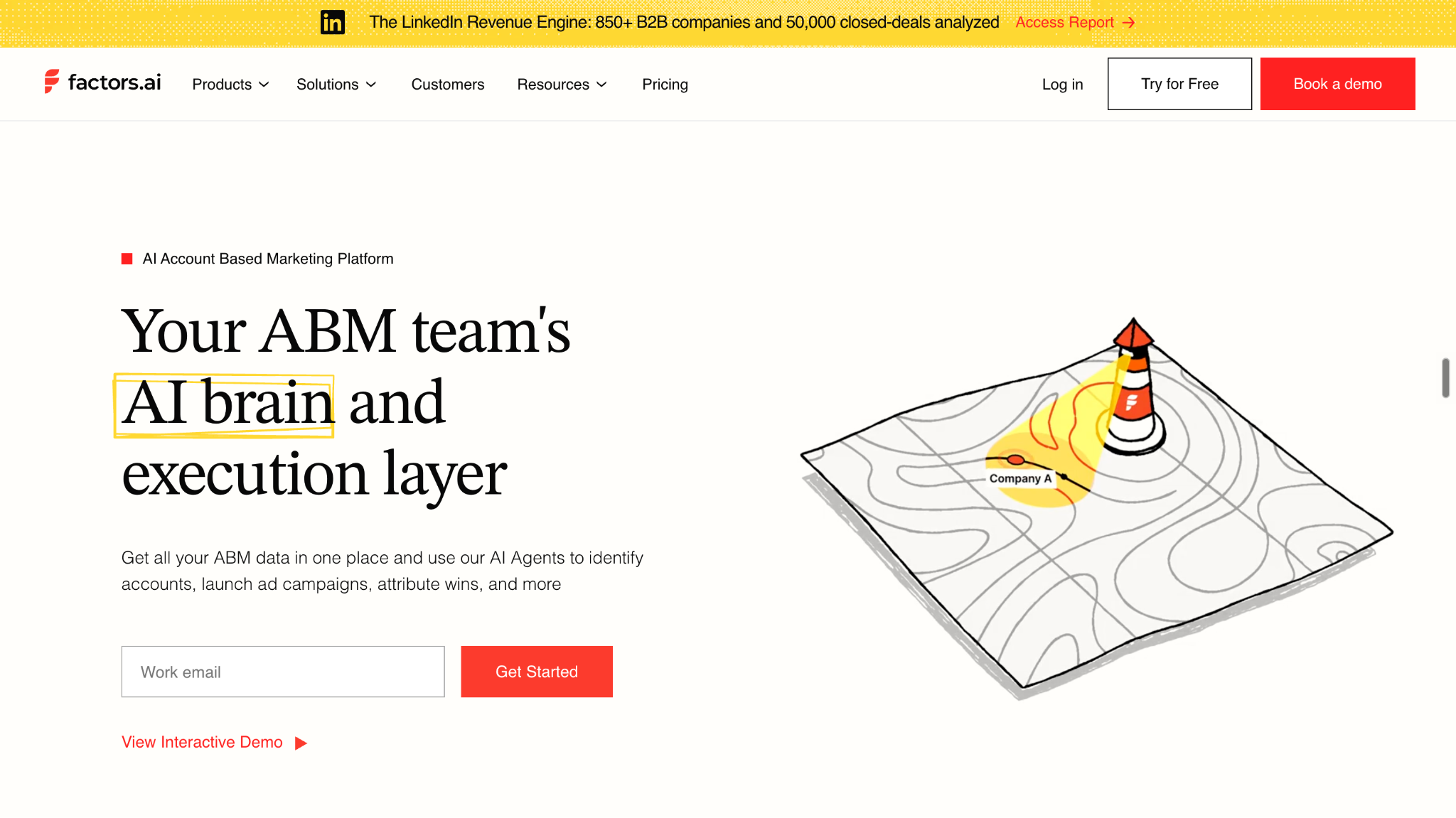
Factors.ai
Best for: Account intelligence, intent, and marketing attribution.
What it does
Factors.ai combines account identification with website behavior, account scoring, buyer journey analytics, intent signals, attribution, and sales workflows. It can identify companies visiting a website and show account activity such as page views, button clicks, repeat visits, traffic sources, and engagement.
Its higher tiers add capabilities such as custom account scoring, predictive account scoring, G2 and LinkedIn intent signals, and custom alerts and workflows.
Best cybersecurity use case
Factors.ai can be particularly useful for a cybersecurity marketing team that wants to connect:
For example, a cybersecurity company could identify target accounts visiting its website, segment them based on firmographic and behavioral criteria, score their engagement, and trigger alerts when activity reaches a meaningful threshold.
It is also useful when the marketing team wants to understand which campaigns and channels are influencing accounts and revenue, rather than looking only at visitor identification.
Where it fits
Factors.ai sits between visitor/account intelligence and marketing analytics.
It is a strong fit when the team wants to understand both:
Who is engaging?
and
How does that engagement contribute to the buyer journey and revenue?
Pricing
Factors.ai currently publishes pricing. Its Lite plan is free during the trial and then $199/month; Basic starts at $6,000/year, Growth at $20,000/year, and Enterprise at $30,000/year and up. Features and usage limits vary by plan.
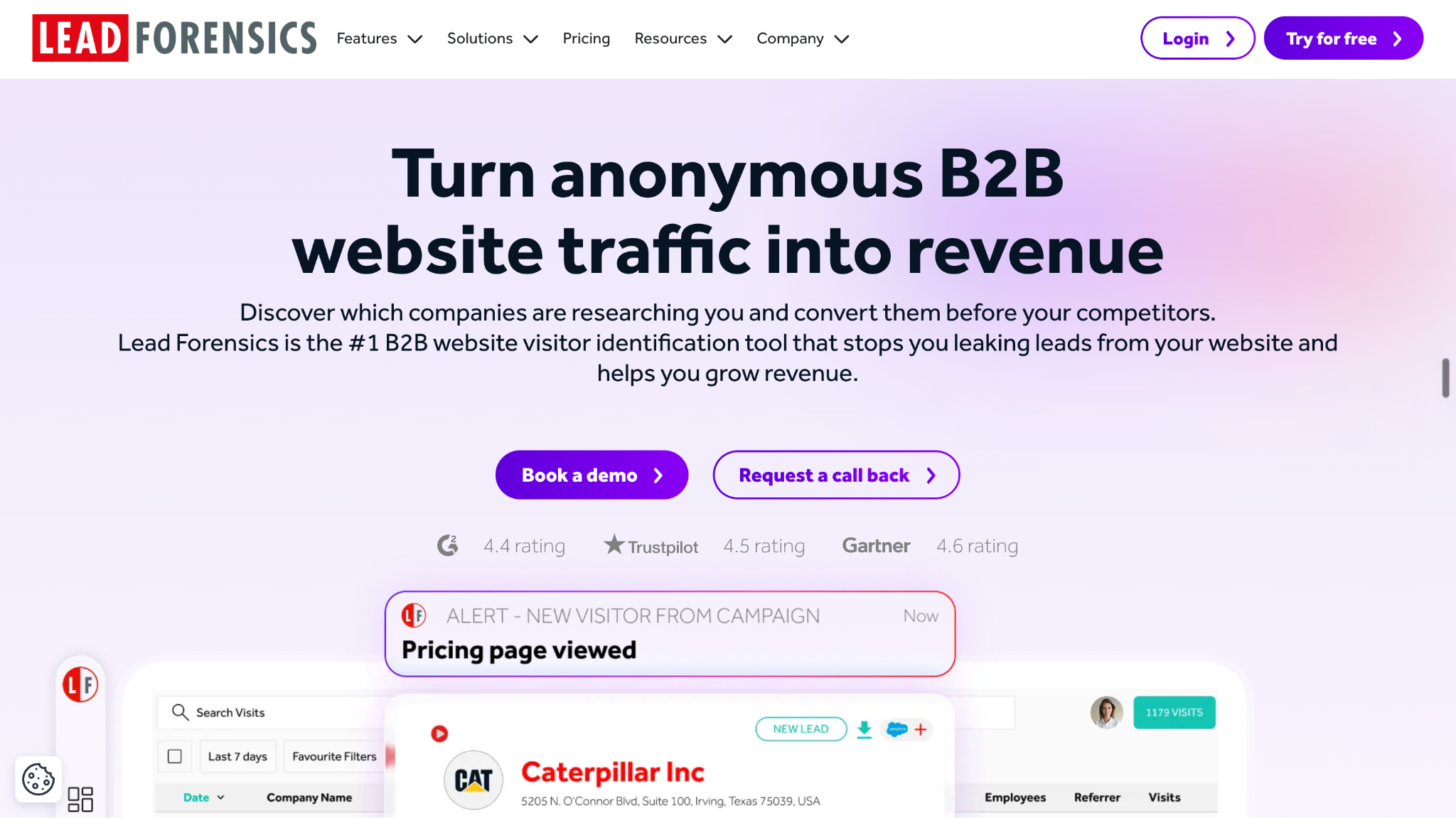
Lead Forensics
Best for: Identifying companies visiting your website.
What it does
Lead Forensics focuses heavily on B2B website visitor identification. It uses website traffic data to identify visiting businesses and provides firmographic information, behavioral insights, decision maker data, visitor alerts, CRM integration, and workflow capabilities.
Best cybersecurity use case
A cybersecurity company can use Lead Forensics to uncover companies visiting important pages without submitting a form.
For example:
Visitor: Target company visits your ransomware protection page.
Behavior: The same company later visits your integrations and pricing pages.
Sales action: The sales team investigates the account, finds relevant contacts, and begins an appropriate outreach motion.
This is particularly useful for companies that have meaningful B2B website traffic but are losing potential opportunities because anonymous visitors leave without converting.
Where it fits
Lead Forensics is a good fit when the primary problem is:
“We have B2B companies visiting our website, but we don't know who they are.”
It can also support automated lead routing and CRM workflows, but its core value proposition is website visitor identification.
Pricing
Lead Forensics does not publish fixed package prices. Pricing is based on website traffic, and the company offers a free trial to determine the appropriate package.
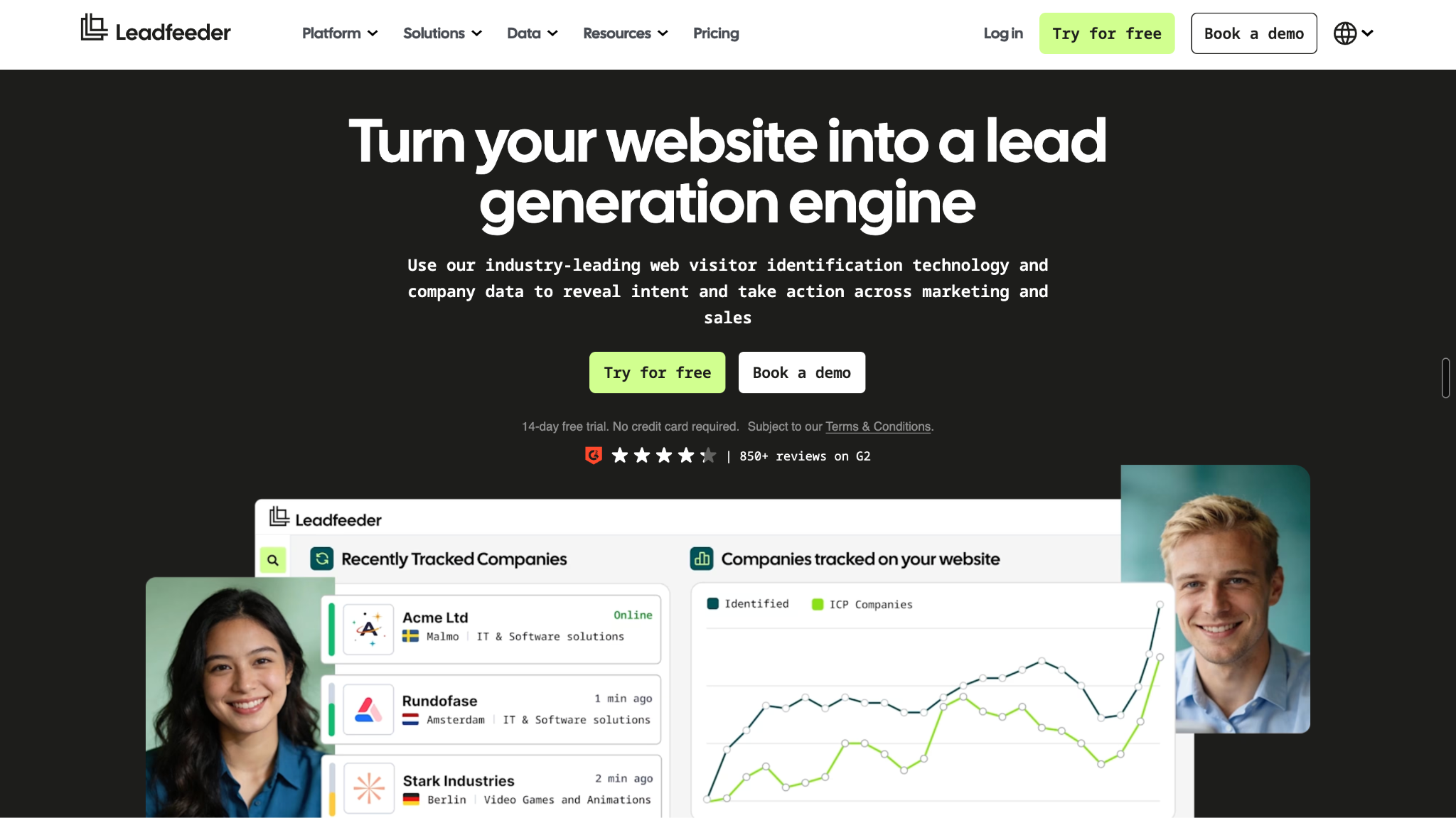
Leadfeeder
Best for: Straightforward company level visitor identification.
What it does
Leadfeeder identifies companies visiting your website and provides company details, visitor history, behavioral information, alerts, CRM integrations, and activation features. Its current product also includes intent filters, contact enrichment, workflows, and CRM automation on higher plans.
Best cybersecurity use case
Leadfeeder works well for a cybersecurity company that wants a relatively straightforward way to answer:
Which companies are visiting our website?
For example, a team could monitor visits from companies in its target industries, receive an alert when a target account arrives, inspect the pages it viewed, and push relevant accounts into its CRM for follow-up.
Where it fits
Leadfeeder is primarily a website visitor identification and activation platform.
It makes sense when a company wants to move beyond Google Analytics style traffic reports and see the businesses behind B2B website traffic without immediately adopting a broader predictive ABM platform.
Pricing
Leadfeeder currently has a free Lite tier. Paid plans start at €79/month for Discover, €369/month for Activate, and €599/month for Scale, billed annually. Enterprise pricing is custom.
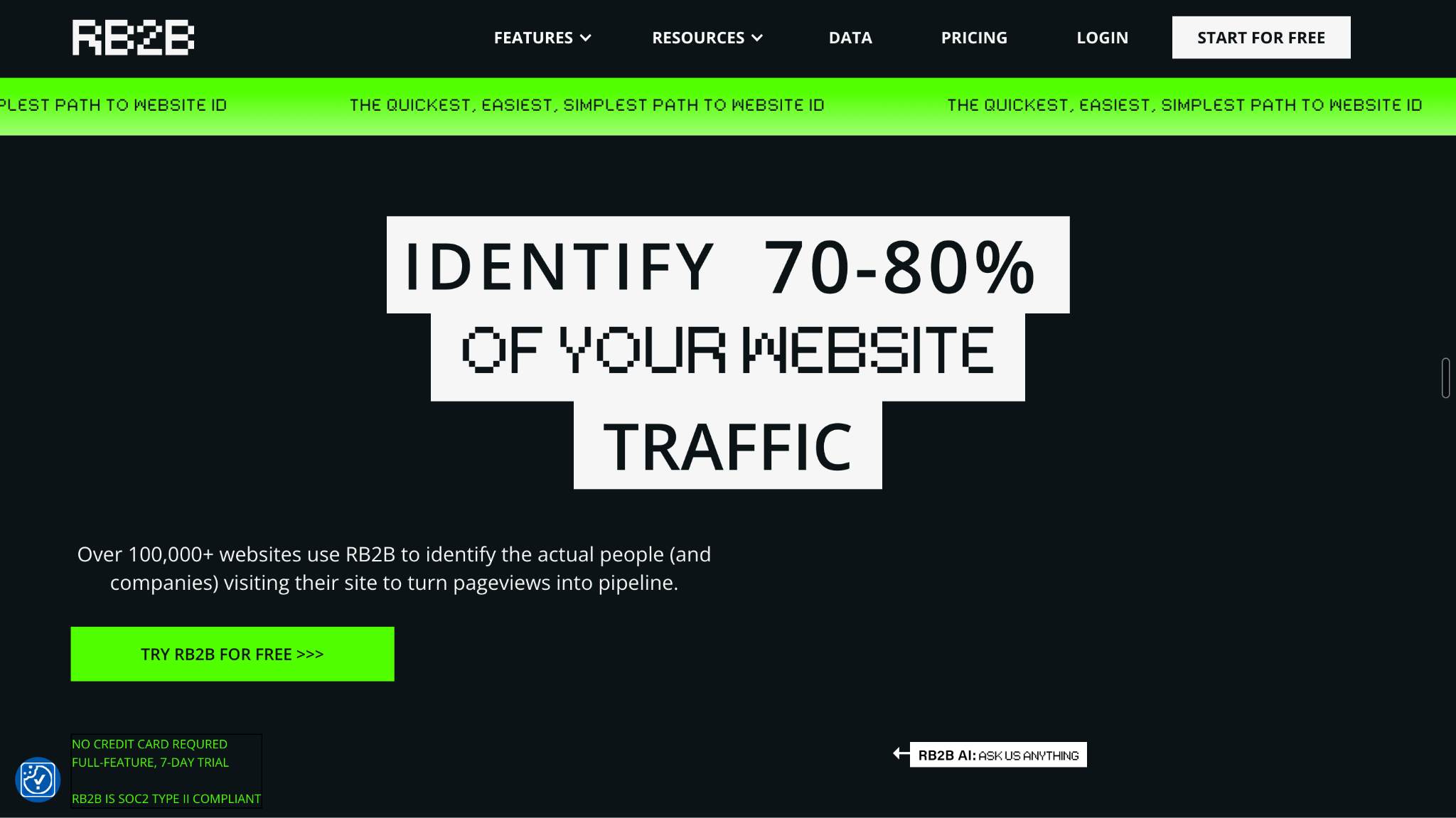
RB2B
Best for: Person level website visitor identification.
What it does
RB2B focuses on identifying individual people visiting a website, with contact level identification available for U.S. traffic and company level identification globally. Its higher plans also provide CRM and outbound integrations for activating those identified visitors.
Best cybersecurity use case
RB2B can be useful when a cybersecurity company wants to move from:
“A company visited our website.”
to:
“This specific person appears to be visiting our website.”
That can be valuable when the marketing or sales team wants to understand which individuals are engaging with high intent pages and potentially use that information to build a relevant outreach list.
For example, a cybersecurity vendor might identify someone from a target account repeatedly visiting its product and pricing pages, then use that signal alongside account and CRM data to determine whether the person is worth engaging.
Where it fits
RB2B is most relevant when person level identification is the missing piece.
It should not automatically be treated as a complete intent-to-revenue platform. Identifying the person is one step. The team still needs to determine whether the account fits its ICP, whether the activity represents meaningful intent, and what action should follow.
Pricing
RB2B currently offers Free, Starter, Pro, and Pro+ plans. Its published Pro pricing starts at $149/month for 600 credits, while Pro+ starts at $199/month for 600 credits. Higher credit tiers are available.
Cybersecurity Visitor Intent Workflows
Identifying a visitor is only the beginning. The real value comes from combining the signal with account context, qualification criteria, and the right sales action.
For cybersecurity companies, four workflows are particularly useful.
High-intent account visits pricing
Signal: A target account repeatedly visits pricing after engaging with product pages.
Identify the account and relevant contacts, enrich the company and CRM context, then check ICP fit, intent, ownership, and other qualification criteria.
If the account qualifies, trigger personalized outreach through Knock AI and route the opportunity to the appropriate account owner, territory, or sales team.
Example:
Target account → repeated pricing visits → ICP match → Knock Outreach → route to account owner → sales follow-up
The important point is that a pricing visit doesn't automatically create an SDR task. The signal is combined with context before sales is asked to act.
Security team researches documentation
Not every intent signal should trigger immediate outreach.
A security engineer researching technical documentation may simply be evaluating whether a product can solve a technical problem. The same activity becomes more meaningful when combined with product, pricing, integration, or repeat-visit signals.
Once the account meets the required ICP and intent criteria, Knock AI can route the opportunity based on factors such as CRM ownership, account information, intent, or other routing rules.
The result is a more complete picture of the buying committee rather than isolated visitor alerts.
High-intent visitor leaves without converting
A visitor can repeatedly research your product, view pricing, and still leave without submitting a form. Without visitor identification and intent workflows, that activity may simply disappear into website analytics.
If the visitor and account meet the required criteria, Knock AI can trigger the appropriate outreach workflow and route the opportunity to the existing account owner or relevant sales team.
This turns otherwise anonymous or unconverted website activity into a potential sales conversation.
The framework
Across these workflows, the process is straightforward:
The goal isn't to identify more visitors for the sake of having more data. It's to determine which visitors matter, why they matter, and what your team should do next.
This version keeps the four use cases, Knock Outreach, qualification, routing, account-level intent, website leakage, and the core framework, but removes the repetitive explanations.
Which Visitor Identification Tool Is Right for Your Cybersecurity Company?
There isn't one visitor identification or intent platform that fits every cybersecurity company. The right choice depends on where the biggest gap exists in your revenue workflow: identifying visitors, understanding intent, enriching accounts, prioritizing opportunities, or turning buyer signals into action.
If your problem is...
Look for...
“Who is visiting my website?”
Visitor identification
“Which accounts are showing buying interest?”
Intent intelligence
“Which target accounts are researching our category?”
Predictive/account intent
“I need company and contact data.”
Sales intelligence
“I know who's interested but don't know what to do next.”
Qualification + routing
“I want website signals to trigger outreach.”
Intent + outreach
“I want AI to qualify inbound buyers.”
AI qualification
“I want the entire workflow connected.”
Revenue conversion platform
Choose Knock AI when...
You need to connect identification → intent → qualification → engagement → routing → conversion.
Knock AI is a fit when your problem goes beyond identifying website visitors and you want buyer signals to trigger an actual revenue workflow. It can combine visitor and first-party intent signals with enrichment, qualification, AI engagement, outreach, routing, and CRM workflows.
For a cybersecurity company, that could mean identifying a high-intent account, checking ICP fit and ownership, triggering personalized outreach, qualifying the buyer, and routing the conversation to the right sales rep or AI agent.
Choose 6sense when...
Your primary need is predictive account intent and account prioritization.
6sense is particularly relevant for cybersecurity companies running an account-based GTM strategy that want to identify target accounts researching their category and prioritize accounts based on buying-stage and intent signals.
Choose Demandbase when...
Your GTM motion centers on enterprise ABM and account intelligence.
Demandbase is suited to teams that want to combine account data, intent, buying groups, and engagement signals to prioritize and activate target accounts across marketing and sales.
Choose ZoomInfo when...
Your biggest need is company and contact intelligence.
ZoomInfo is useful when your cybersecurity sales team needs to identify relevant companies and contacts, enrich accounts, understand buying committees, and support prospecting and sales engagement.
Choose Factors.ai when...
You want to connect visitor and account activity with attribution and revenue analytics.
Factors.ai is a useful option for teams that want to understand which accounts are engaging, how they interact with marketing campaigns, and how those activities connect to pipeline and revenue.
Choose Lead Forensics when...
Your primary problem is identifying anonymous companies visiting your website.
It is particularly relevant for cybersecurity companies that have meaningful B2B website traffic but want to know which businesses are behind that traffic and which accounts deserve follow-up.
Choose Leadfeeder when...
You want company-level website visitor identification with straightforward sales activation.
Leadfeeder fits teams that want to identify visiting companies, understand their website behavior, receive relevant alerts, and push qualified accounts into sales workflows.
Choose RB2B when...
Your priority is person-level website visitor identification.
RB2B is most relevant when knowing the individual behind a website visit is more important than simply identifying the company. Teams can then combine that information with their existing qualification and outbound processes.
The simplest way to decide
Think about the question your revenue team is trying to answer:
Who visited? → Visitor identification
Who is showing intent? → Intent intelligence
Who is likely entering a buying cycle? → Predictive/account intent
Who are the relevant people? → Sales intelligence
Should we act? → Qualification
What should we do? → Outreach and engagement
Who should handle it? → Routing
Can we connect everything? → Revenue conversion platform
For cybersecurity companies, the most important consideration is therefore not simply how accurately a platform identifies visitors, but how far it can take the signal after identification.
How to Measure Visitor Intent
Visitor identification only becomes valuable when it contributes to the pipeline. Instead of measuring how many visitors your software identifies, cybersecurity companies should measure what happens after those visitors are identified.
Identified ICP accounts
Measure how many website visitors can be connected to companies that actually fit your target customer profile.
This is more useful than total visitor volume because a smaller number of relevant accounts can be more valuable than thousands of unidentified or low-fit visitors.
High-intent accounts
Track how many identified ICP accounts demonstrate meaningful buying behavior.
You can define this using signals such as repeat visits, pricing activity, product-page engagement, security documentation, integrations, or multiple stakeholders from the same account becoming active.
Visitor-to-conversation rate
Are identified and qualified visitors actually starting conversations?
This helps determine whether your intent signals are strong enough to trigger useful engagement rather than simply generating alerts.
Visitor-to-opportunity rate
The next question is whether those conversations become actual pipeline.
Track the percentage of identified or high-intent accounts that eventually create qualified opportunities. This connects visitor intent to a measurable sales outcome.
Pipeline and revenue influenced
Ultimately, the most important metric is not how many visitors your platform identified.
It's:
Did visitor intent create revenue, or did it just create another dashboard?
Track influenced pipeline, opportunities, and revenue associated with identified and intent-qualified accounts to understand whether your visitor intelligence strategy is actually contributing to growth.
FAQs
What is visitor identification software?
Visitor identification software helps businesses determine which companies or, in some cases, individuals are behind otherwise anonymous website activity. It can provide information such as company identity, contact information, firmographics, and visitor behavior.
What is website visitor tracking software?
Website visitor tracking software records activity on your website, such as pages viewed, sessions, traffic sources, clicks, and other engagement events. Some platforms also identify the companies or people behind that activity.
What is the difference between visitor tracking and visitor identification?
Visitor tracking tells you what happened; visitor identification tells you who was involved.
For example, tracking might show that someone viewed your pricing page, while identification could connect that activity to a specific company or contact.
What is buyer intent data?
Buyer intent data consists of behavioral or research signals that indicate a company or person may be actively evaluating a product, service, or category. For a cybersecurity company, examples can include repeat visits, pricing-page activity, product research, security documentation engagement, and activity from multiple stakeholders.
How can cybersecurity companies identify anonymous website visitors?
They can use visitor identification platforms that match website activity with available company or contact information. Depending on the platform and data available, identification may happen at the company level, account level, or person level.
What are the strongest website visitor intent signals?
There isn't one universal signal. Stronger intent typically comes from a combination of behaviors, such as repeat visits, pricing or product-page activity, high-value content engagement, security or integration research, and multiple relevant people from the same account becoming active.
How can visitor intent trigger sales outreach?
A company can define intent and qualification criteria, then use those signals to trigger an action when the criteria are met. For example:
Platforms such as Knock AI can connect first-party intent signals with qualification, outreach, AI engagement, and routing workflows.
How much does visitor identification software cost?
Pricing varies significantly depending on the platform, traffic volume, data access, users, intent capabilities, and workflow features. Some visitor identification tools offer relatively low-cost plans, while enterprise intent and ABM platforms typically use customized pricing.
For that reason, companies should compare the cost of the platform against the pipeline it helps identify, activate, and influence, rather than comparing subscription prices alone.


.svg)


.svg)
.svg)
.svg)


.svg)
.svg)


.svg)