star iconstar iconstar icon
icon starDecorative blue sparkle icon
Get Started

Fintech Lead Generation: Why Good Pipeline Stalls and What Actually Works

Key takeaways

What is fintech lead generation?

Fintech lead generation is the process of attracting, qualifying and converting business buyers for a financial technology product into sales conversations and pipeline. It is a regulated-market application of B2B lead generation, and the regulation shapes both what you can publish and who can actually buy.

One clarification worth making early, because the term is used in two opposite directions. This guide is about how a B2B fintech company generates its own leads. It is not about selling into fintech companies, which is a different job with a different buyer.

A fintech lead is an identified person or account at a business that could plausibly buy your product. The word "plausibly" is carrying more weight in fintech than it does anywhere else, and most of this article is about why.

Why fintech lead generation is different from standard B2B

Standard B2B lead generation rests on two assumptions that do not hold here.

The first is that you can say what you want about your product. In fintech, marketing claims about financial products, performance, pricing and outcomes are regulated. Assets go through compliance review before publication.

The second is that a prospect who fits your ICP and has budget can buy. In fintech, they frequently cannot, for reasons that are invisible from the outside and that nobody mentions on the first call.

Those two constraints are the whole difficulty. Everything else about fintech lead generation is ordinary B2B work.

Which kind of B2B fintech are you?

Before any tactic makes sense, be specific about who you sell to. These four are different lead generation problems and the advice does not transfer between them.

You sell to Typical buyer Cycle What dominates lead generation
Banks, credit unions, regulated financial institutions Head of Payments, Head of Digital, CIO, Chief Risk Officer 9 to 18 months Vendor risk management, references from named peer institutions, procurement
Other fintechs CTO, Head of Product, Head of Engineering 1 to 4 months Documentation, API quality, sandbox, developer word of mouth
Finance teams at non-financial companies CFO, Controller, VP Finance 2 to 6 months ROI framing, integration with ERP and accounting stack, security review
SMBs Owner, bookkeeper, office manager Days to weeks Self-serve, pricing transparency, volume acquisition

If you sell into banks, the binding constraint is their vendor risk process and nothing you do in marketing shortens it materially. If you sell to other fintechs, your documentation is your funnel. If you sell to CFOs, you are closer to standard B2B SaaS than the rest of this article assumes, and the compliance gate on your own marketing is lighter.

Most fintech lead generation advice is written as if all four are one market. They are not, and mixing the playbooks is the most common reason a fintech marketing program underperforms.

Why fintech lead generation stalls: the two gates

Here is the pattern almost every B2B fintech marketing team eventually hits. Traffic is fine. Content gets published, slowly. Leads arrive and look reasonable on paper. Then pipeline creeps, cycles stretch, and cost per acquisition climbs without a clear cause. It looks like funnel leakage and it is not.

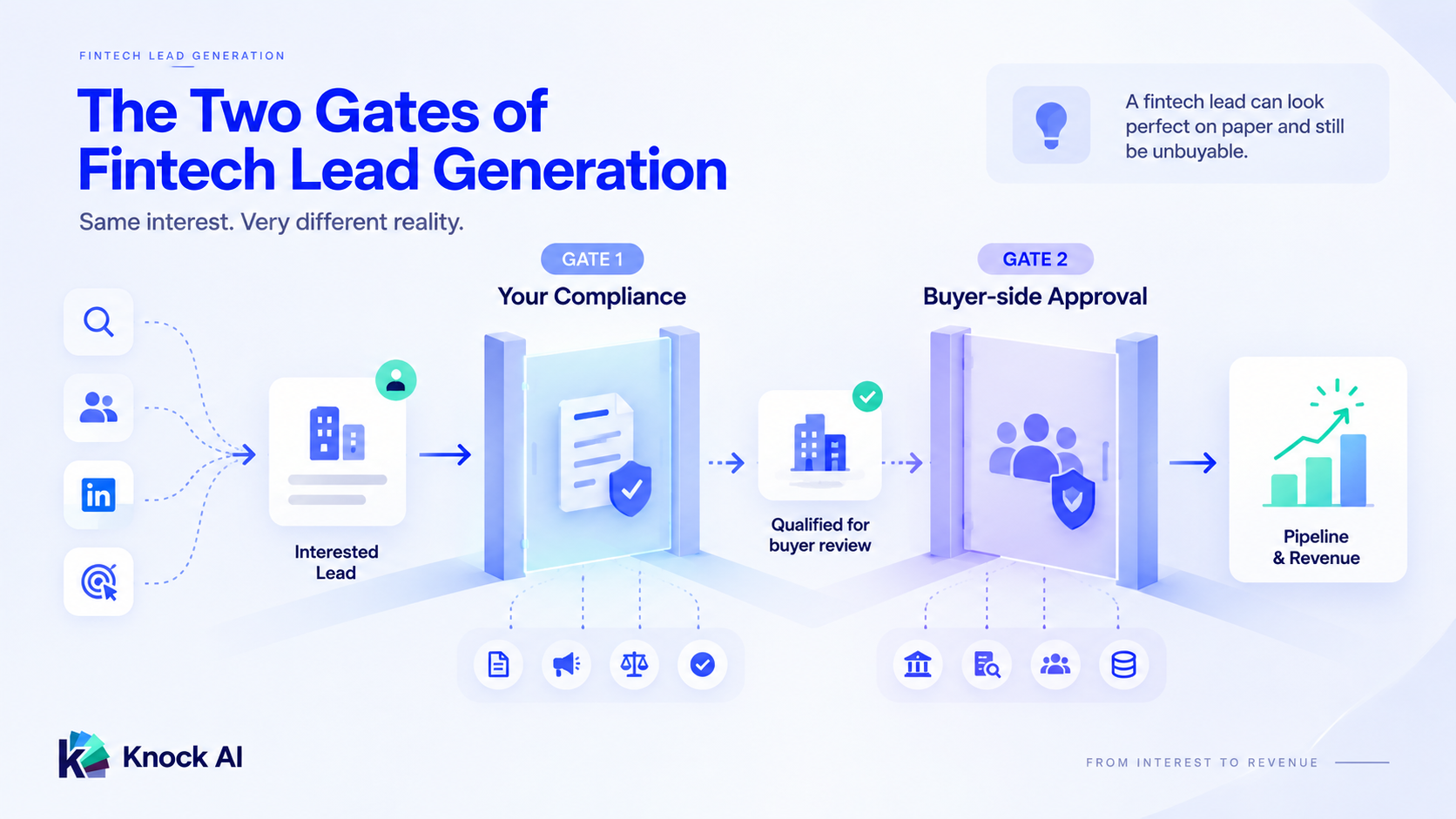
That happens because fintech lead generation passes through two gates that a standard funnel does not model.
Why fintech lead generation stalls: the two gates

Gate one is on your side. Everything you publish that makes a financial claim goes through compliance review. That caps how fast you can publish, how specific you can be, and how much you can say about outcomes. Competitors in unregulated categories publish three times as often with claims you are not allowed to make.

Gate two is on their side. Your prospect's risk, compliance and procurement functions decide whether they can buy you, and that decision is often already made before you ever speak to them. Vendor freezes, sponsor bank approvals, regulatory examinations and licensing boundaries disqualify accounts silently.

The two gates compound. Gate one slows how quickly you can build demand. Gate two destroys a portion of the demand you build. Most fintech teams work hard on the first and never diagnose the second.

The rest of this article is the two gates, then what to do about each.

Gate one: what your fintech marketing is allowed to say

Marketing claims in financial services are regulated, and enforcement has increased. The specifics depend on where your customers are, so treat these as separate frameworks rather than one blended set of rules.

United States

The CFPB applies its Unfair, Deceptive, or Abusive Acts or Practices standard to marketing claims for consumer financial products. It covers not only what an ad says but whether the product experience matches the marketing promise. A landing page displaying a favorable rate prominently with fees in fine print is a UDAAP exposure, not just a conversion choice. For B2B fintech, CFPB jurisdiction is narrower, but marketing to small business owners using consumer-style claims can still attract scrutiny.

The SEC Marketing Rule (Advisers Act Rule 206(4)-1) became fully effective in November 2022 and has driven multiple examination sweeps covering testimonials, endorsements, performance claims and hypothetical performance. If any part of your product touches investment advice, this applies.

FINRA Rule 2210 governs communications with the public for broker-dealers, including pre-use principal approval for certain categories.

United Kingdom

The FCA financial promotions regime is the strictest of the three and its enforcement volume has risen sharply. Promotions amended or withdrawn following FCA intervention went from 573 in 2021 to 8,582 in 2022, 10,008 in 2023, and 19,766 in 2024.

That last number gets quoted frequently as evidence that the regulator has turned against financial marketing generally. The composition says something narrower. Claims management companies account for 9,197 of the 2024 total, roughly 46%, largely over housing disrepair and motor finance claims. Other concentrations are similarly specific: 1,633 promotions across 21 firms in the March 2024 social media review, and 856 across four buy-now-pay-later firms. It is several sectors with particular problems rather than a blanket verdict on fintech product marketing.

One change is worth checking against your own setup. Since 7 February 2024, an authorised firm cannot approve financial promotions for unauthorised persons without specific permission, obtained through a Variation of Permission application. Firms that wanted to continue approving had to apply by 6 February 2024. If your distribution model relies on a partner approving your promotions, that arrangement may no longer be permitted.

The FCA has also acted on social media promotions, identifying 1,267 illegal financial adverts reaching at least 2.3 million UK accounts, with 66% coming from firms or individuals already on its Warning List. Distribution, reuse and third-party edits now form part of the compliance risk, not only the original wording.

European Union

MiFID II governs marketing communications for investment services, with fair, clear and not misleading requirements plus specific rules on past performance. GDPR governs the data side of lead generation, including consent for outreach, which affects list building and cold email more than it affects content.

What this actually costs you

The practical consequence is that every asset making a financial claim, citing a customer result or carrying a testimonial needs a compliance review step built into production. Teams that treat this as an afterthought publish slowly and inconsistently. Teams that build the review into the workflow publish at close to normal speed.

Which raises the obvious next question.

How to publish fintech content faster without breaking compliance
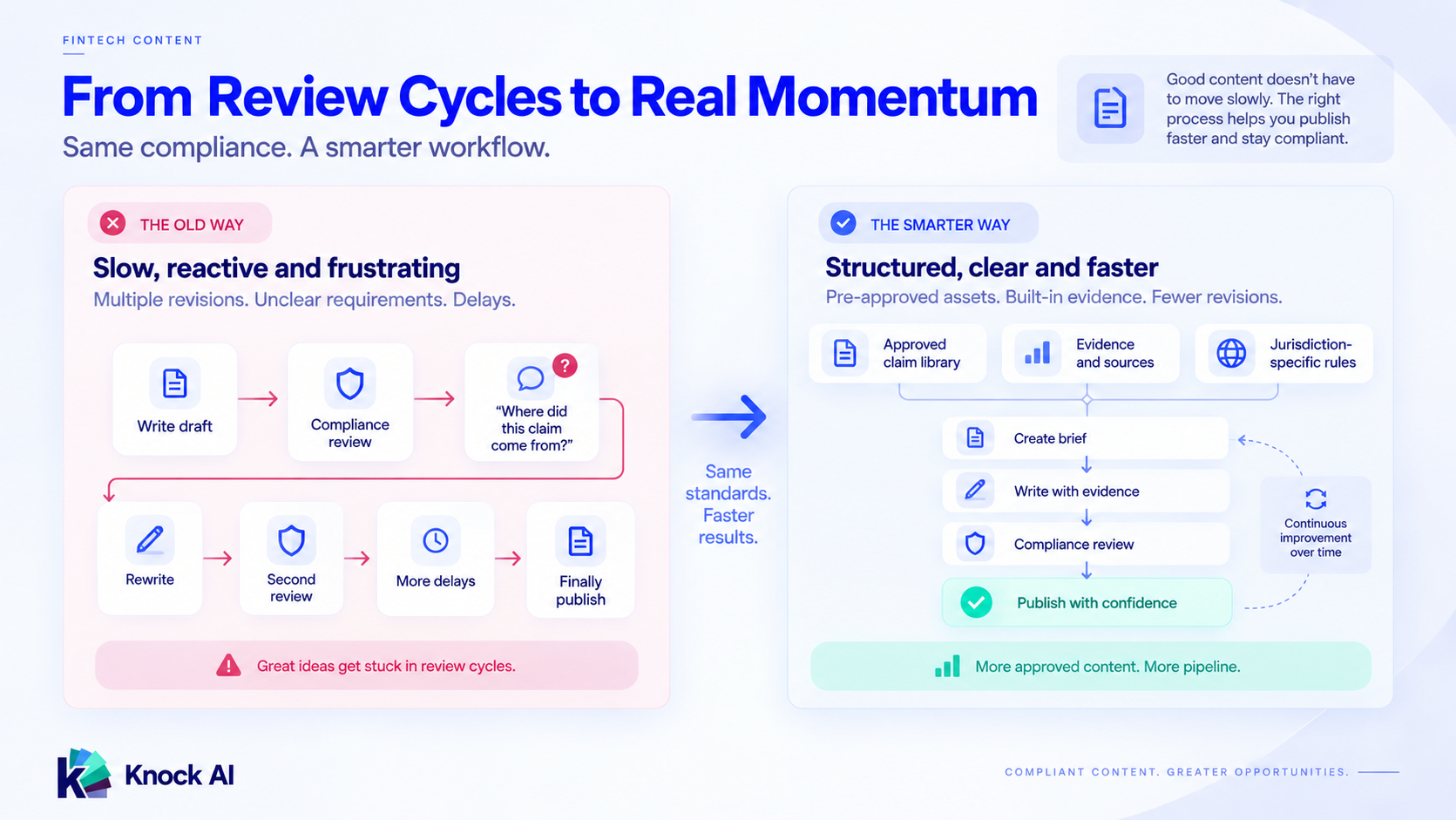
How to publish fintech content faster without breaking compliance

The bottleneck in fintech lead generation is rarely writing. It is the review queue. These reduce it.

Build a pre-approved claim library. Get compliance to approve a set of standard claims, statistics, disclosures and product descriptions once, in writing. Any asset assembled from approved components skips most of the review. New claims get reviewed individually. This single change usually does more for publishing velocity than hiring another writer.

Attach evidence at draft, not at review. Most review cycles stall because compliance asks where a number came from. Include the source, date and methodology inline in the draft. Reviews that arrive with substantiation attached clear in one pass instead of three.

Write jurisdiction-tagged variants. If you market in the US and UK, a single asset satisfying both is usually worse in both. Write the claim once, then produce variants with the right disclosures for each regime.

Separate regulated from unregulated content. An explainer about ACH return codes, a guide to reconciliation workflows, or a comparison of integration approaches carries no financial promotion risk. That content can move at normal speed and it is often what a technical buyer actually wants. Reserve the slow review path for assets that make claims about money.

Get compliance in at the brief, not the draft. A ten-minute conversation before writing prevents the rewrite that costs two weeks.

Keep an approval record. Who approved what, when, which version, where it was published. It is required in several regimes and it makes the next review faster.

None of this removes gate one. It converts it from a blocker into a process with a known cost.

Gate two: the fintech lead disqualifiers you cannot see

This is the part that costs more money and gets diagnosed less often.

A fintech lead can match every firmographic criterion you have, express genuine interest, have budget and a named project, and still be impossible to close. Not because they did not like you. Because something inside their organization made buying you unavailable before the conversation started.

The common ones:

Disqualifier What it means How it usually surfaces
Vendor freeze No new vendors this quarter or this year, often after a cost review or an acquisition Late, usually at procurement
Sponsor bank approval A fintech built on a sponsor bank needs that bank to approve new vendors touching regulated flows Very late, sometimes after a signed agreement
Regulatory examination cycle The institution is mid-exam or preparing for one, and nothing new gets approved until it closes Rarely volunteered
Licensing and geography You are not licensed, registered or permitted in a market they operate in Mid-cycle, often via legal
Risk committee calendar Approvals happen monthly or quarterly, and missing a cycle adds a quarter After verbal agreement
Existing contract lock-in Multi-year agreement with an incumbent, often with punitive exit terms Mid-cycle
Data residency and hosting Your architecture cannot satisfy where their data must live Technical review
Concentration risk policy They will not add a vendor that increases dependency on a cloud region or a single provider Enterprise only, very late

Every one of these is knowable early and almost nobody asks. This is a lead qualification failure rather than a lead volume failure.

The cost is not just the lost deal. It is the SDR hours, the solution engineering, the security questionnaire, the legal review, and the forecast that was wrong. A fintech pipeline full of accounts that cannot buy looks identical to a healthy one until the quarter closes.

See Knock AI in Action — Book Your Live Demo Today

Qualifying for gate two on the first call

Add these to discovery. They take four minutes and they are the highest-leverage change available to most B2B fintech teams.

Asking these early feels like disqualifying your own pipeline. That is exactly what it is, and it is worth doing. A smaller pipeline that closes beats a larger one that does not.

The flip side: compliance as a buying trigger

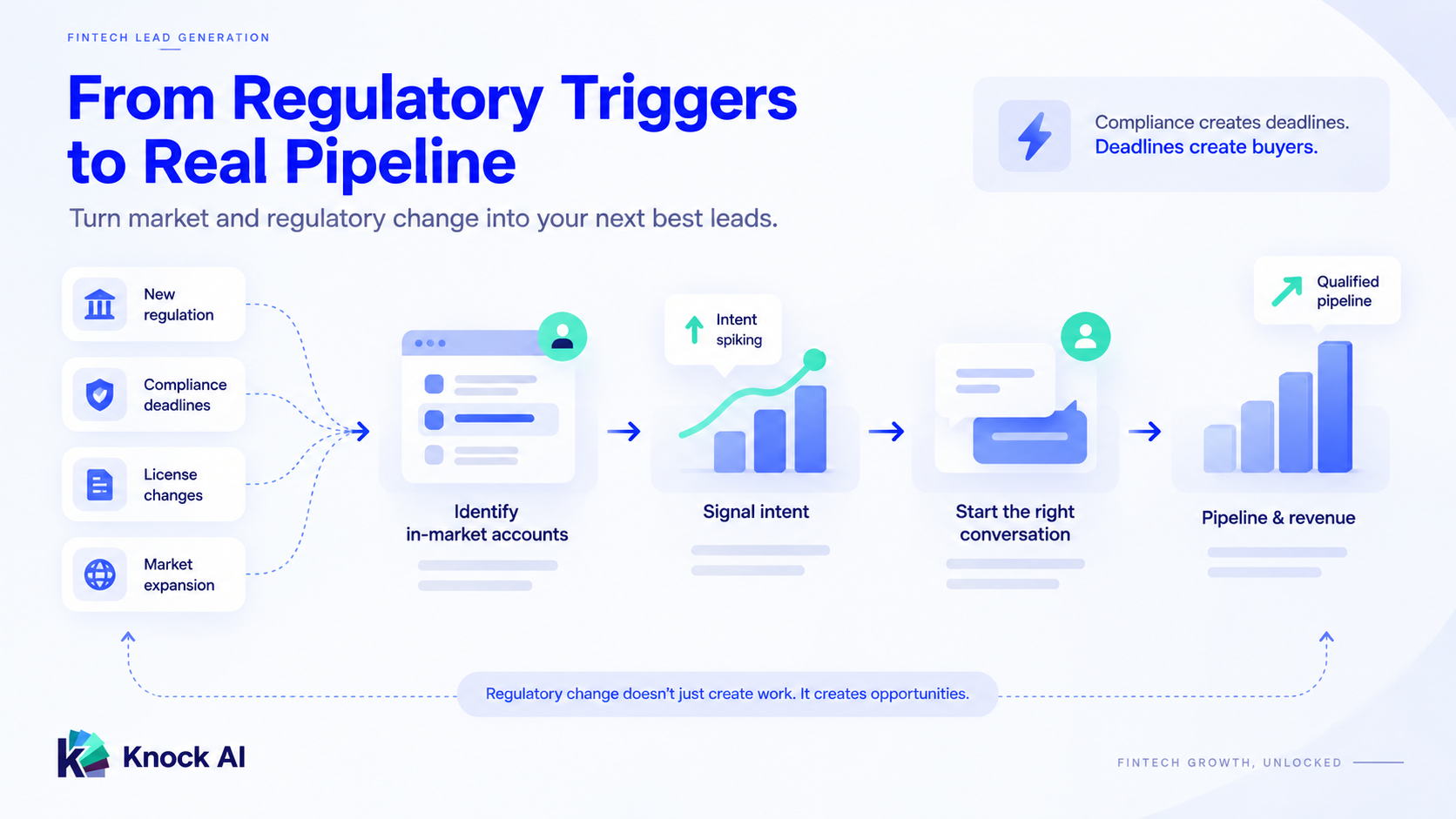
Gate two is not only a brake. A dated regulatory obligation is the most reliable buying signal in fintech lead generation, because the budget exists and the deadline is published.

DORA has applied to EU financial entities since January 2025, with Register of Information submissions running annually. PCI DSS 4.0 future-dated requirements are now in force. Open banking and instant payment mandates create implementation deadlines in multiple markets. SOC 2 renewal cycles are frequently triggered by a customer's security review rather than the vendor's own calendar.

Mapping your product to a named obligation your prospect is already subject to turns an abstract value proposition into a line item they have to fund. That is a different conversation from the one most fintech vendors are having.

Fintech lead generation strategies that work

These fintech lead generation strategies are ordered by impact for a B2B fintech company, and each accounts for one or both gates.

1. Publish the unregulated content at full speed

Technical explainers, integration guides, operational how-tos, reconciliation and payment-rail content. None of it makes a financial promotion and all of it is what your technical buyer searches for. This is where fintech companies can compete on publishing velocity despite gate one.

2. Make documentation the conversion asset

If you sell to other fintechs or to engineering teams, your API documentation is the real landing page. Ungated, complete, with error handling, sandbox credentials and honest rate limits. Practitioners evaluate there and leave silently if it is thin, which is the pattern behind winning technical buyers who already know what they want.

3. Build a named-peer reference program deliberately

In regulated markets, a reference from a comparable institution is worth more than any content asset. Banks ask who else like them uses you. Build that list on purpose, with permission to name, segmented by institution type and size.

4. Map your product to named compliance obligations

Not "we help with compliance." A specific control, in a specific framework, with a specific date. That is what gets funded.

5. Run founder-led distribution where the regulation allows

Named individuals talking about the category outperform brand accounts in fintech, partly because trust is personal and partly because it is faster through review. Tilled, a payment facilitator-as-a-service company, is the most-cited example: founder-led LinkedIn activity reportedly drove up to 75% of qualified inbound leads, with a marketing team roughly twice the size of the sales team. That figure comes from a content agency case study rather than independent research, so treat it as an illustrative account rather than a benchmark.

6. Use partner and ecosystem channels

Core banking providers, processors, ERP marketplaces, cloud marketplaces and implementation partners. A referral arriving through an existing approved vendor skips a meaningful part of gate two, because someone already cleared vendor risk.

7. Qualify for gate two before sales invests

Covered above. It belongs in the strategy list because it is a lead generation decision, not a sales one. What you qualify out determines what your funnel means.

8. Treat security and compliance documentation as marketing collateral

A trust center, a public SOC 2 summary, a data residency map, a subprocessor list. Prospects in this market look for these before they book a call, and their absence ends evaluations quietly.

9. Shorten the path from interest to conversation

A buyer working through vendor selection under a deadline will not wait through a form, an SDR sequence and scheduling back and forth. Response time matters more when a procurement calendar is running. That is the case for removing the form at high-intent moments.

Fintech lead generation channels compared

Channel Best for Gate one friction Time to first fintech leads
Technical and operational content Fintech and engineering buyers Low 4 to 9 months
Documentation and sandbox API and infrastructure products None Immediate once built
Industry conferences and associations Bank and FI buyers Low Days after the event
Partner and marketplace channels Any regulated buyer Low 1 to 2 quarters
Founder-led social Category education, brand Medium 2 to 6 months
Analyst and advisory relations Enterprise FI credibility Low 2 to 4 quarters
Paid search on high-intent terms Active evaluation Medium Days
Outbound and ABM to named accounts Bank and FI coverage Medium, GDPR and consent in EU and UK Weeks
Webinars and virtual events CFO and finance buyers Medium Weeks
Content syndication Volume High, third-party claims carry your risk Weeks

Who actually decides in B2B fintech lead generation

Fintech lead generation programs frequently target one role and get blocked by another.

Who actually decides in B2B fintech lead generation

The buying committee at a bank routinely includes all six. The practical implication for lead generation is that a single strong champion is not enough, and content that only speaks to the economic buyer leaves five people unaddressed.

How to measure fintech lead generation

How to measure fintech lead generation

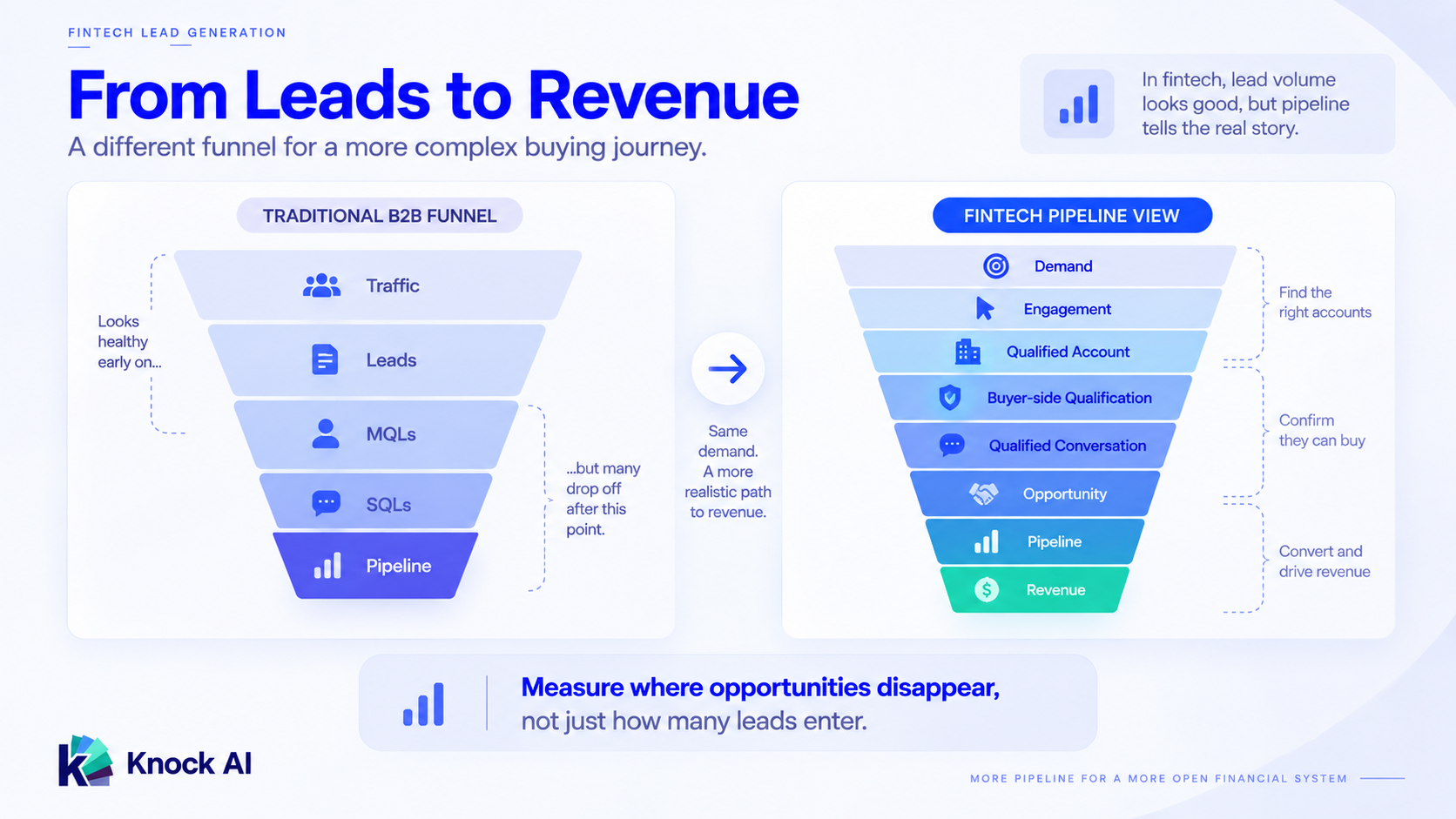
Standard funnel metrics mislead in this market, for reasons that follow directly from the two gates.

Metric Why it misleads in fintech Watch instead
MQL volume Includes accounts that cannot buy Qualified accounts that have cleared gate two screening
Cost per lead Ignores the disqualification rate Cost per gate-two-qualified opportunity
Pipeline value Inflated by accounts stuck behind a freeze or exam Pipeline weighted by approval-path status
Sales cycle average Blends a 3-month fintech deal with an 18-month bank deal Cycle length by buyer segment
Content volume Penalizes teams operating under review Assets published per approved claim, and review turnaround time
Last-touch attribution Misses the partner or peer reference that unlocked the account First identifiable source plus whether a named reference was involved

The single most useful number most B2B fintech teams do not track: what share of closed-lost deals died at gate two, and at what stage. If that number is high and late, your qualification is the problem, not your lead volume.

Raw MQL counts and blended sales cycle averages hide more than they show here. The relevant comparison is inbound lead generation benchmarks for your segment, not the market average.

Fintech lead generation tools: where they help and where they do not

No tool solves gate one. Compliance review is a process problem and the fixes are workflow fixes.

Tooling helps on gate two, in one specific way: identifying earlier who is engaging and getting to a real conversation sooner, so that qualification happens before sales invests. That is the case for buyer intent signals and for turning those signals into pipeline.

Knock AI works on that narrow piece: identifying engaged accounts, scoring what they do, and letting a buyer start a conversation at the moment they want one rather than filling in a form and waiting. It does nothing about what you are allowed to publish, and it will not tell you a prospect's risk committee meets quarterly. Those remain human questions asked early.

If your problem is that fintech buyers in your category have never heard of you, no conversion layer helps. That budget belongs in content, partnerships and category presence first.

Fintech lead generation FAQs

What is fintech lead generation?

Fintech lead generation is the process of attracting, qualifying and converting business buyers for a financial technology product into sales conversations and pipeline. It differs from standard B2B lead generation because marketing claims are regulated and because prospects are frequently blocked from buying by internal risk, compliance or procurement constraints.

Why is fintech lead generation so difficult?

Two gates. Your own compliance function limits what you can publish and how fast, and your prospect's risk function determines whether they can buy you at all. Both are invisible in a standard funnel, which is why fintech pipeline often looks healthy and converts poorly.

What are the best fintech lead generation strategies?

Publishing unregulated technical content at full speed, making documentation the conversion asset, building a named-peer reference program, mapping your product to dated compliance obligations, founder-led distribution, partner and marketplace channels, and qualifying for buyer-side blockers before sales invests. The right mix depends on whether you sell to banks, to other fintechs, to CFOs or to SMBs.

How do you generate B2B fintech leads from a website?

Ungate the documentation, publish pricing or at least pricing structure, put your security and compliance artifacts where a buyer can find them without asking, and shorten the path between wanting a conversation and having one. Our website conversion guide covers the mechanics. Most fintech sites make a qualified buyer work too hard at the exact moment they are ready.

Why do our fintech leads not convert?

Usually gate two. A high share of B2B fintech accounts cannot buy for reasons unrelated to interest: vendor freezes, sponsor bank approvals, examination cycles, licensing gaps, existing contracts. Check what share of closed-lost died at those reasons and at what stage. If it is high and late, qualification is the problem rather than lead volume.

How long is the fintech sales cycle?

It depends entirely on who you sell to. Selling to other fintechs commonly runs one to four months. Selling to CFOs at non-financial companies, two to six. Selling to banks and regulated financial institutions, nine to eighteen months, because vendor risk management and committee calendars set the pace rather than the buyer's enthusiasm.

What compliance rules affect fintech marketing?

In the US, CFPB UDAAP standards, the SEC Marketing Rule for anything touching investment advice, and FINRA Rule 2210 for broker-dealers. In the UK, the FCA financial promotions regime, including the February 2024 change to who may approve promotions for unauthorised persons. In the EU, MiFID II for investment services and GDPR for the data side of outreach. These differ meaningfully, so a single blended approach usually satisfies none of them well.

How do you market a fintech product without making claims you cannot support?

Build a pre-approved claim library, attach evidence at draft rather than at review, and separate regulated from unregulated content so operational and technical material moves at normal speed. Most of what a technical fintech buyer wants to read makes no financial promotion at all.

Does content marketing work for fintech lead generation?

Yes, with a qualification. Content that explains how something works, integrates or fails carries no promotion risk and is what technical buyers search for. Content that makes claims about returns, savings or performance carries real risk and needs review. Teams that separate the two publish far more than teams that treat all content as regulated.

How do you sell fintech to banks?

Expect a nine to eighteen month cycle, a buying committee of six or more, a vendor risk questionnaire, and a requirement for references from comparable institutions. Lead generation into banks is largely about being credible enough to enter the process, which means peer references, conference and association presence, analyst visibility and partner introductions rather than volume outbound.

Is outbound effective for fintech lead generation?

It works on a small, researched list where the reason for contact is specific, and it works better when it follows a partner introduction. It fails at volume, and in the EU and UK consent requirements under GDPR constrain list building in ways that catch teams out.

Should fintech companies publish pricing?

Publishing at least the pricing structure is a strong trust signal in a market where buyers expect opacity, and it filters accounts that could never fund the line item. Full published pricing is harder when pricing is volume or risk-based, but a range, a model explanation or a calculator does most of the work.

What metrics should we track for fintech lead generation?

Accounts that have cleared buyer-side qualification, cost per qualified opportunity rather than cost per lead, cycle length split by buyer segment, review turnaround time on content, and the share of closed-lost that died at a compliance or procurement blocker. Raw MQL counts and blended sales cycle averages hide more than they show here.

Do fintech lead generation agencies work?

They can, when your ICP is small and nameable and you need coverage faster than you can hire. They fail when they run volume outbound into regulated buyers, because that produces meetings with accounts that cannot buy and consumes the qualification time you should have spent upfront. Ask any agency how they screen for buyer-side blockers before booking a meeting.