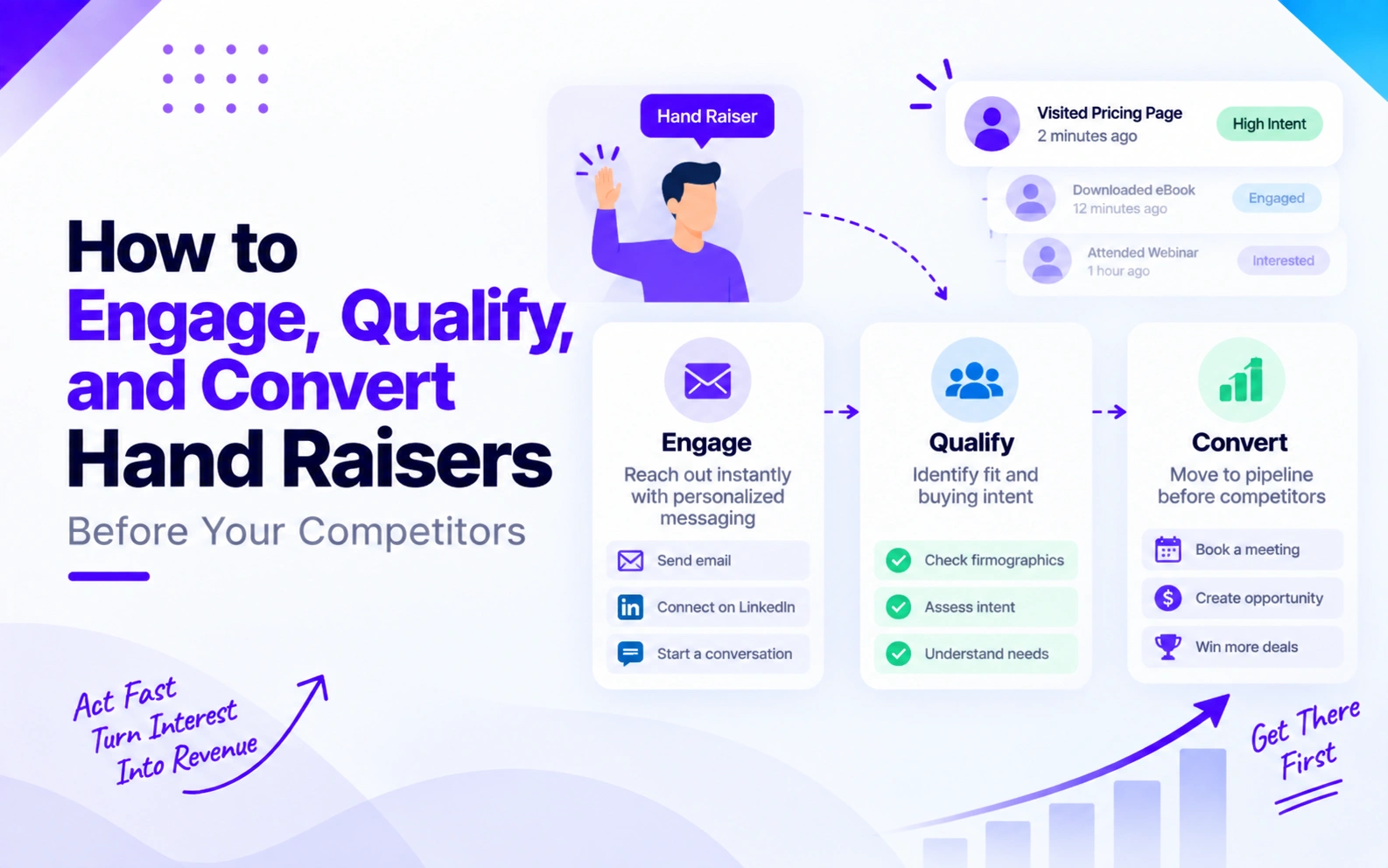
How to Engage, Qualify, and Convert Hand Raisers Before Your Competitors
A hand raise is a buying signal, not just a lead
Someone requests a demo. They ask for pricing. They start a conversation with Sales. They reply to an email saying they want to talk.
That's a hand raise.
And unlike a cold prospect or a passive content lead, the buyer has already given you a reason to engage.
The problem is what happens next.
For many revenue teams, the process still looks like this:
Hand raise → CRM record → Lead score → SDR queue → Follow-up
By the time someone actually looks at the lead, the CRM may tell them the buyer's name, company, title, and source. But it may not tell them why the buyer reached out, what they were looking for, what they've already done, or what they want to do next.
That's a problem because B2B buyers increasingly want to research on their own, but they still turn to sellers when they need contextual help. Gartner's 2025 research found that 61% of B2B buyers preferred an overall rep-free buying experience, while buyers still preferred seller involvement for tasks requiring contextual intelligence, such as determining whether a solution fits their needs.
And the buying journey is getting more fragmented. Gartner's 2026 research found that B2B buyers used an average of seven information sources during a recent purchase, with 45% saying they used GenAI during the process.
So the opportunity isn't simply to respond faster.
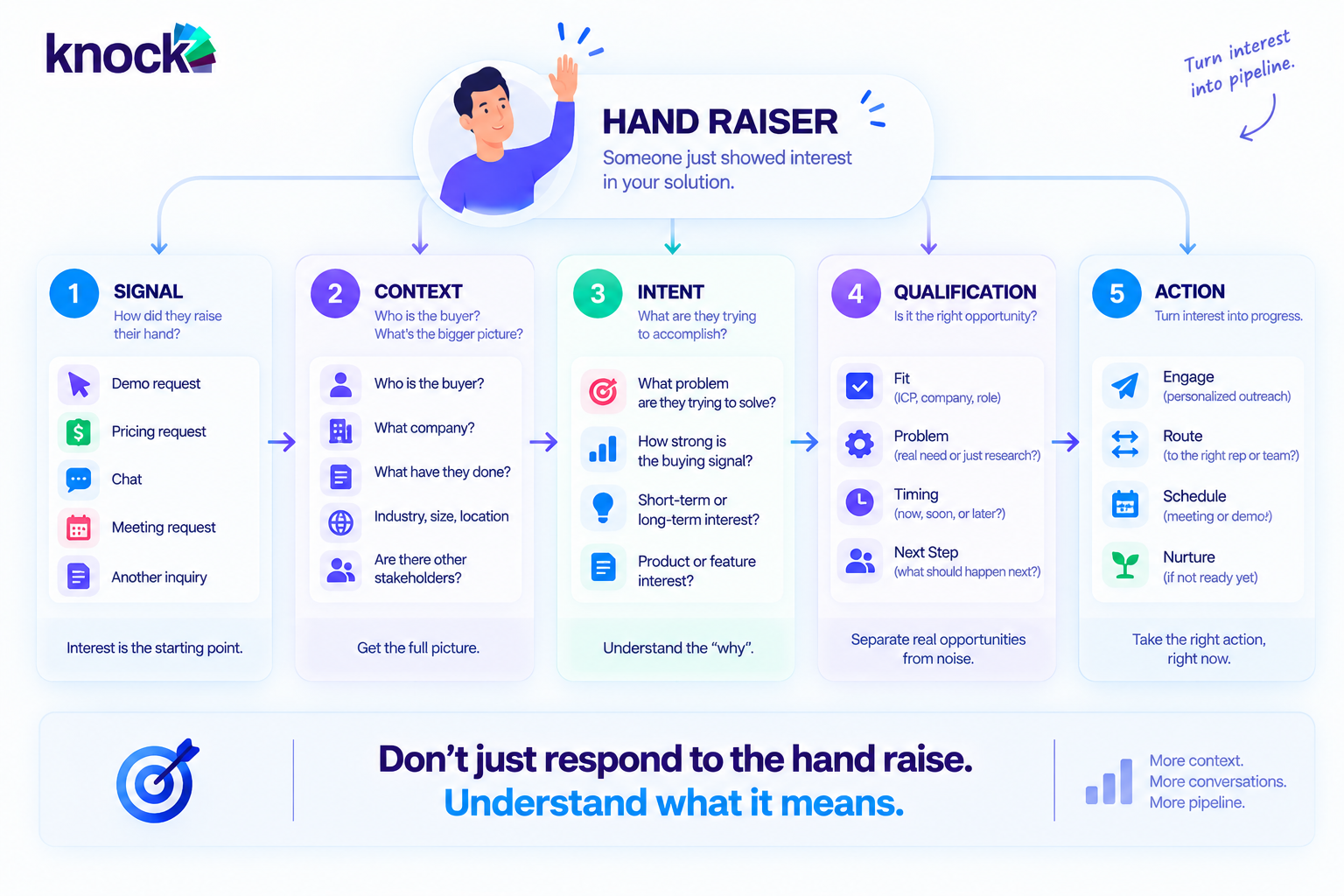
First, identify who raised their hand. Then understand the context around the interaction. Determine what they actually intend to do. Qualify the signal without creating unnecessary friction. Then take the right action: engage, route, schedule, nurture, or continue the conversation.
The advantage isn't simply responding faster. It's understanding the buyer faster and giving them a more relevant next step.
That's the framework we'll use throughout this guide:
Signal → Context → Intent → Qualification → Action
The goal isn't to treat every hand raiser as a sales opportunity. It's to make sure that when a buyer signals interest, your team can understand that signal and act on it before the moment disappears.
What Is a Hand Raiser in B2B Sales?
A hand raiser in B2B sales is a prospect who explicitly or behaviorally signals that they are interested in engaging with your company or evaluating your solution. They have done more than simply visit your website or consume content. They have taken an action that gives your team a reason to engage.
Common hand-raiser signals include:
Requesting a demo
Asking for pricing
Clicking “Contact Sales” or “Talk to Sales”
Requesting a meeting
Asking a product or implementation question
Starting a high-intent chat
Replying positively to an outbound message
Engaging with a sales conversation during a webinar or event
Taking a high-intent trial or product action
Returning to your site after previous engagement
The important part is that a hand raise is a signal of interest, not a guarantee of purchase.
Is a Hand Raiser the Same as an MQL or SQL?
No.
A hand raiser is a buyer signal. An MQL or SQL is a qualification or lifecycle classification used by a revenue team.
For example, someone requesting pricing is clearly raising their hand. But Sales may still need to determine whether they fit the ICP, what problem they're solving, how serious the evaluation is, and what they want to do next.
So:
Hand raiser = “I’m interested.” MQL/SQL = “We’ve assessed what this interest means.”
Are All Hand Raisers Equally Valuable?
No. Signal strength, buyer fit, and buying intent are different things.
Someone asking, “Can you send me more information?” has raised their hand.
Someone saying, “We're evaluating three vendors and need to replace our current solution this quarter,” has provided a much stronger buying signal.
Why Hand Raisers Need a Different Follow-Up Strategy
A hand raiser has already done something most prospects haven't: they've shown interest. That means your follow-up shouldn't feel like another cold sales touch.
A hand raiser has already given you permission to engage
With a cold prospect, your first job is to earn attention.
With a hand raiser, the buyer has already created an opening. They may have requested a demo, asked for pricing, started a conversation, or responded to an outreach message.
Your job now is to understand the signal and make the next interaction useful.
The problem isn't only response time
Speed matters, but fast + irrelevant is still a poor buyer experience.
A hand raise can still pass through several steps before anyone acts on it:
Hand raise → Capture → Enrichment → Scoring → Routing → Rep research → Outreach
By the time the rep reaches out, they may know the lead's name and company but still have to figure out why the person raised their hand.
The better approach is to reduce the gap between the signal and the context:
Hand raise → Identity → Context → Intent → Action
The cost of losing the moment
When the process is slow or disconnected, teams can end up with:
Delayed response: The buyer waits while the lead moves through internal workflows.
Missing context: Sales sees a contact record instead of the interaction behind it.
Generic follow-up: The buyer gets a message that ignores what they actually asked about.
Wrong salesperson: The lead reaches someone without the right account, product, or conversation context.
Unnecessary qualification: Buyers are asked questions they've already answered.
Lost buyer context: Important details from chat, events, forms, or previous conversations don't make it to Sales.
Missed intent signals: The team sees the hand raise but misses the reason behind it.
The goal isn't simply to respond to the hand raiser quickly. It's to respond with enough context to make the next interaction relevant.
How to Engage a Hand Raiser
Once someone raises their hand, the first interaction can determine whether that signal turns into a meaningful sales conversation or simply becomes another CRM record.
1. Respond to the Actual Signal
Don't treat every hand raise as the same form submission.
“I want pricing for your Salesforce integration.”
is very different from:
“Can you tell me what your product does?”
The first signals a specific evaluation. The second may indicate early-stage research.
The response should reflect that difference.
2. Bring Buyer Context Into the First Interaction
Before engaging, give Sales the context already available about the buyer:
Role and company
Previous interactions
Pages or content viewed
Event or webinar engagement
Stated problem
Product or feature of interest
Previous conversations
This helps the rep start with what the buyer already told you, rather than asking them to start over.
The buyer should experience one continuous conversation, even when multiple systems or teams are involved.
And that's the real objective: turn the hand raise into a better conversation, not just a faster notification.
How to Qualify Hand Raisers Without Creating Friction
A hand raiser has already shown interest, so qualification shouldn't feel like making them prove they deserve a conversation.
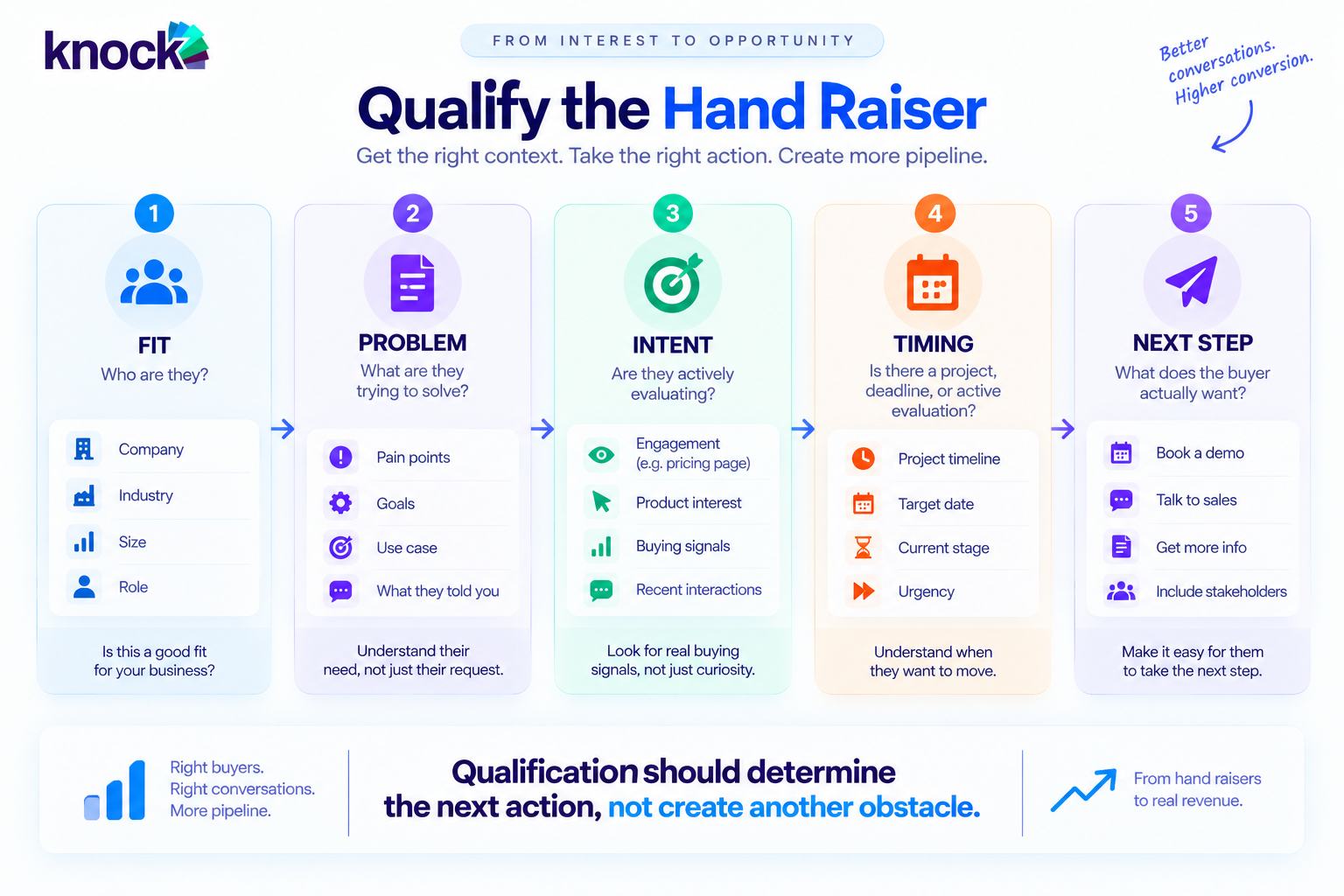
A practical way to qualify a hand raiser is to look at five things:
Fit + Problem + Intent + Timing + Next Step
The goal isn't to collect every possible data point. It's to understand what this buyer needs and what your team should do next.
Fit
Start with whether the buyer and account match your ideal customer profile.
Look at:
Company
Industry
Company size
Geography
Role and seniority
Account type
Fit tells you who the buyer is and whether the account makes sense for your solution.
Problem
Next, understand what the buyer is actually trying to solve.
A demo request tells you they want to talk. It doesn't necessarily tell you why.
For example:
“We're struggling to route inbound leads to the right rep.”
is much more useful than simply:
“Interested in your product.”
The problem gives Sales something meaningful to respond to.
Intent
Then ask: What evidence suggests this buyer is actually evaluating a solution?
Look for signals such as:
Explicit product questions
Pricing requests
Integration questions
Repeat engagement
Active evaluation language
Conversations with Sales
Intent isn't just whether someone interacted with your company. It's what that interaction suggests they're trying to do.
Timing
Determine whether there's an active project, evaluation, or deadline.
For example:
“We're looking to replace our current solution this quarter.”
provides much more actionable context than simply knowing someone downloaded a product guide.
Timing helps determine how urgently the team should respond.
Next Step
Finally, understand what the buyer actually wants.
They may want to:
Speak with Sales
See a demo
Get pricing
Ask a technical question
Compare solutions
Receive more information
Continue researching
This matters because the right next step isn't always a sales call.
Qualification should help determine the next action, not create unnecessary friction.
How to Tell Which Hand Raisers Are High Intent
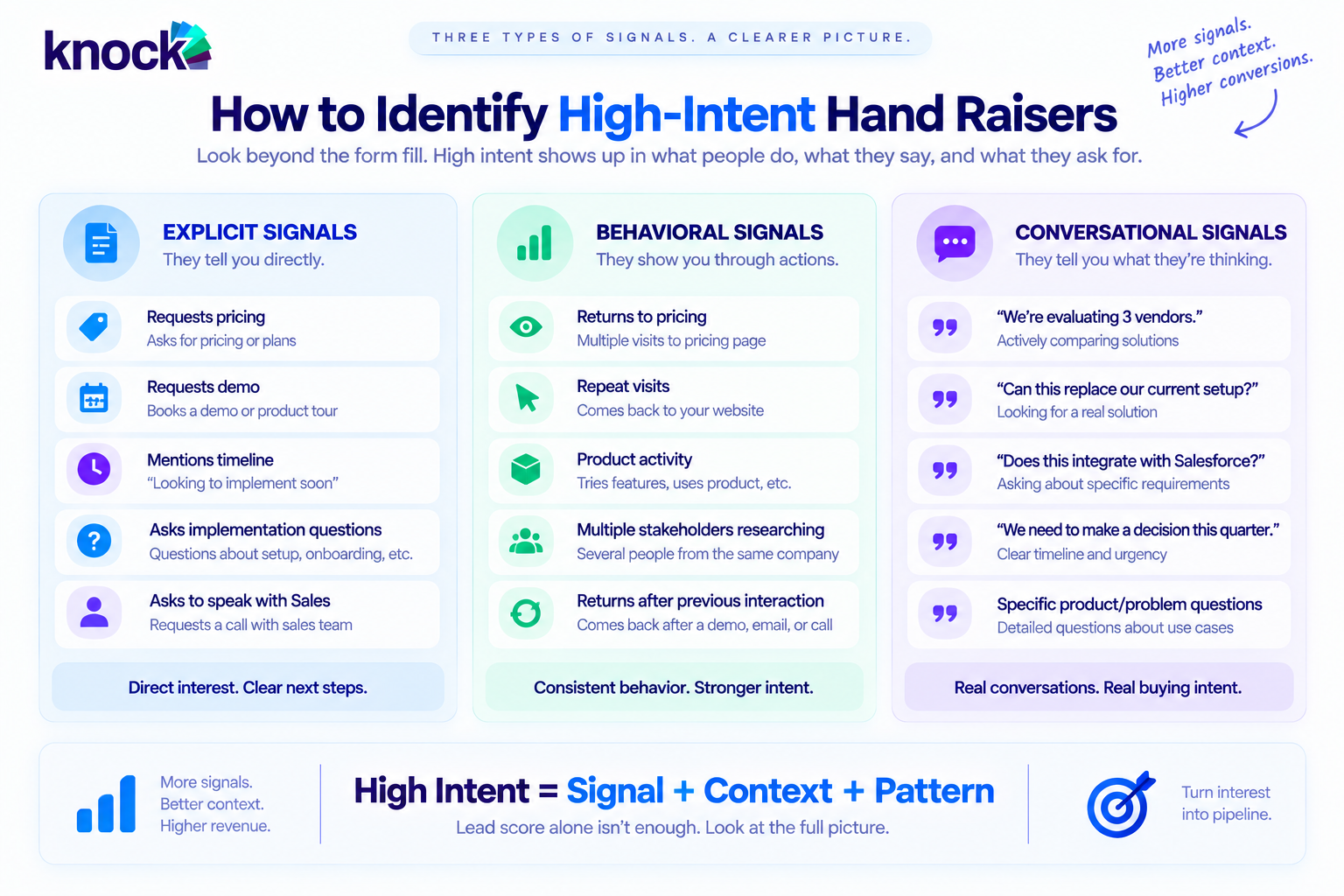
Not every hand raise carries the same level of buying intent. The strongest signals usually come from a combination of what the buyer explicitly says, what they do, and the context surrounding the interaction.
Explicit Intent Signals
These are the clearest signals because the buyer directly tells you what they're trying to do.
Examples include:
Requesting pricing
Asking for a demo
Mentioning an active evaluation
Asking implementation or integration questions
Mentioning a purchase timeline
Asking how you compare with another solution
Asking to speak with Sales
For example:
“We're evaluating three vendors and need to make a decision this quarter.”
is a much stronger signal than a generic content download.
Behavioral Intent Signals
Buyer behavior can add context to an explicit hand raise.
Look for signals such as:
Returning to the website
Visiting pricing or product pages
Repeated engagement with high-intent content
Multiple people from the same account researching
Product or trial activity
Returning after a previous conversation
A single action may not tell you much. A pattern of relevant actions can provide more context about what the buyer is researching.
Conversational Intent Signals
This is where conversations become particularly valuable.
A buyer might say:
“We're currently evaluating three vendors.”
Or:
“Can this replace our current routing setup?”
Or:
“Does this integrate with Salesforce?”
These statements reveal something a lead score often can't: what the buyer is actually trying to accomplish.
Why Lead Score Alone Isn't Enough
A lead score can summarize multiple signals into a number.
But a score of 85 doesn't necessarily tell a salesperson:
Why the buyer is interested
What problem they're solving
What they've already evaluated
What they asked about
How urgent the project is
What the buyer wants to do next
That's the shift from score → context.
The goal isn't simply to identify the highest-scoring hand raiser. It's to understand why the buyer is raising their hand and what action makes sense now.
How to Route Hand Raisers to the Right Person
Once you've identified a hand raiser and understood their intent, the next question is simple: who should act on it?
Sending every inbound lead to the same SDR queue creates another layer of delay. The goal is to route the buyer to the person best equipped to handle their specific situation.
What Should Determine Routing?
Routing can consider:
Account: Which company is the buyer from?
Territory: Who owns the relevant geography?
Segment: SMB, mid-market, or enterprise?
Product: Which product or use case are they interested in?
Industry: Does the buyer belong to a specialized segment?
Existing ownership: Is there already an AE or account owner?
Buyer role: Who is raising their hand?
Intent: How strong is the buying signal?
Urgency: Is there an active evaluation or deadline?
Conversation topic: What does the buyer actually want to discuss?
The more relevant context you have, the more precise the routing decision can be.
Route Based on Context, Not Just Form Fields
A form might tell you:
Enterprise account → Demo request
That's useful, but incomplete.
Now consider:
Enterprise account → Active evaluation → VP Marketing → Asked about Salesforce integration → Previously visited pricing
The second version gives Sales a reason to prioritize the conversation and a clear starting point.
Routing shouldn't only answer “Who owns this lead?” It should answer “Who is best positioned to help this buyer right now?”
What Should Sales Receive?
A useful handoff should carry enough context for the rep to act without starting from scratch.
For example:
Acme | VP Marketing Evaluating lead-routing solutions. Asked about Salesforce integration. Previously visited pricing. Suggested action: Connect with Sales.
That's far more actionable than:
Acme | VP Marketing | Demo Request
The difference is context.
How to Convert Hand Raisers Into Meetings
Getting a hand raiser to Sales is only part of the job. The next step is turning that interest into a useful conversation.
Make the CTA Match the Intent
Don't automatically push every hand raiser toward:
Someone asking for pricing may want pricing. Someone asking about an integration may want a technical answer. Someone actively evaluating vendors may be ready for a Sales conversation.
Match the next step to what the buyer is actually trying to accomplish.
Reduce the Number of Steps
Every additional handoff creates another opportunity for the buyer to drop off.
The goal isn't to eliminate qualification. It's to make qualification part of the conversation rather than another obstacle between interest and action.
Use Contextual Scheduling
When the buyer is ready for a meeting, make the invitation relevant to what they already told you.
Instead of:
“Would you like to book a demo?”
Try:
“You mentioned you're evaluating Salesforce lead routing. Here's a time with someone who can walk you through that workflow.”
The difference is small, but the second message tells the buyer why the meeting is relevant to them.
When Should a Hand Raiser Be Contacted by Sales Immediately?
A hand raiser should generally receive faster Sales attention when fit, intent, and urgency are all strong.
For example:
Strong fit + active evaluation + specific product question + near-term timeline
is a stronger reason for immediate Sales engagement than:
Relevant company + general request for information
There isn't one universal threshold that determines when every hand raiser should go directly to Sales. The right approach is to combine who the buyer is, what they're trying to solve, what they've done, and how urgently they need help.
The objective is simple:
Get the right buyer to the right person with enough context to make the first conversation useful.
What to Do When a Hand Raiser Doesn't Book a Meeting
Not every hand raiser will book a meeting immediately. Some are still researching, some need to involve other stakeholders, and others simply aren't ready to talk yet.
That doesn't mean the original signal is worthless.
The Buyer Abandons the Form
Don't immediately treat an abandoned form as a dead lead.
If you have enough information to identify the buyer, look at the context around the interaction. Did they visit pricing? Were they researching a specific product? Had they interacted with Sales before?
The next action should reflect that context rather than triggering the same generic follow-up sent to every abandoned form.
The Buyer Asks for Information Instead
A request for information can be an early-stage buying signal.
If someone asks for a product guide, pricing details, or information about a specific use case, give them what they asked for while preserving the context of why they asked.
That gives Sales something useful to work with if the buyer engages again.
The Buyer Doesn't Respond
No response doesn't necessarily mean no interest.
Avoid treating silence as a reason to immediately restart the buyer journey from zero. Instead, use subsequent engagement to determine whether the buyer's interest has changed.
A later pricing-page visit, product interaction, or new conversation can provide a new reason to engage.
The Buyer Returns Later
A returning hand raiser can be more informative than the original interaction.
For example:
First interaction: Requests information Later: Returns to pricing Later: Asks about an integration
Those signals together tell a much richer story than any single activity.
Another Stakeholder Becomes Involved
B2B purchases rarely involve only one person.
A buyer who initially raises their hand may bring in a colleague, manager, technical stakeholder, or executive later.
The important thing is to preserve the relationship and context across those interactions rather than treating every new contact as an entirely separate lead.
Don't treat a missed meeting as a lost signal. Treat it as an incomplete buying journey.
Use subsequent behavior, conversations, and buyer context to determine what should happen next.
How to Follow Up With Hand Raisers Without Sounding Generic
The easiest way to make a hand raiser feel like just another lead is to ignore the reason they raised their hand.
Generic Follow-Up
“Thanks for your interest. Would you like to schedule a demo?”
There's nothing inherently wrong with this message, but it doesn't show that the company understood the buyer's specific interest.
Contextual Follow-Up
“You mentioned you're evaluating lead routing for Salesforce. I can connect you with someone who can walk through that workflow.”
The second message connects the follow-up to what the buyer actually told you.
That's the important difference.
Good hand-raiser follow-up should answer three questions:
What did the buyer show interest in?
What context do we already have?
What is the most useful next step?
The goal isn't to make every follow-up highly personalized for the sake of personalization. It's to make sure the message reflects the actual buying signal.
How Fast Should You Respond to a Hand Raiser?
Speed matters because a hand raiser has created an opportunity for engagement. But response time alone doesn't tell you whether the response was useful.
Speed Matters, But What Counts as a Response?
There's an important difference between:
Automated acknowledgment
“Thanks for reaching out. We'll be in touch soon.”
and
Meaningful engagement
“You mentioned you're evaluating Salesforce lead routing. Here's the person who can help you understand how it works.”
The first confirms that the request was received.
The second uses the signal to move the buyer forward.
So don't think only about time to response. Think about time to useful action.
Measure More Than Time to Lead
Most teams measure how long it takes to get a lead into the CRM or assign it to Sales.
A more useful metric is:
Time to Context
Time to Context = the time between a hand raise and usable buyer context becoming available to the person taking action.
For example:
Hand raise → Identify buyer → Enrich → Understand intent → Context available to Sales
You can then think about the workflow as:
Time to Lead → Time to Context → Time to Action
The shorter the gap between those stages, the less likely important buyer context is to get buried in the process.
The Modern Hand-Raiser Workflow
A modern hand-raiser workflow should connect the signal to the action that follows it.
Signal: A buyer requests a demo, pricing, meeting, or starts a high-intent conversation.
Identify: Determine who the buyer is and which account they belong to.
Enrich: Add relevant company, role, account, and buyer information.
Understand: Capture what the buyer is asking about, researching, or trying to solve.
Qualify: Assess fit, intent, timing, and the appropriate next step.
Route: Get the interaction to the right person or workflow.
Engage: Respond using the context already available.
Convert: Move the buyer toward a meeting, conversation, evaluation, or another appropriate next step.
Sync: Preserve the relevant context in the systems your revenue team uses.
The important shift is that the hand raise isn't the end of lead capture. It's the beginning of buyer activation.
Traditional Hand-Raiser Follow-Up vs. Context-Aware Activation
Traditional workflow
Context-aware workflow
Capture form
Capture signal
Create CRM record
Identify buyer
Lead score
Enrich context
Assign lead
Understand intent
SDR researches
Route with context
Generic outreach
Contextual engagement
Book meeting
Continue conversation
Update CRM
Sync buyer context
The difference isn't simply more automation.
Traditional workflows optimize lead processing. Context-aware workflows optimize the buyer's next interaction.
And that's where the real opportunity lies: turning a hand raise from a record in your CRM into an informed conversation with the buyer.
How Knock AI Helps Turn Hand Raisers Into Buyer Conversations
Knock AI applies this approach to inbound buyer interactions by combining identity, enrichment, intent, conversation context, qualification, routing, and scheduling.
Identify the Buyer
Knock AI can identify and enrich the person and company behind an interaction, giving the team relevant buyer and account context before routing or qualification.
Enrich the Buyer and Account
Knock Enrichment can add company and contact information and make that information available to routing, Slack notifications, scheduling, and CRM workflows.
Knock AI uses intent signals, engagement signals, CRM data, and chat context to understand why someone is engaging. Its intent system can distinguish different intent types and expose the signals behind an intent score.
Qualify the Interaction
Knock AI can evaluate a lead against defined ICP and routing criteria. When required information is missing, its AI can ask targeted qualification questions rather than turning the conversation into another form.
Route It to the Right Person
Routing rules can use company attributes, CRM data, intent, territory, ownership, and other criteria to determine which rep or team should handle the conversation.
Engage and Schedule
Qualified buyers can be routed to the appropriate rep and can book meetings through Knock AI’s conversational scheduling flow.
Sync Context Back to the CRM
Knock AI can sync accepted lead information, enrichment, intent, attribution, and conversation transcripts into supported CRMs based on configured field mappings.
This helps you identify whether the problem is response, qualification, routing, conversion, or what happens after the hand raise.
Hand-Raiser Conversion Checklist
Before the Hand Raise
Identify high-intent entry points
Define qualification criteria
Establish routing rules
Connect relevant CRM data
Decide which signals should trigger Sales engagement
When the Hand Raise Happens
Identify the buyer
Enrich the account
Capture the interaction context
Detect intent
Determine the appropriate next action
Route to the right person or workflow
During Engagement
Use the context already available
Avoid asking questions the buyer has already answered
Match the CTA to buyer intent
Make scheduling easy when a meeting makes sense
Keep the conversation connected across handoffs
After the Interaction
Sync important context to the CRM
Record the next step
Continue relevant engagement
Monitor new intent signals
Preserve the relationship history
The objective is simple:
Don't just capture the hand raise. Capture what it means, act on it, and carry that context forward.
FAQ
What is a hand raiser in sales?
A hand raiser is a prospect who explicitly or behaviorally signals interest in engaging with a company or evaluating its solution. Examples include demo requests, pricing requests, Contact Sales requests, high-intent conversations, and positive responses to sales outreach.
What is a hand-raiser lead?
A hand-raiser lead is a lead that has actively demonstrated interest rather than simply entering a database through passive engagement. The signal can come from a form, conversation, meeting request, product interaction, event, or other high-intent activity.
What are examples of hand-raiser leads?
Examples include someone requesting a demo, asking for pricing, requesting a meeting, asking a product question, starting a high-intent chat, responding positively to outbound outreach, or explicitly saying they are evaluating solutions.
Are hand raisers qualified leads?
Not necessarily. A hand raiser indicates interest, but qualification still requires evaluating factors such as buyer fit, problem, intent, timing, and the appropriate next step. Interest is a signal; qualification is an assessment of that signal.
How do you qualify a hand raiser?
Qualify a hand raiser by assessing fit, problem, intent, timing, and next step. Use information already available from CRM data, enrichment, behavior, and conversations before asking the buyer additional questions.
How quickly should you respond to a hand raiser?
Respond as quickly as practical, but don't measure speed alone. A useful response should also contain enough context to move the buyer toward an appropriate next step. Measuring time to context alongside response time can show how quickly Sales receives actionable information.
What is speed-to-lead?
Speed-to-lead is the time between a prospect expressing interest and the company's response. For hand raisers, it can be useful to distinguish between an automated acknowledgment and meaningful engagement that actually moves the conversation forward.
How do you convert inbound hand raisers?
Convert inbound hand raisers by identifying the buyer, understanding their context and intent, qualifying only what is necessary, routing them appropriately, and giving them a relevant next step. That may be a conversation, meeting, answer, or continued nurture depending on their intent.
How do you prioritize hand raiser leads?
Prioritize hand raisers using a combination of fit, intent, urgency, and context rather than relying on a single lead score. An active evaluation from a high-fit account may require a different response from a general information request.
What is the difference between a hand raiser and an MQL?
A hand raiser is an expression of interest. An MQL is a marketing-defined qualification or lifecycle classification. A person can raise their hand without meeting the criteria your organization uses to classify an MQL.
How should hand raisers be routed?
Route hand raisers using relevant criteria such as account ownership, territory, company size, industry, product interest, intent, qualification, and urgency. The objective is to connect the buyer with the person or workflow best positioned to handle their specific situation.
How can AI qualify hand raisers?
AI can identify and enrich buyers, analyze behavioral and conversational signals, compare leads against qualification rules, ask for missing information, and recommend or trigger routing and follow-up workflows. It should operate within defined rules and guardrails rather than being treated as a perfect predictor of purchase intent.
How do you follow up with a hand raiser?
Follow up using the context behind the hand raise. Instead of sending the same generic message to everyone, reference the buyer's stated interest, problem, or question and provide the most relevant next step.
What should you do when a hand raiser doesn't book a meeting?
Don't automatically treat the missed meeting as a lost lead. Preserve the original context and use subsequent behavior, conversations, and new intent signals to determine whether the buyer needs another response, more information, continued engagement, or a later sales conversation.


.svg)


.svg)
.svg)
.svg)


.svg)
.svg)


.svg)