


A lead matches your ideal customer profile, holds a senior position, and has downloaded your latest industry report. Sounds like a promising prospect, right? Not necessarily. They may have no immediate plans to purchase. Meanwhile, another account repeatedly visits your pricing page, explores your integrations, and has multiple employees researching your product. Which one should your sales team prioritize?
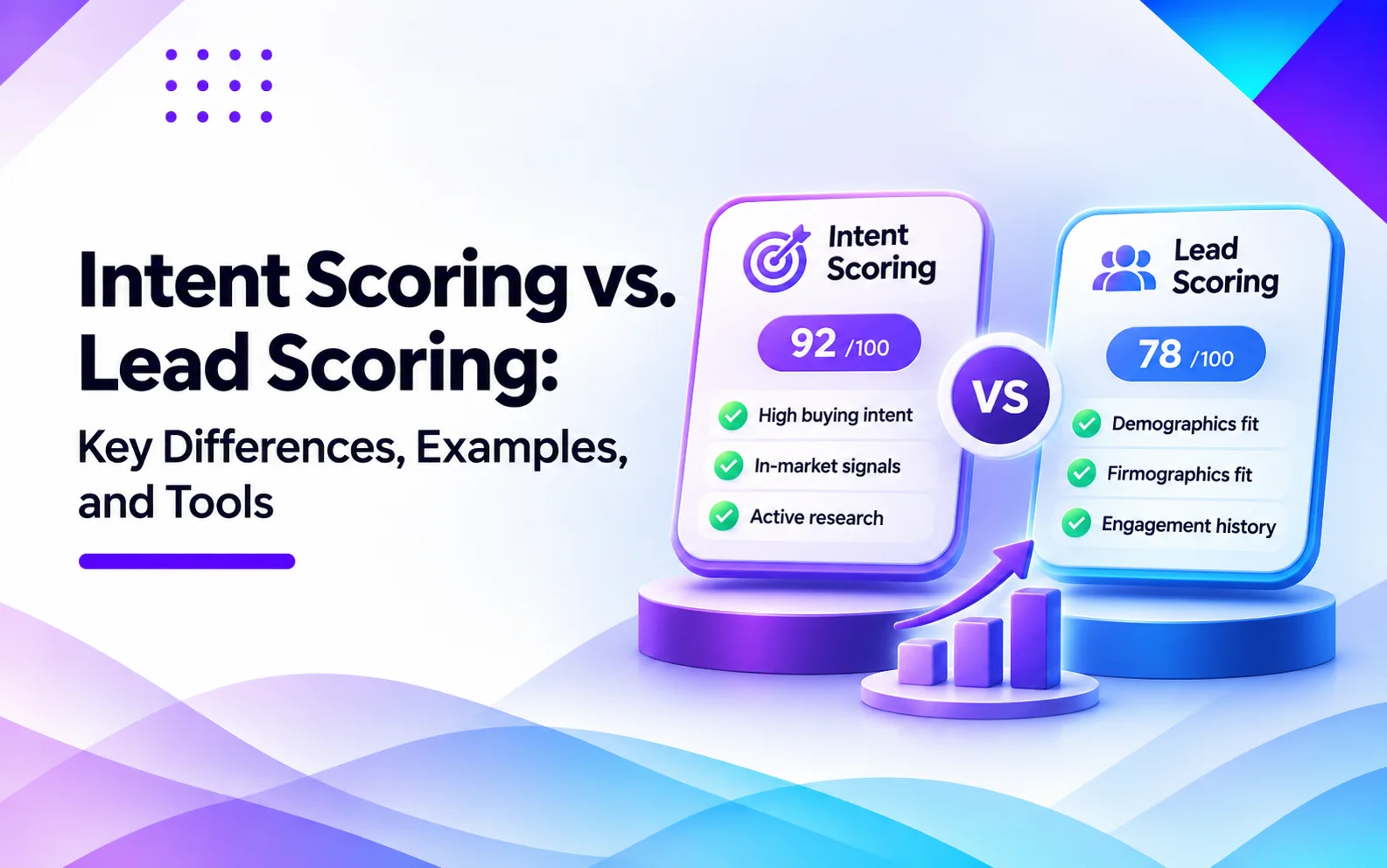
This is where lead scoring and intent scoring differ. Lead scoring evaluates prospect quality and likelihood to convert, while intent scoring identifies signals of active buying interest. Let's explore how both work, how their tools differ, and why combining them can help B2B teams prioritize opportunities more effectively.
What Is Lead Scoring?
Lead scoring is a method businesses use to assign numerical values to potential customers based on their characteristics, engagement, and likelihood of becoming paying customers. It helps marketing and sales teams distinguish promising prospects from those who may need more nurturing.
A typical lead scoring model considers two main factors:
- Demographic and firmographic fit: Job title, seniority, industry, company size, annual revenue, and other attributes that indicate whether a prospect matches the ideal customer profile (ICP).
- Behavioral engagement: Email clicks, form submissions, content downloads, website visits, webinar attendance, and other interactions with your brand.
Businesses can use rule-based scoring, where predefined criteria determine how many points an action or attribute receives, or predictive lead scoring, where machine learning analyzes historical conversion data to identify patterns associated with successful customers.
For example, a VP of Marketing at a 500-person SaaS company might receive a high lead score because their role and company match your ICP. However, if they've only downloaded one introductory guide, there's limited evidence of active buying interest.
Sales teams use these scores to prioritize follow-ups, identify marketing-qualified leads (MQLs), and determine which prospects are ready for further qualification.
Best Lead Scoring Tools
Lead scoring tools help businesses evaluate prospect fit, engagement, and qualification using predefined criteria or predictive models. Here are four platforms that support different approaches to lead prioritization.
1. HubSpot
HubSpot offers configurable lead scoring based on fit and engagement. Marketing and sales teams can create separate scores for company or contact attributes, engagement activities, or combine both into a single score. Scores can also feed into workflows, segments, and reports.
2. Salesforce
Salesforce Einstein Lead Scoring uses machine learning to analyze historical lead conversion patterns and predict which current leads are more likely to convert. It also highlights the fields influencing individual scores, helping sales representatives understand which leads deserve attention.
3. Adobe Marketo Engage
Adobe Marketo Engage supports demographic, firmographic, and behavioral lead scoring. Teams can assign positive or negative points based on prospect attributes and interactions, then use scoring thresholds and alerts to guide sales follow-up.
4. Knock AI
Knock AI adds buyer intent and account context to lead qualification. Its contact and company enrichment, Intent Score, and CRM workflows help teams understand prospect fit, engagement, and buying interest when prioritizing inbound opportunities. Rather than positioning it as a standalone predictive lead-scoring engine, Knock AI connects intent intelligence with qualification, routing, and sales engagement.
What Is Intent Scoring?
Intent scoring is the process of evaluating behavioral and research signals to estimate how strongly a person or company is demonstrating buying interest. It helps B2B teams identify potential buyers based on what they are researching and how their engagement develops.
These signals can come from several sources, including:
- Website activity: Repeated visits to pricing pages, product pages, and integration documentation.
- Content research: Engagement with product guides, competitor comparisons, and industry resources.
- External research: Review-platform activity and topic-level research, where data is available.
- Conversations: Direct questions about pricing, product capabilities, integrations, and implementation.
The strength of an intent score depends on factors such as signal type, recency, frequency, and volume. For example, repeatedly exploring pricing and implementation resources may indicate stronger buying interest than a single visit to an introductory blog post.
Intent scoring can operate at the contact level, evaluating an individual's activity, or at the account level, combining signals from multiple employees to understand broader company interest. However, one isolated action should never automatically be treated as proof that a prospect is ready to buy.
For example, Knock AI's Intent Score evaluates signal type, recency, and volume to classify intent as High, Medium, or Low. Its separate Intent Type classification identifies the purpose of an interaction, such as Buying, Partnership, Support, or Job seeker. The score measures the strength of intent, while the type identifies its category.
Best Intent Scoring Tools
Intent scoring platforms help B2B teams identify accounts and contacts demonstrating buying interest, prioritize engagement, and determine where sales efforts should be focused. Here are three platforms approaching intent intelligence from different angles.
1. Knock AI
Knock AI captures first-party intent signals across website activity, shared resources through Knock Links, and conversations. Its Intent Signals Timeline brings buyer interactions together chronologically, while Intent Score classifies interest as High, Medium, or Low based on signal type, recency, and volume. Intent Type separately identifies whether an interaction relates to Buying, Partnership, Support, or Job seeker activity. Contact and company enrichment adds account context, while qualification, routing, and scheduling workflows help teams act on these signals.
2. 6sense
6sense combines predictive analytics, account and contact intent data, and buying-stage insights to help B2B teams identify potential buyers. Its scoring capabilities consider factors such as fit, engagement, and intent to prioritize accounts and support account-based marketing (ABM) campaigns.
3. Demandbase
Demandbase combines account intelligence with third-party intent data to help businesses identify companies researching relevant topics and solutions. Teams can use these insights to prioritize accounts, build targeted audiences, and coordinate marketing and sales activation through ABM workflows.
The key difference is their approach to intent intelligence. Knock AI emphasizes first-party engagement signals and the workflows needed to convert that interest into sales conversations. 6sense and Demandbase provide broader account-level intent intelligence, predictive insights, and ABM activation capabilities.
Intent Scoring vs. Lead Scoring: Key Differences
Lead scoring evaluates how well a prospect matches successful customer and qualification patterns, while intent scoring evaluates the strength of buying-interest signals. Both help B2B teams prioritize opportunities, but they answer different questions.


