Data and prospecting
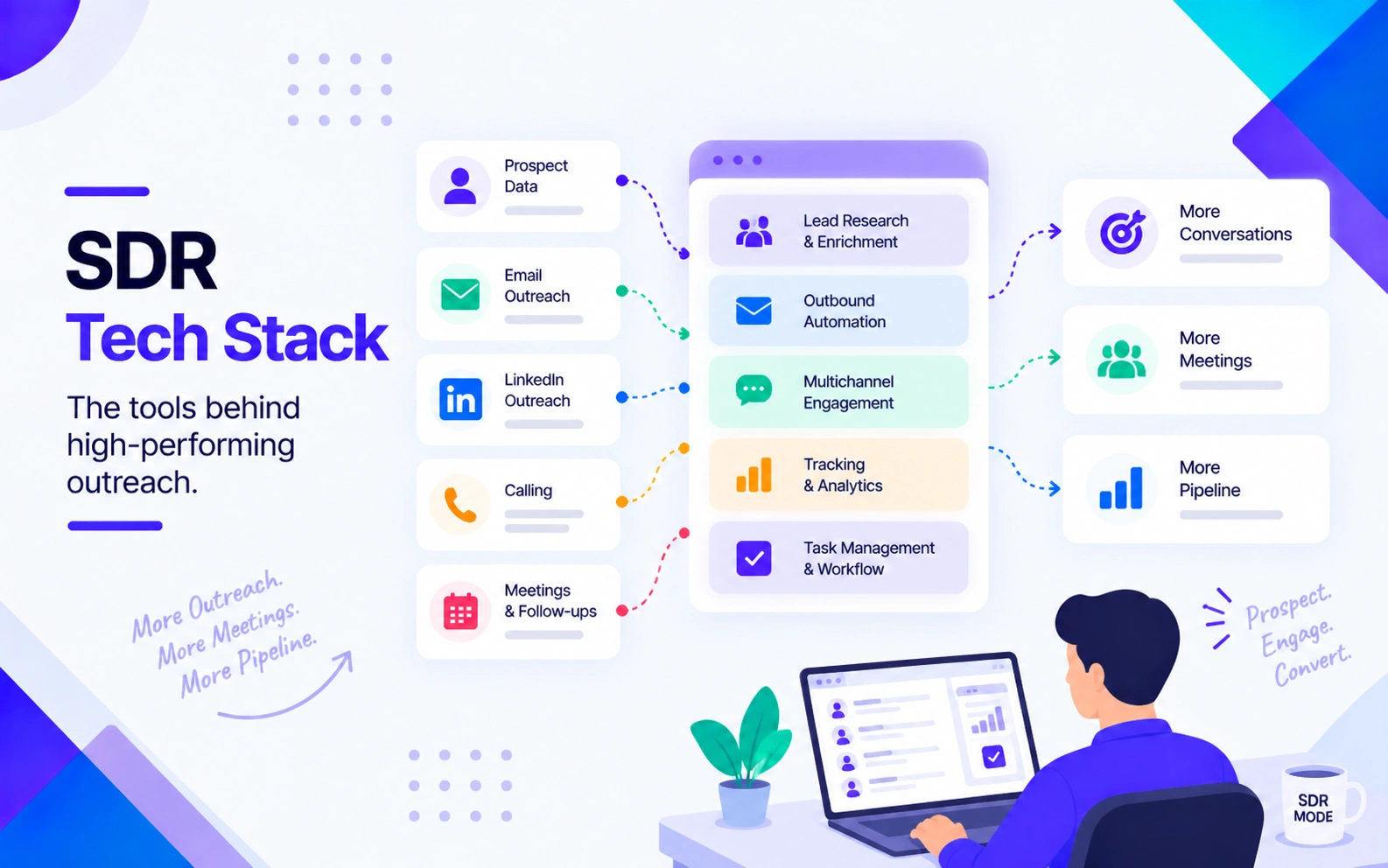
The data layer supplies who to contact and how to reach them. This is where SDR stacks are won and lost, because everything downstream inherits its accuracy.
Pricing here is the least predictable in the stack. Credit models, export caps, and per-record reveals mean two teams with identical headcount can pay very differently depending on how they work. Teams that run large list pulls burn credits fast. Teams that research narrowly and deeply barely touch them.
ZoomInfo is the coverage benchmark and prices accordingly, which puts it out of reach for smaller teams. Apollo bundles database and sequencing, which is why it is the default for teams under about thirty reps. Cognism is the common addition for European phone coverage, and Clay sits on top of many providers for teams with someone technical enough to build workflows. Our guide to data enrichment tools covers the wider category.
Engagement and sequencing
The engagement layer runs the multi-touch cadences that produce replies. Outreach and Salesloft lead at scale, and Apollo covers it adequately for teams that also buy their data there.
Two costs hide here. Sequences built for volume degrade sender reputation when the list is poor, which turns a data problem into a deliverability problem that takes months to repair. And multichannel is now table stakes rather than a differentiator, since email alone stopped carrying outbound some time ago.
Knock Outreach triggers follow-up from live buyer signals rather than static enrollment, which is a different model from cadence scheduling.
Dialing and conversations
The dialer layer exists to convert list into live conversation. Parallel dialers raise connect rates, and per-minute or per-number pricing makes this the layer most sensitive to how the team actually works rather than how many people are on it.
The honest note: dialer economics improve with list quality, not with dialing speed. Calling a bad list faster produces more rejections per hour and a worse quarter for morale.
Meetings and handoff
The meetings layer turns a positive reply into time on an account executive's calendar, then tries to make sure it holds.
Most tools consider the job finished when the invite sends, which leaves no-shows and reschedules to the SDR. Our comparisons of Chili Piper alternatives and Calendly pricing cover the category, and Knock Scheduling books inside the conversation rather than after a redirect.
Handoff quality is the underrated metric here. A booked meeting where the account executive has no idea what was discussed converts worse than a meeting that never happened, because it burns the buyer's patience as well as the slot.
Intelligence and coaching
The intelligence layer records calls, scores conversations, and feeds coaching. Gong leads it.
For SDR teams specifically, this earns its cost later than people expect. Below roughly fifteen reps making steady call volume, a manager listening to three calls a week produces most of the same insight. The platform pays back when you have dedicated managers with a coaching cadence, which is a process condition rather than a headcount one.
The AI SDR transition
This is the part of the stack changing fastest, and the part where the numbers are worth stating carefully.
Adoption is real: roughly two in five enterprise B2B teams now run at least one AI SDR in production, against about one in eight a year before. What those teams actually deploy them for is narrower than the marketing suggests, concentrating on first-touch outreach and initial qualification while humans take live conversations and anything approaching a close.
Three things follow for stack planning.
Pricing stops matching the org chart. If an agent handles first touch, you are buying volume or outcomes rather than seats, and your per-rep cost model no longer describes the function.
Data quality matters more, not less. A human SDR notices when a contact is obviously wrong and skips it. An agent sends. Volume amplifies whatever the list got wrong.
The handoff multiplies. You now have agent to human, human to agent, and agent to account executive, and each is a place where context is lost. Our guide to AI SDR tools covers the category, and our own approach covers what we think the agent needs to have before it opens a conversation.
The defensible position is not that agents replace SDRs. It is that pipeline can grow without early-sales headcount growing at the same rate, provided the agent has something real to work from.
Three stacks, by team size
Two to five SDRs. One combined data and engagement platform, LinkedIn Sales Navigator, a scheduler, and your CRM. Do not buy intent data or conversation intelligence yet. At this size the constraint is list quality and message quality, and both are fixed by a person rather than a purchase.
Ten to thirty SDRs. Separate the data layer from the engagement layer once list volume justifies it, add a dialer if outbound calling is a real motion, and add conversation intelligence once you have a manager whose job includes coaching. This is the size where duplicate tooling first appears, usually because two managers bought overlapping products in the same quarter.
A hundred or more SDRs. The stack stops being a tool choice and becomes a system: a data layer, an engagement layer, a dialer layer, an intelligence layer, and a CRM that keeps one version of the truth. At this scale run a paid pilot on one pod before committing to a full contract, and price each layer separately rather than accepting a bundle.
Where Knock AI fits for SDR teams
Knock is not a sequencer or a dialer.
It is the layer that decides whether the conversation starts warm.
Two things change for a sales development team. Inbound buyers who would have bounced off a form become live conversations instead, so SDRs spend more time replying to interested people and less time on cold lists. And buyers who go quiet get reengaged on the channel they actually use, which is the problem behind SDRs chasing ghosts.
At events, the Knock Sales Card starts a real relationship rather than a badge scan that becomes a list nobody works.
Veho reported more than four SDR hours saved per day and 46% higher SQL conversion, which is the shape of what changes when the top of the funnel arrives identified rather than anonymous.
Where it is the wrong fit. If you run pure cold outbound into a market that has never heard of you, there is no existing relationship to resolve. Fix the list first.
What goes wrong
Budgeting per tool instead of per rep. Seat prices vary wildly by vendor and tier, and credit-based tools scale on usage rather than headcount. Model the whole cost of one rep before adding twenty.
Buying speed before accuracy. A faster dialer on a worse list produces more rejections per hour.
Adding intent data at ten reps. It generates account-level signals nobody has capacity to act on, and it resolves to a domain rather than a person.
Measuring activity because it is easy. Calls and emails sent are the numbers most SDR dashboards lead with and the least connected to pipeline.
Deploying an AI SDR on top of a bad list. It does not fail quietly. It sends.
Treating the meeting as the finish line. A booked meeting with no context handed to the account executive converts worse than no meeting.
FAQs
What is an SDR tech stack?
An SDR tech stack is the set of tools a sales development team uses to find prospects, reach them across channels, get into live conversations, and hand qualified meetings to account executives. It typically spans data and prospecting, engagement, dialing, meetings, and intelligence.
What is the difference between an SDR stack and a sales tech stack?
An SDR stack is the top-of-funnel subset. A sales tech stack also covers pipeline management, quoting, and closing, which SDRs never touch. The two share the CRM, the data layer, and usually the engagement platform.
How much does an SDR tech stack cost?
It depends far more on pricing model than on tool count, because layers bill per seat, per credit, per record, per minute, and per account tracked. Model the fully loaded cost of one rep across every layer, then multiply, rather than adding up list prices.
How many tools should an SDR team have?
The prevailing 2026 advice is to consolidate from twelve to fifteen tools toward three to five integrated ones, mainly to reduce context switching. That helps focus, but it does not improve data quality, which is usually the actual constraint.
What is the core SDR stack?
A CRM, a prospecting and enrichment source, and a sales engagement platform. Everything else, including dialers, intent data, and conversation intelligence, is an addition justified by volume or by a specific motion.
Are AI SDRs replacing human SDRs?
Not so far. Around 41% of enterprise B2B teams run at least one AI SDR in production, up from about 12% a year earlier, and most use them for first-touch outreach and qualification while humans handle live conversations and closing. The realistic effect is pipeline growing faster than early-sales headcount.
Do SDR teams need intent data?
Rarely below thirty reps. Intent resolves to an account rather than a person and arrives as a score, so acting on it requires both capacity and a way to identify the human behind the signal.
When should we add conversation intelligence?
When you have managers whose job includes coaching and enough call volume to make patterns visible. Below that, a manager listening to a few calls a week produces most of the same insight at no cost.
Why do SDR meetings not hold?
Because most scheduling tools treat the sent invite as completion, leaving no-shows and reschedules to the rep. Booking inside the conversation and continuing engagement afterwards is what changes the hold rate.
What should an SDR team fix first?
Data accuracy, in almost every case. It determines bounce rates, connect rates, sender reputation, and whether any AI layer you add helps or scales the error.
Your stack charges you five different ways.
Your buyer only notices one of them.


.svg)


.svg)
.svg)
.svg)


.svg)
.svg)


.svg)


