

.svg)


.svg)
.svg)
.svg)


.svg)
.svg)

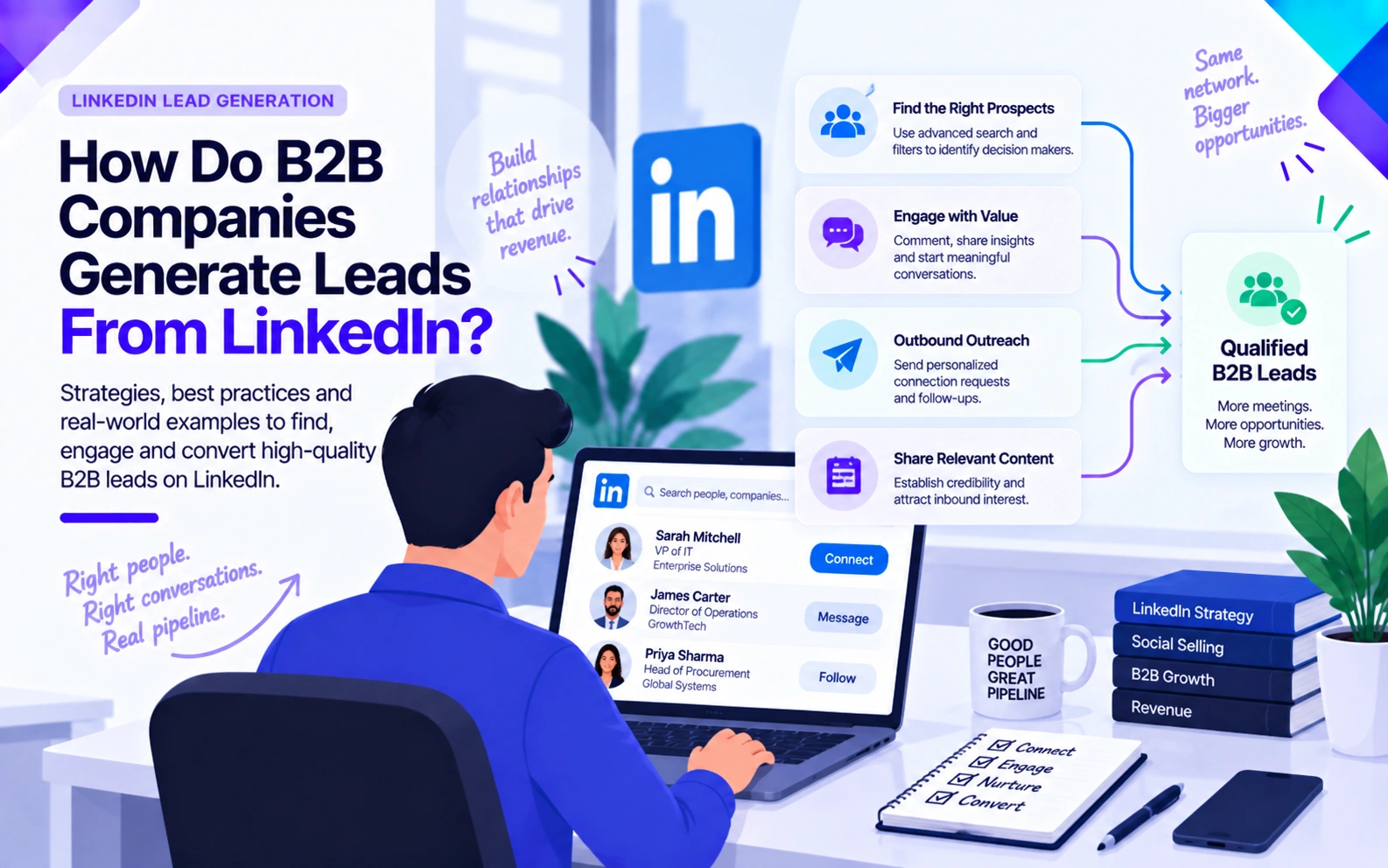
LinkedIn has become one of the most important channels for B2B companies to find prospects, build demand, and create sales conversations.
But generating leads on LinkedIn is no longer as simple as sending connection requests or publishing company updates.
B2B buyers can discover your company through a LinkedIn post, interact with an ad, click through to your website, research your product, engage with your content, or respond to a salesperson before they ever fill out a form.
That creates both an opportunity and a problem.
The opportunity: LinkedIn gives you access to the accounts and professionals you actually want to reach.
The problem: much of the buyer journey happens across multiple touchpoints, and not every interested buyer raises their hand in an obvious way.
A strong LinkedIn lead-generation strategy therefore needs to do more than find prospects. It needs to identify the right accounts, create demand, recognize buying signals, capture interest, qualify buyers, and turn that interest into sales conversations.
In this guide, we'll look at the most effective ways B2B companies can generate and convert leads from LinkedIn.
What Is LinkedIn Lead Generation?
LinkedIn lead generation is the process of finding potential B2B buyers, engaging them, capturing their interest, and converting qualified prospects into sales opportunities.
It can happen through several different motions:
- Account-based prospecting
- Organic LinkedIn content
- Social selling
- Direct outreach
- LinkedIn Ads
- Lead Gen Forms
- Retargeting
- Events and webinars
- Website conversion
- Intent-based follow-up
The important distinction is that lead generation doesn't end when someone clicks or submits a form.
The real funnel looks more like:
Target accounts → buyers → engagement → intent → qualification → sales conversation → meeting → opportunity
With that in mind, let's look at how B2B companies can build the process.
Best Strategies for B2B Companies to Generate Leads from LinkedIn
1. Build Your LinkedIn Strategy Around Your Ideal Customer Profile
The first step in LinkedIn lead generation isn't LinkedIn.
It's deciding who you actually want to generate leads from.
If your ICP is vague, LinkedIn gives you too many possible prospects.
A B2B company might define its ICP using:
- Industry
- Company size
- Revenue
- Geography
- Growth stage
- Technology used
- Business model
- Department
- Job function
- Seniority
- Business problem
For example, a B2B SaaS company selling to revenue teams might target:
US and UK SaaS companies with 100 to 1,000 employees, a sales-led GTM motion, and a large volume of inbound leads.
That immediately makes your LinkedIn strategy more focused.
Instead of asking:
"Who should our SDRs message?"
you can ask:
"Which accounts match our ICP, and which people inside those accounts influence the purchase?"
Use an account-first approach
For larger B2B deals, start with accounts rather than a massive list of individual LinkedIn profiles.
Build a list of target companies and then identify:
- Decision-makers
- Economic buyers
- Champions
- Users
- Technical stakeholders
- Other members of the buying committee
LinkedIn Sales Navigator can help sales teams find accounts and contacts using company and professional filters.
This creates a much stronger foundation for both organic and outbound LinkedIn campaigns.
Key takeaways
- Define your ICP: Know which companies and buyers you actually want.
- Build account lists: Prioritize high-value companies instead of collecting random prospects.
- Map buying committees: Identify multiple stakeholders inside important accounts.
- Segment your accounts: Use different messaging and engagement strategies for different tiers.
2. Create Demand With LinkedIn Content
Finding your target buyers is only half the job.
You also need to give them a reason to pay attention.
That's where LinkedIn content comes in.
Instead of making every post about your product, build content around the problems your buyers are trying to solve.
For example, a revenue technology company might publish content about:
- Why inbound leads don't convert
- How to reduce lead response time
- Why qualified leads get lost between marketing and sales
- How to identify buying intent
- Why sales teams waste time on poor-fit leads
- How to improve demo conversion
- How companies can personalize B2B outreach at scale
This does two things.
First, it puts your company in front of people who care about the problem.
Second, it creates behavioral signals that can help you understand what those buyers are interested in.
Don't optimize content only for engagement
A post with 100,000 impressions isn't necessarily a lead-generation success.
You should also ask:
- Who engaged?
- Which accounts engaged?
- What topics generated interest?
- Did those people visit the website?
- Did they return?
- Did they eventually convert?
This is where content becomes more than brand awareness.
It becomes part of your demand-generation system.
Key takeaways
- Create problem-led content: Talk about problems your ICP already cares about.
- Build multiple content pillars: Address awareness, consideration, and buying-stage questions.
- Track account engagement: Look beyond total likes and impressions.
- Use high-intent content: Pricing, comparisons, product pages, and solution-specific content can indicate stronger commercial interest.
3. Use LinkedIn Outreach to Start Relevant Conversations
Organic content creates demand, but sometimes you need to proactively reach the right people.
LinkedIn outreach works best when the prospect has a clear reason to hear from you.
That reason might come from:
- Their role
- A company announcement
- A new position
- Hiring activity
- Expansion
- A technology change
- An industry event
- A relevant post
- A business problem connected to your solution
The mistake is turning LinkedIn into a volume contest.
Sending 5,000 generic messages doesn't automatically create more pipeline than sending 500 relevant ones.
A stronger workflow is:
Identify account → research buyer → find relevant context → personalize message → start conversation → follow up
Use multiple stakeholders for important accounts
If you're selling an enterprise product, don't rely on one person.
A target account might have several people involved in the purchase.
Engaging multiple relevant stakeholders creates a more resilient sales motion and gives your team a better understanding of the account.
Don't automate before you have a good message
Automation should remove repetitive work, not remove relevance.
If your targeting, positioning, or messaging doesn't work manually, automating it won't solve the underlying problem.
Key takeaways
- Research before reaching out.
- Give the buyer a reason to respond.
- Personalize around relevant context, not superficial details.
- Multi-thread important accounts.
- Use automation to scale a proven process, not replace strategy.
4. Use LinkedIn Ads to Reach High-Value Audiences
LinkedIn Ads allow B2B companies to put their offers, content, and thought leadership in front of specific professional audiences.
Common use cases include:
- Lead generation campaigns
- Webinars
- Research reports
- Product launches
- Demo campaigns
- Account-based marketing
- Retargeting
- Events
- Thought leadership
LinkedIn Lead Gen Forms can reduce friction by allowing members to submit information using profile data that LinkedIn can pre-populate.
LinkedIn reported a 13% average conversion rate for Lead Gen Forms in its 2025 guidance, compared with a 4.02% landing-page benchmark from Unbounce. (Source)
But conversion rate isn't the whole story.
A campaign that generates 1,000 leads isn't necessarily better than one generating 300 if most of those 1,000 leads are unqualified.
Optimize for what happens after the form
Your real funnel should be:
Ad → Lead → Qualified Lead → Meeting → Opportunity → Pipeline
That's why B2B marketers should connect advertising data to downstream sales outcomes.
LinkedIn now supports qualified-lead optimization when the required conversion data is available, allowing advertisers to optimize toward qualified leads rather than relying only on upper-funnel conversion events.
Where Knock AI can help
For companies using LinkedIn Ads to generate demand, Knock AI can add a conversion layer after the click.
For example, a LinkedIn campaign can send buyers into a Knock Link experience where the buyer can engage or schedule rather than simply landing on another static page.
From there, relevant buyer information can move through identification, enrichment, intent, qualification, routing, and scheduling workflows.
The important point isn't that Knock AI replaces LinkedIn Ads.
LinkedIn creates the demand. Knock AI can help turn that demand into a qualified sales interaction.
Key takeaways
- Target narrowly: Focus campaigns on the accounts and buyers that matter.
- Match the offer to intent: Don't send every audience to a demo.
- Reduce conversion friction: Make it easy for interested buyers to take the next step.
- Measure downstream outcomes: Track qualified leads, meetings, opportunities, and pipeline.
5. Retarget Buyers Who Already Showed Interest
Not every buyer converts the first time they encounter your company.
Someone might:
- Click your LinkedIn ad
- Read a blog post
- Visit a product page
- Check pricing
- Download a report
- Watch a webinar
- Leave without filling out a form
That doesn't necessarily mean they aren't interested.
It may simply mean they aren't ready to convert at that moment.
Retargeting lets you continue the conversation with people who have already interacted with your brand.
But don't put everyone into the same retargeting audience.
A person who briefly visited your homepage should not necessarily receive the same message as someone who visited your pricing page three times.
You can segment audiences based on behavior:

.svg)


