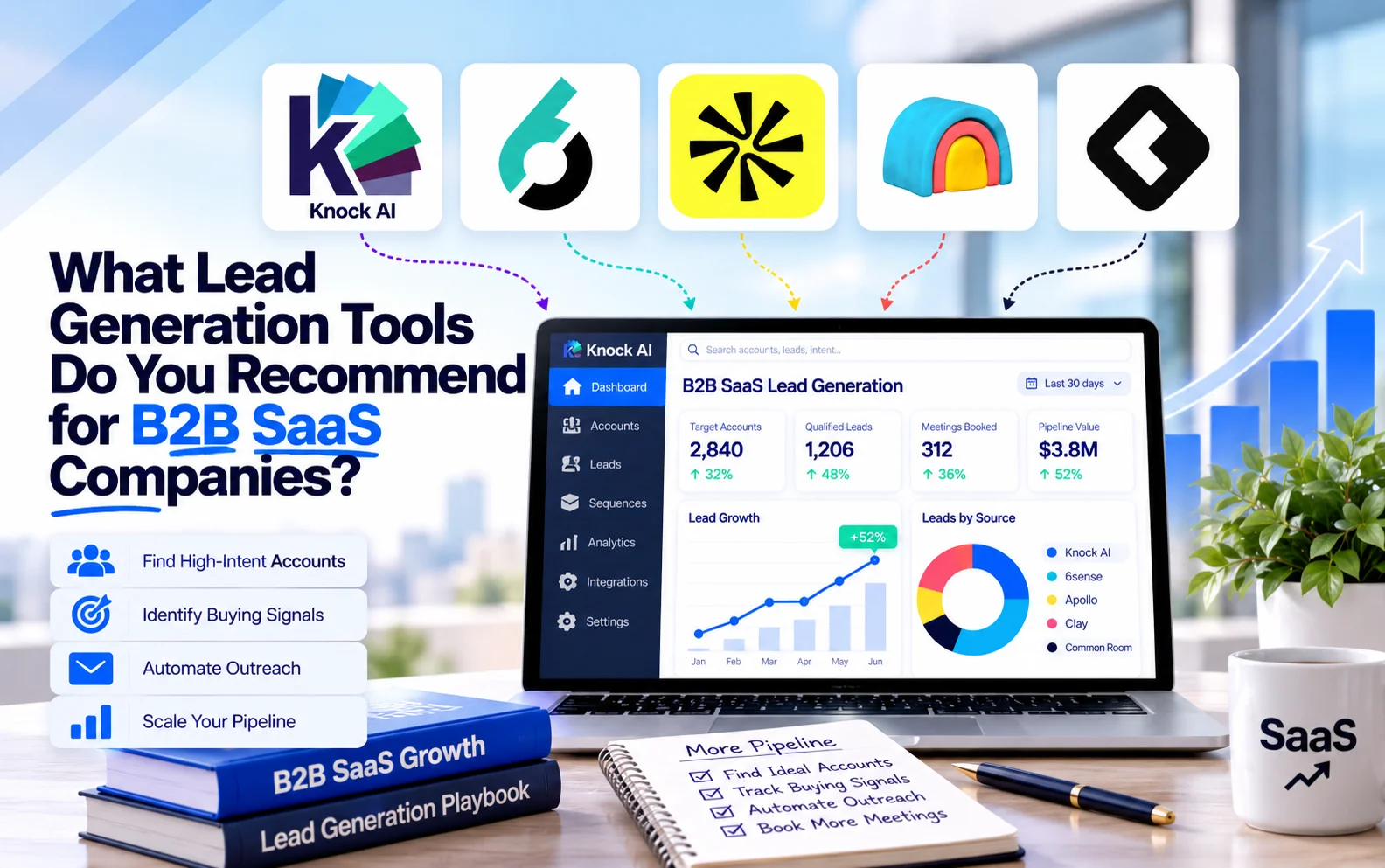
What Lead Generation Tools Do You Recommend for B2B SaaS Companies?
B2B SaaS lead generation is no longer just about finding email addresses and adding contacts to a prospecting list. SaaS companies can have thousands of potential buyers, but the real challenge is identifying which accounts fit the ideal customer profile, which buyers are showing interest, and when that interest is strong enough to justify sales engagement.
A buyer might visit your pricing page, read several product articles, start a free trial, use a key feature, engage with your content, or research your category elsewhere before ever requesting a demo.
That means effective B2B SaaS lead generation needs to connect these signals and turn them into action.
The goal is not simply to generate more leads. It is to identify the right buyers, understand their behavior, engage them with relevant messaging, and turn meaningful activity into qualified pipeline.
Why B2B SaaS Lead Generation Is Different
B2B SaaS companies can generate demand through websites, content, free trials, product usage, communities, outbound sales, and other channels. That creates more potential signals, but also makes it harder to determine which activity actually represents buying interest.
SaaS Companies Have Multiple Buyer Signals
A SaaS buyer can demonstrate interest without ever filling out a form.
Relevant signals can include:
Website visits
Pricing or product page activity
Content engagement
Repeat visits
Free trial activity
Product usage
Feature adoption
Community participation
Review site research
Demo requests
Direct conversations with sales
The important part is connecting these signals to the account and buyer behind them.
For example, a single blog visit may not mean much. But repeated visits from the same target account, followed by pricing page activity and a product trial, provide much stronger evidence that the account may be evaluating a solution.
ICP Fit Does Not Mean Buying Intent
Your ideal customer profile tells you who could be a good customer. It does not tell you who is ready to buy.
A 200 person SaaS company using the right technology and operating in your target market may be an excellent ICP match. But if there is no relevant problem, project, or buying activity, it may not deserve immediate sales attention.
This creates two separate questions:
ICP fit: Could this company benefit from our product?
Buying intent: Is this company showing signs that it may be evaluating a solution now?
Effective SaaS lead generation combines both. The strongest opportunities often come from accounts that match the ICP and show meaningful intent or engagement.
Buyers Research Before They Talk to Sales
SaaS buyers can research products, compare vendors, read reviews, consume educational content, and evaluate alternatives before they ever speak with a salesperson.
That makes the traditional:
Visitor → Form Fill → Lead → SDR
model incomplete.
A lead generation strategy should also recognize the signals that happen before the form submission.
Website behavior, content engagement, product activity, review site research, and other intent signals can help revenue teams understand potential demand earlier in the buying process.
Product and Website Behavior Can Reveal Demand
For SaaS companies, the product itself can become a source of lead generation signals.
A free trial user who repeatedly uses a core feature, invites teammates, reaches a usage threshold, or explores a paid feature may be demonstrating stronger commercial interest than someone who simply downloaded an ebook.
The same applies to website behavior. Repeated visits to pricing, product, integration, comparison, or implementation pages can provide useful context about what an account is researching.
These signals become particularly valuable for PLG and hybrid SaaS companies, where users can interact with the product before speaking with sales.
The key is not to treat every action as a lead. Instead, combine behavior with account fit, buyer context, intent, and timing to determine which activity deserves sales attention.
What Should a B2B SaaS Lead Generation Tool Do?
A B2B SaaS lead generation tool should help teams move from potential buyer → meaningful signal → sales action → pipeline.
Depending on the company's GTM model, the tool should support capabilities such as:
Prospect and account discovery: Find companies and buyers that match the ICP.
Contact intelligence: Identify relevant decision makers and stakeholders.
Data enrichment: Add firmographic, technographic, organizational, and contact context.
Intent detection: Identify signals that suggest an account or buyer may be evaluating a solution.
Website and buyer behavior: Understand how prospects interact with your site and content.
Product or account signals: Surface meaningful activity from trials, freemium users, and existing accounts.
AI research and qualification: Automate research, interpret signals, and identify higher potential leads.
Sales engagement: Turn relevant signals into timely and personalized outreach.
Lead routing: Send qualified activity to the appropriate rep, team, or workflow.
CRM and pipeline integration: Connect lead activity with opportunities, pipeline, and revenue.
The key principle is simple:
A B2B SaaS lead generation tool should help turn buyer signals into sales action, not simply generate more contacts.
B2B SaaS Lead Generation Tools Comparison
Tool
Primary Role
Best For
Main Signal / Data
Core Question
Knock AI
Buyer intelligence and conversion
Turning buyer activity into qualified conversations
Intent, engagement, account context
What should happen when a buyer shows intent?
Apollo
Prospecting and sales intelligence
Finding and engaging prospects
Contact, company, and enrichment data
Who should we contact?
Clay
Data enrichment and prospecting workflows
Building customized GTM workflows
Enrichment, research, and multiple data sources
How can we build a better prospecting workflow?
6sense
Predictive intent and account intelligence
Identifying in-market accounts
Intent and account signals
Which accounts may be ready to buy?
Common Room
Signal intelligence
Connecting product, community, social, and web activity
Behavioral and community signals
Which people or accounts are showing meaningful interest?
See Knock AI in Action — Book Your Live Demo Today
B2B SaaS teams can approach lead generation from very different angles. Some need a large prospect database, others need better enrichment, while others already have demand but struggle to identify which buyers are actually showing intent.
The five tools below cover different parts of that process, from prospect discovery and data enrichment to buyer intelligence, intent detection, and sales engagement.
SaaS companies often have valuable buyer activity happening across their website, marketing assets, LinkedIn, G2, events, and other channels. The challenge is turning that activity into a conversation before the buying window disappears.
Knock AI can identify and enrich buyers, evaluate their intent and ICP fit, engage them in real time, and determine the appropriate next step. Qualified buyers can be routed to a sales rep, sent to a scheduling workflow, or handled by an AI agent depending on the team's rules.
Where It Fits
Knock AI sits between buyer intent and sales execution.
This makes it particularly relevant for SaaS companies that already have website, campaign, product, or other inbound demand but need a better way to turn that activity into pipeline.
Key Capabilities
Buyer identification and enrichment
First party intent scoring
Website and marketing asset engagement
AI powered qualification
Intent based routing
AI and human handoffs
Meeting booking
CRM synchronization
Slack integration
Trackable Knock Links for websites, LinkedIn, G2, events, email, and other touchpoints
Best For
B2B SaaS teams that want to turn existing buyer activity and intent into qualified conversations and pipeline, particularly when forms, manual qualification, or delayed SDR follow up are creating friction.
Apollo combines B2B prospecting, contact data, sales intelligence, enrichment, and engagement capabilities in one platform. Its prospecting database provides company and contact information that teams can filter based on attributes such as persona and other data points. Apollo also provides buying intent data and prospecting workflows.
How It Helps B2B SaaS Teams
For SaaS companies building outbound programs, the first challenge is often finding the right companies and people to contact.
Apollo can help teams define their ICP, build prospect lists, enrich records, identify potential buyers, and move those prospects into sales engagement workflows.
This makes it useful when the primary problem is not identifying existing buyer activity, but building a relevant prospect universe to engage.
Where It Fits
Apollo primarily fits at the prospecting and sales intelligence layer.
B2B SaaS teams that need to find relevant companies and contacts, build prospect lists, enrich their data, and execute outbound sales campaigns from one platform.
Focus: Prospect discovery → contact data → enrichment → outreach
3. Clay
What It Does
Clay is a data enrichment and GTM workflow platform that lets teams combine multiple data sources, enrich records, and use AI for custom research. Its enrichment system can run across more than 200 data providers and use AI web research when standard databases do not contain the required information.
How It Helps B2B SaaS Teams
B2B SaaS teams often need information that isn't available in a standard prospect database.
For example, a team might want to identify companies that match a particular technology stack, have recently changed leadership, have specific website characteristics, or meet a custom ICP condition.
Clay allows teams to build these types of workflows by combining data providers with enrichment and AI research rather than relying on a single database.
Where It Fits
Clay fits primarily at the data enrichment and custom prospecting workflow layer.
The workflow can look like:
Prospect List → Enrich → Research → Filter → Personalize → Activate
Key Capabilities
Multi provider data enrichment
Waterfall enrichment
AI web research
Custom prospect research
CRM enrichment
Data cleaning and updating
Custom GTM workflows
Automated enrichment
Prospect personalization
Best For
B2B SaaS teams with complex ICP requirements or technical GTM workflows that need to combine multiple data sources and conduct custom research before engaging prospects.
Focus: Data enrichment → AI research → custom prospecting workflows
4. 6sense
What It Does
6sense is an account intelligence and predictive platform focused on identifying accounts and buyers that may be in market. Its account prioritization capabilities combine buying intent, buying stage predictions, engagement, firmographic data, technographics, and other account signals.
How It Helps B2B SaaS Teams
A SaaS company may have thousands of accounts that fit its ICP, but only a portion are actively evaluating a solution at a given time.
6sense helps revenue teams prioritize those accounts by combining intent and account signals to identify which companies deserve attention. It can also provide account context such as intent data, persona information, and technographics.
This is particularly relevant for SaaS teams running an account based sales or marketing motion.
Where It Fits
6sense sits primarily at the intent, predictive intelligence, and account prioritization layer.
B2B SaaS companies with large target account lists that need to identify in market accounts and prioritize sales and marketing resources around active buying signals.
Common Room brings together signals from product usage, websites, CRM, social networks, communities, GitHub, job changes, and other sources to create a unified view of people and organizations. Its buyer intelligence capabilities combine these signals with identity resolution and enrichment to help teams identify and prioritize buyers.
How It Helps B2B SaaS Teams
SaaS buyers can interact with a company long before they become a traditional lead. They may use the product, visit the website, participate in a community, interact with content, contribute to GitHub, or change jobs.
Common Room connects these different signals to people and accounts so teams can identify patterns that might otherwise remain scattered across different systems.
For example, a SaaS team could identify a power user who recently changed companies, an account showing increased product usage, or a target company showing activity across its website and community.
Where It Fits
Common Room fits at the signal intelligence and buyer intelligence layer.
The workflow is:
Product + Website + Community + Social + CRM → Identity → Signals → Prioritization → Engagement
Key Capabilities
Product usage signals
Website visitor identification
Community signals
Social signals
GitHub activity
Job changes and hiring signals
CRM data
Identity resolution
AI powered enrichment
Buyer and account prioritization
Signal based workflows and alerts
Best For
B2B SaaS companies that have meaningful product, community, social, or website activity and want to connect those signals to specific people and accounts for sales engagement.
Focus: Product → community → social → website signals → buyer intelligence
How to Build a B2B SaaS Lead Generation Workflow
A B2B SaaS lead generation workflow should connect account selection, buyer signals, engagement, qualification, and revenue. The goal is to avoid treating every contact as equally valuable and instead create a process that helps sales focus on accounts and buyers with the strongest combination of fit and buying activity.
A practical framework is:
ICP Fit + Intent + Engagement + Timing = Lead Priority
Step 1: Define Your ICP
Start by defining the companies most likely to become successful customers. Consider factors such as industry, company size, revenue, geography, technology stack, business model, use case, and existing customer characteristics.
For SaaS companies, it can also help to define the conditions that indicate a particularly strong fit, such as a specific technology stack, growth stage, team structure, or operational problem.
A clear ICP gives every downstream lead generation activity a consistent target.
Step 2: Build Your Target Account and Prospect List
Once the ICP is defined, identify companies that match it and then find the relevant people within those accounts.
Starting with accounts prevents the team from building a large contact database without knowing whether those contacts belong to companies worth pursuing.
For sales led SaaS companies, this can mean creating a named account list. For broader outbound programs, it may mean building segmented prospect lists based on ICP, persona, geography, industry, or use case.
Step 3: Enrich Account and Contact Data
Raw prospect lists rarely contain enough context to support relevant engagement.
Enrich accounts and contacts with information such as:
Company size and revenue
Industry
Technology stack
Location
Job title and seniority
Department
Hiring activity
Company changes
CRM history
Relevant account relationships
The objective is not to collect as much data as possible. It is to collect the information that helps the team determine whether the account fits, who matters, and why the account may be relevant now.
Step 4: Identify Intent and Behavioral Signals
Next, look beyond static account and contact information.
Relevant signals can include:
Website activity
Pricing and product page visits
Content engagement
Trial or product activity
Repeat visits
Demo requests
Community activity
Intent data
Review site research
Company changes
Hiring or expansion
These signals become more useful when combined. For example, an ICP account repeatedly visiting product pages and starting a trial provides more context than a single website visit.
Step 5: Prioritize High Potential Accounts and Buyers
Not every account that matches the ICP deserves the same level of attention.
Prioritize accounts based on the combination of:
ICP Fit + Intent + Engagement + Timing
An account with strong ICP fit but no current activity may belong in a longer term nurture motion. Another account with the same fit but increasing engagement and relevant buying signals may require immediate sales attention.
The same principle applies at the buyer level. Prioritize people based on their relevance to the buying process and the signals they generate.
Step 6: Engage With Relevant Messaging
Once an account or buyer has been prioritized, engagement should reflect the context behind the lead.
A SaaS executive may care about business outcomes, while a technical evaluator may care about integrations, implementation, security, or functionality.
Use the available account and buyer context to make outreach more relevant rather than sending the same message to every prospect.
The goal is to connect the reason for reaching out with something the buyer is likely to care about.
Step 7: Qualify and Route
When a prospect engages, determine whether the activity represents a meaningful sales opportunity.
Qualification can consider:
Fit + Need + Intent + Timing + Authority + Opportunity Potential
Once a lead meets the relevant criteria, route it to the appropriate sales representative, account owner, territory, specialist, or automated workflow.
Fast routing matters because a high intent signal becomes less useful when there is a long delay between buyer activity and sales follow up.
Step 8: Connect Activity to Pipeline and Revenue
Lead generation should not end when a contact becomes an MQL, SQL, or meeting.
This makes it possible to determine which lead sources, accounts, signals, and campaigns actually contribute to business outcomes.
It also helps SaaS teams distinguish between activity that creates volume and activity that creates commercial value.
Strategies to Generate More B2B SaaS Leads
The biggest improvements usually come from improving targeting, signal quality, relevance, and timing, rather than simply increasing outreach volume.
Focus on ICP Quality, Not Lead Volume
A database containing thousands of contacts is not necessarily valuable if most contacts belong to companies that are unlikely to buy.
Define the characteristics of your highest value customers and use those characteristics to guide prospecting, content, campaigns, and sales activity.
A smaller pool of highly relevant accounts can provide more useful sales opportunities than a much larger pool of poorly matched contacts.
Combine First Party and Third Party Signals
First party signals come from interactions with your own business, such as website visits, content engagement, product usage, and direct conversations.
Third party signals can provide information about research and activity occurring outside your properties.
Combining the two can provide a broader picture of buyer activity and help teams understand whether an account is simply a good fit or may actually be researching a solution.
Turn Website and Product Activity Into Sales Signals
Your website and product can provide valuable information about buyer interest.
For example, repeated visits to pricing pages, increased product usage, feature adoption, team invitations, or activity from multiple users at the same company can provide context for sales teams.
Rather than treating every event as a lead, identify the behaviors that correlate with meaningful buying interest.
Prioritize Accounts Showing Intent
Once intent signals are available, use them to change account priority.
An ICP account showing increasing research activity may warrant more attention than an otherwise identical account with no engagement.
This allows sales and marketing teams to allocate resources based on both fit and timing.
Personalize Outreach Around Buyer Context
Personalization should go beyond inserting a prospect's first name into an email.
Use relevant information about the account, buyer role, business situation, technology environment, or demonstrated interest to explain why the conversation is relevant.
The more useful the context, the less the outreach feels like generic prospecting.
Use AI to Automate Research and Qualification
AI can reduce the manual work involved in researching accounts, interpreting signals, enriching records, identifying relevant stakeholders, and qualifying activity.
The most useful applications are not limited to generating messages. AI can help turn fragmented data into a clearer picture of who the buyer is, what they may need, and what action should happen next.
Follow Up Based on Buyer Behavior
Not every prospect should receive the same follow up sequence.
A prospect who repeatedly engages with high intent content may warrant a different response from someone who downloaded a top of funnel resource once.
Using buyer behavior as a trigger allows follow up to happen based on actual activity rather than an arbitrary schedule alone.
Create Content for Buyers Before They Are Sales Ready
SaaS buyers often research problems and potential solutions before contacting sales.
Create content that addresses the questions they encounter during this research, including:
Problem specific content
Product comparisons
Use cases
Implementation guidance
Integration information
Pricing questions
Alternatives
Industry specific challenges
This allows content to contribute to demand generation before a prospect becomes a conventional sales lead.
Connect Marketing and Sales Around Shared Account Data
Marketing and sales should have a common understanding of target accounts, engagement, intent, qualification, and opportunity status.
When both teams work from disconnected data, marketing may prioritize accounts that sales does not consider valuable, while sales may miss engagement signals generated by marketing activity.
Shared account context creates a more consistent path from demand generation to revenue.
How to Measure B2B SaaS Lead Generation
Lead generation should be measured across the funnel. Contact volume can show activity, but it does not tell you whether that activity is creating commercial value.
Lead and Account Metrics
Useful leading indicators include:
Qualified leads
Engaged accounts
High intent accounts
Product Qualified Leads (PQLs), where applicable
Buying group engagement
Account engagement
These metrics help show whether the right companies and buyers are entering the sales process.
Pipeline Metrics
Pipeline metrics show whether lead generation is producing actual sales opportunities.
Track:
Qualified opportunities
Pipeline generated
Lead to opportunity conversion
Opportunity velocity
Average opportunity value
These are more useful for evaluating lead generation quality than raw lead counts.
Revenue Metrics
Ultimately, connect lead generation to financial outcomes:
Revenue generated
Revenue per account
Customer acquisition cost
CAC payback
Customer acquisition efficiency
The key principle is:
Measure pipeline and revenue, not contact volume alone.
A lead generation program that produces fewer leads but generates more qualified opportunities and revenue may be creating substantially more value than one optimized for database growth.
Common B2B SaaS Lead Generation Mistakes
Optimizing for Lead Volume Instead of Quality
Generating more contacts does not automatically generate more customers. Lead volume should be considered alongside ICP fit, intent, qualification, and conversion.
Treating Every ICP Account the Same
ICP fit establishes potential, but accounts can differ significantly in timing, engagement, buying activity, and opportunity value.
Relying Only on Contact Databases
Contact databases answer who someone is. They do not necessarily tell you whether that person or company is currently interested in your solution.
Ignoring First Party Buyer Signals
Website, product, content, and account activity can provide valuable context. Ignoring these signals can leave sales teams dependent on static data and form submissions.
Waiting for Demo Requests
A demo request is a strong signal, but it is not the first sign of interest. Buyers can research and engage with a SaaS company long before they request a conversation.
Sending Generic Outreach
Generic messaging makes it harder to connect the outreach with the buyer's role, business situation, or reason for evaluating a solution.
Using Too Many Disconnected Tools
Adding more tools does not necessarily improve lead generation. If prospect data, intent signals, engagement activity, and CRM information remain disconnected, teams may still struggle to understand which leads deserve attention.
Failing to Connect Leads to Revenue
Measuring only leads, MQLs, or meetings can hide whether lead generation is actually producing business results.
The full measurement chain should be:
Lead → Opportunity → Pipeline → Revenue
FAQs
What are the best lead generation tools for B2B SaaS companies?
The right tool depends on the lead generation problem you need to solve. Knock AI focuses on buyer signals, qualification, engagement, and routing. Apollo focuses on prospect discovery and sales intelligence. Clay supports enrichment and custom prospecting workflows. 6sense focuses on intent and account prioritization. Common Room connects product, community, social, and website signals.
What is B2B SaaS lead generation?
B2B SaaS lead generation is the process of identifying companies and potential buyers, understanding their fit and buying signals, engaging relevant prospects, and converting qualified interest into sales opportunities. It can include inbound, outbound, product signals, website behavior, content, intent data, referrals, communities, and sales engagement.
How do SaaS companies generate leads?
SaaS companies generate leads through inbound content and SEO, outbound prospecting, product usage, free trials, referrals, communities, events, partnerships, paid acquisition, and sales engagement. The strongest approach depends on the company's ICP and GTM model, but most programs combine multiple channels rather than relying on a single source.
What is the best tool for SaaS prospecting?
The appropriate tool depends on the prospecting requirement. Apollo is focused on prospect discovery and contact intelligence, Clay on custom enrichment and research, 6sense on account intent, Common Room on behavioral signals, and Knock AI on turning buyer activity into qualified conversations. The right choice depends on which part of the prospecting process needs improvement.
What is the difference between SaaS lead generation and prospecting?
SaaS lead generation is the broader process of creating and identifying potential sales opportunities across inbound, outbound, product, content, referrals, and other channels. Prospecting is a specific activity within that process focused on identifying and engaging potential accounts or buyers.
What is intent data in B2B SaaS?
Intent data provides signals that indicate an account or buyer may be researching a topic, category, product, or solution. First party intent comes from interactions with your own website, product, content, or other properties. Third party intent comes from research activity outside your own digital properties.
How do you identify high intent SaaS leads?
Start with ICP fit and combine it with intent, engagement, behavioral signals, and timing. For example, an account that matches your ICP and shows repeated website engagement, product activity, or other relevant research signals may deserve more attention than an ICP account with no current activity.
How do you generate SaaS leads without cold calling?
SaaS companies can generate leads through SEO, content, product led acquisition, free trials, communities, referrals, partnerships, events, inbound experiences, website engagement, and intent driven sales engagement. These approaches can create opportunities by capturing existing demand rather than relying exclusively on unsolicited outreach.
What is a PQL in SaaS?
A Product Qualified Lead (PQL) is a user or account that demonstrates product behavior associated with potential buying interest. Depending on the SaaS model, signals can include repeated usage, feature adoption, reaching usage thresholds, inviting additional users, or other behaviors that indicate meaningful product value.
How do you qualify B2B SaaS leads?
B2B SaaS leads can be qualified using factors such as fit, need, intent, engagement, timing, authority, buying stage, and opportunity potential. The exact criteria should reflect the company's ICP and sales process rather than treating every lead or interaction as equally valuable.
How do you measure SaaS lead generation?
Measure SaaS lead generation using qualified leads, engaged accounts, qualified opportunities, pipeline generated, conversion rates, revenue, customer acquisition cost, and CAC payback. Contact volume can be useful as a supporting metric, but pipeline and revenue provide a clearer view of whether lead generation is creating business value.


.svg)


.svg)
.svg)
.svg)


.svg)
.svg)


.svg)