Best Lead Generation Tools for Cybersecurity Companies
What Lead Generation Tools Do You Recommend for Cybersecurity Companies?
Generating leads for a cybersecurity company is rarely as simple as driving more traffic and collecting more demo requests.
A cybersecurity company can attract thousands of visitors through SEO, technical content, paid campaigns, webinars, events, review sites, and other channels without knowing which accounts are actually showing buying intent. A security engineer might be researching a problem for months before a purchase is even discussed, while a CISO may be comparing several vendors with a buying committee already forming behind the scenes.
The buying process can also involve multiple stakeholders across security, IT, engineering, procurement, compliance, and executive teams. That means a single form submission rarely tells the whole story. The real opportunity may be hidden across multiple interactions, from a technical article or research report to a product page, event, review site, campaign link, or direct conversation.
At the same time, cybersecurity buyers increasingly research vendors before speaking with sales. They evaluate technical capabilities, compare alternatives, look for peer validation, examine implementation requirements, and use AI-powered tools alongside traditional search and review platforms.
That's why the goal shouldn't simply be generating more cybersecurity leads.
The goal is to identify the right buyers, understand their intent, engage them at the right moment, qualify the opportunity, connect the relevant buying committee, and turn that demand into a pipeline.
A modern cybersecurity lead-generation process therefore looks more like:
Different tools solve different parts of that journey.
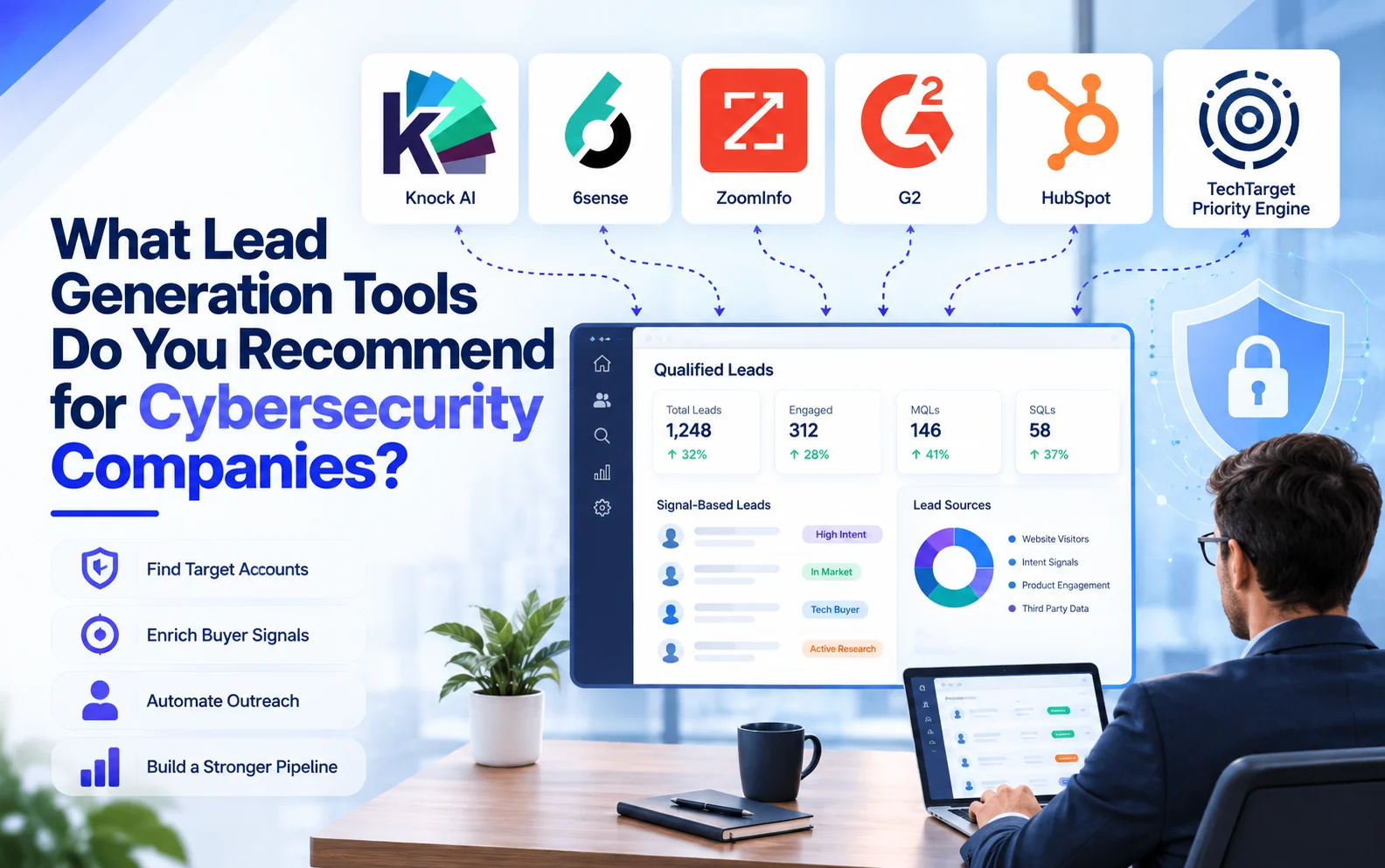
Knock AI focuses on identifying and acting on high-intent buyer signals across digital touchpoints. 6sense helps companies identify target accounts and buying intent for account-based programs. G2 captures software research and buyer-intent signals. TechTarget Priority Engine provides technology-specific intent data. ZoomInfo helps identify and enrich the people behind target accounts. And HubSpot provides CRM, marketing automation, lead capture, and nurturing.
The key is not choosing the platform with the longest feature list. It's choosing the tools that address where your cybersecurity demand-generation and conversion process is currently losing opportunities.
What Are the Best Lead Generation Tools for Cybersecurity Companies?
Tool
Primary Role
Buyer / Account Identification
Intent Signals
AI Engagement
Lead Qualification
Lead Routing
CRM / GTM Workflows
Where It Fits
Best For
Knock AI
Buyer identification + intent + conversion
Identifies and enriches buyers across digital touchpoints
Why Cybersecurity Companies Need a Different Lead Generation Strategy
Cybersecurity lead generation is different from generating leads for a typical B2B SaaS product. The buyer is often evaluating a high-risk purchase that can affect security operations, compliance, infrastructure, and the organization's overall risk posture. That makes trust, technical evidence, buying-group visibility, and timing especially important.
Cybersecurity Buying Committees Are Large
A cybersecurity lead rarely represents the entire buying opportunity.
Research from ActualTech Media found that 43% of IT and cybersecurity technology purchases involve six or more stakeholders. The buying process also tends to take time, with 58% of respondents saying IT product purchases take three months or longer.
That changes how cybersecurity companies should think about lead generation.
A security engineer downloading a technical report may be the first person to engage, but the eventual purchase could also involve the CISO, CIO, IT leadership, procurement, compliance, finance, and other technical stakeholders.
In other words:
One lead ≠ one buying opportunity.
The goal is to understand the account and buying group, not simply collect individual form submissions.
Cybersecurity Buyers Need Technical Proof
Cybersecurity buyers are also asking for more substance from vendor marketing.
A 2026 study of 320 enterprise cybersecurity decision-makers found that 52% said cybersecurity marketing lacked sufficient technical depth, while 49% cited insufficient ROI justification. The same research found that buyers wanted stronger evidence, clearer real-world performance information, and a better explanation of how solutions integrate with their existing security stacks. (Source)
That means generic content such as "Why cybersecurity matters" isn't enough to move many buyers toward a sales conversation.
Cybersecurity companies need content that helps buyers answer questions such as:
How does the product actually work?
How does it integrate with our existing security stack?
What does implementation involve?
What problem does it solve better than alternatives?
What evidence supports the vendor's claims?
What is the expected business or risk outcome?
How will our security team use it in practice?
This is why technical guides, original research, solution briefs, benchmarks, case studies, architecture documentation, webinars, and evidence-backed comparisons can play such an important role in cybersecurity demand generation.
Cybersecurity Buyers Research Before Talking to Sales
The cybersecurity buying journey is increasingly self-directed.
Rather than moving directly from an advertisement to a sales call, buyers can spend weeks or months researching a problem, understanding the technology, comparing vendors, reading reviews, consulting peers, and validating whether a solution fits their existing environment.
A typical journey can look like:
Problem → Education → Technical Research → Vendor Comparison → Validation → Evaluation → Sales Conversation
The 2026 cybersecurity buyer research supports this behavior. Peer recommendations were the leading source of vendor discovery at 55%, followed by staff recommendations at 48% and peer review sites at 44%. Research and survey reports were also the content format with the strongest direct influence on purchasing decisions at 46%.
For cybersecurity companies, this means lead generation cannot be separated from trust-building and buyer education. The content that creates the first interaction may be very different from the content that convinces an account to enter a sales process.
AI Is Changing How Security Buyers Research Vendors
AI is becoming another part of that research journey.
The 2026 cybersecurity buyer study found that 51% of respondents use AI chatbots for product research, 48% use AI-generated overviews, 42% use AI for product comparisons, and 39% use AI to help draft RFPs.
That creates a new challenge for cybersecurity marketers.
A buyer may never start with a vendor's website. They might first ask an AI system:
"What are the best platforms for [security category]?"
Then ask for alternatives, compare vendors, investigate integrations, and only later visit individual vendor websites.
So cybersecurity companies need to be discoverable and credible across AI-assisted research as well as traditional search and third-party platforms.
But visibility alone isn't enough. The same research shows that buyers remain concerned about credibility and technical depth. AI can accelerate discovery, but buyers still need evidence before trusting a cybersecurity vendor.
Vendor Consolidation Changes the Buying Conversation
Cybersecurity companies are also selling into organizations that are increasingly evaluating the size and complexity of their security stack.
In Lightspeed's 2024-2025 CISO survey, 50% of CISOs said vendor consolidation was a top priority for their organization over the following year.
For vendors, that means the question isn't always:
"How do we convince this company to buy another security product?"
It can instead be:
"Why should this company add, replace, consolidate, or expand a security capability with us?"
That makes several factors increasingly important during lead generation and sales:
Integration: How does the solution work with the existing security stack?
Consolidation: Can it replace or reduce overlapping tools?
ROI: Can the vendor demonstrate measurable business value?
Existing-stack compatibility: Can security teams deploy it without creating another isolated workflow?
Differentiation: What does the product do that existing vendors or alternatives don't?
For cybersecurity companies, these considerations should influence not only sales conversations but also the content, intent signals, qualification criteria, and account-level data used to generate and prioritize leads.
What Should a Cybersecurity Lead Generation Funnel Look Like?
Cybersecurity lead generation works best when it is treated as a revenue journey rather than a lead-collection exercise. A visitor reading a technical article isn't necessarily ready for a demo, while an account repeatedly researching a security category, comparing vendors, and engaging with product content may already be much closer to a buying decision.
The first stage is creating demand among the right audience.
Cybersecurity companies can use SEO, technical content, original research, webinars, events, paid campaigns, review platforms, social media, partnerships, and industry publications to reach potential buyers.
The goal isn't simply to maximize traffic. It is to attract companies and security professionals who fit the ideal customer profile.
2. Education
Once buyers discover a cybersecurity company, they often need considerably more information before engaging with sales.
This stage can include:
Technical guides
Security research
White papers
Case studies
Solution briefs
Architecture documentation
Webinars
Product comparisons
Implementation guides
ROI content
The objective is to help buyers understand the problem, evaluate possible approaches, and determine whether the solution fits their environment.
3. Account Identification
The next question is:
Who is actually engaging with us?
Instead of treating every interaction as an anonymous session or isolated lead, cybersecurity companies can identify the account behind relevant activity and enrich available information about the company and its stakeholders.
This becomes particularly important when a cybersecurity purchase involves multiple people across security, IT, engineering, procurement, and executive leadership.
4. Intent Detection
Not every interaction represents buying intent.
A person reading a general cybersecurity article may simply be researching a topic. Someone repeatedly viewing product pages, comparing solutions, engaging with a campaign, researching a specific technology category, or returning to a site may represent a much stronger signal.
The goal is to combine relevant signals and answer:
Is this account merely researching, or is there evidence of an active buying process?
This is where first-party intent, third-party intent, review-site activity, technology research, and account-level signals can become valuable.
5. Engagement
Once meaningful intent appears, the next step is to engage the buyer while that interest is still active.
Depending on the situation, this could involve:
Personalized content
AI conversations
SDR outreach
Email
LinkedIn
Webinars
Technical consultations
Product demonstrations
Relevant follow-up
For example, Knock AI can connect buyer identification and first-party intent with AI-powered engagement, allowing cybersecurity companies to act on signals instead of waiting for every buyer to complete a traditional form.
6. Qualification
Engagement alone doesn't make an opportunity.
The company needs to determine whether the buyer and account actually fit the sales criteria.
Qualification can consider:
Company size
Industry
Technology environment
Security problem
Use case
Buying timeline
Existing tools
Budget
Role
Intent signals
ICP fit
The goal is to separate interesting engagement from genuine sales opportunities.
7. Buying Committee Expansion
This stage is particularly important for cybersecurity.
The first person who engages with your company may not be the person who approves the purchase.
The goal is to understand the account as a whole and identify the relevant stakeholders rather than treating the first lead as the entire opportunity.
8. Routing
Once an opportunity meets the qualification criteria, it needs to reach the right person or workflow.
Routing can be based on:
Account
Territory
Company size
Industry
Product
Intent
ICP
Existing CRM ownership
Buying stage
Sales team
The faster the qualified opportunity reaches the right person, the less likely valuable intent is to disappear between marketing and sales.
9. Sales Conversation
Now the buyer is ready for a meaningful sales interaction.
At this point, sales should already have context around:
Who the account is → what they researched → what signals they generated → what problem they may have → who else may be involved → why the opportunity was qualified
That is much more useful than handing an SDR a name and email address with no context.
10. Pipeline
Finally, the objective is to turn qualified engagement into measurable revenue.
This is also where the different tools in the stack begin to make sense. Some are strongest at research and intent, others at account intelligence and contact data, and others at engagement, qualification, routing, or CRM management.
Best Lead Generation Tools for Cybersecurity Companies
1. Knock AI
Knock AI is a revenue conversion platform that identifies, understands, engages, qualifies, and routes high-intent buyers across digital touchpoints.
For cybersecurity companies, that means looking beyond a single website visit or form submission and connecting buyer activity across the digital journey.
Knock AI can identify and enrich buyers from the website and marketing links, while its broader messaging capabilities allow buyers to start conversations through channels including LinkedIn, WhatsApp, Slack, and Telegram. Its platform also supports AI-powered qualification, meeting booking, advanced enrichment, intent routing, and CRM workflows.
This makes Knock AI particularly relevant to cybersecurity companies that already generate demand but need a better way to turn that demand into sales conversations.
Why Knock AI Is Relevant to Cybersecurity Companies
The core problem can be summarized as:
Engagement → Intent → Action
A cybersecurity company may already have buyers interacting with its research, campaigns, website, events, and other marketing assets. The problem is knowing which activity matters, identifying the buyer and account behind it, and deciding what should happen next.
A journey could look like:
Security professional engages with research → clicks a campaign link → visits product pages → returns later → intent increases → buyer identified → AI engages → qualification → meeting → sales
Instead of treating every interaction as an isolated marketing event, Knock AI can connect relevant signals and help move qualified buyers toward a sales conversation.
Key Features
Cross-touchpoint buyer identification: Identify and enrich buyers interacting with digital touchpoints.
Account and contact enrichment: Add company, role, intent, CRM status, and other available information.
First-party intent: Use engagement and behavioral signals to understand buyer interest.
Website behavior: Analyze meaningful website activity as part of the broader intent picture.
Knock Links: Create conversational entry points from marketing assets and other touchpoints.
AI engagement: Allow buyers to start or continue conversations through supported channels.
Lead qualification: AI can run qualification flows based on defined criteria.
Meeting booking: Automatically book meetings with qualified buyers.
Lead routing: Route qualified buyers to the appropriate ICP group, workflow, or sales team.
CRM integration: Connect buyer information and activity with CRM workflows.
Real-time sales signals: Surface relevant buyer activity for sales teams.
GTM workflows: Connect buyer signals with broader revenue workflows.
Knock AI's current Pipeline Acceleration plan specifically includes AI qualification, automated meeting booking, advanced enrichment and intent routing, and multiple buyer messaging channels.
Best For
B2B cybersecurity companies that already generate meaningful digital demand and want to convert more of that demand into qualified pipeline.
This can be particularly relevant for cybersecurity SaaS companies selling into defined ICPs, where a large amount of research and engagement may happen before a prospect submits a traditional demo form.
Example Use Case
Imagine a cybersecurity SaaS company targeting enterprise security teams.
A target account:
Reads a security research report → clicks a campaign link → visits the company's solution page → returns to evaluate another product page → engages with a conversational entry point → is identified and enriched → intent is assessed → AI qualifies the opportunity → meeting is booked → opportunity is routed to the appropriate sales team
The important part isn't simply identifying the visitor.
It is connecting buyer activity with intent and action.
Pros
Connects buyer identification, intent, engagement, qualification, and routing.
Works across website and other digital touchpoints.
Uses first-party engagement signals to understand buyer intent.
Supports AI-powered qualification and meeting booking.
Can create conversational entry points from marketing assets.
Supports advanced enrichment and intent routing.
Connects with CRM and broader GTM workflows.
Designed to help companies generate more pipeline from existing demand.
Cons
Best suited to B2B organizations rather than consumer-focused cybersecurity products.
Its value is strongest when a company already generates meaningful digital demand.
It is not a replacement for a CRM, ABM platform, review marketplace, or contact database.
Pricing starts at a higher level than basic lead-capture or CRM tools.
Pipeline Foundation includes auto identification and enrichment, while Pipeline Acceleration adds capabilities including multi-channel messaging, AI qualification, automated meeting booking, and advanced enrichment and intent routing.
When Should You Choose Knock AI?
Choose Knock AI when the problem isn't simply:
"We need more leads."
but:
"We're already generating demand, but we don't know which buyers are serious, how to engage them, or how to get the right opportunities to sales."
It is particularly relevant when your cybersecurity company wants to connect buyer identification → first-party intent → engagement → qualification → routing → pipeline.
2. 6sense
6sense is a revenue intelligence and account-based platform designed to help B2B teams identify accounts, understand buying behavior, orchestrate engagement, and prioritize sales and marketing activity.
Its platform is particularly relevant to companies operating an account-based GTM model where the account, rather than an individual lead, is the primary unit of focus.
Why Cybersecurity Companies Use 6sense
Cybersecurity companies often have clearly defined enterprise ICPs and long buying cycles.
6sense can support programs around:
Account identification
Intent data
Buying stages
Predictive intelligence
Buying groups
ABM
Sales prioritization
Marketing orchestration
That makes it relevant when a cybersecurity company wants to understand which target accounts are entering an active buying process and coordinate marketing and sales around them.
6sense's current platform also uses a credit-based model across some of its products, with contract-specific credit allocations.
Best For
Enterprise cybersecurity companies running sophisticated ABM and account-intelligence programs.
Pros
Strong account-based approach.
Useful for enterprise GTM teams.
Combines intent and account intelligence.
Supports marketing and sales orchestration.
Useful for identifying and prioritizing target accounts.
Cons
Can be more infrastructure than a smaller cybersecurity company needs.
Requires a relatively mature ABM process.
Pricing is typically contract-based.
It addresses a broader account-based GTM problem rather than being solely a conversion layer.
Pricing
Custom pricing. 6sense's current documentation indicates that credit allocations are determined by the terms of the customer's contract.
When Should You Choose 6sense?
Choose 6sense when your primary challenge is account intelligence, buying-stage visibility, and ABM orchestration across enterprise target accounts.
3. G2
G2 is a software discovery and review platform where buyers research products, compare vendors, read reviews, and evaluate software categories.
For cybersecurity companies, that makes G2 particularly interesting because buyers may already be comparing vendors before they ever speak with a salesperson.
Why G2 Matters for Cybersecurity Companies
G2 Buyer Intent identifies companies based on research activity such as:
Product-page views
Category research
Competitor comparisons
Pricing-page activity
Review consumption
Alternative-product research
G2 says its Buyer Intent data is based on verified buyer activity rather than modeled or inferred behavior. It can also identify the account rather than the individual person and integrate with tools used to find relevant members of the buying committee.
This can be especially valuable for cybersecurity companies competing in established software categories.
Best For
Cybersecurity companies selling established software categories where buyers actively research, compare, and evaluate vendors.
Pros
Strong software-research context.
Buyer-intent signals come from actual marketplace activity.
Useful for competitive research.
Captures pricing and comparison behavior.
Can integrate intent signals into sales and marketing workflows.
Cons
Focused on software research behavior rather than the entire buyer journey.
Does not identify the specific individual behind an account through Buyer Intent.
Requires another system for deeper contact enrichment and engagement.
Most useful when buyers actively research your category on G2 and related properties.
Pricing
G2 offers different plans and Buyer Intent capabilities depending on the package. Current public pricing shows paid seller plans beginning at $299/month, while higher-tier capabilities are available through sales.
When Should You Choose G2?
Choose G2 when your buyers are already in software discovery, comparison, and evaluation mode and you want visibility into which accounts are researching your category, your product, or competitors.
4. TechTarget Priority Engine
TechTarget Priority Engine provides technology-specific buyer-intent data designed to help B2B technology vendors identify accounts researching particular technologies.
Why It Matters for Cybersecurity
Cybersecurity buyers often research highly specific technologies rather than simply searching for "cybersecurity software."
They might be researching:
SIEM
CNAPP
SASE
Identity security
Cloud security
MDR
SOC automation
Threat detection
Zero trust
Technology-specific research behavior can therefore provide valuable context around what an account may be evaluating.
For a cybersecurity vendor, the distinction between someone generally researching cybersecurity and an account actively researching a category directly related to its product can be significant.
Best For
Cybersecurity companies selling technical solutions to technology buyers and using technology-specific intent to prioritize accounts.
Can complement ABM and sales intelligence platforms.
Cons
Primarily an intent and research signal layer.
Requires other systems for engagement and qualification.
Can be less useful if your target audience doesn't conduct significant technology research through the underlying network.
Not a replacement for a CRM or sales-engagement platform.
Pricing
Custom pricing / contact sales.
When Should You Choose TechTarget?
Choose TechTarget when you need technology-specific account intent and want to identify companies researching security technologies related to your offering.
5. ZoomInfo
ZoomInfo is a B2B sales intelligence and data platform used for company and contact discovery, enrichment, prospecting, and sales workflows.
Why It Matters for Cybersecurity
Intent tells you that an account may be researching a problem.
You still need to answer:
Who should we talk to?
For cybersecurity companies, that might mean finding:
CISO
CIO
VP of Security
Security Engineering leader
SOC leader
Cloud Security leader
Compliance leader
IT leadership
Procurement stakeholders
ZoomInfo can help teams build and enrich those target-account and buying-group lists.
Best For
Cybersecurity companies that need to find, enrich, and organize the people behind their target accounts.
Pros
Large B2B company and contact database.
Useful for prospecting and enrichment.
Supports account and contact targeting.
Can complement intent-data platforms.
Useful for building buying-group lists.
Cons
Primarily a data and intelligence layer rather than a complete cybersecurity demand-conversion platform.
Contact data needs to be combined with engagement and intent signals for stronger prioritization.
Pricing can be significant for smaller teams.
Doesn't replace the need for content, engagement, qualification, or routing infrastructure.
Choose ZoomInfo when your biggest gap is finding and enriching the right contacts inside cybersecurity target accounts.
6. HubSpot
HubSpot combines CRM, marketing automation, content, lead capture, sales workflows, nurturing, and reporting.
For cybersecurity companies, it can serve as the central system connecting marketing activity with lead management and sales follow-up.
Why It Matters for Cybersecurity
A typical workflow might look like:
Content → Landing Page → Lead Capture → Nurture → Lead Scoring → Sales Handoff → CRM → Reporting
HubSpot can help teams manage that process from a central platform rather than stitching together separate systems for every stage.
Best For
Cybersecurity companies building an integrated CRM, marketing automation, lead capture, and nurturing infrastructure.
Pros
Integrated CRM and marketing platform.
Strong lead capture and nurturing capabilities.
Marketing automation.
Lead scoring and workflows.
Sales handoff and reporting.
Broad ecosystem of integrations.
Useful for teams that want to consolidate marketing and CRM operations.
Cons
More expensive as teams move into higher-tier plans.
Can require significant configuration for complex enterprise workflows.
It is primarily a CRM and marketing automation platform rather than a specialized cybersecurity intent platform.
Companies with sophisticated ABM or first-party intent requirements may need additional tools.
Pricing
HubSpot's current public pricing shows Marketing Hub Professional starting at $900/month and Enterprise starting at $3,800/month, with required onboarding fees for those tiers. Sales Hub currently starts at $10/month per seat for Starter, $100/month per seat for Professional, and $150/month per seat for Enterprise.
When Should You Choose HubSpot?
Choose HubSpot when the main requirement is CRM + marketing automation + lead nurturing, particularly if you want those functions managed within one platform.
Knock AI vs. 6sense vs. G2 vs. TechTarget vs. ZoomInfo vs. HubSpot
These platforms can all contribute to cybersecurity demand generation, but they solve different problems. The biggest distinction is that Knock AI is not simply another data provider or intent database. It connects buyer identification and first-party intent with AI engagement, qualification, meeting booking, and routing, helping teams turn active buyer signals into sales conversations.
Tool
Primary Role
Intent
Contact Data
AI Engagement
Qualification
Routing
CRM
Best For
Knock AI
Buyer identification + revenue conversion
First-party
Yes
Yes
Yes
Yes
Yes
Converting existing demand into qualified sales conversations
6sense
ABM + account intelligence
Yes
Yes
Yes
Yes
Yes
Yes
Enterprise ABM and account-based GTM
G2
Reviews + buyer intent
Yes
Limited
No
No
No
Integrations
Identifying buyers researching and comparing vendors
TechTarget Priority Engine
Technology-specific intent
Yes
Yes
No
No
No
Integrations
Identifying accounts researching specific technologies
ZoomInfo
B2B data + prospecting
Yes
Yes
Limited
No
No
Yes
Finding and enriching cybersecurity decision-makers
HubSpot
CRM + marketing automation
Behavioral
Yes
Yes
Yes
Yes
Yes
Lead capture, nurturing, and CRM management
The difference becomes clearer when you look at where each platform sits in the revenue journey.
G2 and TechTarget can help surface research and intent signals. ZoomInfo helps identify the people and companies behind target accounts. 6sense combines account intelligence, intent, and ABM capabilities to help teams prioritize and orchestrate activity around target accounts. HubSpot provides the CRM, marketing automation, and nurturing layer.
Knock AI operates across a different part of the journey. It can identify and enrich buyers across digital touchpoints, use first-party engagement signals to understand intent, engage buyers with AI, qualify opportunities, book meetings, and route qualified buyers to the appropriate sales workflow.
So the question isn't necessarily which platform replaces the others. A cybersecurity company may use several of them together:
Research / Intent → Account & Contact Data → First-Party Engagement → AI Engagement → Qualification → Routing → CRM → Pipeline
That is also why lead volume alone isn't enough. The more useful question is whether your technology stack can turn meaningful buyer signals into qualified sales conversations.
The key is that these tools are complementary rather than interchangeable.
A cybersecurity company might use TechTarget to discover accounts researching a specific security technology, ZoomInfo to identify the relevant decision-makers, 6sense to understand account-level buying activity, G2 to capture software research signals, and HubSpot to manage the resulting contacts and nurture workflows.
Knock AI operates at the point where buyer activity needs to become an actionable revenue event. It connects identification and intent with engagement, qualification, and routing rather than treating an intent signal as the end of the process.
That creates a more complete cybersecurity lead-generation system:
Generate demand → Identify the buyer → Detect intent → Understand the buying committee → Engage → Qualify → Route → Create the sales conversation → Build pipeline
And that's ultimately the shift from lead generation as a collection of marketing activities to lead generation as a connected path to revenue.
How to Choose the Right Cybersecurity Lead Generation Tool
There is no single cybersecurity lead generation tool that solves every part of the funnel. The right choice depends on where your company is losing potential pipeline.
Identify accounts researching software categories, vendors, reviews, comparisons, and alternatives
Identify accounts researching specific technologies
TechTarget Priority Engine
Surface organizations researching specific cybersecurity technologies and topics
Find and enrich cybersecurity decision-makers
ZoomInfo
Find companies and contacts, enrich account data, and support prospecting
Manage CRM, marketing automation, and nurturing
HubSpot
Capture, organize, nurture, score, and manage leads through CRM and marketing workflows
The important distinction is that these platforms address different bottlenecks.
If the problem is finding the right accounts, a data or account-intelligence platform may be more relevant. If buyers are actively researching your category, intent sources such as G2 or TechTarget can add valuable signals. If the challenge is managing contacts and nurturing them, a CRM such as HubSpot addresses that layer.
If your company is already generating meaningful digital demand but struggles to identify who is showing intent, engage them at the right moment, qualify them, and get them to the right sales team, that is a different problem.
That's where a platform such as Knock AI fits.
Don't choose based on the number of features. Choose based on where your cybersecurity revenue funnel is losing opportunities.
FAQs
What are the best lead generation tools for cybersecurity companies?
The right tools depend on the part of the funnel you need to improve. Knock AI focuses on buyer identification, first-party intent, AI engagement, qualification, and routing. 6sense supports account intelligence and ABM, G2 provides software research and buyer-intent signals, TechTarget Priority Engine provides technology-specific intent, ZoomInfo supports contact and account intelligence, and HubSpot provides CRM and marketing automation.
These tools can also be used together because they address different stages of the buyer journey.
What is the best lead generation tool for cybersecurity SaaS?
Cybersecurity SaaS companies typically need a combination of demand generation, account intelligence, intent detection, engagement, qualification, and CRM infrastructure.
For a company that already generates digital demand and wants to identify and convert high-intent buyers, Knock AI can address the layer between buyer activity and qualified sales action. Other platforms may be more relevant when the primary requirement is ABM, technology intent, contact data, software research, or CRM management.
How do cybersecurity companies generate B2B leads?
Common channels include technical SEO, security research, webinars, events, paid media, review platforms, LinkedIn, partner programs, referrals, content marketing, and account-based marketing.
The strongest approach is usually not to treat these as isolated acquisition channels. Connect them to a system that can identify relevant accounts, detect intent, engage buyers, qualify conversations, and move qualified opportunities into sales.
How do cybersecurity companies identify high-intent buyers?
Look beyond individual lead actions and evaluate patterns of meaningful activity.
Signals can include repeated website visits, product and pricing-page activity, technical-content consumption, comparison research, campaign engagement, event participation, review-site activity, and direct conversations.
This helps distinguish someone casually researching cybersecurity from an account actively evaluating a solution.
How does intent data help cybersecurity companies?
Intent data helps sales and marketing teams prioritize accounts based on evidence of active research or engagement.
For example, technology-specific intent can reveal that an organization is researching a particular security category, while first-party intent can show what that organization is doing on your own digital properties.
The value comes from connecting the signal to an action. An intent signal sitting in a dashboard does not create pipeline by itself.
How can cybersecurity companies identify website visitors?
Website visitor identification tools can help reveal the companies or buyers behind otherwise anonymous website activity. The capabilities vary by platform.
Some focus primarily on account identification, while others connect identification with enrichment, intent, engagement, qualification, and CRM workflows.
Knock AI is designed around this broader workflow, connecting identified buyer activity with account context, first-party intent, engagement, qualification, and routing.
How can cybersecurity companies identify buying committees?
Start at the account level rather than treating the first contact as the entire opportunity.
Once an account shows meaningful engagement, identify the relevant stakeholders involved in the purchase. Depending on the organization and solution, that could include security engineers, security leaders, CISOs, CIOs, IT teams, procurement, finance, or executive sponsors.
The goal is to understand:
Who discovered the solution → Who is evaluating it → Who influences the decision → Who approves the purchase
How can AI help cybersecurity lead generation?
AI can automate parts of the lead-generation process including prospect research, enrichment, lead scoring, qualification, conversational engagement, meeting booking, personalization, and workflow automation.
The important question is not whether a platform uses AI. It is what part of the revenue process the AI actually improves.
For example, AI can help a cybersecurity company respond to an engaged buyer, ask qualification questions, provide relevant information, and determine whether a conversation should move toward a meeting or a human sales representative.
How can cybersecurity companies qualify leads automatically?
Automated qualification can combine firmographic data, account fit, behavioral activity, intent signals, conversation context, and explicit qualification questions.
For example:
ICP Fit + Buyer Intent + Use Case + Company Context + Engagement → Qualification
Knock AI can combine buyer and account context with behavioral signals and AI-powered engagement to help qualify relevant interactions and route them appropriately.
How can cybersecurity companies generate leads without cold outreach?
Cybersecurity companies can generate inbound demand through:
Technical SEO
Original security research
Educational content
Webinars
Industry events
Review platforms
Product comparisons
LinkedIn content
Partner marketing
Referrals
Paid search
High-intent website experiences
The important part is what happens after the demand arrives.
If relevant buyers are already visiting your website or engaging with your content, identifying and acting on those signals can create additional opportunities without requiring another outbound campaign.
What is the difference between Knock AI and 6sense?
6sense is centered on account intelligence, intent, buying stages, and account-based GTM.
Knock AI focuses more directly on turning buyer activity into sales action through buyer identification, first-party intent, AI engagement, qualification, and routing.
There can be significant overlap, and the two can also serve complementary roles within a broader cybersecurity GTM stack.
What is the difference between Knock AI and ZoomInfo?
ZoomInfo primarily provides B2B company and contact intelligence, enrichment, and prospecting capabilities.
Knock AI focuses on what happens when buyers are actively engaging with a company's digital presence: identifying relevant buyers, interpreting first-party intent, engaging them, qualifying conversations, and routing opportunities.
So the distinction is broadly:
ZoomInfo: Find and enrich prospects.
Knock AI: Identify and act on meaningful buyer activity.
What is the difference between Knock AI and G2?
G2 is a software research and review platform. Its buyer-intent capabilities can help companies identify accounts researching software categories, products, comparisons, reviews, and alternatives.
Knock AI operates further into the conversion process by connecting buyer identification and first-party intent with AI engagement, qualification, and routing.
The two can therefore complement each other:
G2: Identify research activity.
Knock AI: Turn relevant buyer activity into an actionable sales conversation.
What is the difference between Knock AI and TechTarget?
TechTarget Priority Engine focuses on technology-specific buyer intent, helping companies identify organizations researching particular technologies and topics.
Knock AI focuses on connecting buyer identification and first-party intent with engagement, qualification, and routing.
For a cybersecurity company, TechTarget can help answer:
Which accounts are researching this technology?
Knock AI can help address:
What should we do when a relevant buyer is actively engaging with us?
Can Knock AI help cybersecurity companies convert website traffic?
Yes. Website activity can be one source of first-party buyer intent that Knock AI can use to identify and understand relevant buyers.
But the broader value is not simply identifying website visitors.
That matters because a cybersecurity company can already have substantial website traffic while still losing potential pipeline if it cannot recognize which accounts are showing meaningful buying signals or respond while that interest is active.
The goal is therefore not simply to identify more visitors. It is to turn relevant buyer activity into qualified sales conversations and pipeline.


.svg)


.svg)
.svg)
.svg)


.svg)
.svg)


.svg)