star iconstar iconstar icon
icon starDecorative blue sparkle icon
Get Started

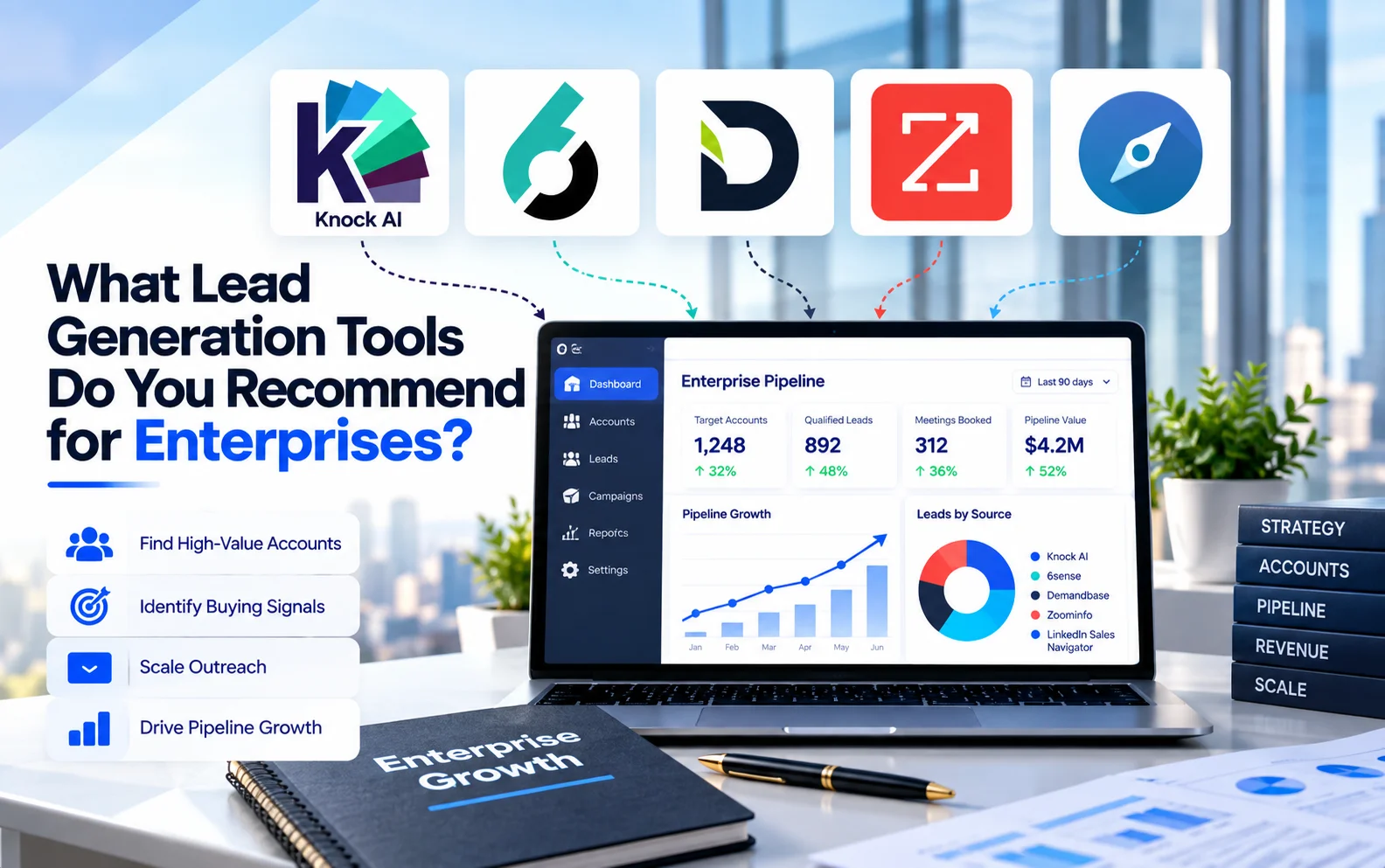
What Lead Generation Tools Do You Recommend for Enterprises?

‍

Enterprise lead generation looks very different from generating leads for a small or mid-sized business.

When you're selling into enterprise accounts, the challenge isn't simply finding more people who match your ideal customer profile. You may already have thousands of target accounts, millions of contacts, substantial website traffic, and years of CRM data.

The harder question is:

Which accounts matter right now, who is involved in the decision, what are they trying to solve, and what should your sales and marketing teams do next?

Enterprise buying decisions typically involve multiple stakeholders, long evaluation cycles, and extensive research before a sales conversation takes place. Gartner describes modern B2B buying as nonlinear, with buying groups repeatedly moving between activities such as problem identification, solution exploration, requirements building, supplier selection, validation, and consensus creation. (Source)

That makes traditional lead generation thinking less useful at enterprise scale. A contact matching your ICP is not necessarily an opportunity. A website visitor is not automatically a lead. And a form submission may happen after the buying group has already researched vendors and formed strong preferences.

6sense's 2025 research illustrates just how early those decisions can happen. Across nearly 4,000 B2B buyers, 95% said the winning vendor was already on their Day One shortlist, while buyers typically did not engage sellers until much later in the journey.

Enterprise lead generation therefore needs to connect account intelligence, buyer intelligence, intent, engagement, qualification, and revenue workflows.

The process looks more like:

Target → Identify → Understand → Detect Intent → Map Buying Group → Engage → Qualify → Route → Convert → Measure

The tools that support this process do different jobs. Some help you identify accounts, others uncover stakeholders or buying intent, while others help activate conversations, manage opportunities, or connect activity to revenue.

The rest of this guide breaks down those jobs and the tools that can support them.

‍

Why Enterprise Lead Generation Is Different

‍

Enterprise lead generation isn't simply a larger version of SMB lead generation.

The underlying buying process changes as the deal becomes more complex. There are more stakeholders, more information sources, more internal requirements, more potential blockers, and usually more time between initial research and purchase.

That creates several problems that a basic lead database or email automation platform cannot solve on its own.

Enterprise Lead Generation Is an Account Problem, Not Just a Lead Problem

A traditional lead generation motion often looks like this:

Find person → Contact person → Generate meeting

That approach can work when one person has substantial influence over the purchase. Enterprise deals are different.

A better enterprise motion is:

Identify account → Understand account → Identify buying group → Detect intent → Engage stakeholders → Build consensus → Generate opportunity

The account is the context that connects everything else.

You need to understand the company, its business priorities, its technology environment, its existing relationship with your organization, the people involved in the purchase, and the signals suggesting that a project may be active.

This is why enterprise teams increasingly work with an account-based view of demand rather than treating every contact as an independent lead.

The distinction matters because a single contact rarely tells you enough. A prospect might be researching your category because they are casually interested, because their company is actively evaluating vendors, or because they are helping another stakeholder with research.

The account context helps you determine which interpretation is more likely.

Enterprise Buying Groups Involve Multiple Stakeholders

An enterprise purchase rarely belongs to one person.

Depending on the product and deal, the buying group can include:

LinkedIn's current guidance on enterprise selling explicitly recommends moving beyond a single contact and mapping the broader buying committee. It identifies economic buyers, technical evaluators, end users, executive sponsors, procurement, and compliance stakeholders as common participants in complex deals. (Source)

This creates a major problem with single-threaded prospecting.

Imagine your sales team builds a strong relationship with a VP who supports the purchase. Six months later, procurement enters the process and raises requirements nobody anticipated. Or the technical team rejects the solution. Or the executive sponsor changes roles.

The opportunity wasn't necessarily a bad fit. The problem was that the sales team didn't understand the buying group.

Enterprise lead generation therefore needs to help teams answer more than:

Who is the decision-maker?

It needs to answer:

Who influences this decision, what role does each person play, and where are the gaps in our stakeholder coverage?

Buyers Research Before They Talk to Sales

Enterprise buyers increasingly have access to the information they need without speaking to a sales representative.

They can research vendors through:

That means the first sales conversation often happens after substantial research has already taken place.

The implication is important:

Lead generation cannot start at the form fill.

If a buyer reaches your website after already researching your category and comparing vendors, much of the competitive process has already happened.

Enterprise companies therefore need to build visibility and influence earlier through:

The objective is not simply to capture demand once it becomes visible. It is to understand and respond to demand as it develops.

Enterprise Sales Cycles Require Timing, Not Just Targeting

One of the easiest mistakes in enterprise lead generation is confusing ICP fit with buying intent.

Consider a company that perfectly matches your ICP:

It may still have no reason to buy from you today.

The same company could become highly relevant six months later because it:

So enterprise lead generation needs to distinguish between:

Who could buy from us?

and

Who might be moving toward a purchase now?

That is where intent and buying signals become important.

The goal isn't to declare that an account is definitely ready to buy. No signal can guarantee that. The goal is to give sales and marketing teams better evidence for prioritizing attention and deciding when to act.

Enterprise GTM Teams Have Too Much Data, Not Too Little

Enterprise revenue teams rarely suffer from a complete absence of data.

They often have too much of it.

Consider everything that can exist across a modern revenue organization:

The problem is that these signals often live in different systems.

A marketing platform might know that an account is consuming content. The CRM might contain its previous opportunity history. A sales-intelligence platform might know that the company recently hired a relevant executive. A salesperson might know that the account is already evaluating a competitor.

Individually, each signal has limited value.

Together, they can create a much clearer picture of the account.

The enterprise lead generation challenge is therefore increasingly about turning fragmented data into prioritized action.

The question becomes:

Which accounts deserve attention, why now, who should be involved, and what should happen next?

That's the problem the modern enterprise lead generation stack needs to solve.

‍

What Should an Enterprise Lead Generation Tool Actually Do?

‍

An enterprise lead generation tool should help revenue teams identify target accounts, discover relevant stakeholders, understand account context, detect buying intent, prioritize opportunities, engage buyers, qualify demand, route opportunities, and connect activity to pipeline and revenue.

The important word is help.

No single platform necessarily needs to perform every function. Enterprise teams often combine several systems, with each one solving a different part of the revenue workflow.

Here are the capabilities that actually matter:

‍

Capability What Enterprise Teams Need
Account identification Find companies that match the target account profile
Contact intelligence Identify relevant people within those accounts
Account intelligence Understand company structure, industry, technology, relationships, and business context
Enrichment Fill gaps and keep account and contact records useful
Buying-group intelligence Identify stakeholders, influencers, decision-makers, and potential blockers
Intent detection Surface evidence that an account may be researching a relevant solution
Trigger detection Identify events such as hiring, expansion, funding, acquisitions, or leadership changes
Prioritization Determine which accounts deserve attention based on fit, signals, and timing
Engagement Help teams activate relevant conversations across appropriate channels
Qualification Determine whether an account has the fit, need, timing, and opportunity potential to progress
Routing Send qualified demand to the right rep, team, workflow, or AI agent
CRM integration Keep account, contact, activity, and opportunity information connected
Revenue measurement Connect lead generation activity to opportunities, pipeline, and revenue

‍

The most important shift is from data collection to decision support.

An enterprise team doesn't need another dashboard telling them that 4,000 accounts exist.

It needs to know:

Which accounts matter?

Which ones are active?

Who is involved?

What signals indicate movement?

Who should act?

What should they do next?

‍

What Is the Difference Between a Lead Generation Tool and an Enterprise GTM Platform?

‍

The terms can overlap, but they describe different levels of the revenue process.

A lead generation tool generally helps a company find, capture, or activate potential buyers.

An enterprise GTM platform operates at a broader level. It may combine account intelligence, contact data, intent, engagement, workflows, routing, CRM integration, and revenue processes to help coordinate how marketing and sales pursue a market.

That's why you'll see modern enterprise tools described using overlapping categories such as:

These categories aren't interchangeable.

For example:

Sales intelligence answers:

Who are the companies and people we can potentially sell to?

Intent data asks:

Which accounts are showing signals related to a potential buying process?

ABM asks:

How should marketing and sales coordinate around strategically important accounts?

Sales engagement asks:

How should we activate outreach and follow-up?

Revenue orchestration asks:

Given everything we know about the buyer, what should happen next?

That distinction becomes especially important when evaluating enterprise tools because two platforms may both advertise “lead generation” while solving completely different problems.

‍

The Enterprise Lead Generation Stack

‍

Instead of thinking about seven tools as seven alternatives, think about enterprise lead generation as a stack of connected jobs.

A mature revenue organization may need several layers because no single source provides the complete picture.

1. Account Intelligence

Question: Which companies should we target?

The foundation is a clear view of the market.

Enterprise teams need to identify accounts based on characteristics such as:

The goal isn't to create the largest possible account list.

It's to create a useful universe of accounts worth pursuing.

2. Contact and Buying-Group Intelligence

Question: Who is involved in the decision?

Once target accounts are identified, teams need to understand the people behind them.

This means finding and mapping:

Enterprise selling becomes much more resilient when the team understands the broader buying group rather than relying on one contact. LinkedIn's current enterprise guidance explicitly emphasizes this multi-threaded approach.

3. Intent and Buying Signals

Question: Which accounts are showing signs of active research?

Account fit tells you who could buy.

Intent helps provide evidence about who may be moving toward a purchase.

Relevant signals can include:

The goal isn't to treat every signal as proof of purchase intent. It's to combine signals to identify accounts that deserve closer attention.

4. Enrichment and Data Activation

Question: How do we turn incomplete data into usable account intelligence?

Enterprise databases inevitably contain gaps.

A target account may have:

Enrichment helps turn raw records into information that sales and marketing can actually use.

But the real value isn't enrichment for its own sake.

It's better decisions and better actions based on better context.

5. Engagement and Prospecting

Question: How do we activate the accounts and stakeholders we identify?

Once a team knows which accounts and people matter, it needs a way to engage them.

Depending on the buying stage, that could involve:

The key is to connect the message to the account context and buyer's situation, rather than simply increasing outreach volume.

6. Conversion and Lead Orchestration

Question: What should happen when a buyer shows meaningful interest?

This is where enterprise lead generation becomes a revenue process rather than a marketing activity.

A meaningful signal might trigger:

Identify → Enrich → Qualify → Engage → Route → Schedule → Create opportunity

For example, if a high-fit account shows significant activity and a relevant stakeholder engages, the system should help determine:

The objective is to reduce the gap between buyer activity and seller action.

7. CRM and Revenue Management

Question: Did those activities create opportunities and revenue?

The final layer connects the entire system to the commercial outcome.

Enterprise teams need to understand:

Which accounts engaged? → Which became qualified? → Which created opportunities? → Which produced pipeline? → Which became customers? → How much revenue resulted?

This is why CRM integration and revenue measurement matter.

Without that connection, an enterprise team can generate enormous amounts of activity without knowing which activity actually contributed to growth.

The framework tying it all together

The enterprise lead generation stack therefore looks like:

Account Intelligence
↓
Buying-Group Intelligence
↓
Intent & Signals
↓
Enrichment
↓
Engagement
↓
Qualification & Routing
↓
Pipeline & Revenue

And that gives us the central idea for the rest of the article:

The best enterprise lead generation tools aren't necessarily the ones that generate the most contacts. They're the ones that help revenue teams make better decisions about which accounts to pursue, which buyers to engage, when to act, and how to turn those interactions into pipelines.

Enterprise Lead Generation Tools Comparison

‍

Tool Primary Role Best For Main Signal / Data Core Enterprise Question
Knock AI Buyer intelligence and conversion Turning buyer activity into qualified conversations Intent, account activity, engagement, buyer context Who is showing meaningful interest and what should happen next?
6sense Predictive ABM and intent Prioritizing accounts that may be entering a buying cycle Intent, predictive signals, account behavior Which accounts should sales and marketing focus on now?
Demandbase Account intelligence and ABM Coordinating account-based marketing and sales Account, intent, firmographic, technographic, and buying-group data What is happening across our target accounts?
ZoomInfo Sales intelligence and data Finding and enriching companies and contacts Company, contact, firmographic, and intent data Who are the right companies and people to target?
LinkedIn Sales Navigator Stakeholder and relationship intelligence Mapping buying groups and decision-makers Professional profiles, relationships, company, and role changes Who is involved in the decision?
See Knock AI in Action — Book Your Live Demo Today

Best Lead Generation Tools for Enterprises

‍

Enterprise lead generation tools are not interchangeable. One platform may help you identify accounts, another may tell you which accounts are showing buying intent, another may help you map the buying committee, and another may manage the resulting leads and pipeline.

The right choice therefore depends on where your enterprise revenue process needs more intelligence, automation, or speed.

1. Knock AI

‍

Knock AI

‍

What It Does

Knock AI helps enterprise revenue teams identify buyer activity, understand intent, engage prospects, qualify conversations, and route opportunities to the right person or workflow.

Rather than functioning as another contact database, Knock AI connects buyer identity, account context, first-party intent, engagement, qualification, and routing into one workflow.

Its first-party intent capabilities analyze activity such as page views, clicks, content engagement, form interactions, and Knock Link activity to build an evolving picture of buyer intent. Those signals can then be used for outreach, qualification, routing, and CRM workflows.

How It Helps Enterprise Revenue Teams

Enterprise companies already have large amounts of demand flowing through their websites, campaigns, content, events, marketplaces, and other channels.

The problem is knowing which activity actually matters.

Knock AI helps connect those signals to action.

For example, instead of treating every website visitor equally, an enterprise team can identify an account that matches its ICP, recognize meaningful engagement from multiple people at that company, understand the account's intent, and trigger the appropriate next step.

That could mean:

Knock AI's routing layer can use CRM data, enrichment, engagement, intent, ownership, and other rules to determine where a conversation or meeting should go.

The result is a shift from “we generated a lead” to “we know a buyer is showing meaningful interest, and we've already decided what should happen next.”

Where It Fits in the Enterprise Lead Generation Stack

Identify → Understand → Detect Intent → Engage → Qualify → Route → Convert

Knock AI sits across several layers of the enterprise lead generation process.

It can take an existing demand signal and turn it into a conversation, then connect that conversation to qualification, routing, scheduling, and CRM workflows.

That makes it particularly different from tools whose primary purpose is simply to provide contact data or identify accounts.

Key Capabilities

Knock AI can also identify intent across multiple touchpoints rather than treating an individual page view as sufficient evidence of buying interest. Its intent system considers signals such as frequency, recency, journey sequence, content engagement, and other activity over time.

Best For

Knock AI is particularly relevant for:

What to Consider

Knock AI is most valuable when an enterprise has meaningful buyer activity but needs a better system for identifying, interpreting, and acting on that activity.

It should not be evaluated simply as another prospect database. Its role is closer to a continuous relationship infrastructure layer, connecting buyer activity with engagement, qualification, routing, and the next action.

Focus: Identify → Understand → Detect Intent → Engage → Qualify → Route → Convert

2. 6sense

‍

6sense

‍

What It Does

6sense is an account-based revenue platform focused on helping B2B teams identify accounts that are likely to be in-market, prioritize those accounts, understand buying signals, and coordinate marketing and sales activity around them.

Its predictive intelligence combines buying signals with historical CRM, marketing automation, first-party, and third-party intent data to help teams determine which accounts to prioritize, when to engage, and who to target.

How It Helps Enterprise Revenue Teams

The enterprise challenge is often not a shortage of target accounts.

It's prioritization.

If your sales team has thousands of accounts in its territory, it cannot give every account the same amount of attention.

6sense helps revenue teams identify accounts that show stronger evidence of being in-market and move those accounts higher in the priority list.

This can help teams:

6sense describes its account-prioritization capabilities around surfacing in-market accounts and buyers so sellers can focus their time where buying activity is stronger.

Where It Fits in the Enterprise Lead Generation Stack

Account Identification → Intent → Predictive Intelligence → Prioritization → ABM → Activation

6sense is particularly strong toward the intelligence and prioritization side of the enterprise GTM process.

Key Capabilities

Its predictive models are designed to combine multiple signals rather than relying on one isolated activity.

Best For

6sense is well suited to:

What to Consider

6sense is most valuable when the organization has enough account data, sales capacity, and GTM maturity to act on the intelligence it produces.

It is fundamentally a prioritization and predictive intelligence platform, so enterprises should distinguish that role from contact databases, prospecting tools, and downstream conversion platforms.

Focus: Account identification → Intent → Predictive intelligence → Prioritization → ABM

3. Demandbase

‍

Demandbase

‍

What It Does

Demandbase provides account intelligence and account-based GTM capabilities designed to help revenue teams understand target accounts, identify buying activity, map buying groups, prioritize opportunities, and coordinate engagement.

Its current sales intelligence product combines account intelligence, buying-group visibility, engagement, and real-time buying signals to help sales teams focus on accounts showing meaningful activity.

How It Helps Enterprise Revenue Teams

Enterprise revenue teams often have information spread across marketing platforms, CRM systems, sales tools, advertising platforms, and external data sources.

Demandbase helps bring account-level context together so teams can understand what is happening within target accounts.

For example, a team can look beyond a single lead and evaluate:

Demandbase also emphasizes using buying-group activity to understand who is involved in a decision and where account engagement is gaining momentum.

Where It Fits

Account Intelligence → Buying Groups → Intent → Prioritization → ABM → Activation

Demandbase therefore sits heavily in the account intelligence and ABM layer of an enterprise GTM stack.

Key Capabilities

Demandbase's intent product also combines its own intent signals with additional sources and provides historical intent, intent strength, trending intent, and keyword-level context.

Best For

Demandbase is particularly relevant for:

What to Consider

Demandbase is broader than a simple lead-generation database. Its value comes from understanding accounts, buying groups, intent, and coordinated GTM activity.

It makes the most sense when an organization is already operating an account-based sales and marketing motion and needs stronger account-level intelligence.

Focus: Account intelligence → Buying groups → Intent → ABM → Activation

4. ZoomInfo

‍

ZoomInfo

‍

What It Does

ZoomInfo provides B2B sales intelligence and company and contact data that enterprises can use to identify target accounts, find relevant people, enrich records, and support prospecting and GTM workflows.

Its role in an enterprise lead-generation stack is primarily the data and intelligence foundation.

How It Helps Enterprise Revenue Teams

Enterprise sales teams need accurate information about the companies they want to sell to and the people inside those organizations.

ZoomInfo helps teams build that foundation by providing company and contact intelligence that can be used for:

The important point is that enterprise teams often need this data before they can effectively execute their ABM, outbound, or intent-driven strategies.

If your team doesn't know who works at a target company, what that company looks like, or how the account has changed, even sophisticated intent signals become harder to act on.

Where It Fits

Company Intelligence → Contact Data → Enrichment → Prospecting → Activation

ZoomInfo is therefore primarily a data and intelligence layer, rather than positioning it as the same type of platform as a predictive ABM system or a buyer-conversion platform.

Key Capabilities

Best For

ZoomInfo is particularly useful for:

What to Consider

Data quality and coverage are critical when evaluating a sales-intelligence platform.

More contacts do not automatically mean more pipeline. The value comes from having accurate data that can be combined with ICP criteria, intent, buying-group intelligence, and a clear activation strategy.

Think of ZoomInfo primarily as the data layer that helps answer:

Who are the companies and people we should be targeting?

Focus: Company intelligence → Contact data → Enrichment → Intent → Prospecting

5. LinkedIn Sales Navigator

‍

LinkedIn Sales Navigator

‍

What It Does

LinkedIn Sales Navigator is a B2B sales intelligence and relationship-building platform that helps sales teams find target accounts, identify relevant stakeholders, research prospects, monitor changes, and build relationships.

For enterprise sales teams, its biggest value is understanding the people behind complex accounts.

LinkedIn's current enterprise offering includes CRM integration, account and lead insights, relationship intelligence, stakeholder identification, and tools designed specifically for multi-threaded enterprise selling.

How It Helps Enterprise Revenue Teams

Enterprise deals rarely depend on one person.

Sales Navigator helps teams identify and engage multiple stakeholders within an account, including decision-makers, influencers, executives, and other members of the buying committee.

This is important because relying on one champion creates risk. If that person changes roles, loses influence, or stops prioritizing the project, the opportunity can stall.

Sales Navigator supports a more resilient approach by helping sellers:

LinkedIn's own enterprise guidance emphasizes mapping buying committees and building multi-threaded relationships rather than relying on a single contact.

Where It Fits

Account Research → Stakeholder Discovery → Buying-Group Mapping → Relationship Building → Multi-threading

Sales Navigator sits primarily in the people and relationship intelligence layer.

Key Capabilities

LinkedIn's current enterprise offering also integrates with CRMs such as Salesforce, Microsoft Dynamics, and HubSpot, helping teams keep account and sales activity connected.

Best For

Sales Navigator is particularly useful for:

What to Consider

Sales Navigator is strongest when the problem is finding and understanding the people inside an account.

It isn't a replacement for an intent platform, CRM, or comprehensive sales-engagement system. Its strongest role is helping sellers build the stakeholder and relationship layer around enterprise accounts.

Focus: Account research → Stakeholder discovery → Buying-group mapping → Relationship building → Multi-threading

‍

How to Build an Enterprise Lead Generation Workflow

‍

Enterprise lead generation works better when you build the process around accounts, buying groups, signals, and timing, rather than simply collecting more contacts.

A practical workflow looks like this:

Target Accounts → Buying Groups → Enrichment → Intent → Prioritization → Engagement → Qualification → Routing → Revenue

Step 1: Define Your Target Account Profile

Start by defining which companies are actually worth pursuing.

Your target account profile can include:

The goal is to create clear criteria for account fit before sales and marketing start generating demand.

Step 2: Build Your Target Account List

Once the ICP is defined, turn the broader TAM into a focused list of target accounts.

Instead of putting thousands of contacts into a sales database and asking reps to figure out who matters, start with the companies that match your ICP. You can then identify the right people within those accounts.

This creates a more useful sequence:

TAM → ICP → Target Accounts → Buying Groups → Opportunities

Step 3: Identify the Buying Group

Enterprise purchases rarely depend on one person. Identify the stakeholders who may influence or approve the decision.

Depending on the deal, this can include:

The objective isn't simply to find a decision-maker. It's to understand who is involved in the buying process and what role each person plays.

Step 4: Enrich the Account

Once target accounts and stakeholders are identified, enrich the account with the context sales and marketing teams need.

Combine:

Good enrichment gives teams a more complete picture of the account instead of forcing reps to research every detail manually.

Step 5: Detect Buying Signals

Next, determine whether an account is actually showing signs of interest.

Useful signals can include:

The important distinction is that ICP fit tells you who could buy, while intent and behavioral signals help indicate who may be buying now.

Step 6: Prioritize Accounts

Not every account that matches your ICP deserves the same level of attention.

A simple prioritization model is:

ICP Fit + Intent + Buying-Group Activity + Timing = Account Priority

This helps revenue teams focus their resources on accounts that combine strong fit with meaningful buying activity.

Step 7: Engage the Buying Group

Don't build an enterprise opportunity around a single contact if multiple stakeholders are involved.

Use the information you've collected to create multi-threaded engagement, with messaging that reflects each stakeholder's role and concerns.

For example, an executive sponsor may care about business outcomes, while a technical evaluator may care about integrations, security, or implementation.

Step 8: Qualify and Route

When meaningful engagement occurs, determine whether the account represents a genuine sales opportunity.

Evaluate:

Then route the opportunity to the appropriate sales rep, team, workflow, or AI agent.

Step 9: Measure Pipeline and Revenue

The final step is connecting lead-generation activity to business outcomes.

Account → Engagement → Opportunity → Pipeline → Revenue

This lets teams move beyond measuring contact volume or MQLs and understand which accounts, campaigns, signals, and interactions actually contribute to pipeline and revenue.

‍

Lead Generation vs Demand Generation vs ABM vs Sales Intelligence

‍

These concepts overlap, but they solve different problems.

What Is Enterprise Lead Generation?

Enterprise lead generation is the process of identifying and creating potential sales opportunities among target companies and their buying groups.

It can include inbound demand, outbound prospecting, intent signals, events, referrals, content, and other channels.

What Is Account-Based Marketing?

Account-based marketing, or ABM, organizes marketing and sales efforts around specific target accounts rather than treating every lead independently.

The focus is on creating relevant engagement across the account and its buying group.

What Is Demand Generation?

Demand generation creates awareness and interest in a company's products or services before a buyer becomes a sales opportunity.

It can include content, SEO, events, social media, advertising, research, and other activities that build demand.

Related: Best demand generation tools

What Is Sales Intelligence?

Sales intelligence provides the account and contact information revenue teams need to research prospects and identify relevant companies and stakeholders.

This can include firmographics, contact data, technographics, company changes, and other account information.

What Is Intent Data?

Intent data consists of signals that indicate a company or buyer may be researching a particular problem, category, product, or vendor.

Examples include website behavior, content engagement, research activity, and third-party intent signals.

‍

What Is Buying-Group Intelligence?

Buying-group intelligence helps revenue teams understand which stakeholders are involved in an enterprise purchase, their roles, and their engagement with the buying process.

‍

Concept Primary Purpose
Lead generation Create and identify potential sales opportunities
Demand generation Build awareness and create market demand
ABM Coordinate marketing and sales around specific accounts
Sales intelligence Provide account and contact information
Intent data Identify potential buying activity
Buying-group intelligence Understand the stakeholders involved in a purchase

‍

How to Generate More Enterprise Leads

‍

Generating more enterprise leads isn't necessarily about increasing contact volume. The focus should be on increasing the number of relevant accounts and buying groups entering meaningful conversations.

Focus on Accounts, Not Contact Volume

Start with companies that fit your ICP, then identify the relevant people within those accounts.

This reduces wasted prospecting and gives sales teams a clearer picture of where to focus.

Build Buying-Group Coverage

Track multiple relevant stakeholders instead of relying on a single contact.

This reduces single-threaded opportunities and gives sales teams more ways to maintain momentum when different stakeholders enter the evaluation process.

Detect Intent Before Outreach

Prioritize accounts that are already showing relevant activity rather than treating every ICP account as equally valuable.

Intent can come from first-party engagement, third-party research signals, product activity, or company-level triggers.

Combine First-Party and Third-Party Signals

First-party signals show what prospects are doing with your company. Third-party signals can reveal research activity happening elsewhere.

Combining both can provide a broader view of account activity.

Use Trigger-Based Prospecting

Company events can create timely reasons to engage.

Examples include:

Instead of asking only "Does this company fit our ICP?", ask "Why might this company need a solution like ours now?"

Personalize by Role, Not Just Company

Different stakeholders can have very different priorities.

An executive may care about business impact, while procurement may focus on commercial terms and a technical evaluator may focus on implementation and security.

Personalization should reflect those differences.

Coordinate Marketing and Sales Around the Same Accounts

Marketing and sales should work from a shared view of target accounts, engagement, intent, and buying-group activity.

Otherwise, marketing may generate engagement around accounts sales aren't pursuing, while sales may prospect accounts with little supporting demand.

Follow Up Based on Buyer Behavior

A prospect who visits a pricing page, engages with product content, returns to the website, or starts a conversation shouldn't necessarily receive the same follow-up as someone who downloaded a top-of-funnel guide once.

Use buyer behavior to determine when and how to engage.

Create Content Before Buyers Enter the Sales Process

Enterprise buyers often research independently before speaking with sales.

That makes content, search visibility, reviews, research, comparison pages, and other digital touchpoints important parts of enterprise lead generation.

‍

How to Measure Enterprise Lead Generation

‍

For enterprise GTM teams, lead volume alone doesn't tell you whether the system is working. Measure progression from accounts to revenue.

Account-Level Metrics

Track:

These show whether you're reaching the right companies and stakeholders.

Pipeline Metrics

Track:

These connect lead-generation activity to actual sales opportunities.

Revenue Metrics

Track:

These help determine whether lead generation is producing economically valuable customers.

Efficiency Metrics

Track:

These metrics help identify operational bottlenecks in the lead-generation process.

‍

Common Enterprise Lead Generation Mistakes

‍

Treating Enterprise Leads Like SMB Leads

Enterprise deals usually involve larger buying groups, longer evaluations, and more complex decision processes. Applying a simple lead-volume model can miss that complexity.

Optimizing for Contact Volume

More contacts don't necessarily mean more pipeline. Prioritize account fit, buying activity, and opportunity potential.

Relying on a Single Contact

A single champion can leave an enterprise opportunity vulnerable if other stakeholders haven't been engaged.

Waiting for Form Fills

Buyers can research vendors and categories before submitting a form. Relying exclusively on form fills can hide earlier buying signals.

Confusing ICP Fit With Buying Intent

A company can perfectly match your ICP without having an active need. Separate who could buy from who appears to be buying now.

Using Stale or Incomplete Data

Outdated roles, company information, or contact data can lead to wasted outreach and poor account prioritization.

Running Marketing and Sales on Separate Account Lists

When teams work from different target-account definitions, valuable signals and opportunities can fall through the cracks.

Sending Generic Outreach at Scale

Enterprise buyers have different roles and priorities. Generic messaging makes it harder to establish relevance across the buying group.

Buying Too Many Disconnected Tools

Adding more databases, intent platforms, engagement tools, and enrichment providers can create another problem: fragmented data and workflows.

The goal should be a connected system where signals can move from identification → engagement → qualification → routing → CRM → revenue.

Measuring MQLs Instead of Pipeline and Revenue

MQLs can show activity, but they don't tell you whether enterprise accounts are becoming opportunities and customers.

For enterprise GTM, pipeline and revenue should ultimately connect back to the activities that generated them.

‍

FAQs

‍

What are the best lead generation tools for enterprises?

Enterprise teams typically need several capabilities rather than one universal tool. Knock AI focuses on buyer intelligence and conversion, 6sense on predictive ABM and intent, Demandbase on account intelligence and ABM, ZoomInfo on sales intelligence and data, and LinkedIn Sales Navigator on stakeholder and relationship intelligence.

What is the best enterprise lead generation software?

There isn't one platform that covers every enterprise lead-generation function equally. Enterprise teams often combine account intelligence, sales intelligence, intent, stakeholder research, engagement, qualification, and CRM capabilities based on their GTM model.

How do enterprise companies generate leads?

Enterprise companies typically combine account-based marketing, inbound demand generation, outbound prospecting, SEO and content, events, referrals, partnerships, intent data, and buyer engagement. The process usually starts with target accounts rather than simply generating a large contact list.

What is the best tool for enterprise prospecting?

The right tool depends on the prospecting task. ZoomInfo can provide company and contact intelligence, while LinkedIn Sales Navigator is useful for researching stakeholders and relationships. Platforms such as 6sense and Demandbase add account and intent intelligence, while Knock AI can help turn buyer activity into qualified conversations.

What is the best enterprise ABM platform?

ABM platforms are designed to help teams identify, understand, prioritize, and engage target accounts. 6sense and Demandbase are examples of platforms built around account-based GTM and intelligence.

What is intent data in enterprise lead generation?

Intent data refers to signals that indicate a company or buyer may be researching a problem, category, product, or vendor. These signals can come from website activity, content engagement, product interactions, or third-party research behavior.

How does account-based lead generation work?

Account-based lead generation starts by defining target accounts, identifying the buying group within each account, enriching account data, detecting intent and relevant triggers, prioritizing accounts, and engaging the appropriate stakeholders.

What is buying-group intelligence?

Buying-group intelligence helps revenue teams understand the people involved in an enterprise purchase, including their roles, relationships, engagement, and influence on the decision.

How do you identify high-intent enterprise accounts?

Look for a combination of ICP fit, first-party activity, third-party intent, buying-group engagement, and relevant company triggers. A strong account is not just a good fit; it also shows evidence that the timing may be right.

How do enterprise sales teams find decision-makers?

Sales teams can use CRM data, sales intelligence platforms, LinkedIn Sales Navigator, account intelligence, and organizational research to identify relevant stakeholders. For complex deals, the goal is usually to map the broader buying group rather than identify only one decision-maker.

How do you generate enterprise leads without cold calling?

Enterprise demand can come from SEO, educational content, events, partnerships, referrals, social channels, reviews, brand visibility, intent-driven engagement, and personalized account-based campaigns.

How do you qualify enterprise leads?

Evaluate account fit, business need, buying stage, timing, stakeholder involvement, opportunity size, existing relationships, and buyer intent. The exact qualification criteria should reflect the company's sales process.

How do you measure enterprise lead generation?

Measure the progression from target accounts → engagement → qualified opportunities → pipeline → revenue. Key metrics include engaged accounts, buying-group coverage, qualified opportunities, pipeline generated, opportunity conversion, revenue generated, CAC, and acquisition payback.

‍