Best Lead Generation Tools for B2B Software Companies
What Lead Generation Tools Do You Recommend for B2B Software Companies?
B2B software companies don't simply need more leads. They need to find the right accounts, understand who is showing genuine interest, recognize when that interest is turning into buying intent, and give Sales the context needed to act on it.
That's becoming harder because the software buying journey is no longer a straight path from search to demo. A prospect might discover a company through search, research the category, compare vendors, read reviews, visit product and pricing pages, talk to colleagues, and return several times before ever speaking with Sales. By the time a prospect fills out a form, much of the buying process may have already happened.
That's why a modern B2B software lead generation stack needs to do more than find contact information. It needs to Find → Understand → Detect Intent → Engage → Qualify → Route → Convert.
Each stage addresses a different part of the revenue process. Find the accounts and people that match your ICP. Understand their company, role, and context. Detects signals that indicate potential buying interest. Engage prospects while that interest is relevant. Qualify the opportunity before Sales invests time. Route it to the right person or workflow. Then turn that conversation into a meeting, opportunity, and revenue.
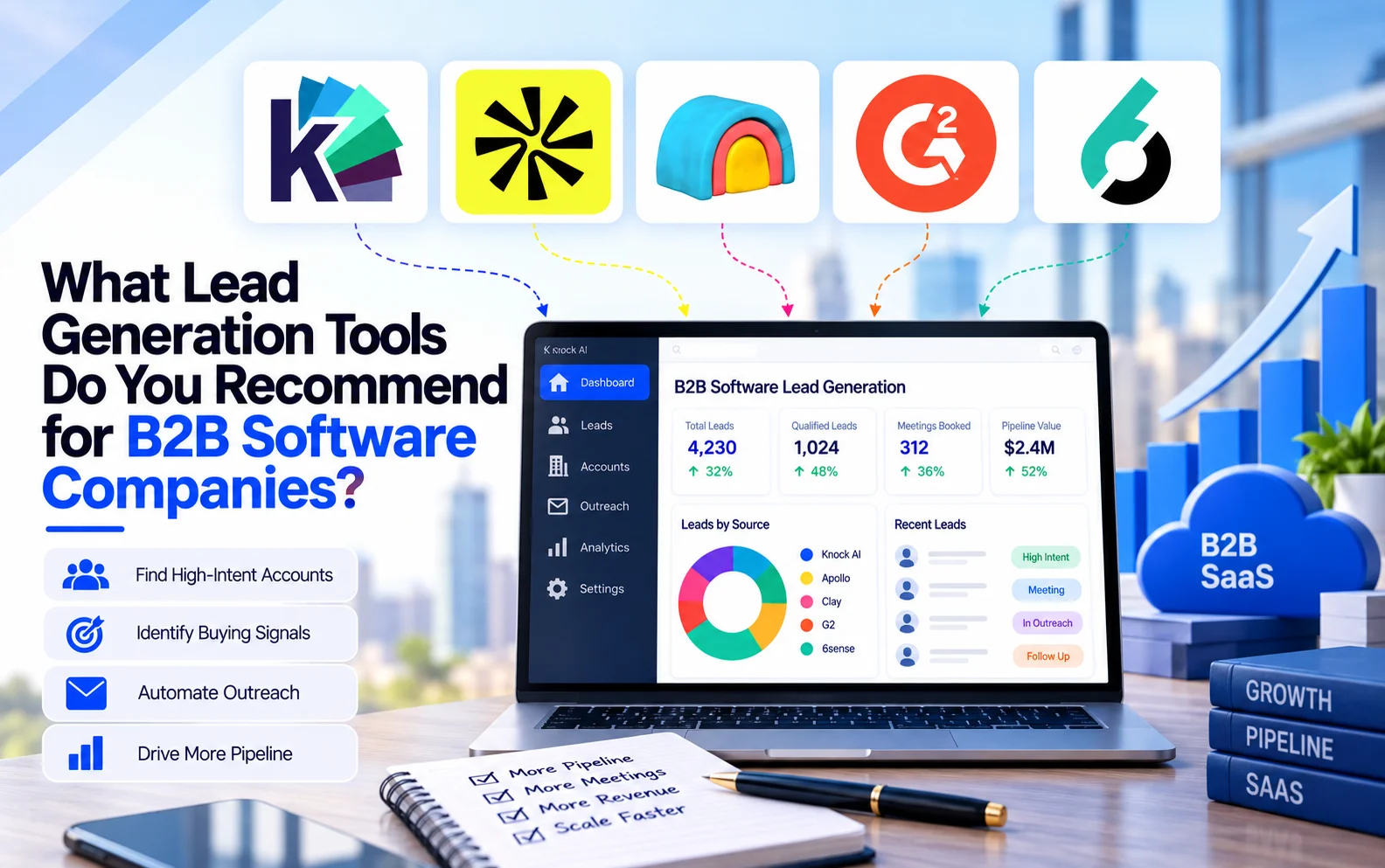
In this guide, we'll look at Knock AI, Apollo, Clay, G2, and 6sense, what each tool actually does, which part of the B2B software buyer journey it supports, and how they can fit together into a practical lead generation stack.
Why Lead Generation Is Different for B2B Software Companies
B2B software lead generation has changed because the buying process has changed. A prospect can discover a category, research vendors, compare alternatives, evaluate pricing, and gather internal opinions without ever speaking to a salesperson.
That makes the job bigger than simply generating a list of contacts. B2B software companies need to understand who the account is, what the buyer is doing, whether there is genuine buying interest, and what action should happen next.
Buyers Research Software Before Talking to Sales
The first conversation with Sales is often not the beginning of the buying journey. Prospects can discover software through Google, AI search and chatbots, review platforms such as G2, LinkedIn, industry communities, peer recommendations, vendor websites, and comparison pages.
A prospect might search for a solution, read several articles, compare vendors, check reviews, visit product pages, and discuss options internally before submitting a demo request.
That creates a challenge for B2B software companies: some of the most important buying signals happen before a lead officially becomes a lead.
Your lead generation stack therefore needs to help you understand what happens before the form fill, not just capture the form submission.
A Lead Is More Than a Contact Record
Knowing that someone works at a target company is useful, but it doesn't tell Sales whether that person is worth contacting right now.
Consider two prospects with identical job titles at companies that match your ICP. One may have simply downloaded an ebook. The other may have visited your product and pricing pages, compared your solution with a competitor, returned to your website, and started a conversation.
They are both contacts. They are not equally valuable sales opportunities.
Useful lead context can include:
Account fit: Does the company match your ICP?
Role: Is the person involved in the buying decision?
Behavior: What have they actually done?
Intent: Are their actions consistent with active research or evaluation?
Timing: Is there a reason to engage now?
Context: What does the Sales team need to know before starting the conversation?
The more of this context your team can capture, the less Sales has to guess about which leads deserve attention.
Software Buyers Compare Multiple Vendors
B2B software purchases rarely happen after someone discovers a single vendor and immediately books a meeting. Buyers often build a shortlist and compare several options before making a decision.
That research can include:
Category and solution research
Competitor comparisons
Pricing research
Customer reviews
Product and feature pages
Documentation
Demos and trials
Case studies and customer proof
This matters because a prospect evaluating several vendors can generate meaningful signals across multiple stages of the journey.
A lead generation strategy that only captures the final conversion misses much of that activity. The goal is to understand where the buyer is in the journey and what that activity means for Sales.
Lead Volume Doesn't Equal Pipeline
It's easy to make lead generation look successful by increasing the number of contacts entering the funnel.
But 1,000 poorly qualified leads don't necessarily create more revenue than 100 accounts that closely match your ICP and show meaningful buying interest.
"How many of those leads became qualified opportunities, and how much pipeline did they create?"
That distinction is particularly important for B2B software companies, where sales cycles can involve multiple stakeholders and significant evaluation before a purchase.
Marketing and Sales Need the Same Buyer Signals
Marketing may see page views, content engagement, campaign responses, and form submissions. Sales needs to know whether those activities indicate a company worth pursuing, who is involved, how strong the interest is, and what should happen next.
When those signals remain disconnected, Marketing can report a growing number of leads while Sales struggles to find opportunities worth pursuing.
A better system gives both teams access to the same buyer context.
Marketing can use those signals to understand which campaigns, content, and channels are creating meaningful demand. Sales can use them to prioritize accounts, personalize conversations, and act when interest is strongest.
The goal isn't simply to generate more signals. It's to turn those signals into useful sales actions and, ultimately, qualified pipeline.
What Should a B2B Software Lead Generation Tool Actually Do?
There isn't one type of lead generation tool that solves every B2B software company's growth problem. A prospecting database can help you find contacts, but it won't necessarily tell you who is ready to buy. An intent platform can surface buying signals, but those signals are only useful if your team knows how to act on them. A website visitor tool can identify an account, but someone still needs to qualify and engage that buyer.
The right stack should therefore cover the different jobs involved in turning an unknown prospect into a qualified sales opportunity.
Capability
What It Helps You Do
Account discovery
Find companies that match your ICP
Contact discovery
Identify relevant decision-makers and buying roles
Enrichment
Add company, contact, and firmographic context
Account research
Understand an account before engaging it
Intent detection
Identify signals that suggest active buying interest
Visitor identification
Understand which companies are showing first-party website interest
Engagement
Start relevant conversations with potential buyers
Qualification
Separate valuable opportunities from low-priority leads
Routing
Get qualified buyers to the right person or workflow
Automation
Reduce repetitive research, prospecting, and sales tasks
Attribution
Connect lead generation activity to opportunities, pipeline, and revenue
The important part is how these capabilities work together. Finding an account is only the beginning. A modern B2B software lead generation process should help your team move from identifying a potential buyer to understanding their context, recognizing intent, engaging them, qualifying the opportunity, and getting the right person involved.
That's also why the tools in this category aren't interchangeable. Apollo can help you find prospects, Clay can help you research and enrich them, G2 can reveal software research behavior, 6sense can identify account-level buying signals, and Knock AI can turn meaningful buyer activity into engagement, qualification, routing, and sales conversations.
The best tool for a particular company therefore depends less on the number of features it offers and more on where the biggest gap exists in your current lead generation process.
Comprehensive B2B Software Lead Generation Tool Comparison
Factor
Knock AI
Apollo
Clay
G2
6sense
Primary job
Turn buyer and account activity into qualified conversations and sales actions
Find prospects and execute outbound
Research, enrich, and automate prospecting workflows
Identify software research and evaluation activity
Identify in-market accounts and orchestrate ABM
Primary problem it solves
Turning existing buyer interest into engagement, qualification, and pipeline
Finding enough relevant contacts for outbound
Getting richer account intelligence and building customized GTM workflows
Understanding which companies are researching software solutions
These platforms overlap, but they aren't interchangeable.
Apollo is primarily about finding prospects and executing outbound. Clay gives GTM teams a flexible layer for researching, enriching, and building customized prospecting workflows. G2 provides visibility into software research and evaluation behavior. 6sense focuses heavily on account-level intent and ABM orchestration.
Knock AI sits further down the buyer journey: it connects buyer and account context with intent, engagement, qualification, routing, and continued sales interaction.
That distinction is important because a B2B software company may not need to choose just one. A team could use Apollo to identify prospects, Clay to enrich and research them, G2 or 6sense to identify intent, and Knock AI to engage, qualify, route, and convert buyers showing meaningful interest.
Best Lead Generation Tools for B2B Software Companies
The right lead generation stack depends on where your biggest gap exists. Some platforms help you find the right companies and contacts, others help you understand accounts or identify buying intent, while others help turn that interest into an actual sales conversation.
The five tools below cover different parts of that process, so they should be viewed as complementary rather than interchangeable.
Instead of treating a lead as a static contact record, Knock AI helps build context around who the buyer is, which company they belong to, what they are doing, how much intent they're showing, and what should happen next.
B2B software companies often have valuable demand already coming through their website, content, campaigns, review platforms, events, and other channels. The problem is recognizing which activity deserves immediate attention.
For example, a target account visits several product pages, returns later, interacts with a CTA, and starts a conversation. Instead of treating those actions as disconnected events, Knock AI can use that context to help determine whether the account should be engaged, qualified, and routed.
Best For
Knock AI is particularly relevant for B2B software companies that:
Already generate website or inbound activity
Have identifiable target accounts
Need to convert more existing demand
Want to respond to buyer intent faster
Need automated qualification and routing
Want Sales and Marketing to work from the same buyer context
Want to connect buyer activity to an ongoing relationship rather than a single form submission
What to Consider
Knock AI delivers the most value when there is meaningful buyer or account activity to act on. Teams should have a reasonably defined ICP and qualification process so that intent signals can be translated into useful sales actions.
Best fit: Identify → Understand → Detect Intent → Engage → Qualify → Route → Continue the Relationship
2. Apollo
What It Does
Apollo is a sales intelligence and engagement platform focused heavily on prospecting, contact data, enrichment, and outbound execution. It gives B2B teams access to company and contact information while providing tools for finding prospects and engaging them through outbound workflows.
For a software company building an outbound motion, Apollo can provide much of the infrastructure needed to identify potential buyers and put them into a repeatable prospecting process.
How It Helps B2B Software Companies
Apollo can help teams:
Build targeted prospect lists
Find decision-makers and relevant buying roles
Filter accounts based on company characteristics
Enrich prospect records
Research potential customers
Build outbound sequences
Automate parts of prospect engagement
Give SDRs a centralized prospecting workflow
This is particularly useful when the problem is not a lack of potential accounts, but the amount of manual work required to find and reach the right people within those accounts.
Where It Fits in the Buyer Journey
Apollo primarily sits toward the beginning of the outbound journey:
The platform is therefore particularly useful before a prospect has necessarily demonstrated first-party buying intent.
Best For
Apollo is a strong fit for B2B software teams that:
Are building an outbound sales motion
Need a large prospecting database
Need contact and company information
Want to automate outbound sequences
Have SDRs or salespeople responsible for prospecting
Want to reduce manual list building
What to Consider
Apollo is primarily a prospecting and outbound platform. Having access to a large number of prospects does not automatically mean those prospects are actively evaluating your product.
Teams should still have a clear ICP and qualification process, and may need additional tools to identify deeper intent or convert existing buyer activity.
Best fit: Prospecting → Contact Data → Enrichment → Outbound Execution
3. Clay
What It Does
Clay is a GTM research and enrichment platform that allows teams to combine data sources, research companies and people, enrich records, personalize prospecting, and build automated workflows.
Rather than functioning only as a traditional prospect database, Clay gives teams considerable flexibility in how they research and build their prospecting process.
How It Helps B2B Software Companies
A B2B software company can use Clay to create more detailed account and prospect research before Sales reaches out.
Common workflows can include:
Finding and enriching target accounts
Combining multiple data sources
Researching companies and prospects
Identifying relevant people
Gathering contextual information
Creating personalized prospecting data
Automating repetitive research
Building custom GTM workflows
This can be especially useful when standard database fields aren't enough and the Sales team needs more context about why a particular account might be relevant.
Where It Fits in the Buyer Journey
Clay primarily operates around:
Find → Understand → Research → Enrich → Activate
Its core question is:
Who should we target, and what do we need to know about them before we engage?
That makes Clay complementary to both prospecting databases and intent or engagement platforms.
Best For
Clay is particularly useful for B2B software companies that:
Have a defined ICP
Want deeper account research
Need highly customized prospecting workflows
Combine multiple data sources
Want to automate repetitive research
Care about highly personalized outbound
What to Consider
Clay's flexibility is also something teams need to account for. Building sophisticated workflows requires thoughtful data selection, logic, and process design.
The platform can be extremely powerful, but simply connecting more data sources doesn't automatically create a better GTM process. The workflows need to be built around clear sales objectives.
Best fit: Account Research → Enrichment → Personalization → GTM Workflow Automation
4. G2
What It Does
G2 is a software marketplace and research platform where buyers can discover, compare, and evaluate software products. For software vendors, its value extends beyond reviews because buyer activity can provide account-level signals about companies researching products and categories.
G2 Buyer Intent can surface activities such as product profile views, category activity, comparisons, alternatives, pricing-related research, and review interactions.
How It Helps B2B Software Companies
G2 can help software companies understand what happens during the research and evaluation stage of the buyer journey.
For example, a company might:
Research a software category
Compare several vendors
Look at product profiles
Review alternatives
Investigate pricing
Read customer reviews
Those activities can provide useful context about where an account may be in its research process.
Instead of waiting for the buyer to submit a form, Sales and Marketing can use research behavior as another source of account-level context.
Where It Fits in the Buyer Journey
G2 primarily sits within:
Discover → Research → Compare → Evaluate → Intent
Its core question is:
Which companies are researching and evaluating software solutions like ours?
This makes it particularly relevant for software categories where buyers actively use review and comparison platforms during vendor selection.
Best For
G2 is particularly useful for B2B software companies that:
Sell software products
Operate in established software categories
Want to build credibility through reviews
Need visibility into software research behavior
Want to identify accounts researching their category
Compete directly with other software vendors
What to Consider
G2 signals are most useful when your target buyers actually use G2 during their research process. Buyer Intent also provides account-level insight rather than automatically identifying the specific individual researching the product.
G2 therefore works best when its research signals are combined with your CRM, account intelligence, and sales workflows.
Best fit: Software Discovery → Research → Comparison → Evaluation → Buyer Intent
5. 6sense
What It Does
6sense is an account-based GTM and revenue platform focused heavily on identifying in-market accounts, understanding buying behavior, and coordinating Sales and Marketing activity around those accounts.
Rather than treating every account equally, the platform is designed to help teams prioritize organizations that show signals associated with active buying journeys.
How It Helps B2B Software Companies
For B2B software companies with larger target accounts or an ABM strategy, 6sense can help teams:
Identify accounts that fit their target market
Detect buying signals
Prioritize accounts based on intent
Understand account-level engagement
Coordinate Sales and Marketing activity
Build account-based campaigns
Personalize engagement around buying stages
Focus GTM resources on accounts showing meaningful activity
The central idea is to move from:
“Which companies could buy from us?”
to:
“Which target companies appear to be actively researching or entering a buying process?”
It is especially relevant when a company has a defined target-account strategy and wants to coordinate multiple GTM activities around those accounts.
Best For
6sense is particularly suited to B2B software companies that:
Have an ABM motion
Sell to larger accounts
Have longer or more complex sales cycles
Need account-level intent intelligence
Have Sales and Marketing teams working together on target accounts
Want to prioritize accounts based on buying signals
What to Consider
6sense is more relevant when a company has the GTM maturity and resources to operationalize account-level intelligence. Intent data is most valuable when there is a clear process for deciding how Sales and Marketing should act on it.
These tools overlap in the broader B2B lead generation category, but they are designed to solve different problems across the buyer journey. Instead of asking which platform is “best,” it is more useful to ask which question your GTM team needs to answer.
Tool
Primary Question It Helps Answer
Knock AI
What should happen when a buyer shows meaningful interest?
Apollo
Who should we prospect and how can we reach them?
Clay
How can we research, enrich, and personalize our target accounts?
G2
Which companies are researching and evaluating software solutions?
6sense
Which target accounts appear to be entering a buying cycle?
How These Tools Fit Together
A B2B software company may use several of these platforms because lead generation involves different jobs.
For example, Apollo can help build a list of target accounts and contacts. Clay can then add deeper research, enrichment, and personalization. G2 can provide visibility into companies researching and comparing software, while 6sense can help identify and prioritize accounts showing broader buying signals.
When a buyer or account begins showing meaningful first-party activity, Knock AI can help turn that interest into engagement, qualification, routing, and a sales conversation.
The important distinction is that these platforms don't all perform the same job. Apollo and Clay are particularly useful for building and understanding the prospect universe, G2 and 6sense provide different forms of buyer and account intelligence, and Knock AI focuses on turning meaningful buyer activity into an active sales relationship.
That makes them potentially complementary components of a B2B software GTM stack rather than five interchangeable lead generation tools.
How to Build a B2B Software Lead Generation Workflow
A B2B software lead generation strategy works best as a connected process rather than a collection of disconnected tools. The objective is to move from knowing who you want to sell to to identifying the right accounts, recognizing buying signals, engaging the right people, and ultimately creating a qualified pipeline.
Here's how to build that workflow step by step.
Step 1: Define Your ICP
Before adding more contacts to your database, define the companies and buyers you actually want.
Your ICP should cover:
Industry: Which industries have the strongest use case for your product?
Company size: What employee count, revenue range, or growth stage typically fits?
Technology: Are there technologies or platforms that indicate a strong fit?
Business model: Does your product work better for SaaS, marketplaces, agencies, fintech companies, or another model?
Buying role: Who typically initiates, evaluates, approves, or influences the purchase?
Use case: What specific problem makes the account a potential customer?
The more specific the ICP, the easier it becomes to filter accounts, prioritize signals, personalize outreach, and qualify opportunities.
Step 2: Find Target Accounts
Once the ICP is defined, build a list of companies that match it.
Tools such as Apollo, Clay, LinkedIn Sales Navigator, and other account intelligence platforms can help identify relevant companies and people.
But don't stop at building a large database.
The goal is to create a target account universe that Sales and Marketing can actually work with. A smaller list of well-matched accounts can provide a stronger foundation than thousands of contacts that only loosely fit your criteria.
Step 3: Understand the Accounts
Finding an account is only the beginning. Before reaching out, build enough context to understand why the company might be relevant.
Look at:
Company information
Technology and existing tools
Growth stage
Business model
Recent business developments
Relevant departments and decision-makers
Potential use cases
Existing relationships or interactions
This context makes it easier to distinguish a generic prospect from an account with a plausible reason to buy.
It also gives Sales something more useful than a name and email address when starting a conversation.
Step 4: Identify Buying Signals
Once you know which accounts fit your ICP, look for evidence that they may be entering a buying process.
Relevant signals can include:
Website activity
Software research
Competitor comparisons
Pricing-page activity
Funding
Hiring
Product activity
Job changes
Content engagement
Event participation
Other relevant company or buyer triggers
Not every signal indicates purchase intent.
For example, a funding announcement may create a potential buying window, but it isn't proof that the company wants your product. A stronger approach is to combine the trigger with ICP fit, buyer role, relevant use case, and actual engagement.
The goal is to identify accounts where multiple pieces of evidence point toward a meaningful opportunity.
Step 5: Activate High-Intent Signals
Signals only become valuable when they trigger an action.
Depending on the signal and buying stage, that action could include:
Personalized outbound
Website engagement
AI-powered conversations
Sales notifications
Automated qualification
Meeting-booking workflows
Account-based campaigns
Follow-up sequences
For example, a high-fit account repeatedly engaging with product and pricing content may deserve a different response from an account that simply downloaded an introductory guide.
This is where a lead generation system moves from collecting data to operationalizing buyer intent.
Step 6: Qualify the Buyer
Before sending every lead directly to Sales, determine whether the opportunity meets your qualification criteria.
Consider:
ICP fit: Does the company match your target market?
Intent: Is there evidence of meaningful interest?
Use case: Does the buyer have a problem your product solves?
Company context: Is there a relevant business situation or trigger?
Buying stage: Are they researching, evaluating, or actively looking for a solution?
Qualification doesn't have to mean adding more forms or creating another layer of manual work. The goal is to give Sales enough context to distinguish someone who might be interested someday from someone who deserves attention now.
Step 7: Route the Opportunity
Once a lead or account is qualified, get it to the right destination quickly.
For example, a high-intent enterprise account might go directly to an enterprise AE, while a lower-intent prospect could enter an automated nurture workflow.
The important thing is to avoid letting qualified demand sit in a shared inbox or CRM queue without a clear next step.
Step 8: Measure Pipeline
Finally, measure what the lead generation process actually creates.
Instead of asking "How many leads did our tools generate?", you can determine which accounts, signals, channels, and workflows are actually contributing to pipeline and revenue.
The result is a lead generation system built around buyer quality and timing, rather than simply increasing the number of contacts entering the funnel.
How B2B Software Companies Can Generate More Qualified Leads
Generating more leads is easy compared with generating more leads that Sales actually wants to work. The goal should be to improve the quality, timing, and context of the opportunities entering your pipeline.
Narrow Your ICP Before Increasing Lead Volume
If your ICP is too broad, every downstream activity becomes less efficient. Sales spends time on companies that aren't a strong fit, Marketing optimizes for the wrong audience, and lead generation campaigns produce volume without enough commercial value.
Start by identifying the characteristics shared by your best customers:
Industry
Company size
Business model
Technology stack
Use case
Buying role
Sales cycle
Customer value
Then use those characteristics to narrow your target account list.
A more precise ICP also makes your other lead generation tools more useful because you can filter data, prioritize accounts, and interpret buying signals against a clear definition of fit.
Prioritize Accounts Showing Buying Signals
Not every account that matches your ICP is ready to buy.
A company may be a perfect customer profile but have no immediate need for your product. Another account may match the same profile while actively researching solutions, comparing vendors, or engaging with your website.
Those accounts should not necessarily receive the same level of Sales attention.
Prioritize signals such as:
Repeated website visits
Product or pricing-page activity
Software comparisons
Content engagement
Demo or trial activity
Relevant company changes
Product usage
Engagement from multiple people at the same account
The objective is to identify fit plus timing, rather than relying on fit alone.
Combine Account Fit With Buyer Intent
Intent becomes more useful when you put it in context.
A company researching your category isn't automatically a qualified opportunity. Likewise, an ICP account isn't automatically ready for outreach.
Consider both:
Account Fit + Buyer Intent + Context = Better Prioritization
For example, a target account that matches your ICP, has a relevant use case, and is actively researching solutions provides considerably more context for Sales than any one of those signals alone.
This helps your team prioritize accounts based on both who they are and what they're doing.
Automate Research Before Adding More Manual Prospecting
Sales teams can spend significant time researching companies, finding relevant people, checking company developments, gathering technology information, and preparing outreach.
Before adding more manual prospecting capacity, automate the repetitive parts of that process.
Tools such as Apollo and Clay can help with prospect discovery, enrichment, research, and workflow automation. The objective isn't to remove human involvement. It's to give Sales more context without requiring a salesperson to manually assemble it for every account.
That leaves reps with more time for activities that require human judgment, such as conversations, discovery, objection handling, and deal progression.
Respond Quickly When High-Intent Buyers Appear
Timing matters when someone is actively evaluating a solution.
A buyer who is researching a problem today may be much more receptive to a relevant conversation than the same buyer several weeks later.
That's why high-intent signals should trigger clear actions rather than simply being stored in a CRM.
Depending on the situation, that action could be:
An immediate sales notification
A personalized message
An AI-powered conversation
Qualification
Meeting-booking assistance
Routing to the appropriate salesperson
A relevant nurture sequence
The key is to reduce the gap between buyer activity and sales response.
Turn Website Activity Into Sales Signals
Website traffic tells you that people are visiting. It doesn't necessarily tell you which visits matter.
Look for meaningful patterns instead:
Which company is visiting?
Which pages are they viewing?
Are they returning?
Are they looking at pricing or product information?
Are multiple people from the same company engaging?
Are they interacting with CTAs?
Are they starting a conversation?
A single page view may not mean much. A high-fit account repeatedly engaging with commercial pages provides considerably more context.
The goal is to transform website activity from an analytics metric into a sales signal that can trigger action.
Connect Marketing and Sales Around the Same Buyer Context
Marketing and Sales often look at the funnel differently.
Marketing may focus on:
Traffic → Engagement → Leads → MQLs
Sales may focus on:
Accounts → Intent → Conversations → Opportunities
Neither view is sufficient on its own.
Both teams need access to the same underlying buyer context so Marketing can understand which activities create meaningful demand and Sales can understand why an account deserves attention.
This also creates a feedback loop. Sales can identify which accounts, use cases, and signals are producing opportunities, while Marketing can use that information to refine targeting and demand generation.
Measure Pipeline Instead of Lead Volume
Lead volume is easy to report but doesn't necessarily tell you whether your GTM engine is working.
Instead, follow the journey:
Lead → Qualified Lead → Meeting → Opportunity → Customer → Revenue
Then determine which sources and workflows are producing the strongest progression through those stages.
A channel generating fewer leads but more qualified opportunities may be contributing more commercial value than a channel producing large numbers of low-quality contacts.
How to Measure B2B Software Lead Generation
A useful measurement framework should follow the entire journey from initial lead to revenue.
Lead-to-Qualified-Lead Conversion
Measures how many generated leads meet your qualification criteria.
A low conversion rate can indicate problems with targeting, acquisition channels, ICP definition, or qualification criteria.
Qualified Lead-to-Meeting Conversion
Shows how effectively qualified demand turns into actual sales conversations.
If qualified leads aren't becoming meetings, examine response time, outreach quality, buyer intent, messaging, and the friction involved in booking a conversation.
Meeting-to-Opportunity Conversion
This helps determine whether Sales conversations are producing genuine commercial opportunities.
A low rate can indicate that leads are being qualified too early or that the targeting and qualification process needs refinement.
Opportunity-to-Customer Conversion
Measures how many opportunities ultimately become customers.
This connects lead generation with the quality of opportunities entering the pipeline.
Pipeline Generated
Track the amount of qualified pipeline created by your lead generation activities.
This is more commercially meaningful than simply counting contacts or MQLs.
Cost per Opportunity
Instead of only calculating cost per lead, determine how much your company spends to create a genuine sales opportunity.
Pipeline Velocity
Pipeline velocity looks at how quickly qualified opportunities move through the sales process and how much pipeline is being created over time.
It can help identify bottlenecks between qualification, meetings, opportunities, and revenue.
Customer Acquisition Cost
CAC shows how much it costs to acquire customers across your sales and marketing process.
For lead generation, it helps connect acquisition investment with the customers ultimately generated.
Revenue Generated
The final question is simple:
How much revenue did the lead generation system actually contribute?
Revenue attribution can be difficult, particularly for B2B software companies with long sales cycles and multiple interactions. But connecting lead sources and buyer signals to opportunities and closed business gives you a much clearer picture than reporting lead volume alone.
The B2B Software Lead Generation Funnel
Lead → Qualified Lead → Meeting → Opportunity → Customer → Revenue
The further you can connect your reporting through this funnel, the easier it becomes to identify which channels, signals, and workflows are actually contributing to growth.
Common B2B Software Lead Generation Mistakes
Buying More Contacts When the Problem Is Lead Quality
Adding another database doesn't solve a targeting problem.
If your ICP is too broad or your qualification process is weak, buying more contacts simply increases the amount of data your Sales team has to work through.
Treating Every Website Visitor as a Sales Opportunity
Website traffic isn't the same as buying intent.
Some visitors are researching a topic, looking for educational information, evaluating your company, or simply browsing.
Look for combinations of fit, behavior, engagement, and intent rather than treating every visitor equally.
Sending Outreach Without Account Context
Generic outreach gives prospects little reason to respond.
Before contacting an account, Sales should understand why the company fits, who the relevant buyer is, what might have triggered interest, and why the conversation is relevant now.
Collecting Intent Data Without an Activation Workflow
Intent data sitting in a dashboard doesn't generate pipeline.
Your team needs a defined process for deciding:
Signal → Interpretation → Action
For example, a high-intent signal might trigger a Sales notification, personalized outreach, an AI conversation, or a routing workflow.
Generating MQLs That Sales Doesn't Trust
If Marketing continuously sends leads that Sales considers irrelevant, the problem isn't simply a Sales follow-up issue.
Marketing and Sales need to agree on what constitutes a valuable lead, account, buying signal, and sales opportunity.
Using Multiple Tools That Solve the Same Problem
Adding more tools doesn't necessarily create a better GTM system.
If three platforms provide overlapping contact data while nobody has a system for interpreting buyer intent or routing qualified demand, the stack becomes more complicated without solving the underlying problem.
Build around jobs to be done, then add tools where they fill a genuine gap.
Measuring Leads Instead of Pipeline
A growing lead count can make a campaign look successful even when opportunities and revenue remain unchanged.
Track the progression from:
Lead → Qualified Lead → Meeting → Opportunity → Pipeline → Customer → Revenue
That gives your team a much clearer view of whether lead generation is actually creating commercial value.
FAQs
What are the best lead generation tools for B2B software companies?
The right tool depends on the specific lead generation problem you're trying to solve. Apollo can help with prospecting and outbound, Clay with research and enrichment, G2 with software research and buyer intent, 6sense with account-level intent and ABM, and Knock AI with engaging, qualifying, routing, and converting meaningful buyer activity.
How do B2B software companies generate leads?
B2B software companies typically combine outbound prospecting, content and SEO, review platforms, referrals, events, partnerships, product-led acquisition, paid campaigns, website conversion, and account-based strategies. The strongest approach depends on the company's ICP, sales model, category, and buying cycle.
What is the best B2B software lead generation tool?
There isn't one tool that performs every lead generation job. Prospecting, account research, intent detection, engagement, qualification, and routing are different functions. The appropriate tool depends on which part of the process needs improvement.
How do I find high-intent B2B software prospects?
Start with ICP fit, then look for meaningful signals such as repeated website activity, product or pricing-page engagement, software research, competitor comparisons, relevant company triggers, and engagement from multiple people within the same account. Combining several signals generally provides more useful context than relying on a single activity.
What tools can identify B2B software buyers?
Different tools identify different types of buyer or account activity. Apollo and Clay can help identify and research prospects, G2 can surface software research behavior, 6sense can identify accounts showing buying intent, and Knock AI can use buyer and account signals to support engagement, qualification, and routing.
How can B2B software companies identify website visitors?
Website visitor identification tools can associate website activity with companies or, where supported, individual visitors. The more useful step is then connecting that activity with ICP fit, account context, and other signals so Sales can determine which visitors deserve attention.
What is the difference between lead generation and buyer intent?
Lead generation focuses on creating or identifying potential prospects. Buyer intent focuses on understanding whether an account or buyer is showing signals associated with an active research or buying process.
A company can be a valid lead without currently having strong buying intent.
How can B2B software companies generate qualified leads?
Start with a narrow ICP, identify relevant accounts and buyers, enrich them with useful context, monitor meaningful buying signals, and establish clear qualification criteria. Then automate the steps that don't require human judgment and route qualified opportunities to the right sales workflow.
How can I convert more B2B software leads into meetings?
Focus on the quality and timing of the leads entering your funnel. Prioritize high-intent prospects, respond quickly, personalize the conversation using account context, reduce friction in the booking process, and make sure qualified leads reach the appropriate salesperson or workflow.
How can B2B software companies build a scalable lead generation process?
Use technology to automate research, enrichment, signal detection, engagement, and routing while keeping human judgment where it has the greatest impact on the sales process.


.svg)


.svg)
.svg)
.svg)


.svg)
.svg)


.svg)