.svg)


.svg)
.svg)
.svg)


.svg)
.svg)

Key takeaways
- IT buyers spend roughly 17% of their total buying time with vendors. The other 83% is research you are not present for.
- Gartner's most recent survey puts rep-free preference at 67%, up from 61% the year before. But 69% still turn to a salesperson to validate what they learned. Rep-free is not rep-never.
- 74% of B2B buying teams show unhealthy internal conflict during the decision. Most IT deals die on consensus, not on comparison.
- Your competition is rarely the other vendor. It is "do nothing," and a buying team that cannot agree.
- Every IT department is under consolidation pressure. You are not competing for budget, you are competing for a slot something else has to vacate.
- 45% of B2B buyers now use AI during a purchase. Being retrievable by a model is a lead generation channel, not a side effect.
12 IT sales lead generation strategies that work
Most readers want the list, so it comes first. The reasoning behind each one is in the sections after it.
1. Publish for the research you are not present in
IT buyers weigh around seven information sources before deciding, and most of those are not your website. Review sites, peer communities, analyst notes, documentation, colleagues, search and increasingly an AI assistant. Technology lead generation now means being findable and quotable in all of them, not just ranking for your category term.
2. Make your documentation ungated and complete
For a technical buyer, docs are the evaluation. Architecture, error handling, rate limits, integration detail, known limitations. Gated or thin documentation ends evaluations silently and you never learn it happened. This is the pattern behind winning technical buyers who already know what they want.
3. Write the comparison content yourself
Buyers compare you whether or not you participate. An honest comparison page, including where a competitor is genuinely a better fit, gets cited by AI assistants and trusted by humans. Leaving it to third parties means the comparison happens without your input.
4. Build consensus material, not just champion material
This is the strategy most IT sales lead generation programs skip. Your champion has to sell you internally to four or five people you will never meet. Give them the artifact that does it: a one-page business case, a security summary, an implementation plan with effort estimates, and a cost breakdown they can forward without editing.
5. Offer a free tier, trial or sandbox
Technical buyers want to run it, not watch it. A product they can try without a conversation converts the rep-free majority that will otherwise never identify themselves.
6. Publish pricing or the pricing model
In a market where most vendors say "contact us," a published price or a clear model is a trust signal and a filter. It also gets extracted by AI assistants summarizing options, which the hidden-price competitor does not. Optimizing the pricing page matters more when the buyer never speaks to you.
7. Answer the consolidation question directly
Every IT buyer is under pressure to reduce vendor count. Say plainly what you replace, what you consolidate, and what you sit alongside. A product that adds a tool without removing one has a harder case than one that names its displacement.
8. Earn review site and peer community presence
G2, Gartner Peer Insights, Reddit, practitioner Slack groups and vertical communities are where the 83% happens. Presence there is not brand work, it is lead generation for technology companies in the most literal sense.
9. Prepare for the security review before it starts
A trust center, a SOC 2 summary, a subprocessor list, a data flow diagram, a completed standard questionnaire. Technology sales leads stall for weeks at this gate, and the vendors who have the artifacts ready move while others assemble them.
10. Design the POC to be winnable
A pilot with no defined success criteria becomes an indefinite evaluation. Scope it, time-box it, write down what "it worked" means, and agree who decides. Unscoped POCs are among the most common ways IT sales leads quietly die.
11. Use partner and marketplace channels
Cloud marketplaces, integration partners and existing approved vendors shortcut procurement, because someone already cleared vendor risk and budget can draw against an existing commitment.
12. Shorten the path from interest to conversation
After months of research, when a buyer decides they want to talk, a form followed by an SDR sequence followed by scheduling loses them, and response time decides whether you are still in the running. That is the case for removing the form at high-intent moments.
What is IT sales lead generation?
IT sales lead generation is the process of attracting, qualifying and converting IT buyers into sales conversations for a technology product. It is a vertical application of B2B lead generation shaped by how technical buyers evaluate. Those buyers are usually CIOs, IT directors, VPs of engineering, platform and infrastructure leads, and the security and procurement functions attached to them.
An IT sales lead is an identified person or account showing enough interest to justify a sales conversation. Lead generation for IT companies differs from generic B2B in three ways that change the tactics: the buyer evaluates technically before talking to anyone, the buying group is large and frequently divided, and almost every purchase now happens against a backdrop of vendor consolidation.
How IT buyers actually buy now
The numbers here are worth getting right, because most content in this space is running a year behind.
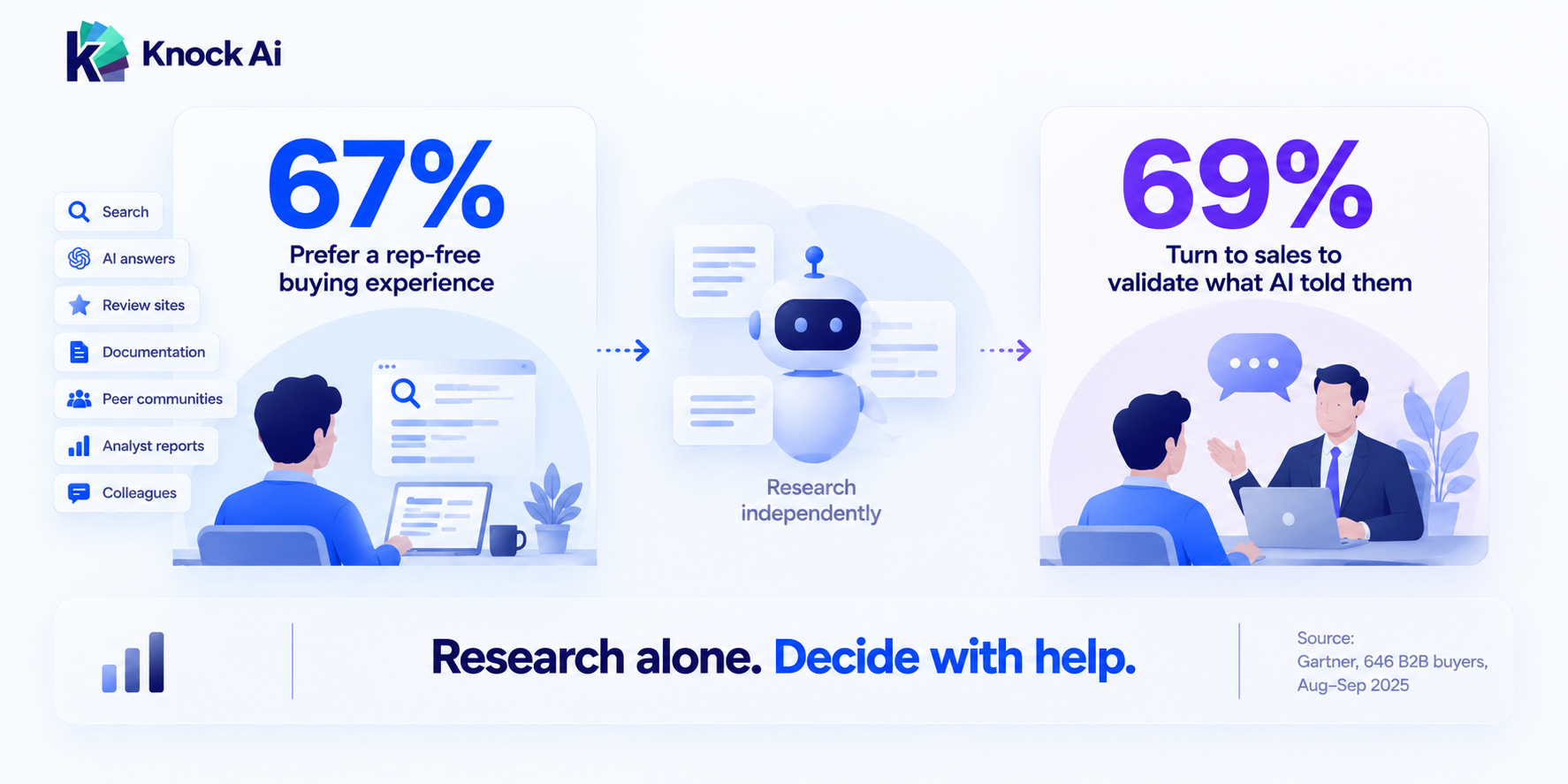
Gartner surveyed 646 B2B buyers between August and September 2025 and published the results on 9 March 2026. 67% now prefer a rep-free buying experience, up from 61% in the comparable prior-year survey. In the same research, 45% used AI tools during a recent purchase, and buyers weighed an average of seven information sources before deciding.
Two things stop this from being the simple story most vendors tell.
Rep-free is not rep-never. The same body of Gartner research found 69% of buyers still turn to a salesperson to validate what AI told them. Buyers want to research alone and decide with help. A lead generation strategy that removes humans entirely misreads the finding as badly as one that ignores it.
Irrelevance is actively punished. Gartner's earlier survey in this series found 73% of B2B buyers actively avoid suppliers who send irrelevant outreach. Not ignore. Avoid. Volume outbound into IT buyers does not fail neutrally, it removes you from consideration.
The 17% problem
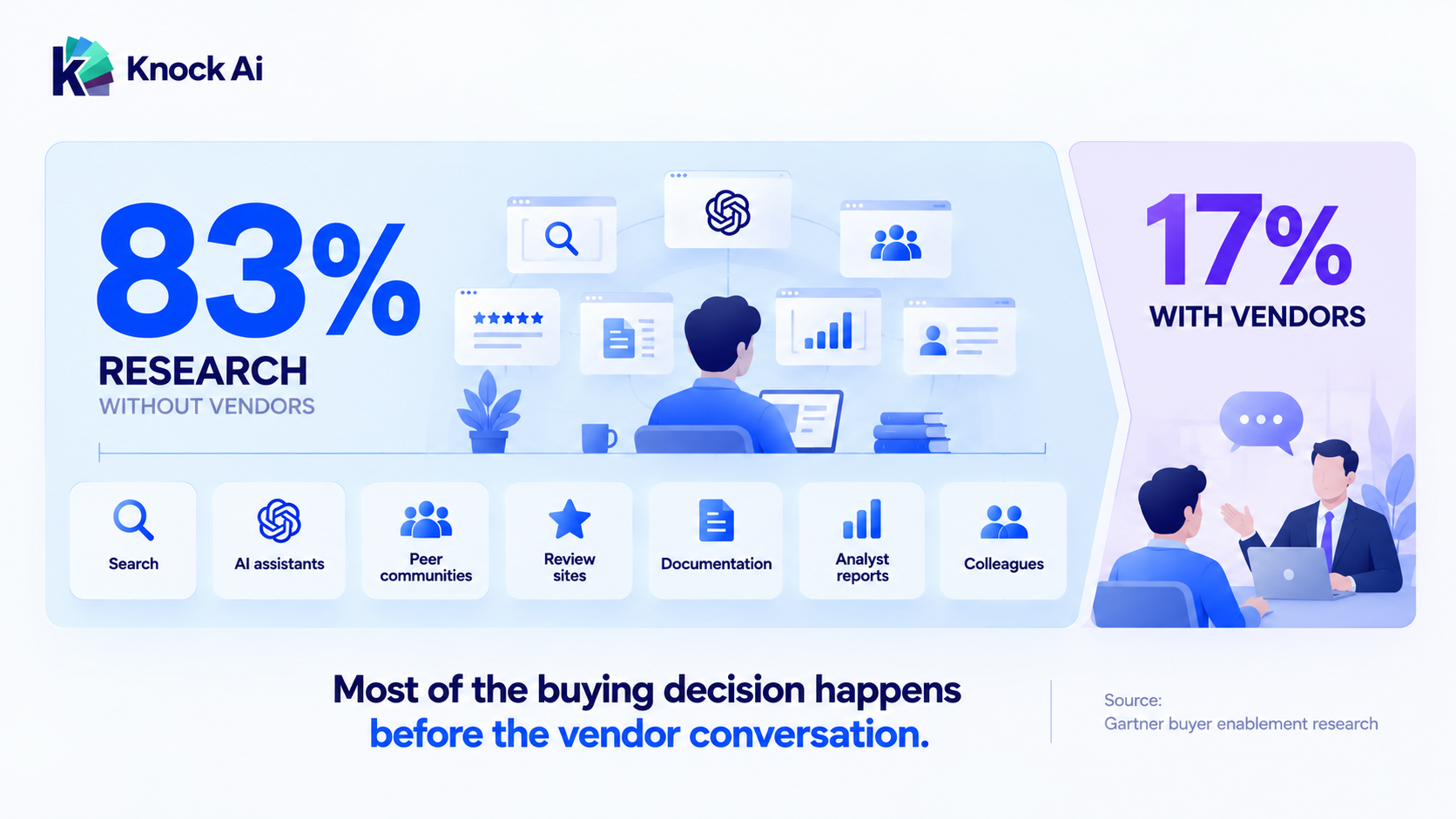
The most useful figure in Gartner's buyer enablement research is that buyers spend only about 17% of their total buying time with vendors, and that time is split across every vendor they are considering.
Do the arithmetic on a three-vendor evaluation and your direct share of the buyer's attention is a single-digit percentage of the process.
Which reframes what IT sales lead generation actually is. Your website, your reps and your demos operate in that 17%. The decision is substantially formed in the other 83%, in search results, AI answers, peer conversations, review sites and documentation you may not have written.
IT lead generation in the research you are not present for
If most of the evaluation happens in the 83%, lead generation for technology companies has to operate there.
Search, still. A buyer researching a category still searches, and the pages that rank still shape the shortlist. This has not changed, it has just stopped being sufficient.
AI assistants, newly. With 45% of buyers using AI during a purchase, your content is increasingly read by a model and summarized to a human you never meet. That has practical consequences for how you write, and it is why showing up in AI search is now a lead generation problem rather than a brand one. Definitions stated plainly and early get extracted. Comparison tables get extracted. Specific numbers with sources get extracted. Vague positioning language does not, because there is nothing in it to lift.
Review sites and peer communities. A buyer trusts a practitioner who has run your product in production more than any asset you produce. This is slow to build and impossible to shortcut.
Documentation. For technical products, the docs are read before the homepage and often instead of it.
Analyst coverage. For enterprise IT buyers, analyst inclusion is frequently the filter that decides who makes the shortlist at all.
The practical test for any asset: if an AI assistant summarized this for a buyer who never visits our site, would the summary be accurate and would it help them? If the answer is no, the asset is only working inside the 17%.
Why IT deals die on consensus, not comparison
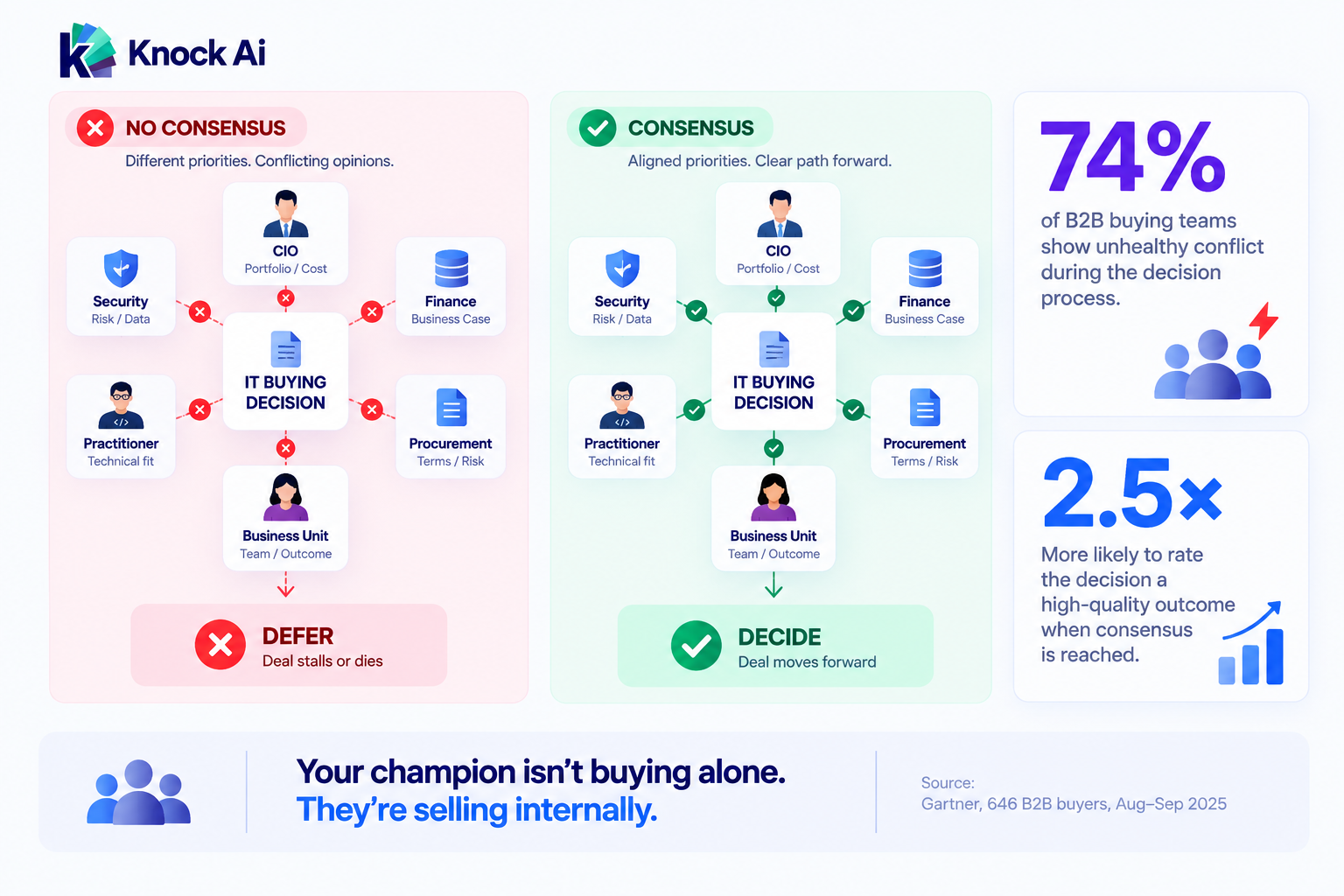
This is the least-covered part of IT sales lead generation and it is where most pipeline is actually lost.
Gartner's research on buying groups found 74% of B2B buying teams demonstrate unhealthy conflict during the decision process, and that teams which achieve consensus are 2.5 times more likely to rate the outcome a high-quality decision.
Read that alongside the 17% figure and the picture is uncomfortable. You get a small share of the buyer's time, then the decision is made in a room you are not in, by people who disagree with each other.
Your champion is not selling your product. They are running an internal negotiation between an infrastructure lead who wants it, a security lead who has questions, a finance owner who sees another line item, and someone who would rather do nothing.
What this changes about lead generation
Your competitor is usually "do nothing." A buying team that cannot agree does not pick a different vendor. It defers. Content framed purely against competitors misses the outcome you actually lose to.
Arm the champion for a meeting you are not in. The single highest-return asset in technology lead generation is the thing your champion forwards internally. It needs to survive being read without you: a business case with real numbers, a security summary, an implementation plan with effort estimates, a clear cost picture, and an honest account of what the product does not do.
Address the dissenter directly. Somebody in that room has an objection. Write the material that answers it rather than hoping your champion improvises well.
Multi-person engagement is your best signal. When three people from one account engage in a short window, a buying group has formed. That is a buyer intent signal worth far more than any individual's behavior, and it is the moment to turn the signal into pipeline rather than to pitch.
Technology lead generation under a consolidation mandate
Technology buying now happens against a standing pressure to reduce vendor count. Most IT organizations are being asked to rationalize their stack, cut overlapping tools and reduce the number of contracts and integrations they maintain.
That changes the shape of the sale in a way generic B2B advice does not account for.
You are competing for a slot, not for budget. Adding a vendor is a decision that has to be defended. If you cannot name what you replace, consolidate or make unnecessary, you are asking for an exception.
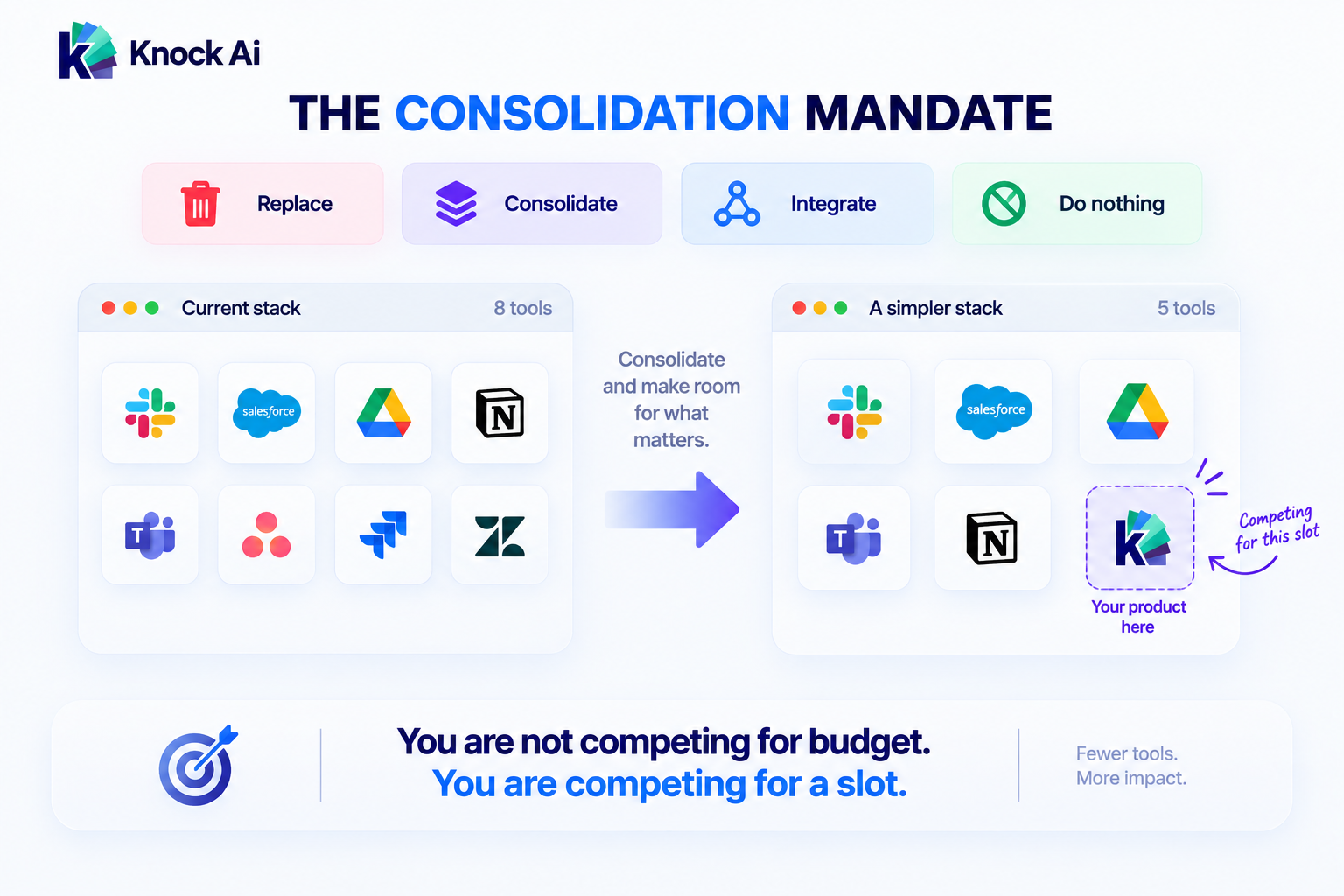
"We do more than X" is the strongest position available. Displacement is easier to fund than addition, because the budget already exists and the case is comparative rather than incremental.
Integration depth is a buying criterion, not a feature. A product that reduces the number of systems someone has to reconcile is doing consolidation work even if it adds a logo.
Contract timing decides everything. The realistic moment to displace an incumbent is at renewal. Knowing which incumbent, and when its contract ends, is worth more than any amount of top-of-funnel activity.
The lead generation implication is concrete. Content that names the incumbent you replace, explains the migration path and quantifies the switching cost reaches buyers at the moment the mandate gives them a reason to look.
The four gates every IT sales lead passes through
Technology sales leads do not die randomly. They die at four predictable places, and each has a different owner.
Most IT sales lead generation programs invest heavily before gate one and almost nothing after it. The leads are generated. They evaporate at gates two through four, and the marketing report still counts them. That is funnel leakage with a technical accent.

.svg)