1mind Pricing: Is the $100K AI "Superhuman" Worth the Investment?
1mind Pricing: Is the $100K AI "Superhuman" Worth the Investment?
TL;DR
1mind Pricing: Starts at approximately $100,000+ per year, positioned as an Enterprise AI-Led Growth investment. It is optimized to replace sales headcount with AI Superhumans like Mindy across the website, product, and live calls.
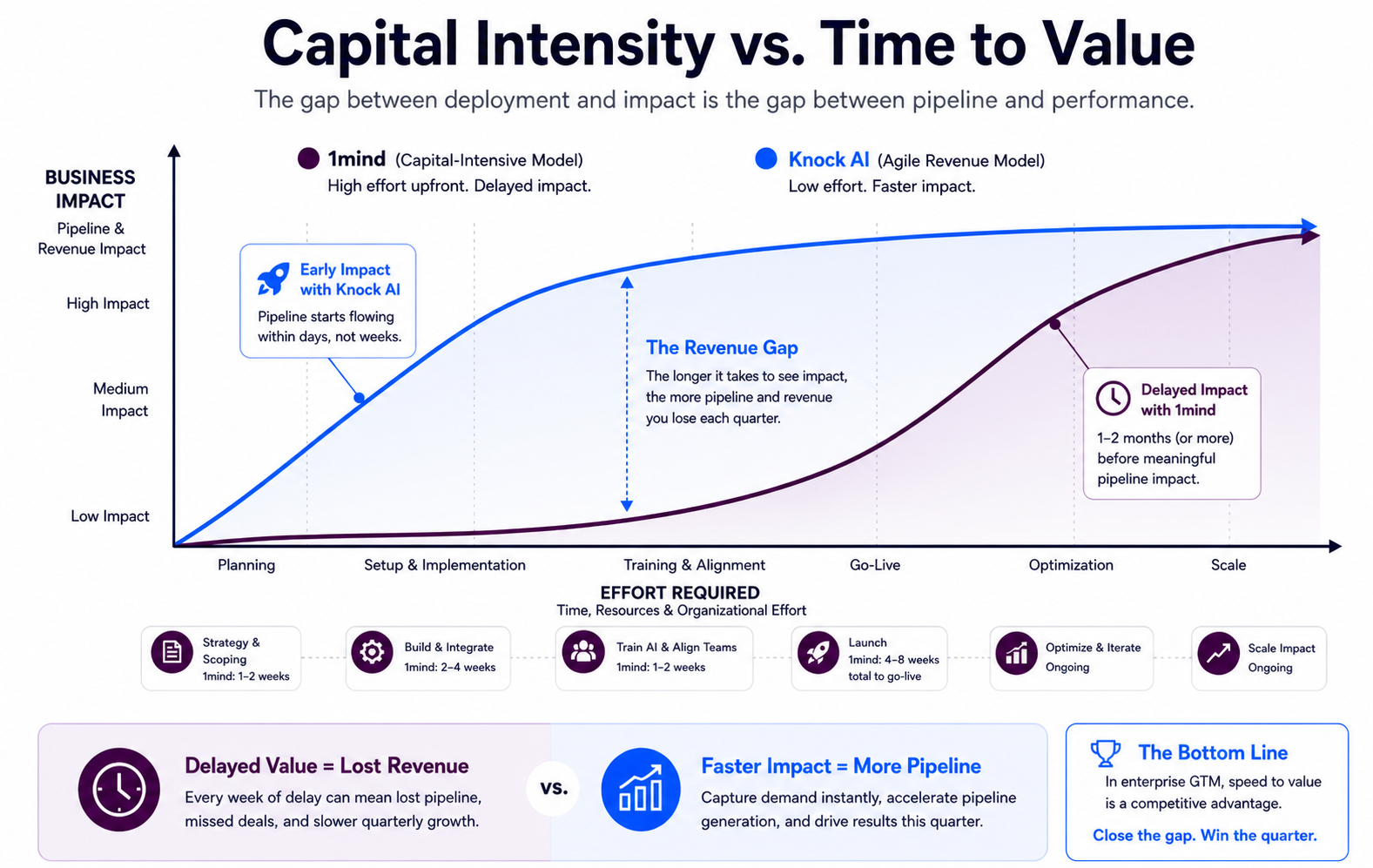
The Challenge: This is a high-capital-intensity model with a 1-2 months deployment window, ongoing training requirements, and cross-team operational complexity.
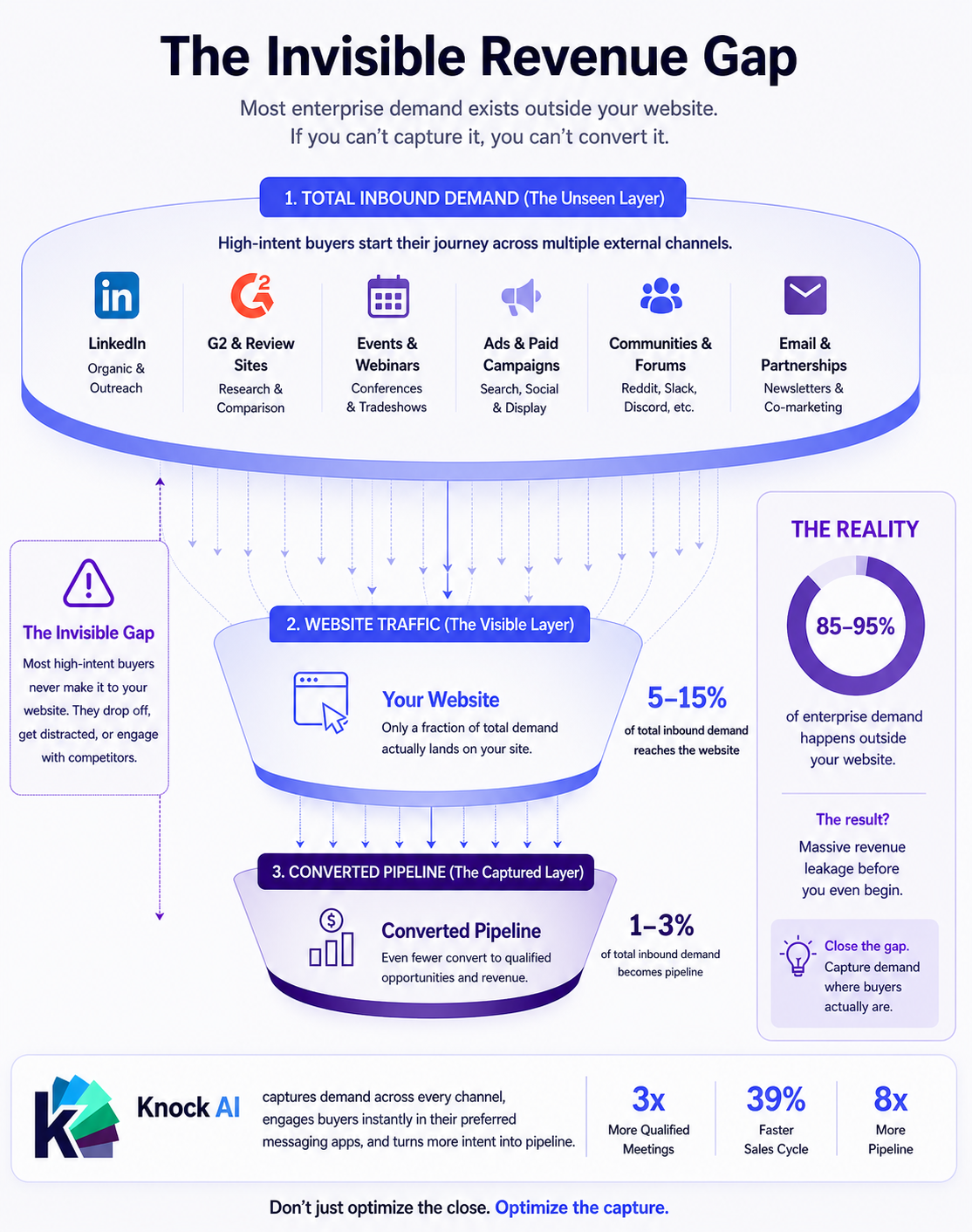
The Strategic Gap: Most enterprise revenue is not lost inside the funnel. It is lost before buyers ever reach the website, across channels like LinkedIn, G2, communities, and events.
1mind Alternative:Knock AI addresses revenue leakage, not just capacity. It captures and converts demand across LinkedIn, Slack, WhatsApp, and other messaging channels, eliminating the friction of forms and email ghosting to preserve buyer momentum from first touch to pipeline.
Choose 1mind if your goal is capacity replacement and lifecycle automation. Choose a revenue-first system if your goal is to capture and convert existing demand into a pipeline.
How much does 1mind cost in 2026?
1mind does not publish pricing publicly. Enterprise estimates place it at $100,000+ per year, with some contracts reportedly reaching the $400,000 range depending on deployment scope.
The clearest source on this is 1mind's founder herself. In a November 2025 TechCrunch interview, CEO Amanda Kahlow stated that 1mind's customers, including HubSpot, LinkedIn, and New Relic, "all have annual contracts, not 'experimental' budgets, and the average contract is six figures."
This positions 1mind as a premium, enterprise-only platform, designed for organizations willing to invest heavily in AI-led go-to-market transformation. There is no transparent pricing tier, no self-serve entry point, and no published rate card. Instead, pricing is structured around enterprise deployment, customization, and long-term adoption across revenue teams.
Industry reporting places the floor more precisely: "$100,000+ before configuration sessions begin", meaning the six-figure number is the platform fee before avatar production, persona workshops, content ingestion, and the typical 1–2 month setup are factored in.
So the practical answer for budget planning: expect $100K as the floor, six figures as the average, and up to $400K for full enterprise deployments, with implementation costs added on top.
What you are actually buying
At this price point, you are not buying a single tool. You are investing in a full AI-led growth system.
This includes:
AI Superhumans, such as Mindy, are trained to handle buyer interactions
Website, in-product, and live call engagement
AI-led demos and onboarding experiences
Lifecycle automation across marketing, sales, and customer success
The core idea is simple. Replace fragmented human workflows with a unified AI layer that can operate continuously across the entire customer journey.
1mind pricing is structured as an Enterprise AI-Led Growth investment, focused on deploying AI Superhumans such as Mindy to replace human sales capacity across the lifecycle.
For organizations prioritizing revenue velocity over capacity replacement, Knock AI represents an omnichannel alternative that captures and converts demand wherever buyers actually research, LinkedIn, G2, communities, events, and messaging apps.
Capital intensity vs ROI
1mind should not be evaluated as a cost. It should be evaluated as a capital-intensive investment in a new operating model.
It requires:
Training AI agents on company knowledge and positioning
Building scripts, workflows, and lifecycle logic
Continuous updates to keep messaging aligned
Coordination across marketing, sales, and customer success
This introduces a level of organizational effort that goes beyond typical software adoption.
See Knock AI in Action — Book Your Live Demo Today
Total Inbound Demand includes all buyer intent across LinkedIn, G2, communities, ads, and events
Website Traffic is only a subset of that demand
The difference represents a lost revenue opportunity
If your $100K investment only improves what happens after a buyer reaches your website and assumes the buyer stays engaged after leaving, you are optimizing only a fraction of the total opportunity.
Saving headcount improves efficiency. Capturing demand drives revenue. 1mind solves for the former. Knock AI solves for the latter.
What the $100K+ investment does not show
At a surface level, 1mind pricing reflects a powerful AI-led growth system. But beneath that investment lies a complexity layer that directly impacts time-to-value, execution speed, and pipeline velocity.
Implementation window
1mind: 1-2 months deployment window
Includes setup, training, workflow design, and alignment
This is not just a delay. It is a missed revenue window.
Every week without pipeline impact compounds:
Slower opportunity creation
Delayed sales cycles
Reduced quarterly performance
Delayed value is not neutral. It is a lost pipeline.
Ecosystem alignment (Clari + Salesloft context)
1mind is designed to integrate deeply into the Clari and Salesloft predictive revenue ecosystem.
This makes it highly effective for:
Deal execution
Forecasting accuracy
Sales productivity
Closing efficiency
But this strength introduces a structural limitation.
It focuses on optimizing what happens after a lead enters the system, but assumes the buyer remains engaged after the session ends.
It does not address how that lead was captured in the first place.
The blind spot most teams miss
Modern B2B journeys do not begin inside your CRM or sales cadence.
They begin across:
LinkedIn conversations
G2 research sessions
Community discussions
Events and outbound touchpoints
If your system activates only after the buyer enters a Salesloft cadence, you are already operating mid-funnel.
Do not just optimize the close. Optimize the capture.
Technical debt risk
AI-led systems require ongoing maintenance to remain effective.
For 1mind, this includes:
Continuous updates to AI avatars
Alignment with evolving product messaging
Adjustments to workflows and qualification logic
Regular retraining to maintain accuracy
Without this, performance declines over time.
Why this matters at enterprise scale
This creates a hidden layer of technical and operational debt:
More resources required to maintain performance
Increased dependency on internal teams
Slower iteration cycles
Over time, this reduces agility and increases friction across the revenue engine.
Efficiency gains come after deployment. Revenue impact depends on how fast you get there.
Technical debt risk
AI-led systems require ongoing maintenance to remain effective.
For 1mind, this includes:
Continuous updates to AI avatars
Alignment with evolving product messaging
Adjustments to workflows and qualification logic
Regular retraining to maintain accuracy
Without this, performance declines over time.
Why this matters at enterprise scale
This creates a hidden layer of technical and operational debt:
More resources required to maintain performance
Increased dependency on internal teams
Slower iteration cycles
Over time, this reduces agility and increases friction across the revenue engine.
Efficiency gains come after deployment. Revenue impact depends on how fast you get there.
The invisible funnel: where enterprise demand starts and where it disappears
Most go-to-market systems are built around a flawed assumption: that the buyer journey begins on your website.
It does not. And it rarely ends there either.
The journey starts off-site
Modern B2B buyers start their research across a fragmented set of channels:
By the time a buyer reaches your website, they have already researched alternatives, formed opinions, and narrowed their shortlist.
Your website is not the beginning of the journey. It is often the final checkpoint before a decision.
This creates a funnel most companies never fully see. At the top, there is a large layer of inbound demand distributed across external channels. In the middle, only a fraction of that demand reaches your website. At the bottom, an even smaller portion converts into a pipeline. The majority of intent never becomes visible inside your systems.
The journey collapses when the buyer leaves
Even when buyers reach your website, the journey is fragile. A typical flow looks like this:
Buyer visits your site
Engages briefly with content, chat, or product pages
Leaves without converting
At that moment, most systems lose context. Follow-up shifts to email sequences, SDR outreach, and retargeting ads. None of these preserve real-time intent or conversation continuity.
The issue is not a lack of interest. It is a loss of momentum.
Within minutes of leaving, buyers get distracted, compare alternatives, delay decisions, and forget context. High-intent demand turns cold.
The biggest leak in your funnel is not traffic. It is what happens after the visit ends.
The compounding impact on pipeline
If the conversation ends when the session ends, your funnel resets every time a buyer leaves. And when that happens, every follow-up starts from zero instead of continuing the momentum.
This is not a single drop-off. It compounds across every interaction:
A buyer leaves once
Momentum is lost
Follow-up is delayed
Conversion probability drops
Multiply this across hundreds of buyers, and the result is significant pipeline loss from already-generated demand. Most revenue is not lost because buyers never reached your website. It is lost because the conversation ended when they left, and because much of the highest-intent activity happened in places your systems never tracked in the first place.
Too Many Tools, Not Enough Pipeline: The Case for Vendor Consolidation
Most enterprise teams are not just dealing with one tool. They are managing an entire stack of disconnected systems.
Before committing to a six-figure GTM investment, the decision should not be based on features. It should be based on where your revenue engine is constrained.
1. Is your constraint capacity or conversion?
If your team cannot handle the volume of leads, conversations, or demos, your problem is capacity
If you are generating demand but not converting it into a pipeline, your problem is conversion
This distinction determines everything.
Capacity problems require more execution power Conversion problems require better capture and continuity
2. Where does your demand originate?
Look at where your highest-intent buyers actually engage:
If most activity happens on your website or inside your product, a website-centric system can be effective
Not just deployment time. Actual time to measurable pipeline impact.
This is the metric that determines whether the investment pays off in the current quarter or the next.
FAQ
What is 1mind pricing in 2026?
1mind pricing is not publicly disclosed, but enterprise estimates place it at $100,000+ annually. It is positioned as an AI-Led Growth investment designed to replace human sales capacity with AI agents across website, product, and live interactions.
Is 1mind worth $100K+?
1mind can be worth the investment for teams whose primary constraint is capacity. If your sales team cannot handle lead volume or requires support across demos, onboarding, and qualification, it delivers value through efficiency and automation.
However, if your bottleneck is conversion or pipeline generation, the return may be limited because it primarily activates after the buyer enters your system.
What does 1mind actually replace?
1mind replaces or augments:
SDR qualification workflows
Sales engineer support on calls
Demo delivery and product explanation
Parts of onboarding and customer success
Its focus is on reducing reliance on human-led interactions across the lifecycle.
What is the biggest limitation of 1mind?
The primary limitation is scope. 1mind is most effective inside owned channels such as website, product, and calls.
It does not fully address:
Off-site demand capture
Buyer engagement across messaging channels
Momentum after the session ends
This means a significant portion of demand may remain unconverted.
If your focus is on lifecycle automation and capacity scaling, 1mind fits
If your focus is on converting existing demand into a pipeline, a revenue-first system like Knock AI is more aligned
The decision is not about which tool is better, but which problem you are solving.
How does 1mind compare to revenue-first platforms?
1mind focuses on efficiency and execution within the funnel. Revenue-first platforms focus on capturing and converting demand across the entire journey.
The difference is:
1mind improves how work gets done
Revenue-first systems improve how much demand becomes revenue
Choosing the Right Model for Your Growth
1mind pricing reflects a broader shift toward AI-led growth and capacity replacement.
It is a strategic investment in improving how revenue teams operate, reducing dependency on human effort, and scaling lifecycle engagement.
But most enterprise revenue problems are not caused by a lack of capacity. They are caused by lost demand, broken journeys, and missed moments of intent.
Buyers no longer move through a linear funnel. They explore across channels, engage briefly, and often disappear before systems can react.
And even when they do engage, the conversation frequently ends when they leave.
Most revenue is not lost because buyers never visit your website. It is lost because the conversation ends when they leave.
This is the gap most teams underestimate.
There is no universal “best” platform. There is only one platform that aligns with your constraint.
If your challenge is scaling execution, 1mind fits
If your challenge is capturing and converting demand, a different model is required
The right decision comes from understanding where your funnel breaks.
The smartest investment is not the most advanced system.It is the one that turns your existing demand into revenue.


.svg)


.svg)
.svg)
.svg)


.svg)
.svg)



.svg)