Intercom (Fin AI) — Best for support-first organizations with sales overlap
Key insight: Most teams don’t have a lead generation problem; they have a funnel leakage problem.
Drift Sunset Context
On March 6, 2026, Salesloft and Clari announced that 1mind would become the exclusive AI successor to Drift, effectively signaling the end of Drift as a standalone solution. For thousands of companies that relied on Drift for conversational marketing, this triggered an immediate evaluation cycle: adopt 1mind or look for alternatives.
The decision isn’t straightforward. Early reports indicate 1mind’s enterprise pricing can reach six figures annually, a significant jump from Drift’s typical $30K–$60K contracts. More importantly, this isn’t just a pricing decision; it’s a strategic one.
The real question isn't"Is 1mind better than Drift? It's "Does 1mind actually solve the bottleneck in your funnel?"
1mind vs Top Alternatives (2026)
Platform
Primary Use Case
Where It Wins
Where It Falls Short
1mind
AI-led growth and lifecycle automation
Replaces SDRs, sales engineers, and onboarding with AI Superhumans like Mindy; strong in-product, website, and call experiences
Requires buyers to engage on owned channels; limited off-site demand capture and post-session continuity
Knock AI
Revenue recovery from existing demand
Captures and converts buyer intent across website, LinkedIn, G2, communities, events, and messaging apps; prevents funnel leakage and improves meeting show rates
Not designed to replace full lifecycle roles like onboarding or support
Warmly
Mid-market inbound + outbound workflows
Strong de-anonymization, visitor intent signals, and outbound automation; attractive pricing for Drift replacements
Earlier-stage product; limited enterprise proof and weaker cross-channel engagement continuity
Qualified (Salesforce)
Salesforce-native pipeline generation
Deep integration with Salesforce, strong routing, and Piper AI SDR for qualification
Heavily dependent on Salesforce ecosystem; limited flexibility outside it
Intercom (Fin AI)
Customer support automation with sales overlap
Excellent for in-app support, onboarding, and resolution with Fin AI
Not built for pipeline generation or revenue conversion as a primary use case
See Knock AI in Action — Book Your Live Demo Today
What Is 1mind and Why Is Everyone Talking About It?
What is 1mind, and how does AI-led growth work?
1mind is an AI-led growth platform that replaces traditional go-to-market roles with AI agents called Superhumans. These agents engage, qualify, demo, and support buyers across the entire customer lifecycle.
At a high level, 1mind is not just a chatbot or conversational tool. It acts as a unified AI layer across marketing, sales, and customer success. Instead of multiple teams handling different stages, one system manages the full journey from first interaction to post-sale support.
What is AI-Led Growth?
AI-led growth is a go-to-market model where AI agents replace human-led sales and support interactions with always-on, real-time engagement.
Instead of waiting for an SDR response, scheduling time with an AE, or bringing in a sales engineer for technical questions, buyers interact directly with AI that can:
Answer questions instantly
Run product demos
Qualify needs
Recommend next steps
The goal is to remove human bottlenecks and compress the buying journey into a single continuous interaction.
What are 1mind Superhumans?
1mind Superhumans are AI agents trained on company data, product knowledge, and sales workflows. They are designed to operate across four deployment modes:
Website Superhuman: Engages visitors, runs demos, qualifies prospects, and books meetings directly on your site
In-Product Superhuman: Activates trial users, drives feature adoption, and supports onboarding inside the product
Call Companion (AI Sales Engineer): Joins live Zoom calls as a ride-along expert, answering technical questions and surfacing relevant content during sales conversations
Unlike traditional chatbots, Superhumans are built to move deals forward across the entire revenue lifecycle, not just respond to questions during a single session.
What is Mindy in 1mind?
Mindy is 1mind’s flagship Superhuman. It is an AI agent with a face, voice, and trained sales intelligence that engages buyers across websites, in-product environments, and live Zoom calls.
Mindy can:
Hold natural conversations with buyers
Ask discovery questions
Run live product demos
Assist during sales calls in real time
This makes Mindy closer to a digital sales representative that operates continuously, without the limitations of human availability.
Why 1mind is gaining traction in 2026
1mind is gaining attention because it aligns with a broader shift in B2B go-to-market strategy.
Companies want to reduce reliance on large sales teams
Buyers expect immediate answers instead of delayed follow-up
AI is now capable of handling complex, multi-step interactions
There are also strong signals from the market:
HubSpot’s AI agent Fiona has reported engagement rates as high as 88 percent
Pipedrive has seen more than 100 percent improvement in trial conversion with AI-assisted flows
The result is clear. 1mind is positioned not just as a tool, but as a new operating model for revenue teams.
What 1mind Does Better Than Most Platforms
Where 1mind excels
AI-native revenue workforce
One of 1mind’s biggest strengths is its ability to function as an AI-native revenue workforce. Instead of supporting human teams, it is designed to replace large parts of them.
AI Superhumans can handle multiple roles at the same time:
Qualifying inbound leads like an SDR
Explaining product value like an account executive
Answering technical questions like a sales engineer
Guiding onboarding like a customer success manager
This reduces the need for multiple handoffs and allows companies to scale revenue operations without increasing headcount. For teams focused on efficiency, this is a major advantage.
Rich owned-channel experiences
1mind performs especially well in environments where the company controls the interaction. This includes:
Website conversations
In-product experiences
Live sales calls and demos
Within these owned channels, AI can deliver a highly structured and guided experience. Buyers can ask questions, explore features, and receive tailored responses in real time.
This makes 1mind particularly strong for companies that want to optimize conversion once the buyer is already engaged on their platform.
PLG and long-tail monetization
1mind is also well-suited for product-led growth companies that have a large volume of users who never interact with sales teams.
In traditional models, these users often remain unmonetized because there is no cost-effective way to assign human sellers. With 1mind, AI can:
Engage trial users
Guide product usage
Recommend upgrades
Answer questions instantly
This allows companies to generate revenue from segments that were previously ignored or underserved.
Executive narrative
From a leadership perspective, 1mind has a very clear and compelling story. It is easy to explain at the board level and aligns with broader trends in AI adoption.
The value proposition is simple:
Increase revenue per employee
Reduce operational overhead
Improve consistency across customer interactions
This makes it appealing not only to GTM teams but also to executives focused on efficiency, scalability, and long-term cost structure.
When 1mind Is the Right Choice
Who should use 1mind in 2026?
Choosing 1mind comes down to one question. Is your primary goal to replace human effort across the revenue lifecycle, or to fix how demand converts?
1mind is a strong fit for specific types of teams and use cases. It performs best when its strengths align directly with how your buyers engage and how your revenue process is structured.
Ideal for:
PLG companies with high in-product engagement If your product has a large user base and most interactions happen inside the product, 1mind can guide users, answer questions, and drive upgrades without requiring human intervention.
Teams that need AI sales engineers on calls For complex products that require technical explanations during live demos, 1mind’s ability to assist in Zoom calls adds real value. It can surface relevant information, support discovery, and reduce reliance on specialized roles.
Salesloft and Clari ecosystem users Teams already operating within the Salesloft and Clari ecosystem will benefit from tighter integration and a more aligned workflow across tools.
Buyers who prefer video or avatar-based engagement If your audience responds well to guided demos, visual walkthroughs, and conversational experiences on your website or product, 1mind’s approach fits naturally.
Not ideal for:
Buyers who research outside your website first If your audience spends time on platforms like LinkedIn, G2, or community forums before visiting your site, 1mind may not engage them early enough in their journey.
Organizations not aligned with Salesforce or Salesloft ecosystems If your stack is more flexible or built outside these ecosystems, the fit may be less seamless.
Teams whose main challenge is funnel friction If your biggest issues are form drop-offs, slow follow-up, or missed meetings, replacing human roles will not directly solve those problems.
Teams that need engagement to continue after the session ends If your process depends on maintaining conversations across channels after a buyer leaves your website, 1mind’s session-based engagement model may feel limiting.
Teams that are unable to commit to a cross-functional change management process. 1mind isn't a chatbot replacement; it's an operating model shift. Deploying it well requires alignment across marketing, sales, sales engineering, and customer success, and that level of organizational coordination isn't realistic for every team, even ones with the budget.
The key takeaway is simple. 1mind is a strong solution when your bottleneck is how work gets done inside the funnel. It is less effective when the problem is what happens before or after that interaction.
Where 1mind Doesn't Fit: The Funnel Leakage Problem
Why AI-led growth doesn’t solve funnel leakage
1mind solves the labor replacement problem extremely well. It reduces dependency on human teams and makes interactions faster once a buyer is already engaged.
But that is only part of the problem.
In many B2B funnels, revenue is lost before AI ever gets a chance to engage. Buyers show intent, but that intent never turns into pipeline. The issue is not a lack of conversations. The issue is that those conversations never happen in the first place, or they break before converting.
This is where a different problem emerges. Not labor efficiency, but revenue leakage.
Demand creation vs demand recovery
To understand this gap, it helps to separate two concepts that are often treated as the same thing.
Demand creation is the process of generating traffic, awareness, and interest. This includes ads, content, SEO, events, and outbound efforts.
Demand recovery is the process of capturing, converting, and preserving that interest once it exists.
Most modern GTM stacks are heavily optimized for demand creation. Teams invest in generating more traffic, more leads, and more visibility.
But far fewer systems are designed to ensure that the demand already created actually turns into revenue.
That gap is where leakage happens.
"More leads won't fix a leaking funnel."
The hardest part isn't generating more demand. It's keeping the demand you've already generated from disappearing.
4 places revenue leaks out of a modern B2B funnel
In every B2B funnel, revenue is lost in the same four places. None of them are problems AI Superhumans solve. They're problems that happen before AI gets a chance to engage, or after the session ends.
1. Forms kill conversion before any conversation starts
Forms are the single biggest source of drop-off in B2B inbound. Every additional field reduces completion. By the time a buyer has typed their name, work email, company, role, team size, and "what brings you here today," most have already left.
The buyers who do complete the form aren't your best leads. They're the ones who tolerated friction. The high-intent buyer who wanted an instant answer is already on a competitor's site.
1mind doesn't fix this. Mindy lives behind the form too. The session only begins after the buyer has decided to engage. The leakage happens before that.
2. Email ghosting kills momentum after the first interaction
A buyer engages once, asks questions, and leaves. The platform sends a follow-up email. The email goes unread. By the time the buyer is ready to re-engage three days later, the context is gone, the thread is buried, and they're starting over from scratch.
This is the structural weakness of session-based AI agents: when the session ends, so does the momentum. Email is where conversations go to die, average B2B email response rates have dropped below 2% in 2026 (HubSpot/Salesloft data). Trying to recover a hot buyer through email is trying to restart a conversation in the wrong channel.
1mind handles follow-up via email. Mindy is brilliant in the moment. She's silent the moment the buyer closes the tab.
3. Poor routing sends qualified buyers to the wrong rep, or to no one
A buyer makes it through the form, completes the conversation, and books a meeting. The meeting goes to the wrong rep. Or it round-robins to a rep who's slammed. Or the routing rules haven't been updated since Q3 and the lead lands in a queue that nobody's watching.
This is the invisible leak. The buyer thinks they did their part. The pipeline metrics show the meeting was booked. But the conversion never happens because the human handoff broke.
Real-time routing based on fit, intent, ownership, and enrichment isn't a 1mind capability. Workflow-based handoffs are. Those are different things. A workflow doesn't know that the buyer's CFO just visited your pricing page on LinkedIn this morning. A real-time routing engine does.
4. No-shows kill the meetings that did get booked
Booking a meeting is not the same as holding a meeting. Without reminders, continuity, and low-friction rescheduling, B2B no-show rates run 25–40% across most enterprise sales motions.
The buyer's intent was real when they booked. The intent fades over the 48 hours between booking and meeting. By the time the calendar invite fires, they're in three other vendor demos and yours got deprioritized.
1mind books meetings. It doesn't actively prevent no-shows through reminders, persistent messaging continuity, and frictionless rescheduling. Those mechanisms live outside its session-based model.
What these four leaks have in common
Each happens in a place 1mind isn't designed to operate.
Forms kill conversion before the AI engages. Email ghosting kills momentum after the AI session ends. Poor routing breaks the human handoff between AI and sales. No-shows happen between booking and meeting, a window AI Superhumans don't actively manage.
The pattern: revenue is lost not because of a lack of AI capability, but because of where AI is deployed. Replacing customer-facing labor inside the funnel does not address leakage that occurs before the funnel begins, between handoffs, or after the session ends.
This is the difference between two architectures:
AI inside the session (1mind's model) replaces human time during active conversations.
AI across the entire buyer journey (Knock AI's model) prevents the leaks that happen when no session is active.
If your team is losing revenue in any of the four scenarios above, the right alternative is not a more advanced version of 1mind. It is a platform built specifically for demand recovery, one that captures buyers before forms, continues conversations after sessions, routes in real time on intent, and actively prevents no-shows.
Customers using Knock AI for this exact problem report a 6x higher conversion rate, a 39% faster sales cycle, 8x more pipeline, and an 83% average reply rate on persistent messaging threads with dropped buyers, the layer of the funnel where most leakage compounds invisibly.
Top 4 1mind Alternatives in 2026
The best 1mind alternative depends on the problem you are trying to solve.
1mind is designed to improve how revenue teams operate by replacing human effort with AI across the lifecycle. But many teams are not constrained by labor. They are constrained by how much of their existing demand actually converts into pipeline.
This is an important distinction. Some platforms help you do more with fewer people. Others help you capture more value from the demand you already generate.
The strongest alternatives to 1mind fall into these different categories. The right choice depends on whether your bottleneck is efficiency or conversion.
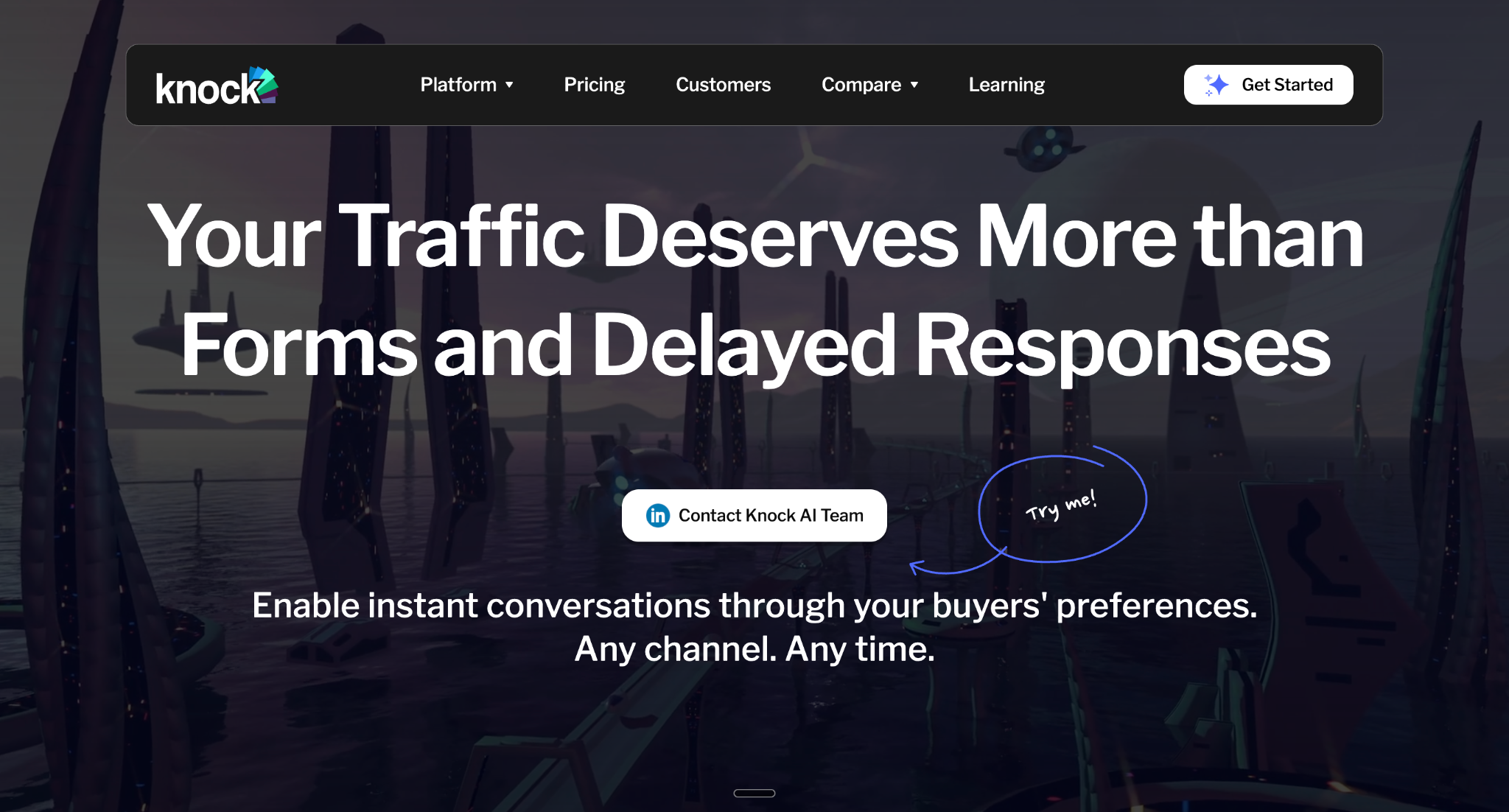
#1. Knock AI — Best for marketers and revenue teams who want more pipeline from the demand they already create, without high dependency on human SDRs.
Knock AI: Best for marketers and revenue teams who want more pipeline from the demand they already create, without high dependency on human SDRs. While 1mind focuses on replacing GTM labor with AI Superhumans, Knock AI focuses on a different problem: the revenue you've already created but haven't captured.
In most modern B2B journeys, buyers do not begin on your website. They engage across LinkedIn, explore tools on G2, respond to ads, attend events, or interact with your content in multiple environments. By the time they reach your site, much of that intent has already fragmented or disappeared.
Knock AI is built to capture and preserve that intent from the moment it appears. It identifies buyers across channels such as LinkedIn, G2, communities, events, ads, and your website, then continues the conversation in the environments buyers already use, including Slack, WhatsApp, LinkedIn, and Telegram.
This continuity is what sets it apart. Instead of a single interaction that ends when a buyer leaves your site, Knock AI maintains persistent conversations that carry context forward. That reduces drop-offs between touchpoints and keeps momentum intact as buyers move through the funnel. The impact on dropped buyers is the most striking number in the entire stack: persistent messaging threads with saved context produce an average 83% reply rate when re-engaging buyers who would otherwise be lost to email follow-up.
Real-time CRM enrichment that actually changes how leads get routed
Most platforms treat enrichment as a post-conversation cleanup task. Knock AI treats it as the foundation of every routing decision. The platform enriches CRM records with attribution, company data, contact data, intent signals, and qualification fields as the conversation is happening, not hours later through a batch sync.
This matters because routing only works if the data is fresh. When a buyer from a Fortune 500 logo lands on a pricing page, the difference between routing them to your enterprise AE in real time versus discovering the fit two days later in Salesforce is the difference between a closed deal and a "lost, went with competitor" disposition. The enrichment layer also feeds reporting, so marketing can attribute pipeline to the campaigns, channels, and content that actually drove it, not just the last-touch source.
LinkedIn outreach that fires on intent, not on cadence
LinkedIn is where most B2B buyers research, but most platforms treat LinkedIn as a single capture surface and stop there. Knock AI automates LinkedIn outreach as a continuous re-engagement layer, triggered by buyer intent signals, campaign source, booking activity, and drop-off patterns rather than a static sequence cadence.
The practical effect: when a buyer engages with your G2 listing, ghosts a demo invite, or visits a high-intent page after hours, Knock AI initiates LinkedIn outreach in the moment that intent is highest. It's the difference between a generic "checking in" message three days later and a contextually relevant message that lands while the buyer is still actively evaluating.
Event capture that doesn't end with a badge scan
Trade shows, conferences, and field events are some of the highest-intent demand sources B2B teams have, and they're also where the most leakage happens. A buyer scans your badge, takes a sticker, and disappears into the conference floor. By the time the event team finishes uploading the lead list to the CRM 72 hours later, the buyer has moved on.
Knock AI turns event scans into instant connections through formless chat, in-the-moment scheduling, and digital sales cards that the buyer keeps in their phone. The conversation continues in their preferred messaging app such as Slack, WhatsApp, LinkedIn, Telegram, long after they've left the booth. That's the difference between a "trade show led to a deal" story you can attribute and a 90-day silence followed by a cold pipeline review where nobody can remember which event the lead came from.
The customer outcomes are concrete. Teams running on Knock AI report 3x more qualified meetings, 8x more pipeline, 6x higher conversion rates, 39% faster sales cycles, and 7+ hours saved daily by replacing the manual qualification, scheduling, and follow-up work that used to consume SDR time. Customers like Optimove have reduced time-to-opportunity to just 3 days. Enterprise teams, including Notion, Descope, Lokalise, Fireblocks, Freightos, Polygon, Riverside, Cymulate, ScaleOps, and Orca Security, use Knock AI to convert high-intent demand at scale.
A single platform that consolidates the modern revenue stack
Knock AI also consolidates several layers of the modern revenue stack into a single platform. Customers often replace inbound SDR tooling along with chatbot tools, form builders, scheduling tools, event lead capture systems, intent and de-anonymization tools, LinkedIn outreach platforms, CRM enrichment vendors, and re-engagement workflows when they deploy Knock AI. That consolidation makes the budget conversation easier to defend at the CFO level, and it's typically the argument that converts a Knock AI evaluation from a marketing decision into a finance-approved one.
If 1mind is built to do the work of your team, Knock AI is built to make sure the demand you have already paid for actually turns into revenue.
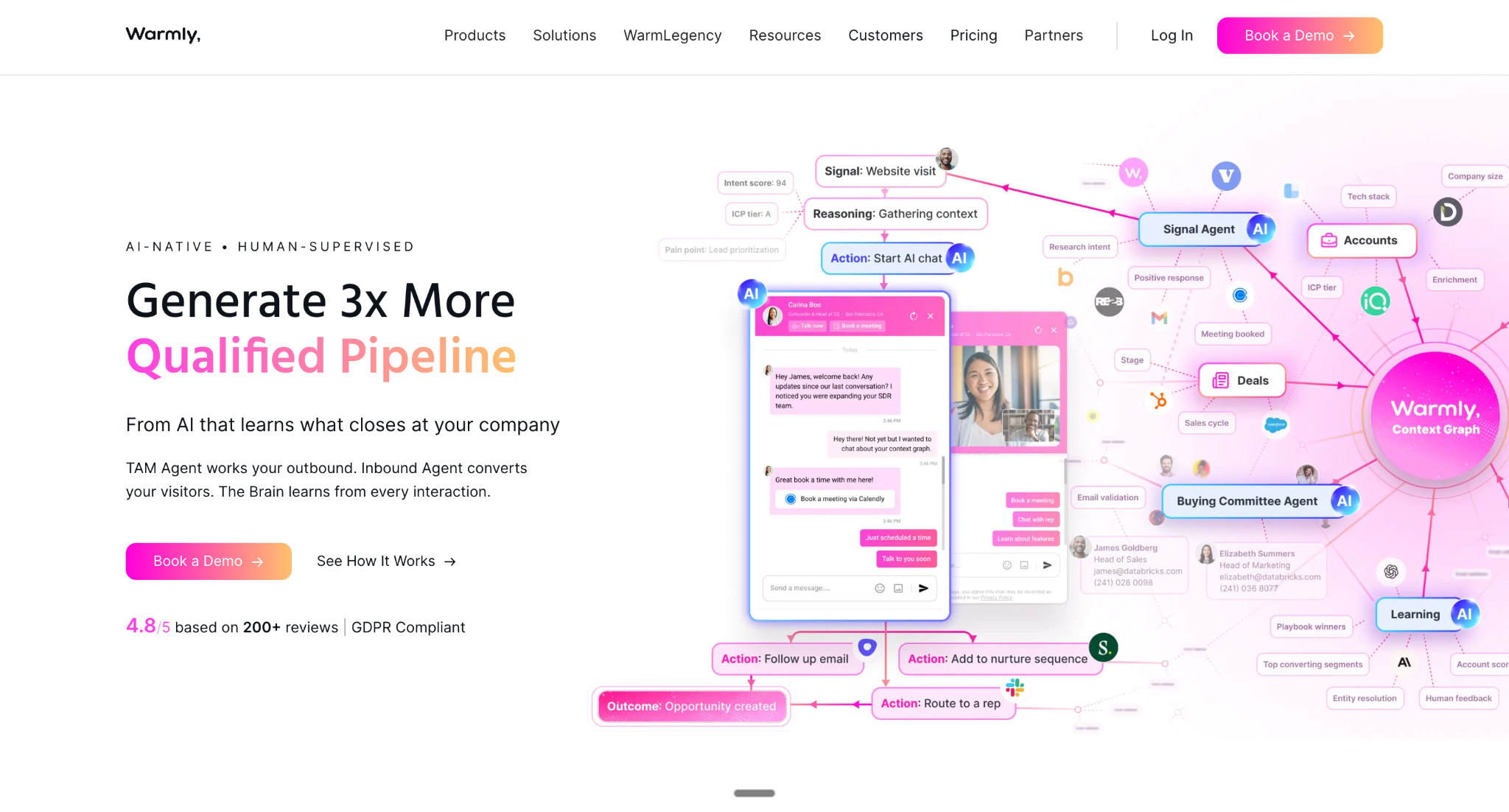
#2. Warmly — Best for full-stack inbound at lower contract sizes
Warmly has positioned itself as a strong option for teams migrating away from Drift, especially in the mid-market segment. One of its biggest advantages is its price-match offer and free migration, which makes it attractive for companies evaluating alternatives under time pressure.
At a product level, Warmly combines de-anonymization, intent data, and outbound workflows into a unified inbound and outbound system. It can identify anonymous website visitors, surface account-level intent, and trigger outreach based on real-time behavior. This gives teams more visibility into who is visiting their site and how to act on that interest.
However, Warmly is still relatively early compared to more enterprise-focused platforms. Its capabilities are more centered around website-driven inbound, and it lacks the depth of cross-channel engagement and messaging continuity seen in more mature solutions.
Best for teams that want cost efficiency, inbound visibility, and basic outbound automation without the complexity of enterprise orchestration.
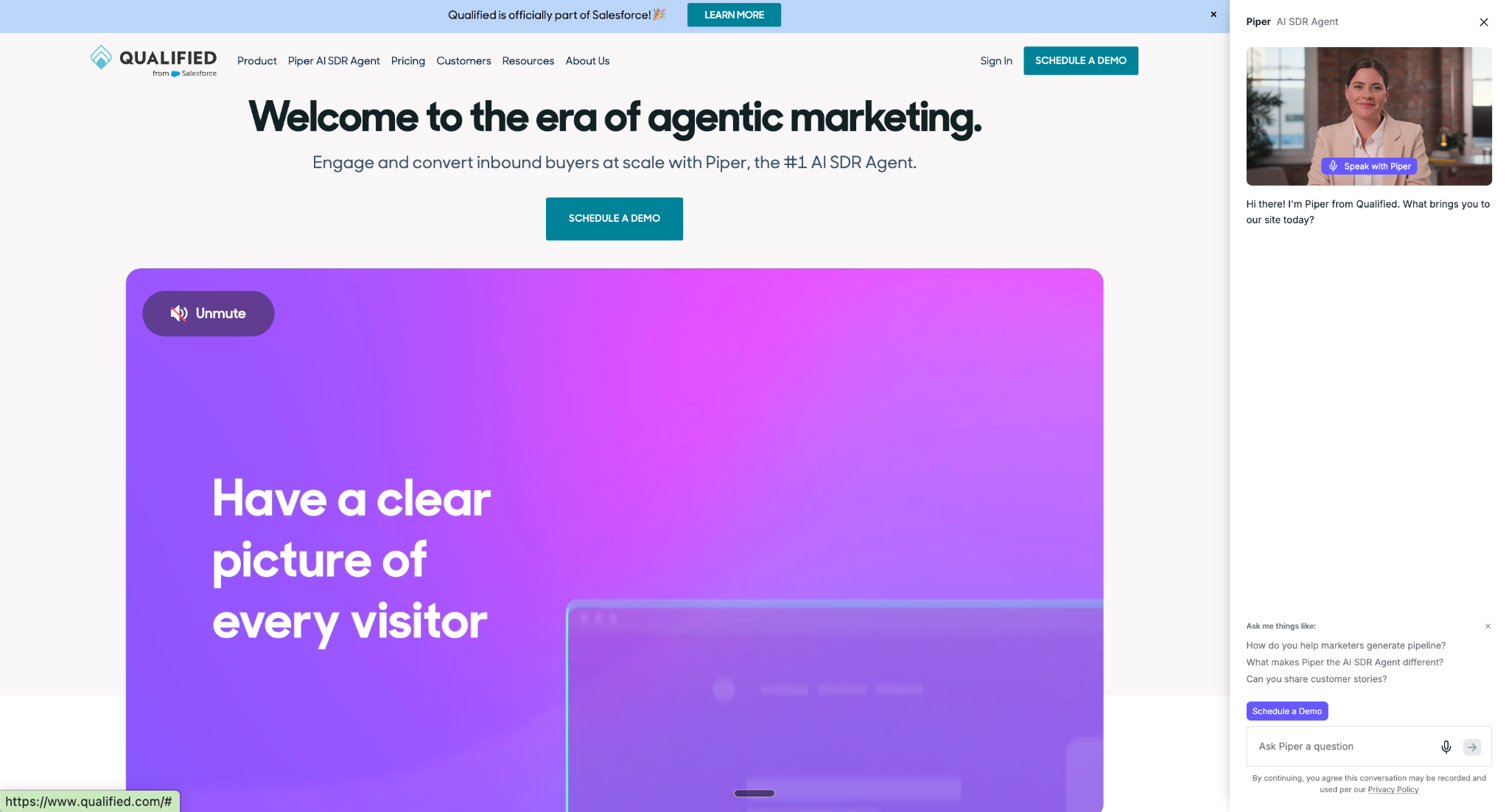
#3. Qualified (Salesforce) — Best for Salesforce-native teams
Qualified, now part of Salesforce, is one of the most established platforms in conversational pipeline generation. With more than 1,800 G2 reviews, it has strong adoption among enterprise teams and a well-developed product.
Its core strength lies in its deep integration with Salesforce. Piper, its AI SDR, operates directly within Salesforce workflows, enabling real-time qualification, routing, and pipeline attribution. This makes it highly effective for teams that rely heavily on Salesforce for their go-to-market operations.
The trade-off is flexibility. Qualified is tightly coupled with the Salesforce ecosystem, which works well for companies already committed to that stack but can be limiting for teams that want a more flexible or multi-system setup.
Best for enterprises that are fully invested in Salesforce and want a tightly integrated pipeline generation layer.
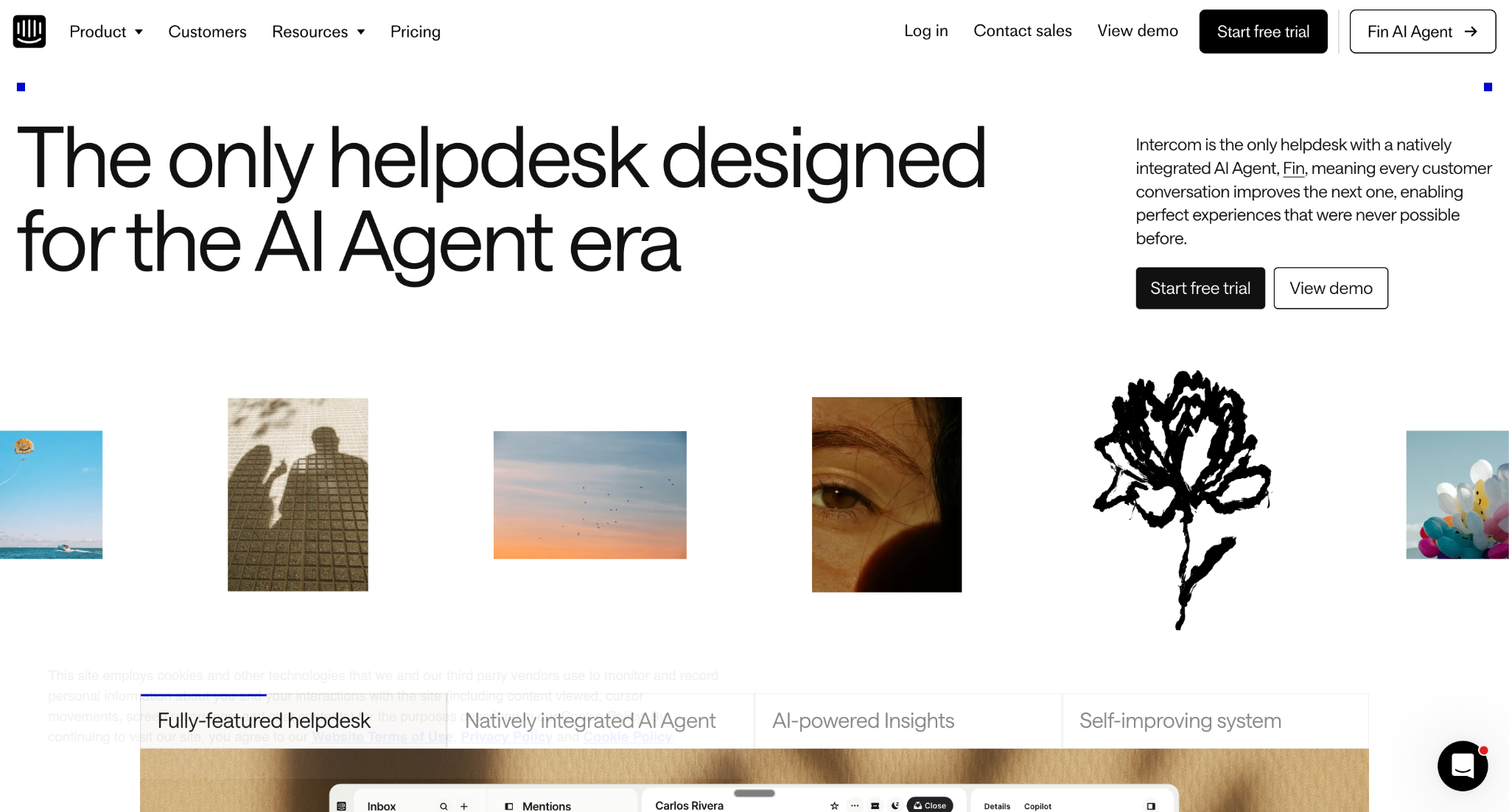
#4. Intercom (Fin AI) — Best for support-first organizations
Intercom’s Fin AI is built primarily for customer support automation, with strong capabilities in handling queries, onboarding users, and reducing support workload. It integrates deeply into in-product experiences and allows teams to manage conversations at scale.
This makes it a natural fit for companies where support and customer experience are the primary focus. It can handle high volumes of interactions efficiently and improve response times across the product lifecycle.
However, its strengths are centered on support rather than revenue generation. While it can assist with lead capture and basic engagement, it is not designed as a core system for pipeline creation or conversion optimization.
Best for teams prioritizing support efficiency and user experience, with only light sales requirements.
Captures intent across LinkedIn, G2, communities, events, PDFs, QR codes, ads
Limited. Focused on website visitor identification
None. Website-only engagement
None. Website and in-app only
Messaging support
Email follow-up
Slack, WhatsApp, LinkedIn, Telegram, iMessage
Limited messaging integrations
Email follow-up
In-app messaging
What happens after buyer leaves site
Session ends. Follow-up handled via email
Conversation continues in buyer’s preferred messaging app
Retargeting via email and ads
Email nurture sequences
In-app and email re-engagement
Lead qualification approach
AI trained on company content, sales playbooks, and product knowledge
Identity graph, real-time intent signals, and enrichment from CRM and data sources
Intent scoring combined with de-anonymization
Salesforce data-driven chatbot and workflows
Rule-based chatbot with Fin AI support
In-product guidance
Strong. Designed for onboarding and activation
Available but not primary focus
Not a core focus
Not a core focus
Strong. Built for in-app support and onboarding
Call assistance
AI joins Zoom calls as a sales assistant
Not a focus
Not available
Not available
Not available
Visitor identification
Not publicly emphasized
Company and contact-level identification across channels
Person-level de-anonymization is a core strength
Company-level identification after chat
Limited identification capabilities
Routing
Workflow-based handoffs
Real-time routing based on fit, intent, ownership, and enrichment
Routing based on identification signals
Native Salesforce routing
Limited routing logic
Re-engagement after drop-off
Limited public capability
Persistent messaging threads with preserved context
Retargeting through ads and email
Email nurture workflows
In-app and email follow-ups
Scheduling
Basic meeting booking within AI interaction
Conversion-focused scheduling with reduced friction
Basic scheduling flows
Native Salesforce scheduling
Basic calendar integrations
No-show prevention
Limited emphasis
Active prevention through reminders and continuity
None
None
None
Event and offline capture
None
QR codes, event capture, and offline conversion flows
None
None
None
Setup time
Typically weeks
Under a few hours, no code required
1 to 2 weeks
4 to 8 weeks with Salesforce setup
A few days
CRM compatibility
Salesforce, HubSpot, Slack, Teams
Salesforce, HubSpot, Marketo, Pipedrive
HubSpot, Salesforce, Pipedrive, Outreach
Salesforce-native
Multiple CRM integrations
Pricing model
Enterprise pricing, often six figures
Enterprise pricing. No per-seat AI fees, unlimited conversations.
Mid-market pricing with migration incentives
Starts around $42K annually
Usage-based pricing
Which 1mind alternative is right for you?
Choosing between 1mind and its alternatives is not about features. It is about identifying where your revenue process is breaking down.
The easiest way to decide is to answer three simple questions.
Where do your buyers engage?
Start by looking at where your buyers actually spend their time.
If most engagement happens on your website, inside your product, or during scheduled demos, then a platform like 1mind fits naturally.
If buyers discover you through LinkedIn, G2, communities, events, or messaging apps, then your funnel starts outside your owned channels.
This distinction matters because it determines whether your system meets buyers where they are, or waits for them to arrive.
What is your bottleneck?
Next, identify the real constraint in your funnel.
If your challenge is scaling conversations, reducing manual work, and improving efficiency, then a lifecycle-focused platform makes sense.
If your challenge is drop-offs, missed opportunities, slow follow-ups, or low conversion from existing demand, then the issue is not capacity. It is leakage.
Most teams assume they need more leads. In reality, they need to convert more of the demand they already have.
What ecosystem do you use?
Finally, consider your current stack and how tightly you want to integrate with it.
If you are deeply invested in Salesforce or Salesloft, certain platforms will align more closely with your workflows.
If your stack is more flexible or spans multiple systems, you may need a solution that works across tools rather than inside one ecosystem.
This decision affects not just implementation, but long-term scalability and flexibility.
Questions to Ask Before Choosing 1mind
Before committing to any platform, especially one with enterprise-level pricing, it is worth asking a few practical questions during your evaluation.
What happens when buyers leave your website?
Does the interaction continue, or does it end? If the session ends and follow-up depends on email, you may lose momentum quickly.
Can it capture demand outside your website?
Buyers rarely start their journey on your site. Ask whether the platform can engage users across channels like LinkedIn, communities, or events, or only after they arrive.
Do we need Salesforce or Salesloft to use it effectively?
Some platforms are deeply tied to specific ecosystems. Make sure you understand how dependent the solution is on your current stack.
What KPI is your team measured on?
Different platforms optimize for different revenue metrics, and the right choice depends on what your CFO or CRO actually tracks.
If your team is measured on revenue per employee, sales cycle compression, coverage scaling, or automation efficiency, 1mind aligns with those KPIs. Its core value is doing more with fewer people.
If your team is measured on pipeline created, conversion rate, held meeting rates, or revenue recovered from existing demand, you're solving a different problem. That's a leakage problem, and the platforms built for it (like Knock AI) optimize directly for those metrics.
The KPI question matters because it determines what success looks like in 12 months. Choose a platform that improves the metrics your team is actually accountable for.
How does pricing scale over time?
Look beyond the initial contract. Understand how pricing changes as usage increases, teams expand, or new use cases are added.
What percentage of the pipeline comes after the first interaction?
This is one of the most revealing questions. If a large portion of your pipeline depends on follow-up after the initial session, then continuity and re-engagement become critical.
FAQ
What is the best 1mind alternative in 2026?
The best 1mind alternative depends on your primary bottleneck. If your goal is to scale AI-led engagement across the lifecycle, 1mind is a strong choice. If your challenge is converting existing demand into pipeline and reducing drop-offs, platforms like Knock AI are better suited. Other alternatives include Warmly for mid-market inbound workflows, Qualified for Salesforce-native teams, and Intercom for support-first use cases.
What is the best alternative to 1mind for enterprise teams that don’t use Salesloft?
For enterprise teams that are not part of the Salesloft or Salesforce ecosystem, flexibility becomes a key factor. In these cases, Knock AI is one of the most relevant alternatives because it operates across multiple systems and channels. Instead of focusing only on AI-led engagement within owned environments, it captures buyer intent across platforms like LinkedIn, G2, and messaging apps, and helps convert that intent into pipeline without requiring tight ecosystem lock-in.
What is 1mind and how does it work?
1mind is an AI-led growth platform that uses AI agents called Superhumans to engage buyers across the customer lifecycle. These agents can qualify leads, run product demos, answer technical questions, and assist during onboarding. The platform is designed to reduce reliance on human teams by handling interactions across website, in-product, and live call environments in real time.
How does 1mind compare to Qualified?
1mind and Qualified serve different purposes within the go-to-market stack. 1mind focuses on AI-led lifecycle engagement and replaces multiple human roles with AI agents across the buying journey. Qualified focuses on conversational pipeline generation within the Salesforce ecosystem, using its AI SDR Piper to qualify and route leads directly inside CRM workflows. The choice depends on whether your priority is lifecycle automation or Salesforce-native pipeline execution.
1mind vs Drift, which makes more sense in 2026?
With Drift being sunset and 1mind announced as its successor on March 6, 2026, many teams are deciding whether to transition or evaluate alternatives. 1mind offers significantly more advanced capabilities than Drift, including AI Superhumans like Mindy that can run demos, qualify leads, and assist in live sales calls. However, this comes with a higher price point, often in the six-figure range compared to Drift’s typical $30K to $60K contracts.
While 1mind improves lifecycle engagement and AI-driven selling, it is more focused on owned-channel experiences such as websites, products, and calls. Drift, in many cases, was used more broadly for conversational marketing across the funnel. The decision depends on whether your priority is adopting AI-led lifecycle automation or maintaining broader funnel coverage with alternative solutions.
Conclusion
There is no universal “best” platform. But there is a best platform for your specific bottleneck.
If your challenge is scaling AI-led engagement and reducing reliance on human effort, 1mind is built for that. It helps teams operate more efficiently by replacing fragmented roles with AI across the lifecycle.
If your challenge is recovering revenue that is already slipping through your funnel, then you are solving a different problem. In that case, a solution focused on capturing and converting existing demand will be a better fit.
The decision framework above is designed to help you identify which of these is true for your team. The answer is rarely about features. It is about where your funnel breaks.
If you recognized your bottleneck in the leakage scenarios discussed earlier, Knock AI is built for that exact problem. It focuses on turning existing demand into a pipeline by preserving buyer momentum and reducing drop-offs across channels.
1mind sells transformation, scale, and modernization. Knock AI sells growth, urgency, and revenue recovery.
If you're feeling the pressure to modernize your team's operating model, you're in 1mind's category. If you're feeling the urgency of revenue slipping through your funnel, you're in Knock AI's.
For everyone else, the most important step is to evaluate your funnel honestly before making a decision. A six-figure investment made under urgency should be based on your actual constraints, not market momentum.


.svg)


.svg)
.svg)
.svg)


.svg)
.svg)


.svg)