What Lead Generation Tools Do You Recommend to Boost My Conversions?
Generating leads is only half the job. Many companies already have a steady flow of form fills, inbound inquiries, and marketing-generated contacts, yet still struggle to turn that demand into qualified conversations, opportunities, and customers.
When that happens, the problem may not be a lack of leads. The leak could be anywhere from the first interaction to the final sale: slow follow-up, poor qualification, inefficient routing, a weak website experience, ineffective sales conversations, or limited visibility into what is actually driving revenue.
Speed is one example. Research conducted by InsideSales in conjunction with MIT's James Oldroyd found that the odds of qualifying a web-generated lead were 21 times higher when the lead was contacted within five minutes rather than 30 minutes. This is a qualification finding from the study, not a claim that responding within five minutes will produce 21× more customers or revenue. (Source)
That's why it makes sense to diagnose the conversion problem before adding another tool. Depending on where the funnel is leaking, the right technology might help you engage high-intent buyers faster, route leads to the right person, personalize the website experience, improve sales conversations, or connect marketing activity to pipeline and revenue.
This guide compares Knock AI, Chili Piper, Mutiny, Gong, and HockeyStack, looking at the specific conversion problem each platform is designed to address.
What Does Lead Conversion Actually Mean?
Lead conversion isn't a single metric. It can happen at different points in the buyer journey:
Visitor → Lead → Qualified Lead → Conversation → Meeting → Opportunity → Customer → Revenue
A visitor may become a lead after filling out a form, while a lead becomes qualified only after meeting your ICP and showing genuine buying potential. A strong visitor-to-lead rate therefore doesn't necessarily mean the funnel is performing well. You could be generating plenty of leads while very few become opportunities or customers.
Why lead volume isn't the same as revenue
A high number of MQLs, form fills, or booked meetings can look impressive, but none of them guarantees revenue. Some leads may not fit your ICP, some may never respond, and others may enter sales conversations without becoming real opportunities.
For that reason, revenue teams should look beyond how many leads were generated and measure how many progressed through the funnel and what they ultimately produced.
Which conversion rate should you actually track?
Start by defining the exact stage you're measuring. For example:
Visitor-to-Lead Rate tells you how well your website captures demand.
Lead-to-Qualified Rate tells you whether you're attracting the right prospects.
Qualified Lead-to-Opportunity Rate shows how effectively qualified demand becomes pipeline.
Opportunity-to-Customer Rate shows how well the sales process converts pipeline into customers.
There is no single "good" conversion rate that applies to every business. Benchmarks only become meaningful when you're comparing the same funnel stage, audience, acquisition source, and business model.
Where Are Your Leads Dropping Out?
Before investing in another lead generation or conversion tool, identify where prospects are leaving the funnel. A strong visitor-to-lead rate can still hide problems with qualification, response time, sales execution, or customer acquisition economics.
Funnel Stage
Common Problem
What to Investigate
Visitor → Lead
Weak CTA, too much friction, or an irrelevant experience
Landing pages, forms, CTAs, messaging, and website personalization
Objections, ROI concerns, security requirements, or internal approval
Sales process, customer proof, case studies, security information, buyer enablement
Customer → Revenue
High acquisition cost or low account value
Attribution, CAC, retention, expansion, cross-sell, and account value
The point is simple: fix the stage where conversion is breaking before trying to generate even more demand. A tool that improves website conversion won't solve slow lead routing, just as better sales conversations won't fix a weak landing page. The right solution depends on where the funnel is actually leaking.
Lead Conversion Problems and the Strategies That Solve Them
Not every conversion problem requires more traffic or more leads. In many cases, the bigger opportunity is to remove friction, respond faster, improve qualification, or give sales and marketing better context about who is actually ready to buy.
Problem
Strategy
Too much friction during conversion
Simplify forms, booking flows, and calls to action. Ask only for information that is necessary at that stage and make the next step obvious.
Leads are responding too slowly
Use real-time engagement, alerts, and routing so high-intent leads reach the right person while their interest is still fresh.
Too many low-quality leads
Combine ICP targeting, enrichment, and qualification to distinguish prospects who fit your business from contacts who are unlikely to become customers.
Website visitors aren't converting
Personalize the experience around the visitor's audience, industry, account, behavior, or intent instead of showing every visitor the same message.
Leads go cold after initial interest
Use behavior-based nurture and timely follow-up that reflects what the prospect has actually done, rather than relying only on fixed time-based sequences.
Sales conversations aren't progressing
Use conversation intelligence, stronger discovery, and better qualification to understand objections, identify gaps, and improve the quality of sales interactions.
High-intent buyers aren't getting attention
Prioritize first-party intent and engagement signals such as repeat visits, pricing activity, chat interactions, form activity, and other meaningful buyer behavior.
Marketing can't prove its impact
Connect lead activity to qualified opportunities, pipeline, revenue, and CAC so marketing performance can be evaluated in business terms rather than lead volume alone.
Existing relationships are being ignored
Reactivate previous buyers, champions, customers, and opportunities when new signals, account changes, or relationship events create another potential opportunity.
The common thread is conversion context. The more your team knows about who the buyer is, what they are doing, how well they fit, and where they are in the buying process, the easier it becomes to decide what should happen next.
Best Lead Generation Tools to Boost Conversions Compared
Tool
Primary Role
Best For
Conversion Problem It Solves
Key Capabilities
Where It Fits in the Funnel
Best Fit
Knock AI
Buyer engagement, qualification, and routing
Converting high-intent B2B demand into qualified conversations
Interested buyers are not being identified, engaged, qualified, or routed at the right time
Buyer and account identification, first-party intent, relationship context, AI conversations, qualification, routing, scheduling
Knock AI's first-party intent capabilities include website activity, Knock Link engagement, chat interactions, page views, CTA activity, and form activity, with those signals feeding its intent scoring and downstream routing and outreach workflows. Chili Piper focuses on real-time qualification, routing, and instant scheduling after a lead converts, while Gong analyzes sales conversations for buying signals, objections, deal risks, and coaching opportunities. Mutiny's current platform combines website and brand context with AI-powered GTM workflows and customer-facing assets, while HockeyStack connects buyer journeys from anonymous first touch through closed-won revenue and supports attribution and incrementality analysis.
The simplest way to understand the differences
Tool
Question It Helps Answer
Knock AI
A buyer is showing interest. What do we know about them, how should we engage, and who should handle the opportunity?
Chili Piper
A qualified visitor just raised their hand. How do we get them into a meeting quickly?
Mutiny
A valuable visitor is on our site. How do we give them a more relevant experience?
Gong
The lead is talking to Sales. What is helping or hurting the deal?
HockeyStack
Which marketing and buyer interactions are actually contributing to pipeline and revenue?
This is why these tools are better evaluated by the conversion problem they solve rather than by a single overall feature score. A company might use Mutiny to improve visitor-to-lead conversion, Knock AI to respond to and qualify high-intent demand, Chili Piper to eliminate scheduling friction, Gong to improve sales execution, and HockeyStack to determine whether those improvements are producing additional pipeline and revenue.
This is why these tools are better evaluated by the conversion problem they solve rather than by a single overall feature score. A company might use Mutiny to improve visitor-to-lead conversion, Knock AI to respond to and qualify high-intent demand, Chili Piper to eliminate scheduling friction, Gong to improve sales execution, and HockeyStack to determine whether those improvements are producing additional pipeline and revenue.
Best Lead Generation Tools to Boost Conversions
The right tool depends on where your conversion process is breaking. Some platforms help turn high-intent demand into conversations, others remove friction from inbound scheduling, personalize the website, improve sales execution, or connect buyer activity to pipeline and revenue. The five tools below therefore solve different conversion problems rather than competing for exactly the same job.
1. Knock AI
What It Does
Knock AI helps revenue teams turn existing buyer interest into qualified conversations, meetings, and pipeline. Instead of waiting for a lead to complete a form and then moving it into a manual SDR queue, Knock AI can identify and enrich the person and company, detect why they are engaging, evaluate fit against your ICP, qualify the opportunity, and determine whether an AI agent or human rep should handle the conversation. It can also route the buyer to the appropriate rep and book a meeting when the lead is ready.
Its first-party intent layer captures actions such as page views, CTA and button clicks, form activity, Knock Link engagement, and chat messages. Those signals are organized into an intent timeline and can contribute to an Intent Score and Intent Type that teams can use for routing and outreach.
The important difference is that qualification does not have to begin with a long form. Knock AI can use enrichment, CRM information, relationship history, engagement, and intent signals first, then ask only the qualification questions that are still missing. It can then route the conversation based on factors such as intent, company attributes, CRM ownership, territory, or custom qualification rules.
That creates a tighter path from buyer signal to sales action:
Buyer activity → form → SDR queue → manual research → follow-up → meeting
Best For
Knock AI is best for B2B companies with meaningful inbound demand or account activity that want to improve conversion between buyer interest and qualified sales opportunities.
It is particularly relevant when teams are dealing with high-intent visitors, multiple types of inbound conversations, complex routing rules, or a need to preserve relationship context across interactions.
What to Consider
Knock AI is most useful when the business has enough inbound or digital buyer activity for qualification, engagement, and routing speed to materially affect pipeline. Teams should also define their ICP and routing logic clearly so the AI is acting on meaningful business rules rather than simply automating an undefined process.
2. Chili Piper
What It Does
Chili Piper focuses on the conversion point immediately after an inbound buyer raises their hand. It can qualify, enrich, route, and schedule leads directly from existing web forms, allowing qualified prospects to book time with the appropriate rep without waiting for a follow-up email or manual assignment.
Its routing logic can use information such as company size, industry, territory, account ownership, CRM fields, and other qualification criteria. It also supports round-robin distribution and real-time handoffs for high-priority leads.
How It Helps Convert Inbound Leads
The core problem Chili Piper addresses is the delay between a form submission and an actual sales conversation.
Qualified buyers can see real-time availability and book with the appropriate rep immediately. That removes several common points of friction while buyer intent is still fresh.
Chili Piper also allows teams to use enrichment behind the scenes, which can help keep forms shorter while still giving routing logic access to information such as company size, industry, and revenue.
Best For
Chili Piper is best for B2B companies with substantial inbound form or chat volume where the main conversion bottleneck occurs between lead capture and booked meeting.
It is especially useful for teams that already generate demand but lose opportunities because leads sit in queues, get routed incorrectly, or have to go through unnecessary scheduling steps.
What to Consider
Chili Piper is primarily focused on inbound conversion, routing, and scheduling. It is not intended to solve every conversion problem further down the funnel, such as improving sales conversations or measuring which marketing activities ultimately generate revenue.
3. Mutiny
What It Does
One important update before we describe Mutiny: its product has evolved significantly in 2026. Mutiny is no longer primarily positioned as a website personalization or CRO platform. Its current product is an AI GTM agent for creating personalized, customer-facing assets and automating work across the buying process.
The platform can generate account-specific assets such as landing pages, microsites, business cases, ROI calculators, pitch decks, deal rooms, pricing proposals, case studies, competitive comparisons, and meeting follow-ups. It can use account and CRM context to personalize those assets for a specific buyer or target account.
How It Helps Improve Website and GTM Conversion
For conversion, the key idea is relevance.
Instead of sending every prospect to the same generic experience, Mutiny can create content tailored to an account's industry, use case, buying stage, or business problem. Its current platform specifically supports personalized landing pages and 1:1 ABM experiences, as well as personalized ROI and business-case materials used later in the deal.
That means personalization can extend beyond:
Visitor → Landing page
into:
Target account → Personalized experience → Evaluation → Business case → Deal
This is useful when the issue is not insufficient traffic, but high-value prospects receiving generic content that doesn't reflect why your solution is relevant to them.
Best For
Mutiny is best for B2B teams running ABM or named-account motions that need to create personalized customer-facing experiences without requiring marketing, design, or engineering to build every asset manually.
What to Consider
Mutiny's current product is broader than traditional website personalization. Teams evaluating it should therefore focus on whether personalized customer-facing assets and GTM workflow automation solve their conversion bottleneck, rather than treating it purely as a website testing or CRO platform.
4. Gong
What It Does
Gong is a conversation intelligence and revenue platform that captures and analyzes customer interactions across calls, meetings, emails, and other conversations. It uses AI to surface buying signals, objections, deal risks, and patterns in successful sales interactions, while also supporting coaching, CRM updates, and sales execution.
Its deal-management capabilities can flag stalled activity, missing stakeholders, unresolved objections, and other risk signals, while its AI Deal Predictor uses hundreds of signals from CRM activity, conversations, emails, and other data to assess relative deal health.
How It Helps Improve Sales Conversion
Once a lead becomes a sales conversation, the next conversion problem is often what happens inside that conversation.
Gong can help teams identify:
Which objections appear repeatedly
Which buying signals are emerging
Where deals are stalling
Which stakeholders are missing
Which talk tracks and behaviors are associated with successful outcomes
Where reps need coaching or support
Gong's own research also illustrates how it analyzes large volumes of sales conversations to identify behaviors associated with successful outcomes. One Gong Labs study analyzed 67,149 demo call recordings to examine objection-handling patterns.
rather than treating the meeting as the end of lead conversion.
Best For
Gong is best for sales organizations with an established volume of customer conversations that want to improve discovery, objection handling, rep performance, deal execution, and pipeline visibility.
What to Consider
Gong becomes most relevant after meaningful sales interactions already exist. If the primary issue is that qualified inbound buyers aren't reaching Sales in the first place, a routing or engagement solution may address an earlier bottleneck.
5. HockeyStack
What It Does
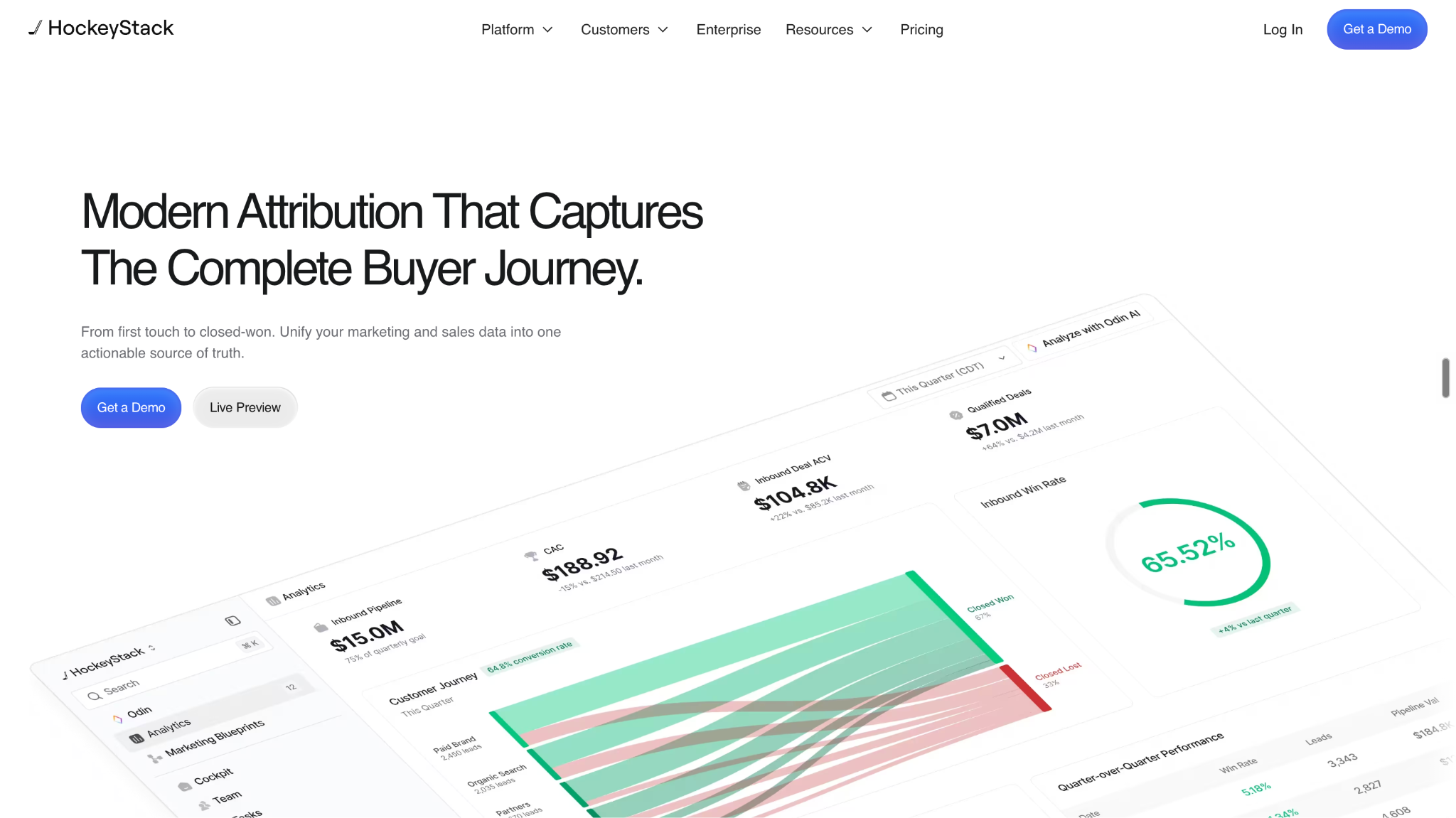
HockeyStack focuses on buyer-journey analytics, attribution, and revenue intelligence. Its platform brings together interactions across the buyer journey so teams can see activity from the first touch through closed-won, apply attribution models, and analyze which channels and campaigns are contributing to pipeline and revenue.
It also supports lift and incrementality analysis, helping teams compare exposed and unexposed accounts to estimate whether a marketing activity actually caused incremental impact rather than simply appearing somewhere in the buyer journey.
How It Helps Connect Marketing Activity to Revenue
The conversion question here is different:
We generated activity, but what actually contributed to pipeline and revenue?
HockeyStack can connect buyer interactions across channels and provide different attribution models, including first-touch, last-touch, and multi-touch views. Its buyer-journey reporting is designed to show the sequence of interactions leading from initial engagement to a closed deal.
rather than stopping at traffic, leads, or campaign-influenced engagement.
HockeyStack's own research also notes that attribution is imperfect and that different attribution models need to be evaluated in context. Its 2025 report analyzed more than 8,500 self-reported attribution answers from 36 B2B SaaS companies to examine how different attribution approaches relate to revenue.
Best For
HockeyStack is best for marketing, RevOps, and revenue teams that need to understand the complete buyer journey and prove which activities contribute to pipeline and revenue.
It is especially relevant when the internal question has shifted from:
"How many leads did Marketing generate?"
to:
"Which activities actually produced opportunities and revenue?"
What to Consider
Attribution should be treated as a decision-making framework, not an unquestionable source of truth. Different models can assign credit differently, and complex B2B buying journeys rarely have a single touchpoint that explains a closed deal. HockeyStack itself recommends evaluating attribution approaches in context rather than assuming one model is universally correct.
Knock AI vs Chili Piper vs Mutiny vs Gong vs HockeyStack
These tools address different points in the conversion journey, so they are better evaluated by the problem they solve rather than as direct substitutes.
Tool
Primary Question It Answers
Knock AI
What should happen when a buyer or account shows meaningful intent?
Chili Piper
How do we turn inbound interest into a qualified meeting faster?
Mutiny
How do we make the website and buying experience more relevant to each audience?
Gong
How do we improve the sales conversation after a lead engages?
HockeyStack
Which marketing and buyer activities actually influence pipeline and revenue?
A company can use several of these tools together because they address different conversion points. For example, Mutiny can make the buyer experience more relevant, Knock AI can identify and engage high-intent buyers and qualify or route them, Chili Piper can remove friction from meeting booking, Gong can help improve the sales conversation, and HockeyStack can connect buyer activity to pipeline and revenue. The right combination depends on where the biggest conversion leak exists in the funnel.
How These Tools Fit Into the Lead Conversion Journey
Revenue Stage
Typical Approach / Tool
Attract demand
SEO, paid media, content, referrals
Convert visitors
Mutiny / website CRO
Identify interest
First-party signals / visitor identification
Engage quickly
Knock AI
Qualify
Knock AI / CRM
Route and book
Knock AI / Chili Piper
Conduct better sales conversations
Gong
Manage opportunities
CRM
Measure pipeline and revenue
HockeyStack / CRM
These tools aren't necessarily substitutes. Each addresses a different part of the conversion journey, and many revenue teams can use them together.
How These Tools Fit Into the Lead Conversion Journey
Revenue Stage
Typical Approach / Tool
Attract demand
SEO, paid media, content, referrals
Convert visitors
Mutiny / website CRO
Identify interest
First-party signals / visitor identification
Engage quickly
Knock AI
Qualify
Knock AI / CRM
Route and book
Knock AI / Chili Piper
Conduct better sales conversations
Gong
Manage opportunities
CRM
Measure pipeline and revenue
HockeyStack / CRM
These tools aren't necessarily substitutes. Each addresses a different part of the conversion journey, and many revenue teams can use them together.
How to Prove Lead Conversion Improvements to Your CFO
Improving a conversion rate only matters if it creates more qualified pipeline and revenue. Your reporting should therefore connect conversion improvements to business outcomes.
This makes it easier to show whether an improvement actually created commercial value.
Track Conversion by Source
Break performance down by acquisition source:
Source → Qualified Lead → Opportunity → Won Revenue
This helps identify which channels generate leads that actually contribute to revenue, rather than simply producing the highest volume.
Calculate the Economics
Track metrics such as:
Cost per lead
Cost per qualified lead
Cost per opportunity
Customer acquisition cost (CAC)
Pipeline generated
Revenue generated
CAC payback
These metrics help connect conversion performance with the financial impact of your marketing and sales programs.
Show the Before-and-After Impact
Keep the calculation simple:
Conversion rate increased from X% to Y% → additional opportunities → additional pipeline → additional revenue.
That gives your CFO a much clearer answer to the question: “Did this actually improve the business?”
Lead Conversion Metrics to Track
Metric
Why It Matters
Visitor-to-Lead Rate
Measures website conversion
Lead-to-Qualified Rate
Measures lead quality
Qualified-to-Meeting Rate
Measures sales acceptance and engagement
Meeting-to-Opportunity Rate
Measures conversation quality
Opportunity-to-Win Rate
Measures sales effectiveness
Pipeline per Lead
Connects demand to commercial value
Cost per Opportunity
Measures acquisition efficiency
Customer Acquisition Cost
Measures overall acquisition economics
Pipeline Velocity
Measures how quickly opportunities progress
Marketing-Sourced Revenue
Measures direct marketing contribution
Revenue per Lead
Shows the economic value of demand
How to Improve Lead Conversion Without Simply Buying More Leads
You don't always need more leads. In many cases, the bigger opportunity is getting more value from the demand you're already generating.
Fix the Biggest Funnel Leak First
Identify the stage with the largest drop-off, then focus your optimization efforts there. Improving a healthy stage while ignoring a major bottleneck won't meaningfully improve overall conversion.
Not every lead deserves the same level of attention. Use ICP fit, engagement, intent, and buying signals to prioritize prospects with a stronger likelihood of becoming customers.
Remove Friction From High-Intent Moments
Make it easy for interested buyers to take the next step. Reduce unnecessary form fields, simplify scheduling, and provide relevant information when prospects are actively evaluating your solution.
Follow Up Based on Behavior, Not Just Time
A prospect who returns to your pricing page or engages with a high-intent asset may warrant a different response from someone who downloaded a top-of-funnel guide weeks ago. Use buyer behavior to determine when and how to follow up.
Connect Every Conversion Improvement to Revenue
Don't stop at “conversion increased.” Track whether the improvement produced more qualified opportunities, pipeline, and closed revenue. That's what turns conversion optimization into a business case.
Frequently Asked Questions
What Is a Good Lead Conversion Rate?
There isn't one conversion rate that is considered good for every business. It depends on the funnel stage, acquisition source, industry, sales model, average deal size, and definition of a qualified lead. The more useful approach is to benchmark the same stage and source over time and measure how changes affect downstream pipeline and revenue.
How Can I Increase My Lead Conversion Rate?
Start by identifying where leads are dropping out of the funnel. Depending on the problem, you may need to improve qualification, reduce conversion friction, respond faster, personalize the buyer experience, improve sales conversations, or strengthen follow-up. Focus on the biggest bottleneck rather than trying to optimize everything at once.
Why Are My Leads Not Converting?
Common reasons include poor ICP fit, weak qualification, slow follow-up, ineffective routing, generic messaging, scheduling friction, weak sales conversations, or a mismatch between buyer intent and the follow-up they receive. The first step is to identify which stage of the funnel is losing the most potential customers.
How Quickly Should I Follow Up With a New Lead?
As quickly as practical, particularly when the lead has shown strong buying intent. Research published by Harvard Business Review found that companies contacting an online lead within one hour were nearly seven times as likely to qualify that lead as companies that waited another hour.
How Can I Convert More Website Visitors Into Leads?
Reduce friction and make the experience more relevant to the visitor. Test clearer calls to action, simpler forms, stronger conversion paths, and personalized experiences based on audience, account, industry, or behavior. The goal is to help the right visitor quickly understand why the next step is relevant.
What Tools Help With Lead Qualification and Routing?
Tools such as Knock AI and Chili Piper can help with different parts of the qualification and routing process. Knock AI focuses on identifying buyer and account context, detecting intent, engaging prospects, qualifying them, and routing them. Chili Piper focuses heavily on inbound qualification, routing, and getting qualified prospects into meetings quickly.
How Do I Prove Lead Generation ROI to My CFO?
Connect acquisition activity to business outcomes. Instead of reporting only leads or MQLs, track the progression from source → qualified lead → opportunity → pipeline → closed revenue. Then compare costs against the pipeline and revenue generated to calculate metrics such as cost per opportunity, CAC, and CAC payback.
Can Knock AI Help Me Convert More Leads?
Yes, particularly for B2B companies that already have meaningful buyer or account activity but need to improve what happens after interest is detected. Knock AI can connect buyer and account identity with relationship context, first-party intent, engagement, qualification, and routing so the right action can happen at the right time.


.svg)


.svg)
.svg)
.svg)


.svg)
.svg)


.svg)