1mind Review: Pricing, Features & Alternatives (2026)
1mind Review 2026
TL;DR
1mind is an AI sales agent platform that uses AI Superhumans to engage website visitors, assist during live sales calls, guide in-product experiences, and support customer success. Founded by Amanda Kahlow, the company launched publicly in November 2025 with $40 million in funding.
1mind Pricing: 1mind does not publish its pricing. Its founder has described average annual contracts in the six figures.
1mind Key features: Website visitor engagement, interactive demos, live-call technical assistance, in-product guidance, and customer success automation, connected through a shared AI brain.
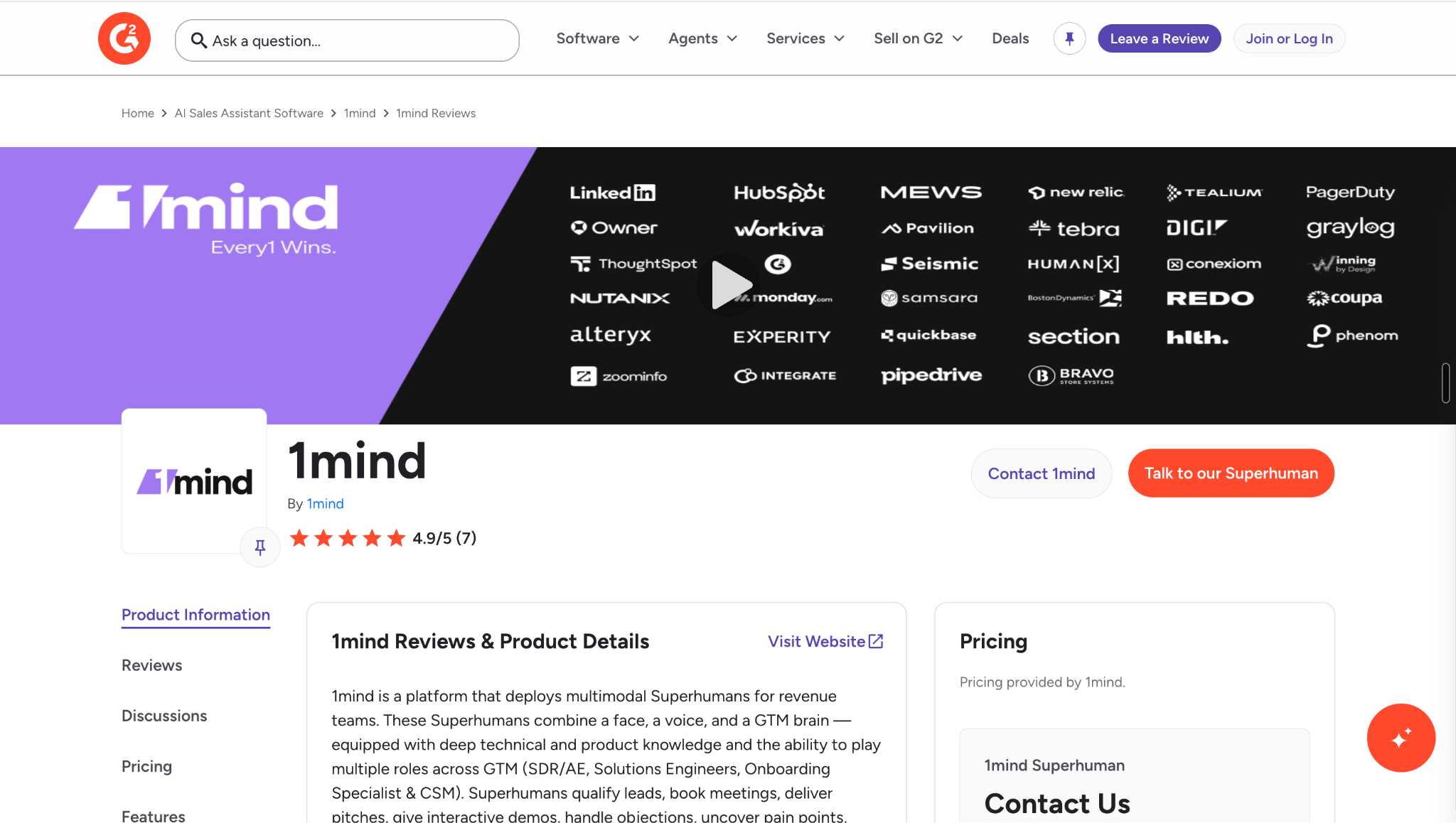
1mind Reviews: 1mind has a 4.9/5 rating from seven G2 reviews in the research covered by this article. The small sample limits how confidently this reflects overall customer satisfaction.
Best for: B2B companies looking to scale AI-powered interactions across the customer lifecycle.
1mind Main limitations: High investment, implementation and maintenance requirements, and the need to validate conversational quality and ROI.
1mind Best alternatives:Qualified for inbound pipeline generation and Knock AI for connecting buyer identity, intent, and relationship context across supported channels to drive revenue action.
Our verdict: 1mind is worth evaluating if AI-powered sales conversations and customer interactions are your priority. Run a proof of concept and measure its business impact before committing to a six-figure annual investment.
What is 1mind?
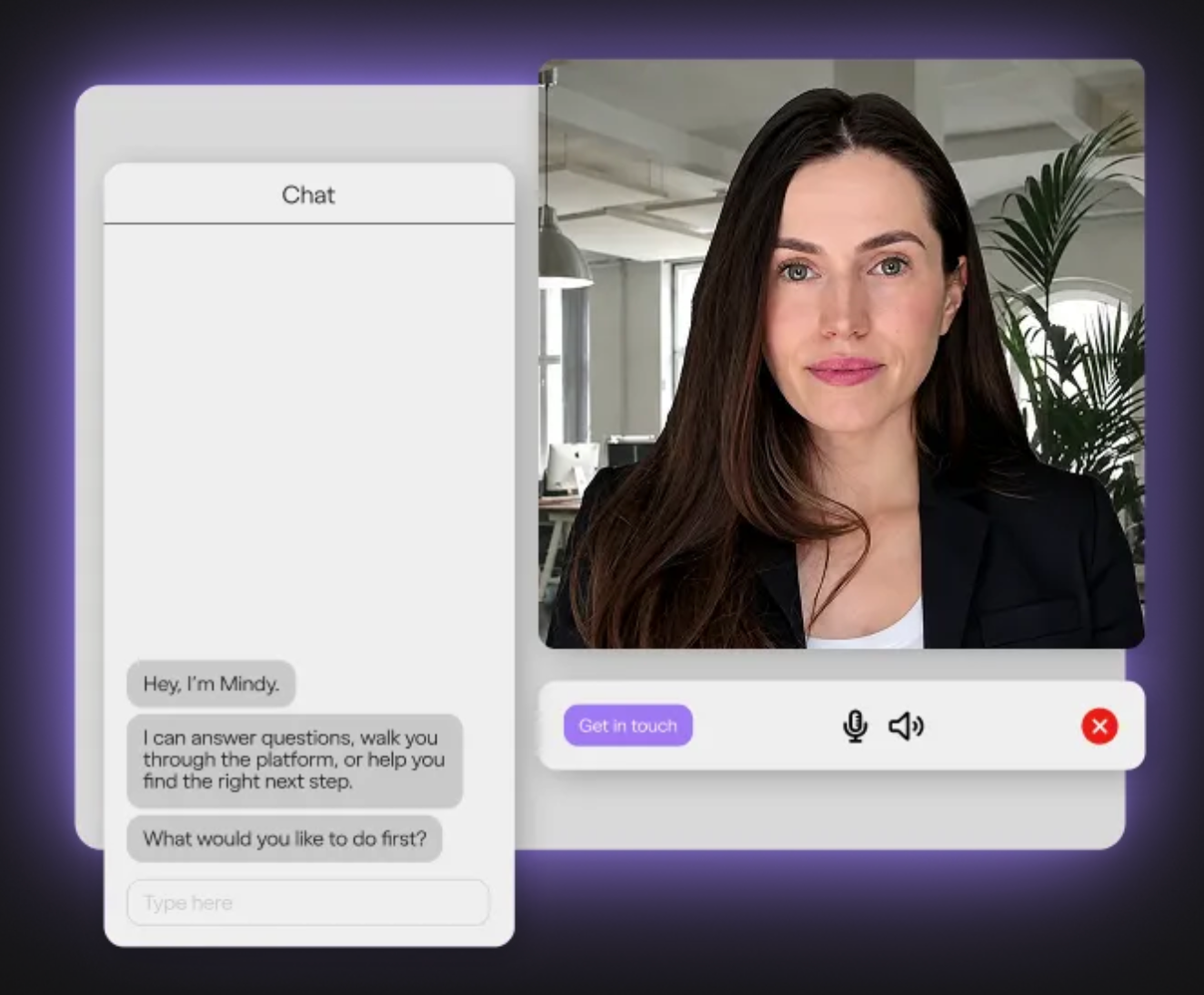
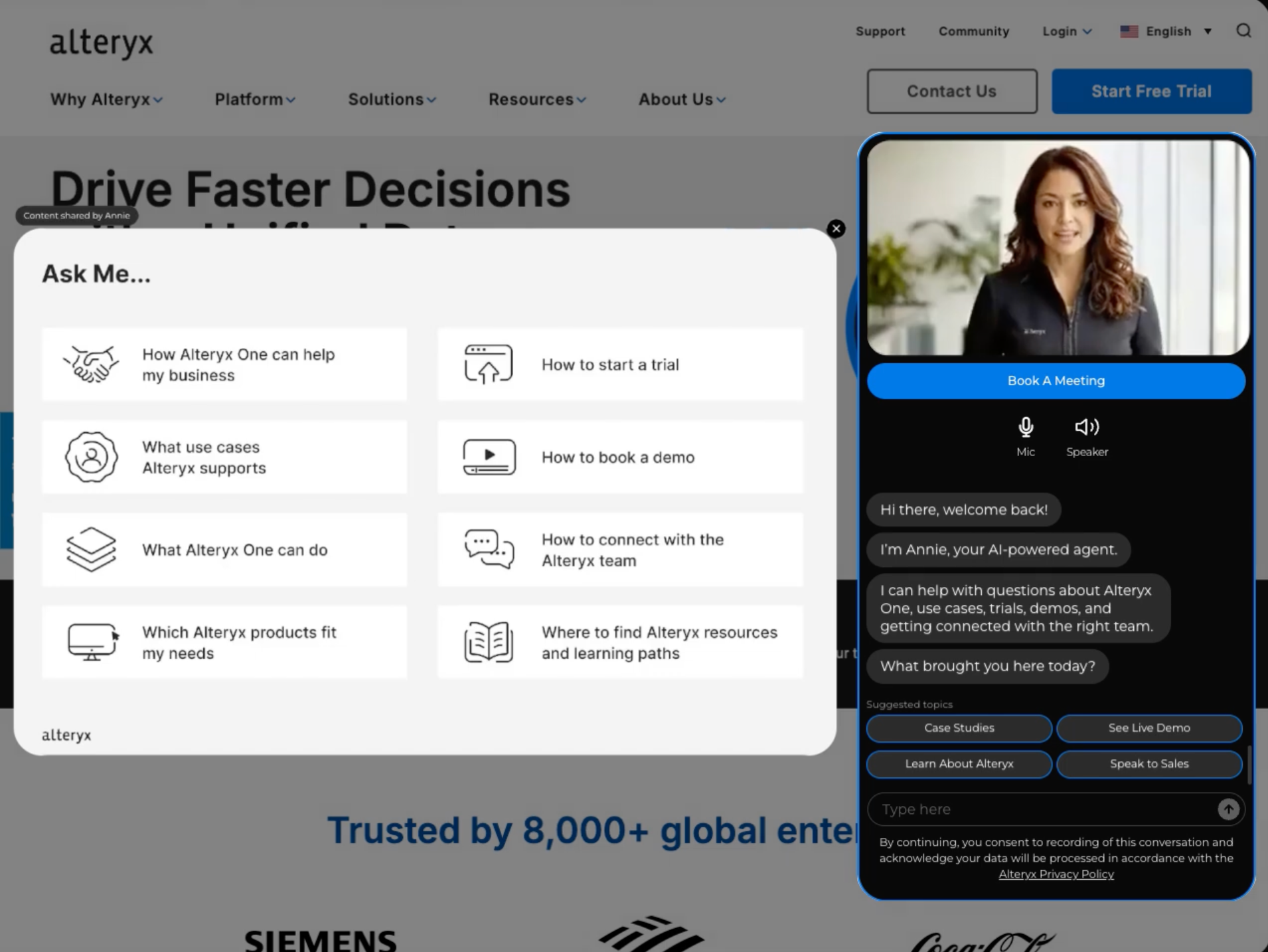
1mind is an AI sales agent platform that offers AI Superhumans, virtual teammates with a face, a voice, empathy, and a go-to-market brain. Designed to interact with buyers in a human-like way, they draw on deep product knowledge and shared context to answer questions, participate in sales calls, engage prospects, qualify buyers, and help convert them into customers. For example, Mindy, one of 1mind's AI Superhumans, can engage potential buyers and guide them through the buying process with personalized, empathetic conversations.
What does 1mind do?
1mind helps businesses automate and improve customer interactions using AI Superhumans, AI-powered digital teammates that can engage prospects, answer product questions, qualify buyers, deliver interactive demos, and support customers. These agents work across the customer journey, from the first website visit to live sales conversations, product onboarding, and customer success. By combining product knowledge with customer context, 1mind helps businesses deliver more personalized experiences, reduce friction in the buying process, and turn more interactions into revenue.
Who Founded 1mind? The Story Behind the Company
1mind was founded by Amanda Kahlow, the entrepreneur best known for founding 6sense, a B2B revenue intelligence platform that helps businesses identify potential buyers and understand buying intent.
After leaving 6sense, Kahlow wasn't initially planning to build another company. What brought her back was an opportunity to apply AI to a different part of the buying journey: helping businesses engage prospects and turn buyer interest into revenue.
The idea took shape when Kahlow met a team from an AI research lab that had developed technology combining synthetic faces, voices, and AI intelligence. Rather than using this technology simply to create realistic digital avatars, she saw an opportunity to build AI teammates capable of handling real B2B sales interactions.
That became the foundation of 1mind and its concept of AI Superhumans. These digital teammates are designed to do more than answer basic questions. They can engage website visitors, explain products, qualify prospects, deliver demos, assist sales representatives during live calls, and support customers after purchase.
Kahlow describes the relationship between her two ventures simply: 6sense helps businesses find buyers, while 1mind aims to help them close those buyers. Her broader vision is to create a more connected buying experience in which customers don't have to repeat themselves or wait for different teams to provide answers at each stage.
1mind publicly launched in November 2025 with $40 million in total funding, including a $30 million Series A led by Battery Ventures. Other investors included Primary Venture Partners and Wing Venture Capital. (Source)
1mind Use Cases and Features
Use Case
What It Does
Key Capabilities
Primary Goal
Website Inbound
Engages website visitors and qualifies potential buyers.
Answers product and pricing questions, runs interactive demos, qualifies intent, routes leads, and books meetings.
Increase website conversions and qualified pipeline.
Ride-Along
Acts as an on-demand technical copilot during live sales calls.
Answers technical questions, provides relevant proof, runs live demos, and carries buyer context into calls.
Help sales reps handle complex questions and move deals forward.
In-Product Guide
Guides users through product setup, workflows, and feature adoption.
Provides in-app answers, interactive walkthroughs, onboarding assistance, and upgrade guidance.
Improve activation, product adoption, and trial-to-paid conversion.
Customer Success
Supports customers after purchase throughout their relationship with a business.
Assists with onboarding, answers account questions, identifies adoption gaps and expansion opportunities, and schedules follow-ups.
Improve retention, renewals, and expansion revenue.
See Knock AI in Action — Book Your Live Demo Today
Let's look at the key features of 1mind one by one.
1. Website Inbound
It turns your website into an always-on sales agent.
Unlike website chatbots that focus on collecting contact details and booking meetings, 1mind's Website Inbound Superhuman is designed to do more by engaging visitors in real-time conversations, answering detailed product and pricing questions, and running interactive product demos directly on the website.
Here's what it can do:
Engage website visitors: Interact with prospects before or after they fill out a form, rather than making every visitor wait for an SDR.
Answer product and technical questions: Use your product knowledge base to respond to detailed questions about features, integrations, pricing, and capabilities.
Run interactive demos: Show prospects how a product works within the conversation, helping them evaluate whether it fits their needs.
Qualify buyer intent: Understand what visitors are looking for and identify high-intent prospects who may be ready to speak with sales.
Route qualified buyers: Direct prospects to the appropriate next step, including booking meetings or handing them off to the right sales representative.
Automate follow-ups: Follow up with inbound leads and write structured qualification information back to your CRM.
Support global visitors: Engage prospects around the clock and in multiple languages.
The goal is to move beyond simply generating more leads. By answering questions and demonstrating value before a sales call, 1mind aims to help businesses convert more website traffic into qualified pipeline.
2. Ride-Along: AI Support During Live Sales Calls
It gives every sales representative access to an on-demand Solutions Engineer.
Sales conversations often involve difficult technical questions that an account executive may not be able to answer immediately. Traditionally, the representative has to bring in a Solutions Engineer, schedule another meeting, or follow up later. That delay can slow down the buying process.
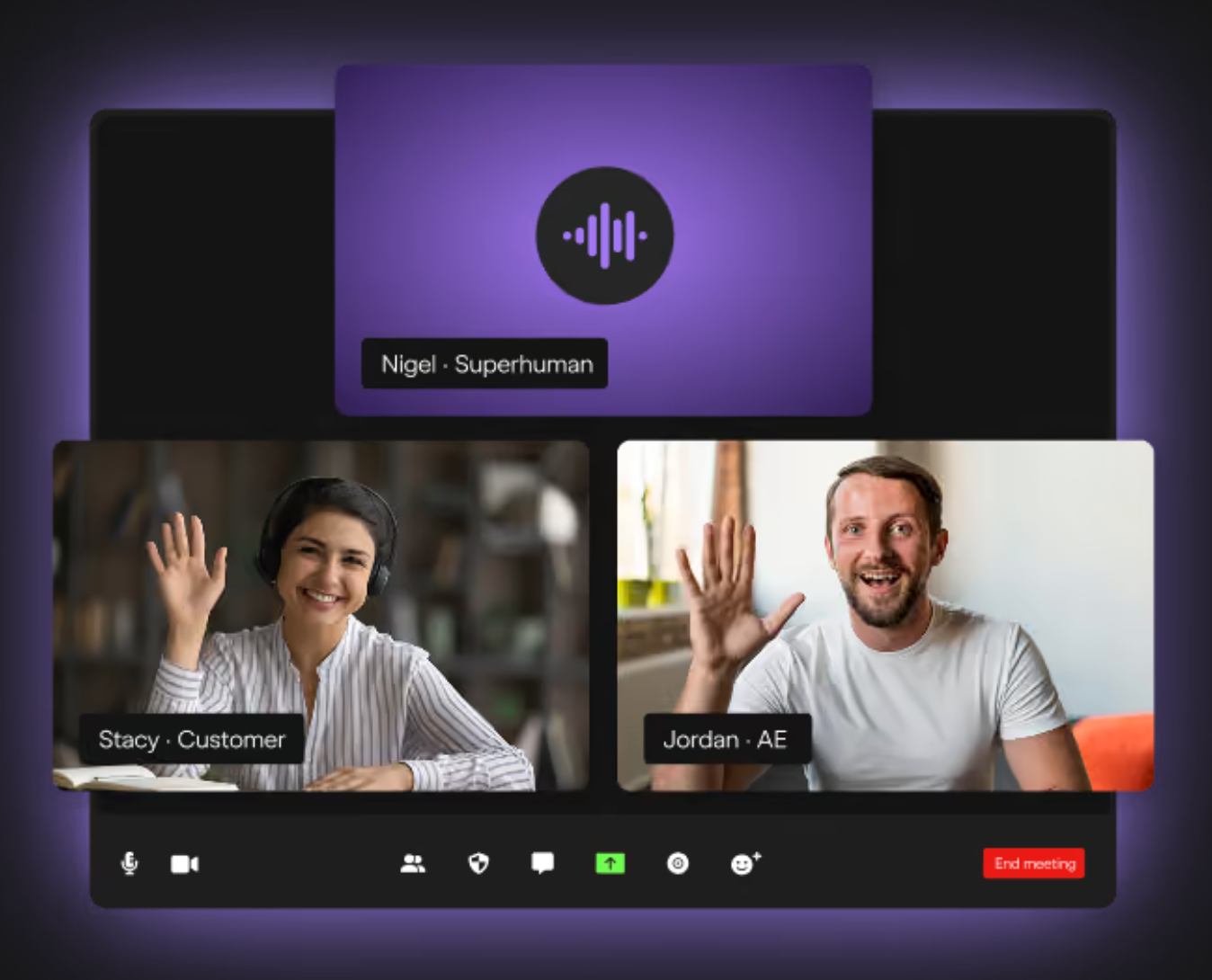
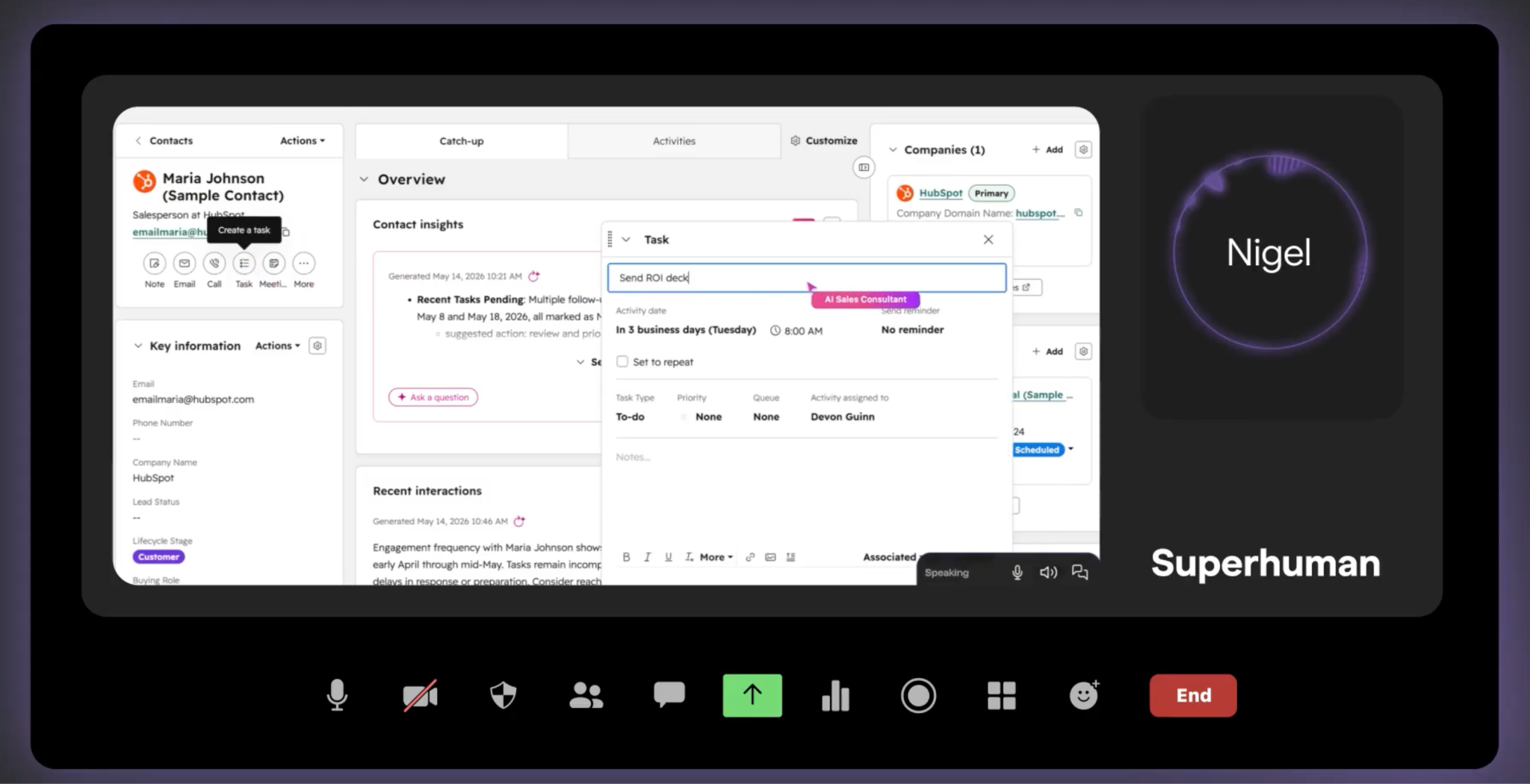
1mind's Ride-Along Superhuman is designed to address this problem. It joins Zoom sales calls in the background and can provide technical answers, relevant proof, and live product demonstrations when the sales representative requests assistance.
Key capabilities include:
Answer technical questions in real time: Help representatives respond to detailed product and implementation questions during a live conversation.
Provide relevant proof: Surface information that helps explain product capabilities and address buyer concerns.
Run live product demos: Demonstrate relevant workflows without requiring the sales representative to switch between tools or interrupt the conversation.
Support early-stage and technical calls: Give account executives access to technical expertise without requiring a Solutions Engineer to attend every call.
Carry forward buyer context: Use information from previous website conversations so the buyer does not have to repeat questions or explain their requirements again.
Capture conversation context: Record relevant questions and information back into connected systems.
An important distinction is that Ride-Along is designed to assist the sales representative, not replace them during the conversation. The representative remains in control and can call on the Superhuman when technical expertise is needed.
3. In-Product Guide
It helps users reach value without waiting for human support.
Getting a customer to sign up is only the beginning. Users can still struggle with setup, miss important features, or abandon a trial before experiencing the product's value. Traditional product tours and static tooltips cannot always answer the specific questions users encounter along the way.
1mind's In-Product Guide brings an AI Superhuman directly into the product experience. It can answer questions, guide users through workflows, and help them discover features relevant to their needs.
Its key capabilities include:
Guide users through workflows: Walk users through setup processes, product features, and complex configurations.
Answer questions in context: Provide product and workflow assistance within the application instead of forcing users to search documentation or contact support.
Deliver interactive product demonstrations: Guide users through features using their own data, rather than relying exclusively on static tours.
Improve product activation: Help users overcome setup friction and reach important milestones sooner.
Support trial-to-paid conversion: Guide trial users toward the features and workflows that demonstrate the product's value.
Encourage feature adoption and upgrades: Highlight relevant capabilities that may help users get more from the product.
Follow defined guardrails: Recognize situations where it should not answer and operate within configured boundaries.
For product-led growth teams, the objective is to help more users experience value, adopt important features, and discover reasons to upgrade without requiring one-to-one human assistance at every step.
4. Customer Success
It scales customer success beyond one-to-one human coverage.
Customer success teams need to do more than resolve support tickets. They also help customers onboard, adopt products, achieve outcomes, and identify opportunities for renewal and expansion. However, human customer success managers cannot proactively engage every account at every important moment.
1mind's Customer Success Superhuman is designed to extend that coverage by assisting customers throughout their post-sale journey, using context gathered from earlier interactions.
Its capabilities include:
Support customer onboarding: Guide new customers through product setup, workflows, and implementation questions.
Drive product adoption: Help customers discover features and overcome obstacles that prevent them from getting value.
Identify expansion opportunities: Surface potential upsell and cross-sell moments based on customer needs and adoption signals.
Surface renewal risks: Help identify potential issues that could affect customer retention before renewal conversations.
Answer account questions around the clock: Provide ongoing assistance with technical and product questions.
Schedule customer meetings: Arrange follow-up meetings, check-ins, and quarterly business reviews.
Maintain relationship context: Carry information from the initial website visit and sales process into post-sale interactions.
Escalate when necessary: Operate within defined guardrails and hand off to a human when appropriate.
The idea is to make customer success more proactive. Instead of waiting for a customer to raise an issue or for a renewal date to approach, the Superhuman can help teams support adoption and identify opportunities throughout the customer relationship.
What Connects These Four Features?
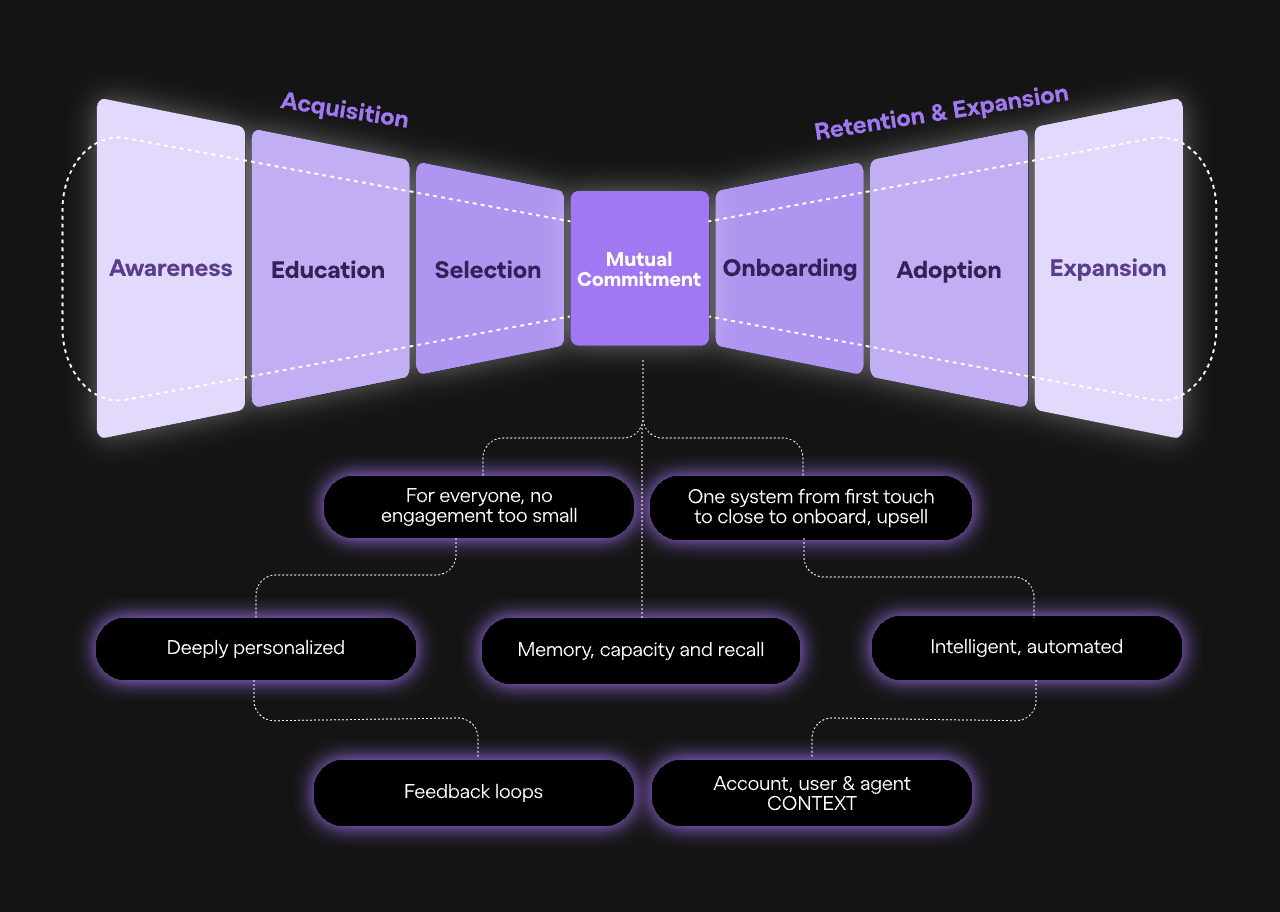
The shared Brain is the central idea behind 1mind's four use cases.
A buyer might first interact with a Website Inbound Superhuman, ask technical questions during a Ride-Along sales call, and later receive guidance from an In-Product Guide after becoming a customer. The Customer Success Superhuman can then use the context carried forward from those earlier interactions.
According to 1mind, this shared context reduces the need to start conversations from scratch at every stage. Businesses can begin with one use case, measure its impact, and expand to other revenue motions without treating each Superhuman as an entirely separate experience.
In short, 1mind is designed to connect website conversion, sales enablement, product adoption, and customer success through a common AI platform.
What is the pricing of 1mind?
1mind does not publicly disclose its pricing. However, in a November 2025 interview with TechCrunch, founder and CEO Amanda Kahlow stated that 1mind's customers have annual contracts rather than experimental budgets, with the average contract valued at six figures per year.
For budgeting purposes, the estimates cited in our research put 1mind's pricing at approximately $100,000+ per year, with some enterprise deployments reportedly reaching $400,000 depending on scope. These figures are estimates, not an official price list, and implementation costs may add to the total.
To get an accurate quote, businesses need to contact 1mind directly.
1mind Reviews
What users are talking about 1mind on Reddit?
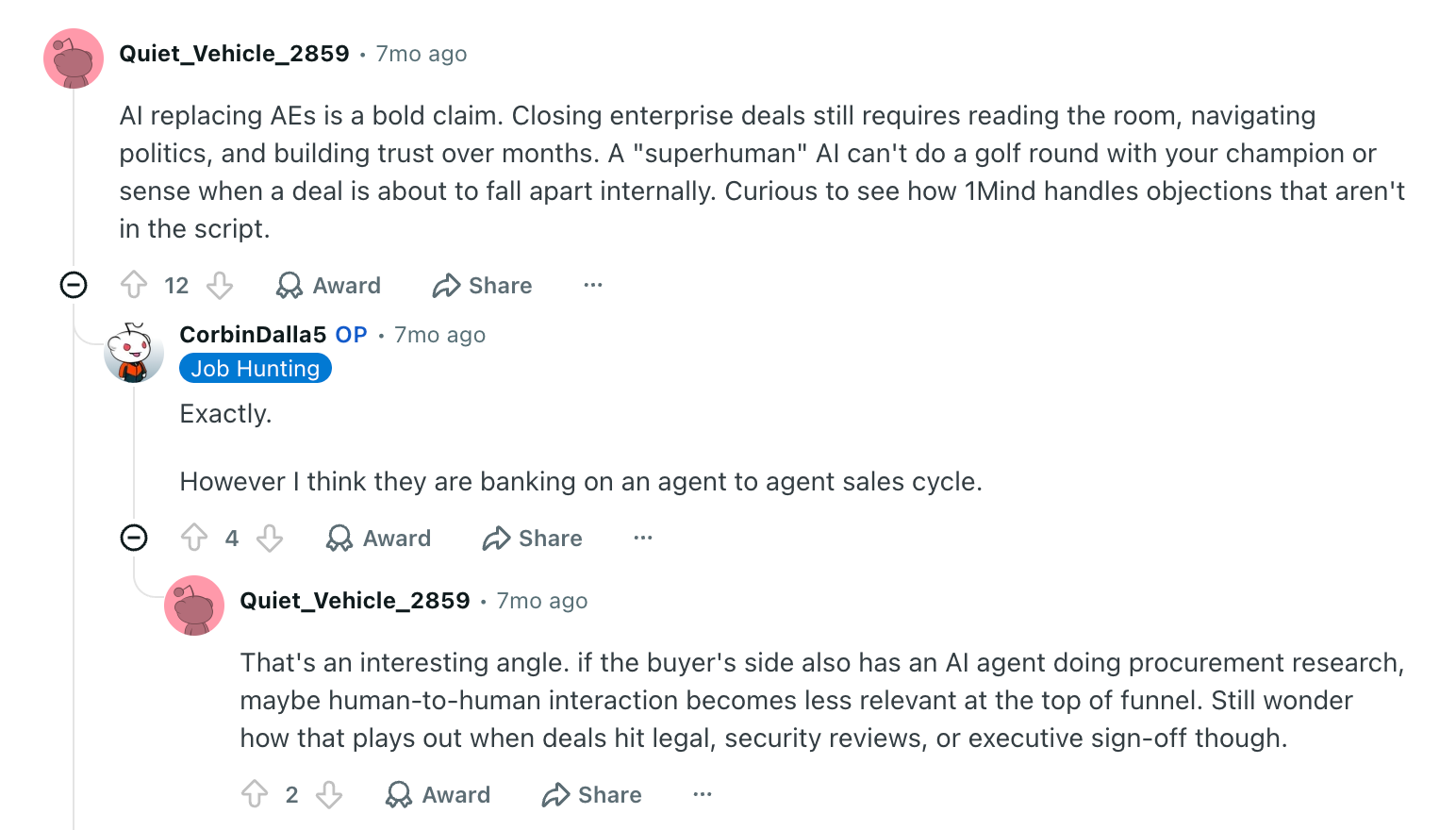
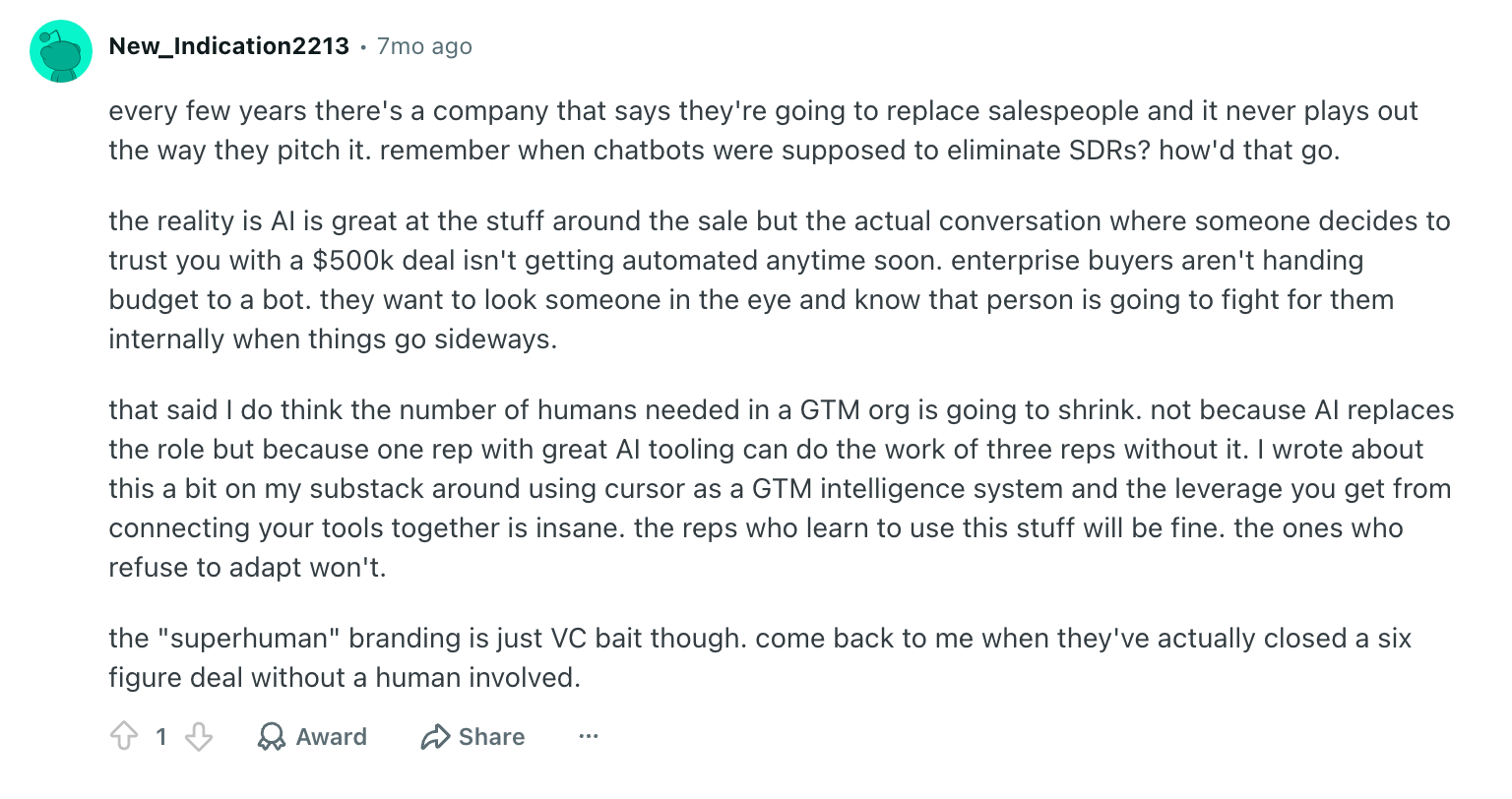
We analyzed a Reddit discussion about 1mind in which sales professionals debated its AI Superhumans, the possibility of AI replacing salespeople, and the challenges of automating complex B2B sales. (Source)
One important caveat: most participants were discussing the concept and its potential rather than sharing extensive firsthand experience with 1mind. The positive comments therefore reflect what users believe AI sales agents could accomplish, not necessarily verified results from 1mind itself.
What Did Reddit Users Like About 1mind's Potential?
Potential to scale sales conversations: One commenter suggested that AI agents could initially handle smaller B2B deals and improve through repeated interactions, testing, and iteration.
Personalization at scale: The same commenter envisioned AI analyzing public information, company documents, and stakeholder interests to personalize outreach across multiple accounts. This was a hypothetical possibility, not a verified 1mind capability.
Potential for AI-to-AI selling: The original poster and other participants discussed a future in which AI agents could handle parts of the buying process on behalf of both sellers and buyers.
Use cases beyond closing deals: Some commenters considered AI more immediately useful for customer success, support, and repetitive sales tasks than for independently managing complex enterprise deals from start to finish.
Overall, the discussion showed interest in AI's potential to scale repetitive work and personalize interactions. However, it provided limited direct evidence of 1mind's real-world performance.
2. What concerns did Reddit users raise about 1mind?
The concerns were much more specific and largely centered on the gap between replacing salespeople and helping them work more effectively.
Concern 1: Can AI build the trust required to close enterprise deals?
This was the dominant theme in the discussion. Several commenters argued that enterprise sales involves more than answering questions or delivering product demonstrations. Salespeople must understand internal company politics, recognize unspoken objections, build relationships with multiple stakeholders, and maintain trust throughout long buying cycles.
One commenter questioned whether an AI Superhuman could handle objections that fall outside its scripts or recognize when a deal is at risk because of internal disagreements.
Another pointed out that enterprise buyers often want a person who will advocate for them internally and remain accountable if implementation goes wrong.
The underlying concern was that automating sales conversations is not necessarily the same as automating the trust required to close a complex deal.
Concern 2: The promise of replacing salespeople created resistance.
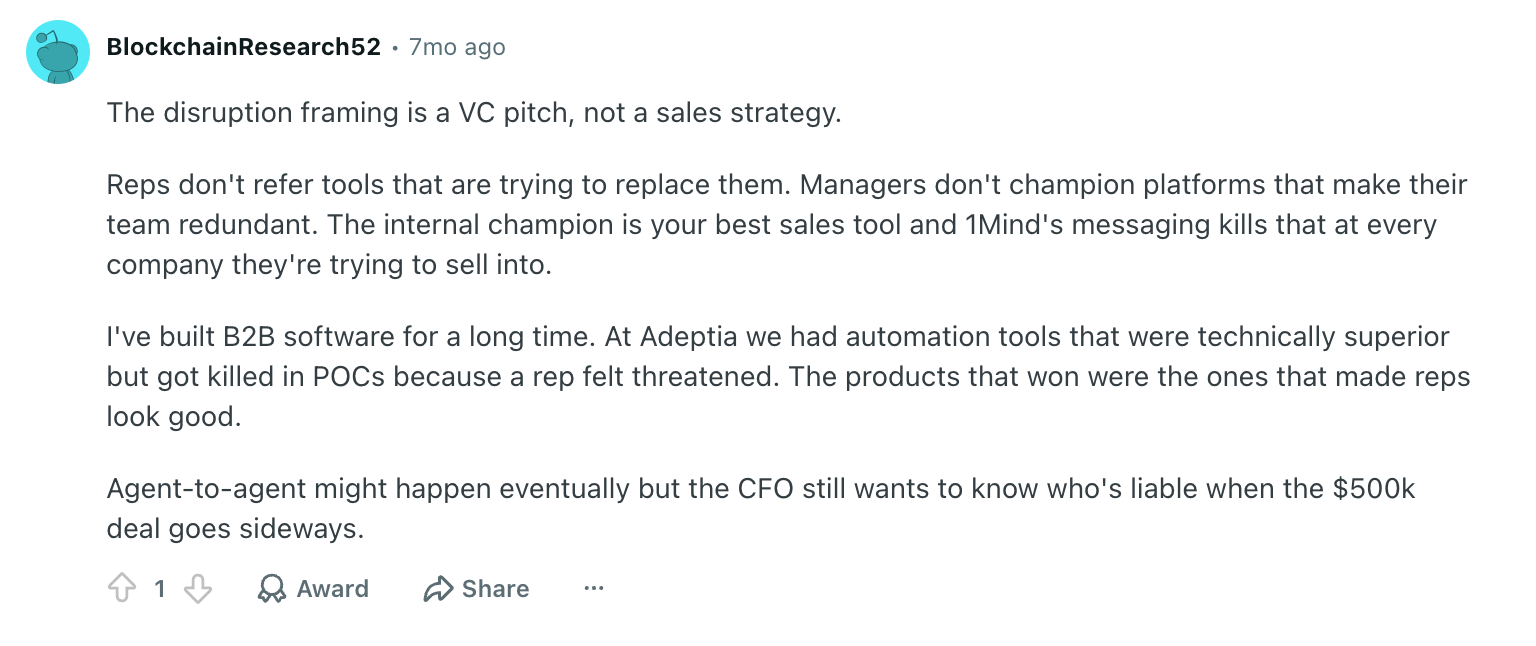
Several commenters pushed back against 1mind's replacement-oriented positioning. They argued that sales representatives and managers may resist adopting a product they believe threatens their jobs.
One commenter described this as a problem with the company's go-to-market strategy: if the people expected to champion a product feel threatened by it, they may be less willing to advocate for its adoption.
Others suggested a different positioning: AI should augment salespeople, automate repetitive work, and allow each representative to handle more opportunities rather than attempt to eliminate the role entirely.
This is an important distinction for 1mind. The discussion suggests that how the product is positioned could influence its acceptance inside sales organizations, independently of its technical capabilities.
Concern 3: Commenters questioned the evidence behind its sales claims.
Some participants expressed skepticism about claims that AI agents could close large, high-value deals without meaningful human involvement.
One commenter questioned how frequently 1mind was closing deals of approximately $100,000 in annual contract value, while another said they wanted to see evidence of a six-figure deal closed without a human involved.
These comments do not establish that 1mind's claims are false. They show that at least some sales professionals want more detailed evidence about deal sizes, the AI's role in the sales process, and how much human involvement was required.
For a serious product review, this raises useful questions: Does the AI source and qualify the opportunity, conduct the entire sales process, or assist a human who ultimately closes the deal?
Concern 4: Some users questioned the quality and maturity of the experience.
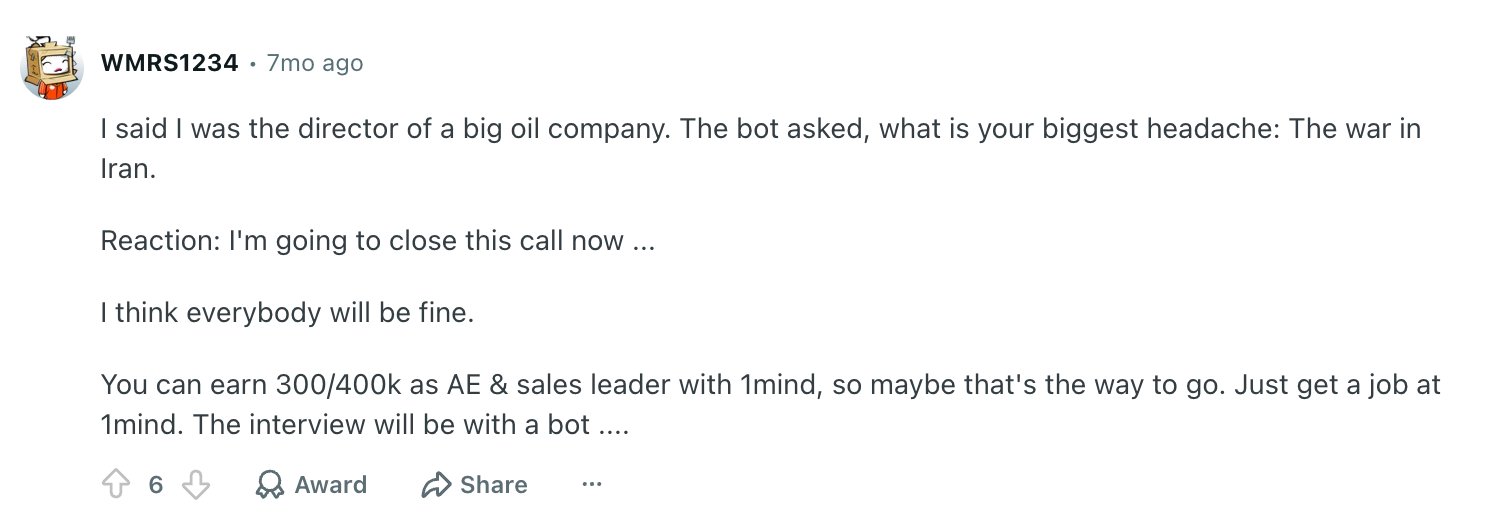
One commenter shared an example of testing an AI sales interaction by claiming to be the director of a large oil company and saying their biggest headache was the war in Iran. They described the bot's response as a reason to end the call.
Another commenter dismissed the product demo as unimpressive, while a person claiming to have worked on a ZoomInfo deployment said they had a negative view of the platform.
These are individual anecdotes, not controlled product evaluations. Nevertheless, they highlight a practical concern: AI sales agents must handle unexpected answers, sensitive topics, and conversations that deviate from the intended script without damaging the buyer experience.
Concern 5: Some users questioned whether AI is better suited to supporting sales than replacing it.
Several commenters drew a distinction between automating tasks around a sale and taking responsibility for the entire relationship.
They identified research, CRM updates, call notes, follow-ups, and routine product explanations as more natural areas for automation. They were less convinced that AI could fully replace discovery conversations, relationship-building, complex negotiations, and executive-level decision-making.
One commenter summarized this perspective by suggesting that a strong salesperson equipped with AI could potentially do the work of several representatives without the same tools.
This points to a different measure of success for 1mind: not simply how many human tasks it can replace, but whether it helps revenue teams improve productivity, conversion, and customer experience.
3. What does this Reddit discussion tell us about 1mind?
The discussion reveals a gap between 1mind's ambitious vision of AI-powered sales and the proof some sales professionals want to see before trusting AI with complex deals.
The thread offers useful insight into buyer and employee perceptions, but it is not a representative sample of 1mind customers. Most commenters discuss the concept, challenge the company's positioning, or speculate about the future of AI in sales. Only a small number describe direct product experience, and their accounts are anecdotal.
For readers evaluating 1mind, the key questions are therefore practical:
How much of the sales process can 1mind’s Superhumans complete independently?
What happens when a buyer raises an unexpected objection?
How much human oversight is required to close complex enterprise deals?
Does the product improve conversion and revenue, or primarily reduce the workload on sales teams?
Can 1mind demonstrate these outcomes with transparent, customer-specific evidence?
1mind G2 Reviews
1mind has 7 reviews on G2, averaging 4.9/5, so the feedback is encouraging but too limited to establish broad customer satisfaction. Reviewers praise its ability to engage website visitors, qualify leads, provide natural product guidance, and support product-led growth, while also highlighting responsive implementation and customer support. The main drawbacks mentioned are limited self-service controls for updating knowledge and conversation flows, a need for repeated testing before launch, and some missing contextual awareness. These reviews offer promising early signals, but the small sample means the results should be interpreted cautiously. (Source)
1mind Pros and Cons
Pros
Cons
Human-like buyer engagement: AI Superhumans combine voice, visual avatars, and product knowledge to engage prospects in a more interactive way than traditional chatbots.
AI avatars may frustrate some buyers: Not everyone wants to interact with an avatar. Some buyers want to skip the conversation, get a quick answer, or speak directly to a human. If the experience feels like an obstacle, it could create friction instead of reducing it.
Supports multiple stages of the customer journey: 1mind covers website engagement, live sales calls, in-product guidance, and customer success.
Potential website performance impact: Avatar-based interactions may introduce additional loading or responsiveness overhead, depending on implementation. Actual performance impact needs to be tested rather than assumed.
Can scale repetitive interactions: It can answer product questions, qualify prospects, deliver demos, and help with onboarding without requiring a human for every interaction.
Primarily focused on owned and controlled touchpoints: Its website, in-product, and live-call use cases may leave gaps in buyer engagement across communities, LinkedIn, review platforms, Slack, and other external channels. Verify channel coverage against the specific deployment.
Consistent product knowledge: AI agents can draw on configured company and product knowledge to deliver consistent answers across interactions.
Implementation and maintenance requirements: Enterprise deployment may require knowledge preparation, workflow configuration, testing, and ongoing updates as products and messaging change.
Potential to improve sales and customer success efficiency: It can help sales reps handle technical questions and support onboarding, product adoption, and customer inquiries.
High investment and uncertain ROI for some teams: Pricing is not public, and the six-figure average annual contract disclosed by the founder makes it a substantial commitment. The return depends on whether automation addresses the team's actual bottleneck.
Useful for teams with high interaction volumes: Companies receiving large volumes of product questions, demo requests, or onboarding queries may benefit from automating parts of these workflows.
Automation does not guarantee trust or conversion: Complex enterprise purchases still involve stakeholder alignment, commercial negotiations, security reviews, and human judgment. AI support alone may not replace those activities.
My take
1mind looks most compelling for businesses that want to scale customer interactions and automate parts of the sales and customer lifecycle. Its biggest potential drawbacks are the risk of forcing an unwanted avatar interaction, the cost and work involved in deployment, and whether its coverage matches how buyers actually discover and evaluate products across channels.
What Are the Key Differences Between 1mind and Qualified?
Many B2B marketing and sales teams already use Qualified to convert website visitors into qualified leads and booked meetings. So, it's natural to ask: What are the key differences between 1mind and Qualified, and which platform is the better fit for your team?
Criteria
1mind
Qualified
Primary focus
AI Superhumans that support sales conversations and customer interactions across the customer lifecycle.
AI-powered inbound marketing and sales, with a strong focus on converting demand into pipeline.
Website engagement
Uses human-like AI avatars to answer questions, qualify buyers, and deliver interactive demos.
Piper engages website visitors through video, voice, or text, qualifies leads, and books meetings.
Beyond the website
Extends into live sales calls, in-product guidance, and customer success.
Extends website engagement into email nurturing and follow-up, with Slack capabilities for team collaboration.
Sales team support
Provides an AI sales engineer that can join live calls and answer technical questions directly.
Focuses on inbound qualification, nurturing, routing, and getting sales meetings booked.
CRM and ecosystem
Integrates with systems including Salesforce, HubSpot, Marketo, Salesloft, and Gong.
Particularly suited to Salesforce-centric teams, with native Salesforce infrastructure and deep CRM context.
Best suited for
Businesses seeking to scale sales conversations, technical demos, onboarding, and customer success with AI agents.
B2B marketing and sales teams seeking to qualify, nurture, and convert inbound demand into pipeline.
While both platforms use AI to engage buyers and support sales conversations, their primary focus differs. Qualified is built around inbound pipeline generation, using its AI SDR agent, Piper, to engage website visitors, qualify prospects, nurture leads, and book meetings. 1mind takes a broader approach to AI-powered customer interactions, using AI Superhumans across website engagement, live sales calls, in-product guidance, and customer success.
Which One Is Better for You: 1mind, Qualified, or Knock AI?
The best platform depends on where your revenue process needs the most help.
If you want AI-powered sales conversations, interactive demos, and in-product guidance, 1mind is worth considering. If your priority is converting inbound website traffic into a qualified pipeline, Qualified is built for that workflow.
But what if your challenge goes beyond website conversion? What if buyers discover your product on LinkedIn, research it on G2, engage through a community, or leave your website before speaking to sales? And what happens when they finally engage, but their context gets lost between marketing, AI agents, and sales reps?
That's where Knock AI stands out as an alternative to both platforms.
#1 1mind Alternative: Knock AI
Knock AI is relationship infrastructure for modern B2B go-to-market teams. Rather than treating every visitor, lead, or conversation as an isolated event, it connects buyer identity, company and contact enrichment, intent signals, existing relationships, engagement history, qualification, routing, and scheduling.
With Knock AI, businesses can turn intent from channels such as LinkedIn, G2, product documentation, marketplaces, websites, and events into direct conversations. AI can respond and qualify within configured guardrails, while the right sales rep can join the same conversation without making the buyer start over.
The distinction is important: 1mind focuses on AI-powered interactions across the customer lifecycle, Qualified focuses on inbound pipeline generation, and Knock AI connects relationships and intent to the next revenue action.
Knock AI is our #1 alternative to 1mind for teams that want to capture demand across channels, preserve context across GTM handoffs, and turn buyer intent into qualified conversations and pipeline.
1mind vs. Qualified vs. Knock AI: Key Differences
Criteria
1mind
Qualified
Knock AI
Core focus
AI Superhumans for sales conversations and customer lifecycle interactions.
AI-powered inbound marketing and pipeline generation.
Relationship infrastructure connecting buyer identity, intent, engagement, and revenue actions.
Primary use case
Interactive sales conversations, demos, technical assistance, onboarding, and customer success.
Engaging inbound buyers, qualifying prospects, nurturing leads, and booking meetings.
Turning buyer intent across channels into direct conversations, qualification, routing, and pipeline.
Where engagement starts
Website, live sales calls, and in-product experiences.
Website and email inbox.
Website, LinkedIn, G2, product docs, marketplaces, events, and other configured touchpoints.
Buyer communication
Human-like AI avatars and AI-assisted live sales interactions.
AI-powered website and email engagement, including text, voice, and video.
Messaging-led conversations across supported channels, with reps able to respond through Slack while buyers stay in their own conversation channel.
Context and relationships
Uses company and product knowledge to support customer-facing interactions.
Uses CRM and go-to-market data to personalize inbound engagement.
Connects identity, relationship history, account context, intent, and engagement through its Relationship Graph.
Human handoff
AI can participate directly in sales calls and other customer interactions.
Routes qualified inbound prospects to sales teams.
Routes the conversation to the right rep while preserving the existing thread and context.
Best suited for
Teams looking to scale AI-powered interactions across sales, product, and customer success.
B2B teams focused on converting inbound demand into pipeline, particularly in Salesforce-centric environments.
Teams seeking to capture demand across channels and maintain relationship continuity from first intent to sales engagement.
Which should you choose?
Choose 1mind if AI Superhumans, interactive demos, live-call assistance, and in-product guidance align with your priorities.
Choose Qualified if your main objective is to scale inbound engagement, lead qualification, nurturing, and meeting generation.
Choose Knock AI if you want to connect buyer identity and intent across channels, engage prospects through messaging, route them to the right people, and preserve relationship context across GTM handoffs.
Is 1mind Worth It? Our Verdict
As per our intensive research and analysis, 1mind is worth considering for B2B companies looking to scale sales conversations, interactive demos, and customer success with AI. However, its six-figure annual contract value makes it a significant investment, and businesses should validate ROI through a proof of concept before committing.
If you need AI-powered interactions across the customer lifecycle, 1mind is compelling. If your priority is converting inbound website traffic, Qualified may be a better fit. And if you want to connect buyer intent, relationship data, and engagement across channels to drive revenue, Knock AI is the best alternative to both 1mind and Qualified.
Ultimately, the best choice depends on your biggest revenue bottleneck and which platform can demonstrate measurable results for your team.
Frequently Asked Questions About 1mind
What Is 1mind's Current Revenue?
GetLatka reports that 1mind reached approximately $6 million in annual recurring revenue (ARR) by March 2026, based on founder Amanda Kahlow's interview. This is a reported historical figure, not a verified October 2026 revenue disclosure. Because 1mind is privately held, its current revenue may differ.
How Much Does 1mind Cost?
1mind does not publish standard pricing on its website. Founder Amanda Kahlow has described six-figure annual contracts, with reported contract values ranging from approximately $100,000 to $400,000 depending on scope. These are budgeting estimates, not official pricing tiers. For enterprise buyers, the key question is whether the incremental revenue and productivity gains justify the investment.
What Does 1mind Actually Do?
1mind deploys AI agents called Superhumans across four stages of the customer journey: website inbound, live sales calls, in-product guidance, and customer success. Its central differentiator is the shared context, or “1 Brain,” intended to carry buyer information and conversation history across these interactions rather than treating each touchpoint as a separate chatbot session.
Who Are 1mind's Competitors?
1mind competes in the broader AI sales agent and revenue engagement market, where alternatives include Qualified and Knock AI. Qualified focuses on converting inbound website traffic into pipeline, while 1mind emphasizes AI-powered interactions across the customer lifecycle. Knock AI takes a different approach: it connects buyer identity, relationship context, and intent signals to conversations and revenue action across supported channels. The right comparison depends on whether your priority is AI-led selling, inbound pipeline conversion, or acting on buyer intent across GTM workflows.
Is 1mind Better Than Qualified?
Neither platform is automatically better for every business. 1mind is the stronger fit to evaluate if you want AI agents to support website conversations, live sales calls, in-product guidance, and customer success. Qualified is worth evaluating if your primary objective is inbound pipeline generation, website visitor qualification, and meeting conversion within a Salesforce-centric setup.
What Is the Difference Between 1mind and Knock AI?
1mind focuses on AI Superhumans that engage buyers and customers across the lifecycle. Knock AI focuses on relationship infrastructure that connects buyer identity, intent, engagement, and context across go-to-market handoffs. If you want an AI agent to run product conversations and demos, evaluate 1mind. If you need to turn intent signals into timely conversations, qualify buyers, route opportunities, and preserve context as humans take over, evaluate Knock AI.
Can AI Sales Agents Replace Human Sales Representatives?
AI sales agents can take on parts of the sales process, including answering product questions, qualifying prospects, demonstrating products, and handling repetitive interactions. But automating conversations is not the same as independently managing complex enterprise deals. Buyers should establish which activities the AI completes autonomously, where human approval is needed, and who owns negotiations and closing.
What Results Have Companies Achieved With 1mind?
1mind publishes customer case studies with results reported by companies including HubSpot, Pipedrive, Experity, and ZoomInfo. For example, HubSpot reported a 25% increase in influenced purchases during a 30-day experiment, while Experity reported a 50% win rate compared with 26% for its previous approach. These are customer-specific results published by 1mind, not a guarantee of equivalent outcomes for every deployment. Review each case study's baseline, measurement period, and methodology before comparing results.
Is 1mind Worth It for Small Businesses?
1mind's reported six-figure annual contracts make it a substantial investment for most small businesses. It may make sense for a company with high interaction volume, meaningful revenue per customer, and a clear bottleneck that AI can address. Smaller teams with simpler needs should compare the expected return against less expensive tools before committing to an enterprise deployment.
What Are the Main Limitations of 1mind?
The main considerations are cost, implementation effort, the need to maintain accurate product knowledge, and whether buyers actually prefer AI-led interactions in the situations where it is deployed. The public review sample is still limited, and a Reddit discussion we examined raised broader concerns about trust, off-script conversations, and replacing human judgment. Those concerns are reasons to test the product against real workflows, not proof that 1mind fails at them.
Is 1mind Secure for Enterprise Use?
1mind publishes security and compliance claims covering frameworks such as SOC 2 Type II, ISO 27001, and ISO 42001, alongside GDPR and CCPA compliance statements. Enterprise buyers should verify the current certificates, scope, data retention policies, subprocessors, and contractual commitments directly with 1mind before deployment. GDPR and CCPA are legal and regulatory frameworks, not certifications.
How Should You Evaluate 1mind Before Buying?
Run a proof of concept against a measurable business outcome, such as qualified opportunities, influenced purchases, conversion rate, time to resolution, or sales-team capacity. Compare results with a baseline, include implementation and ongoing management costs, and test how the agent handles unexpected questions and human handoffs. Don't evaluate 1mind solely on engagement rates or how human-like its avatar appears. Evaluate whether it produces a measurable improvement in your revenue process.