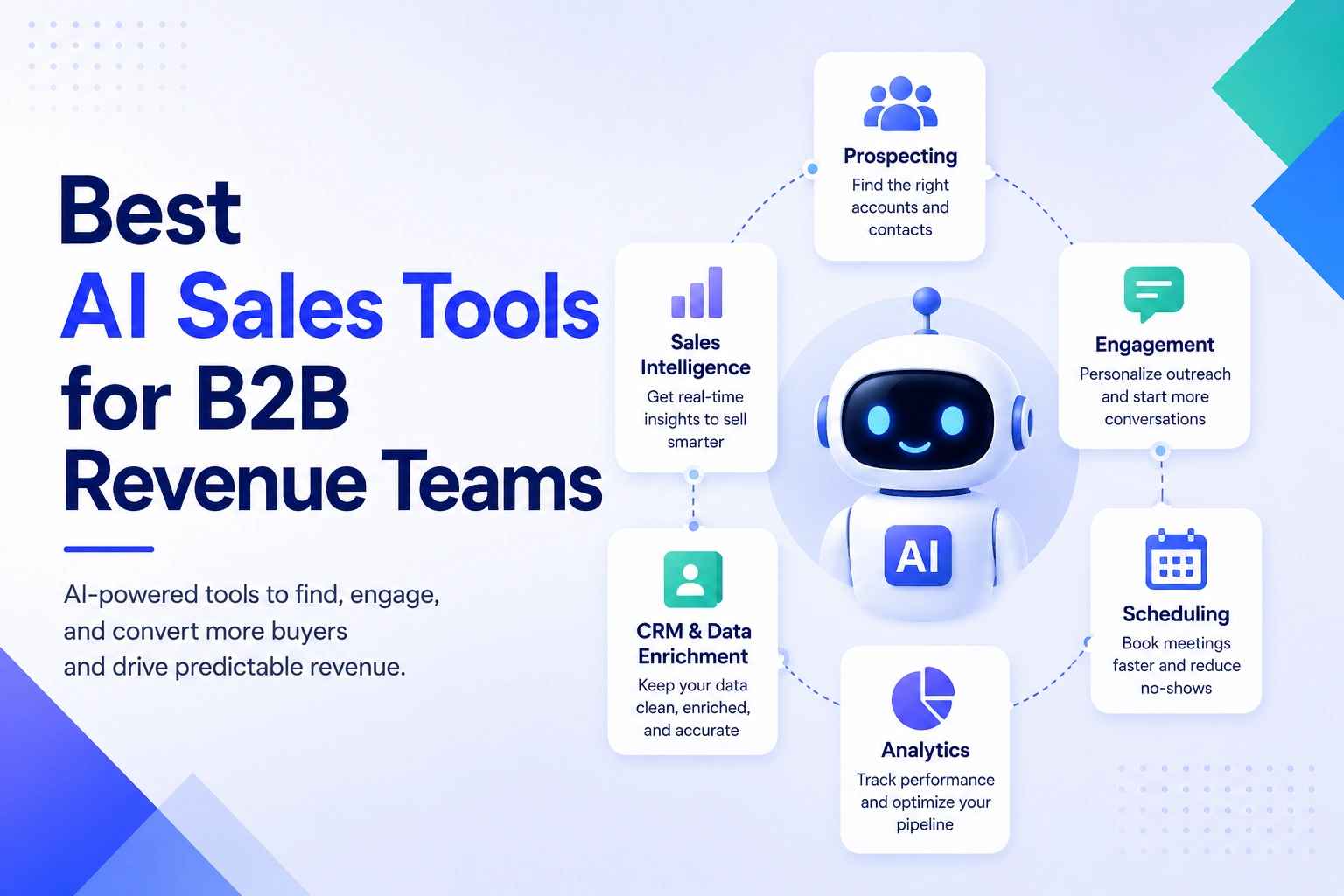
There are hundreds of AI sales tools available in 2026, but they don't all solve the same sales problem. Some help sales teams find prospects and enrich accounts, while others automate outbound engagement, identify buyer intent, engage inbound buyers, analyze sales conversations, or manage CRM workflows.
The best AI sales tools for B2B teams are therefore the ones that address a specific bottleneck in the revenue process.
For example, Apollo is a strong choice for prospecting and outbound engagement, Clay for AI-powered research and enrichment, ZoomInfo for B2B sales intelligence, Gong for conversation intelligence, HubSpot and Salesforce for CRM-native AI, Salesloft and Outreach for sales engagement, and Knock AI for identifying, engaging, qualifying, and converting high-intent buyers into sales conversations.
The right choice depends on where your sales process is losing the most time or revenue. A team focused on outbound prospecting may need a very different AI sales stack from a team trying to convert more of its existing inbound demand.
In this guide, we'll compare the best AI sales tools by their primary sales use case, AI capabilities, workflow coverage, ideal users, pricing, and limitations.
The best AI sales tool isn't necessarily the one with the most AI features. It's the one that removes the biggest bottleneck from your sales workflow.
Best AI Sales Tools at a Glance
Tool
Best for
Primary sales problem it solves
What it does particularly well
Best fit
Knock AI
Inbound sales conversion & buyer engagement
Turning anonymous or inbound buyer activity into qualified sales conversations and pipeline
Identifies and enriches buyers in real time, understands intent, engages buyers through AI conversations, qualifies leads, routes them to the right rep, books meetings, and gives reps the buyer and company context they need to act immediately. Supports conversations across channels including Slack, WhatsApp, Telegram, and LinkedIn workflows.
Inbound-heavy B2B teams, RevOps, and revenue teams focused on conversion
ZoomInfo
B2B data & sales intelligence
Finding target accounts and getting reliable contact and company data
Contact and company intelligence, intent data, account research, prospect discovery, and sales intelligence for identifying potential buyers and prioritizing accounts.
Sales and RevOps teams
Apollo
Prospecting & sales engagement
Finding prospects and executing outbound workflows
Prospect database, list building, AI-assisted prospect research, email engagement, sequencing, and outbound sales automation.
SMB and mid-market sales teams
Clay
GTM research & enrichment
Building flexible prospect research and data-enrichment workflows
Multi-source enrichment, account and prospect research, buying-signal workflows, data customization, and AI-assisted personalization for sophisticated outbound programs.
GTM, RevOps, and technical sales teams
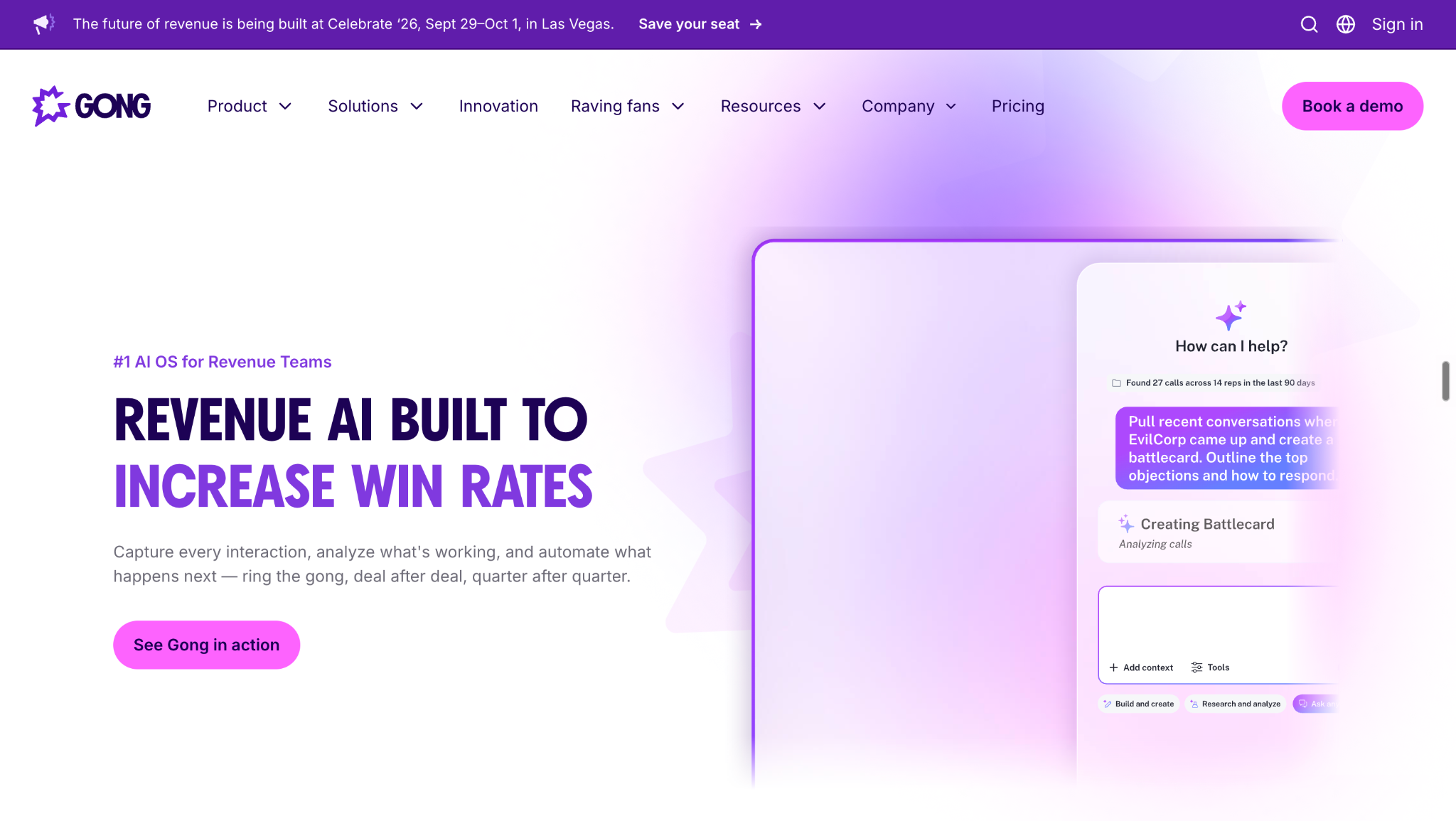
Gong
Revenue intelligence & conversation intelligence
Understanding what is happening across sales conversations and deals
Conversation intelligence, deal insights, coaching, forecasting, objection analysis, and identifying patterns across calls and customer interactions.
Sales organizations with established sales teams
HubSpot
CRM + AI sales automation
Managing leads, deals, and sales workflows in one system
CRM, AI-assisted sales workflows, lead management, automation, pipeline management, reporting, and sales engagement.
SMB and mid-market teams
Salesforce
Enterprise CRM + AI
Managing complex sales operations and customer relationships at scale
CRM, opportunity management, automation, forecasting, AI capabilities, account management, and enterprise sales workflows.
Enterprise revenue organizations
Intercom
AI inbound conversations
Engaging, qualifying, and supporting inbound website visitors
AI-powered conversations, visitor engagement, lead qualification, customer support, and automated inbound workflows.
AI sales tools are software platforms that use artificial intelligence to automate, analyze, or improve sales activities such as prospecting, account research, buyer engagement, outreach, lead qualification, sales conversations, forecasting, and CRM management.
Different AI sales tools focus on different parts of the revenue process:
AI prospecting: Find target accounts, contacts, and potential buyers.
AI sales intelligence: Enrich accounts and identify buyer or company signals.
AI research and enrichment: Build richer context around prospects and accounts.
AI outbound sales: Personalize outreach, run sequences, and automate follow-ups.
AI inbound sales: Engage high-intent website visitors and inbound buyers.
AI qualification and routing: Determine which buyers meet qualification criteria and connect them with the right sales rep.
Conversation intelligence: Analyze sales calls and meetings to identify objections, deal risks, and coaching opportunities.
CRM automation: Automate lead management, pipeline updates, forecasting, and other sales operations.
Because these tools solve different sales jobs, there isn't one AI sales tool that is best for every sales team. The best choice depends on whether your biggest bottleneck is prospecting, outbound engagement, inbound conversion, sales conversations, or pipeline management.
How these tools fit together
These aren't interchangeable alternatives. They solve different problems across the revenue workflow.
A team might use ZoomInfo to identify target accounts, Clay to research and enrich them, Apollo, Salesloft, or Outreach to execute outbound engagement, Knock AI to identify and convert active inbound buyer intent, Gong to analyze sales conversations, and Salesforce or HubSpot to manage the resulting pipeline.
The important distinction is where each tool enters the sales process.
Some AI sales tools help create demand by finding and contacting prospects. Others help sales teams understand existing opportunities. Knock AI is focused on the conversion point where a buyer is already showing interest and the challenge is turning that intent into a qualified conversation, the right sales handoff, and ultimately pipeline
How We Chose the Best AI Sales Tools
We didn't choose these tools simply because they have “AI” in the product description or because they are widely known. Each tool was evaluated based on the sales problem it is designed to solve, how deeply AI is integrated into that workflow, how well it fits into an existing GTM stack, and where it may not be the right fit.
The main questions we considered were:
What sales job does it solve?
What does the AI actually automate or improve?
How deeply does it fit into the sales workflow?
How does it integrate with the rest of the stack?
Which sales motions benefit most from it?
Where does another type of tool make more sense?
The goal is to help you match the tool to the bottleneck, rather than simply collect another AI product.
1. Knock AI
Best for: Inbound sales conversion and AI sales engagement
Knock AI is an AI sales platform built to identify, understand, engage, qualify, and convert active B2B buyers. It combines buyer identification, enrichment, intent detection, AI conversations, qualification, routing, meeting booking, and CRM workflows to help revenue teams turn buyer activity into sales pipeline.
Most sales teams already have plenty of ways to capture demand. The harder part is what happens after a buyer shows interest.
A visitor lands on the website, submits a form, starts a conversation, or engages with a campaign. Then someone has to identify the buyer, understand the company, figure out whether there is real intent, qualify the lead, route it to the right person, and get the conversation moving.
Knock AI is built around that part of the sales process.
A traditional inbound workflow often looks something like:
Website traffic → form → CRM → SDR notification → research → outreach → qualification → meeting
The problem is that every step after the initial buyer action introduces friction.
The buyer may be ready to talk now, while the SDR is busy with another lead. The form may capture basic information but tell the rep little about actual intent. And by the time someone researches the account and follows up, the buyer may have moved on.
Instead of treating the form submission or CRM record as the beginning of the sales process, it treats buyer intent as an opportunity to start a conversation.
The AI can gather buyer and company context, understand what the person is looking for, apply qualification rules, and route qualified conversations to the appropriate rep. The rep then joins with the context already available rather than starting the conversation from scratch.
That makes Knock AI particularly relevant for teams trying to improve the gap between buyer interest and qualified pipeline.
Where Knock AI is particularly useful
1. High-intent inbound leads
When someone is actively looking for a solution, response time matters. Knock AI can engage the buyer, gather context, qualify the interaction, and move toward a meeting without waiting for an SDR to become available.
2. Form-heavy funnels
Forms can create friction and often leave sales teams with another problem: deciding which submissions are actually worth pursuing.
Knock AI can provide an alternative conversational path while also working with form-based workflows. This is particularly useful for teams dealing with form abandonment, low-quality submissions, or too much manual lead research.
3. Website and campaign traffic
Not every buyer who clicks an ad or visits a high-intent page wants to fill out a form. Giving buyers another way to start a conversation can help teams capture demand that might otherwise disappear.
4. Sales teams operating across channels
Knock AI can support buyer conversations and workflows across channels including Slack, WhatsApp, Telegram, and LinkedIn, while giving the internal sales team a centralized workflow for responding and taking over conversations.
That matters for teams selling across different regions or buyer preferences, where relying on a single channel can create unnecessary friction.
5. SDR teams spending too much time qualifying
Instead of having SDRs manually research every inbound lead, Knock AI can gather information about the person, company, role, intent, and use case, apply qualification logic, and route the conversation accordingly.
The result is less time spent figuring out whether a lead deserves attention and more time spent on conversations that do.
What makes Knock AI different?
Knock AI sits at a critical conversion point in the sales funnel: the moment when a buyer has already shown interest and the sales team needs to turn that signal into a qualified conversation and pipeline.
Think about the jobs different tools perform:
ZoomInfo: Who should we target?
Clay: How can we research and enrich that buyer?
Salesloft: How do we execute structured outbound engagement?
Knock AI: How do we turn active buyer intent into a qualified sales conversation?
That distinction is important.
Knock AI isn't primarily about giving sales teams another prospect database or another outbound sequence. Its value is in connecting buyer intent, context, conversation, qualification, routing, and sales action.
For an inbound-heavy B2B team, that can mean moving from:
Buyer shows intent → wait for SDR → research → respond
The strongest evidence for Knock AI comes from the customer outcomes reported in its G2 reviews. These should be viewed as customer-reported results, not guaranteed outcomes, since results will vary by sales motion, implementation, traffic, and qualification strategy.
Reported examples include:
One customer reported reducing time-to-opportunity from 86 days to 13 days.
Another reported improving lead-to-deal conversion from approximately 4.5% to 21%.
The common thread isn't simply “more leads.” Customers describe using Knock AI to improve qualification, response time, buyer context, routing, and conversion into actual sales opportunities.
Where Knock AI may not be the right fit
Knock AI isn't necessarily a set-it-and-forget-it tool.
Customer reviews specifically mention that qualification and routing require thought, particularly when a company has different rules for different lead types. Some customers also needed to test and refine AI instructions and the information provided to the agent before reaching the desired behavior.
That's actually an important consideration:
Knock AI delivers the most value when a team is willing to define what a qualified buyer looks like and how different buyers should be routed.
If your sales process is extremely simple and you only need a basic CRM notification or outbound sequencing tool, Knock AI may solve a larger problem than you actually have.
Best for
B2B revenue teams with meaningful inbound demand that want to improve speed-to-lead, buyer qualification, routing, and conversion without putting all of the workload on SDRs.
2. ZoomInfo
Best for: B2B data and prospect intelligence
ZoomInfo is a strong fit when the first problem in your sales process is figuring out which companies and people your team should be talking to.
Its sales capabilities center around contact and company intelligence, account discovery, buyer identification, intent signals, and prospect research. That makes it useful for building a more targeted prospecting motion instead of relying on incomplete contact lists or manual account research.
Best for
Sales and RevOps teams whose biggest bottleneck is finding the right accounts, contacts, and buying signals.
Limitation
ZoomInfo is primarily a data and intelligence layer. Having better information about a prospect doesn't automatically solve the downstream problems of engaging, qualifying, routing, or converting that buyer.
3. Apollo
Best for: Prospecting and sales engagement
Apollo combines prospect data with tools for building lists and executing outreach, making it a practical option for teams that want prospecting and engagement capabilities in one platform.
Its workflow can cover:
Prospect and company discovery
List building
Contact management
Sequencing
Email and other outreach
Prospect engagement
AI-assisted sales workflows
Best for
Sales teams that want to find prospects and execute structured engagement from a single platform.
Limitation
Apollo and Knock AI can appear similar if you look only at the word “AI,” but they address different points in the funnel.
Apollo:Who should we prospect and how do we engage them?
Knock AI:A buyer is already showing intent. How do we identify, understand, qualify, route, and engage that buyer quickly?
So if your bottleneck starts with building a prospect list and running outbound, Apollo makes more sense. If it starts with converting active inbound demand, Knock AI is closer to the problem.
4. Clay
Best for: GTM enrichment and research workflows
Clay is less about being another conventional sales engagement platform and more about giving GTM teams the infrastructure to research, enrich, and build customized prospecting workflows.
Its capabilities can include:
Data enrichment
Multiple data sources
Company and contact research
Buying signals
Custom workflows
AI-assisted research
Personalized prospecting
The appeal is flexibility. Instead of forcing every sales team into the same workflow, Clay gives RevOps and GTM teams more control over how data is gathered, enriched, evaluated, and used.
Best for
RevOps and GTM teams that want to build customized data, research, enrichment, and personalization workflows.
Limitation
That flexibility comes with a tradeoff: more flexibility can mean more setup and operational complexity. Teams looking for a ready-to-run sales workflow may prefer a more specialized product.
Best for: Revenue intelligence and conversation analysis
Gong focuses on what happens inside sales conversations and deals, rather than primarily helping teams find new prospects.
Its AI capabilities can help sales organizations analyze conversations, identify patterns, surface deal intelligence, support rep coaching, understand objections, and improve visibility into pipeline and sales execution.
That makes Gong particularly useful when a team already has conversations happening but wants to understand why certain deals progress while others stall.
Best for
Sales organizations that want deeper visibility into conversations, deal health, rep performance, and revenue patterns.
Limitation
Gong isn't primarily a prospecting or inbound conversion tool.
A simple way to think about the distinction:
Gong:What is happening in our sales conversations and deals?
Knock AI:How do we turn an active buyer signal into a qualified sales conversation?
The two can therefore complement each other rather than being direct substitutes.
6. HubSpot
Best for: CRM and AI-powered sales automation
HubSpot takes a broader approach than specialized AI sales tools. Its sales capabilities sit inside a larger CRM and GTM ecosystem, covering areas such as lead management, sales automation, Hubspot Forms, workflows, enrichment, reporting, chatbot, and AI-assisted sales processes.
For teams already using HubSpot, the advantage is having sales data and automation connected to the CRM rather than adding another standalone system.
Best for
SMB and mid-market teams that want CRM, sales automation, reporting, and AI capabilities within one broader ecosystem.
Limitation
HubSpot's breadth is also its tradeoff. If your primary problem is a very specific workflow, such as converting high-intent inbound buyers through conversational qualification and routing, a specialized tool may provide more depth in that particular area.
7. Salesforce
Best for: Enterprise CRM and AI-powered sales workflows
Salesforce is built for organizations managing complex sales operations, account structures, workflows, reporting, and integrations at enterprise scale.
Large sales organizations with complex operations and an existing Salesforce-centered GTM stack.
Limitation
The tradeoff is operational complexity. Enterprise CRM implementations can require significantly more administration, configuration, and ongoing management than a lightweight or specialized sales tool.
Salesforce can be the system of record without necessarily being the specialized system that handles every sales workflow around it.
8. Intercom
Best for: AI-powered inbound conversations
Intercom is particularly relevant when website engagement, customer communication, support, and sales overlap.
Its AI capabilities can help teams handle website conversations, answer questions, engage visitors, qualify demand, route conversations, and support the transition from customer interaction to sales or support.
Best for
Teams where website engagement, customer communication, support, and inbound sales are closely connected.
Where it differs from Knock AI
The distinction isn't that one tool can “do AI chat” and the other can't. It's about the sales workflow around the conversation.
Intercom is a broader customer communication platform with strong inbound and support capabilities.
Knock AI is more specifically oriented around turning buyer intent into a qualified sales conversation, including buyer identification, enrichment, qualification, routing, meeting booking, and sales handoff.
So if the primary question is:
“How do we engage and support people visiting our website?”
Intercom is a strong fit.
If it's:
“How do we identify, qualify, route, and convert high-intent buyers into pipelines?”
Knock AI is more directly aligned with that workflow.
9. Salesloft
Best for: Sales engagement and outbound execution
Salesloft is designed around helping sales teams execute structured engagement workflows consistently.
Its capabilities include:
Sales engagement
Sequences and cadences
Multichannel outreach
Rep workflows
Engagement analytics
AI-assisted sales execution
The core value is helping teams turn a defined outbound process into a repeatable workflow that reps can execute at scale.
Best for
Sales teams with an established outbound motion that need consistency, structured engagement, and execution at scale.
Where it differs from Knock AI
Again, the distinction comes down to where the problem starts.
Salesloft: “How do we consistently execute our outbound sales process?”
Knock AI: “A buyer has already shown interest. How do we identify, qualify, route, and engage them before that intent disappears?”
That makes Salesloft a natural fit for outbound execution, while Knock AI is particularly relevant to inbound conversion and buyer-initiated engagement.
Best AI Sales Tools by Use Case
If you need to…
Consider
Why
Find B2B prospects
Apollo / ZoomInfo
Find target accounts, contacts, and prospect intelligence
Research and enrich prospects
Clay
Combine data sources, research accounts, and create richer prospect context
Run outbound sales
Apollo / Salesloft / Outreach
Build sequences, automate follow-ups, and execute structured outreach
Identify active buyer intent
Knock AI / ZoomInfo
Surface buyer and account signals that indicate potential interest
Engage inbound buyers
Knock AI
Identify, engage, qualify, route, and book meetings with high-intent buyers
Qualify and route inbound leads
Knock AI
Apply qualification logic and connect buyers with the appropriate sales rep
Improve sales conversations
Gong
Analyze calls, objections, deal risks, and rep performance
Automate CRM sales workflows
HubSpot / Salesforce
Manage leads, opportunities, workflows, reporting, and pipeline
Improve sales emails
Lavender
Analyze messaging and provide AI-assisted email coaching
Which AI Sales Tool Should You Choose?
The right tool depends less on the tool's feature count and more on where your sales funnel is leaking.
If your bottleneck is…
Consider…
Why
Finding the right prospects
ZoomInfo / Apollo
Identify target accounts, contacts, and prospects for outbound sales
Enriching and researching accounts
Clay
Build flexible enrichment, research, signal, and personalization workflows
Executing outbound sales
Apollo / Salesloft
Build lists, run sequences, and execute structured prospect engagement
Converting inbound demand
Knock AI
Identify, enrich, engage, qualify, route, and book meetings with high-intent buyers
Identifying active buyer intent
Knock AI / ZoomInfo
Surface buyer and account signals so sales teams can prioritize potential opportunities
Engaging inbound buyers in real time
Knock AI
Engage buyers, understand their needs, qualify conversations, route them, and move toward meetings
Understanding sales conversations
Gong
Analyze calls and conversations, surface deal insights, and improve sales execution
Managing CRM-driven sales operations
HubSpot / Salesforce
Manage leads, accounts, opportunities, workflows, reporting, and broader CRM operations
Engage website visitors and handle AI-powered customer and inbound conversations
You don't necessarily need one AI sales tool. The right stack depends on where your revenue funnel is leaking.
For example, a team might use ZoomInfo or Apollo for prospecting, Clay for enrichment, Salesloft for outbound execution, Knock AI for inbound conversion, Gong for conversation intelligence, and Salesforce or HubSpot as the CRM.
How AI Sales Tools Fit Into the Revenue Stack
Revenue stage
Primary job
Tools
What happens here
1. Target accounts
Identify who to sell to
ZoomInfo, Apollo
Find target companies, contacts, and potential buyers
2. Data & intelligence
Understand the account
ZoomInfo
Add company, contact, intent, and buyer intelligence
3. Research & enrichment
Build richer prospect context
Clay
Enrich records, research accounts, identify signals, and build custom workflows
4. Outbound engagement
Start and manage prospect outreach
Apollo, Salesloft
Execute sequences, cadences, and structured outbound engagement
5. Inbound buyer engagement
Convert active buyer interest
Knock AI, Intercom
Engage website visitors and inbound buyers through AI-powered conversations
6. Qualification & routing
Decide who should talk to sales
Knock AI
Identify buyer context, assess intent, qualify leads, route conversations, and book meetings
7. Sales conversations
Understand and improve active deals
Gong
Analyze conversations, surface deal insights, identify patterns, and support sales coaching
8. CRM & pipeline management
Manage the revenue process
HubSpot, Salesforce
Store customer data, manage opportunities, automate workflows, and track pipeline
How the pieces fit together
The tools overlap at the edges, but they aren't interchangeable. A mature revenue stack may use several of them together: ZoomInfo to identify target accounts, Clay to enrich and research them, Apollo or Salesloft to execute outbound engagement, Knock AI to convert inbound buyer intent, Gong to analyze sales conversations, and HubSpot or Salesforce to manage the resulting pipeline.
The important thing is to choose tools based on the stage of the revenue process you need to improve, rather than assuming one AI sales platform should handle everything.
FAQs
What are the best AI sales tools?
The best AI sales tool depends on the sales workflow you need to improve. Apollo is strong for prospecting and outbound engagement, Clay for research and enrichment, ZoomInfo for B2B sales intelligence, Knock AI for inbound buyer engagement and sales conversion, Gong for conversation intelligence, Salesloft and Outreach for sales engagement, and HubSpot or Salesforce for CRM-driven sales operations.
What does an AI sales tool do?
AI sales tools use artificial intelligence to automate or improve sales activities such as prospecting, account research, data enrichment, outreach, buyer engagement, lead qualification, sales conversations, forecasting, and CRM workflows. Different tools specialize in different parts of the sales process.
Which AI sales tool is best for prospecting?
Apollo and ZoomInfo are strong options for B2B prospecting. Apollo combines prospect discovery with sales engagement, while ZoomInfo focuses more heavily on B2B contact, company, and sales intelligence.
Which AI sales tool is best for inbound leads?
Knock AI is designed for teams that want to convert high-intent inbound buyers into qualified sales conversations. It can identify and enrich buyers, understand intent, engage them through AI conversations, qualify leads, route conversations, and book meetings.
Which AI sales tools are best for outbound sales?
Apollo, Salesloft, and Outreach are strong choices for outbound sales. Apollo combines prospecting and engagement, while Salesloft and Outreach focus more heavily on structured sales engagement and sequencing.
Which AI sales tool is best for sales conversations?
Gong is a leading option for conversation intelligence. It analyzes sales calls and interactions to surface buyer objections, deal risks, patterns, and coaching opportunities.
Can AI sales tools replace sales reps?
AI sales tools are generally better viewed as sales capacity multipliers rather than complete replacements for sales teams. They can automate research, outreach, qualification, conversation analysis, and administrative work while allowing sales reps to focus on discovery, relationships, complex objections, and high-value opportunities.


.svg)


.svg)
.svg)
.svg)


.svg)
.svg)


.svg)