Best Tools for Qualifying & Routing Inbound Website Visitors
What Are the Best Tools for Automatically Qualifying and Routing Inbound Website Visitors?
Getting inbound traffic is one problem. Knowing which visitors are worth sales attention is another.
A website can generate hundreds or thousands of inbound interactions every month, but not every visitor is a potential buyer. Some match your ICP and are actively evaluating your product. Others may be early researchers, poor-fit companies, existing customers, students, or people who simply are not ready to talk to sales.
The challenge is determining the difference quickly without asking SDRs to manually research every inbound lead.
Automated inbound qualification combines visitor identity, company information, website behavior, buying intent, conversation data, and CRM context to determine whether an inbound visitor is worth pursuing and what should happen next.
Instead of treating every inbound interaction as another lead in the queue, teams can use these signals to prioritize qualified buyers and send them to the right sales destination.
Knock AI is particularly well suited for B2B teams that want to automate this process, combining visitor identification, enrichment, intent, AI qualification, CRM context, routing, and engagement in one workflow.
What Is Automated Inbound Website Visitor Qualification?
Automated inbound website visitor qualification is the process of determining whether a website visitor or inbound lead is a worthwhile sales opportunity using data and qualification rules before assigning it to a sales rep.
It goes beyond simply identifying who visited your website.
Lead scoring answers: How valuable does this lead appear to be based on predefined signals?
Automated qualification goes further by evaluating factors such as ICP fit, buyer role, website behavior, intent, conversation context, enrichment data, and CRM history to determine whether the visitor actually meets your qualification criteria.
Routing answers: Now that we know this visitor qualifies, who or what should handle them?
In other words:
Automated qualification determines whether an inbound visitor is actually worth sales attention before deciding what should happen next.
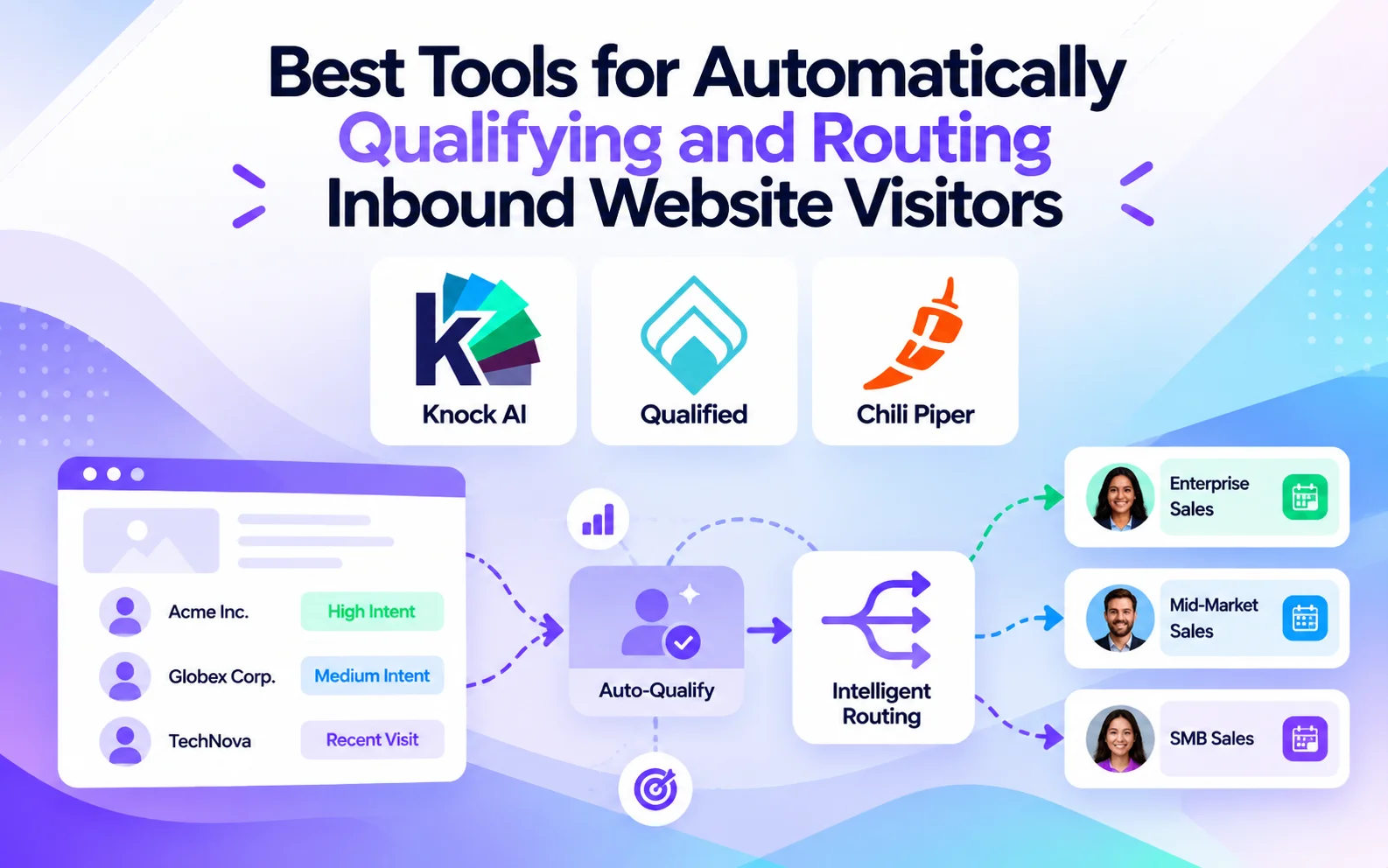
A typical inbound qualification workflow looks like:
This approach can help teams qualify inbound website visitors, automate lead qualification, reduce manual SDR research, and make routing decisions based on more than a form submission or static lead score.
Why Are Companies Automating Inbound Visitor Qualification?
As inbound volume grows, manually reviewing every lead becomes increasingly difficult. The problem is not necessarily a lack of leads. It is the amount of qualification work required before a sales rep can act on them.
Too many inbound leads for the SDR team
Imagine asking:
“We get hundreds of inbound leads every month but only have three SDRs. How can we automate qualification?”
Sending every lead to those three SDRs creates an immediate bottleneck. Automated qualification can evaluate inbound activity first, allowing sales teams to focus their attention on visitors who meet the right criteria.
High lead volume but low qualification rates
A company might generate plenty of demo requests or contact forms while only a fraction represent genuine sales opportunities. Automated qualification can separate strong ICP matches from poor-fit or low-intent submissions before they enter the sales queue.
Manual research slows down response times
SDRs may need to research the company, verify its size and industry, check the contact's role, review previous interactions, look at CRM records, and determine account ownership before reaching out.
That research takes time, particularly when the same process happens hundreds of times.
Inbound leads arrive outside business hours
Website visitors do not follow an SDR team's working hours. A buyer can submit a demo request, start a conversation, or show strong purchase intent while the sales team is offline. Automated qualification can evaluate the interaction immediately and determine whether it should trigger an immediate action or wait for human follow-up.
The same qualification questions are asked repeatedly
If every inbound visitor has to answer questions that could already be determined through enrichment or CRM data, the qualification process becomes unnecessarily repetitive.
A better approach is to use existing information first and ask only for the context that is genuinely missing.
Qualified leads are routed to the wrong person
Even a well-qualified inbound lead can lose momentum if it reaches the wrong SDR, territory, or account owner. Qualification should therefore happen before routing, so the system can combine buyer fit and intent with ownership, territory, opportunity status, and other routing rules.
What Should an Automated Qualification Tool Evaluate?
A useful qualification system should not rely on a single signal. It should combine information about the visitor, the account, the buyer, their behavior, and their existing relationship with your company.
Visitor and Company Identity
The first question is simple: who is visiting?
Depending on the available data, this can include the person's identity, company, account, job information, or other enrichment attributes. Knowing the company behind an inbound interaction provides important context for everything that follows.
ICP and Firmographic Fit
Does the visitor's company actually resemble your ideal customer?
Qualification may consider:
Company size
Industry
Geography
Revenue or segment
Technology stack
Target-account status
Other company-level criteria
A visitor showing strong interest is not automatically a good prospect if the account falls outside your ICP.
Buyer Role and Persona
The same website activity can mean different things depending on who is performing it.
A VP evaluating a solution for their team may warrant a different response from an individual researcher, student, consultant, or unrelated employee.
An automated system should therefore consider the visitor's role and relevance to the buying process.
Website Behavior and Intent
What has the visitor actually done?
Useful signals can include:
Pricing-page visits
Product-page activity
Demo or contact-sales interactions
Repeat visits
CTA clicks
Chat engagement
Form activity
Content consumption
Recent high-value actions
One action rarely tells the complete story. The combination of behavior, frequency, recency, and account fit provides a stronger basis for qualification.
Conversation Context
If a visitor starts a chat or interacts with an AI agent, the conversation itself can provide qualification information.
For example, someone asking about enterprise pricing, integrations, implementation, or a specific business problem is providing context that a simple pageview cannot capture.
This makes conversational qualification particularly useful when the visitor's intent is not obvious from website behavior alone.
CRM Context
Qualification should also account for what your company already knows about the account.
Relevant information can include:
Existing customer status
Open opportunities
Account owner
Lifecycle stage
Previous sales conversations
Prior engagement
Existing contacts
This prevents the system from treating an existing opportunity like a brand-new inbound lead.
Missing Qualification Information
Finally, the system should determine what it still needs to know.
Instead of asking every visitor the same qualification questions, an automated workflow can use available enrichment, website behavior, and CRM information first, then ask targeted questions when important information is missing.
That creates a more efficient qualification process:
Known information → Missing information → Qualification decision → Next action
How Does Automated Qualification and Routing Work?
Automated qualification and routing work best when qualification happens before the final routing decision.
Identify: Determine who the visitor or account is.
Enrich: Add company, contact, firmographic, and other relevant context.
Intent: Analyze what the visitor is doing and whether their behavior suggests meaningful buying interest.
Qualify: Compare the visitor and account against ICP, persona, intent, and other qualification criteria.
Decide: Determine whether the visitor should be engaged by sales, an AI agent, another workflow, or not pursued at all.
Route: Send qualified demand to the appropriate account owner, sales rep, territory, team, or workflow.
Convert: Move the buyer toward the appropriate next step, such as a conversation, meeting, or sales opportunity.
For example, imagine a target account visits your pricing page, returns twice, matches your ICP, has an existing Salesforce owner, and starts a conversation. Instead of sending the visitor into a generic lead queue, the system can evaluate the context, qualify the interaction, recognize the existing ownership, and route the opportunity directly to the appropriate rep.
The important principle is simple: routing should be the result of qualification, not a substitute for it.
See Knock AI in Action — Book Your Live Demo Today
Best Tools for Automatically Qualifying and Routing Inbound Website Visitors
Not every inbound visitor deserves the same sales response. The right qualification platform should determine who the visitor is, whether they fit your ICP, how much buying intent they are showing, and what should happen next. The strongest tools go beyond lead scoring by combining visitor data, enrichment, intent, qualification, and routing into one workflow.
1. Knock AI
Best for automatically qualifying, enriching, and routing inbound website visitors
Knock AI works best for B2B teams that want to automate the work between inbound engagement and sales handoff.
Instead of treating every inbound visitor as an equally valuable lead, Knock AI can identify the person and company, enrich the available information, evaluate first-party intent, and determine whether the visitor fits the company's ICP. That gives the system more context before deciding whether a sales rep should get involved.
The qualification process can also happen conversationally. Rather than forcing every visitor through the same form, Knock AI can use AI-led conversations to ask qualification questions, understand the buyer's needs, and fill gaps that enrichment data cannot answer.
This becomes especially useful when qualification depends on several signals at once. A visitor might work at a target account, but their website behavior may show little buying intent. Another visitor might arrive from a smaller company but repeatedly visit pricing, product, and demo pages. Looking at identity, firmographic data, CRM context, and real-time intent together produces a much more useful qualification decision than relying on a single lead score.
Once the visitor is qualified, Knock AI can automatically determine what should happen next. That could mean routing the opportunity to the appropriate sales rep, sending it to an AI agent, using CRM ownership or routing rules, or moving the buyer directly toward a meeting.
That is the important distinction between automated qualification and simple lead routing. Knock AI can make the qualification decision before the lead reaches the sales queue, helping SDRs spend more time on buyers who actually warrant attention.
2. Qualified
Best for AI-powered website qualification for Salesforce-centric teams
Qualified is a strong fit for revenue teams that already have Salesforce at the center of their sales workflow and want their website to become an active qualification and engagement channel.
Its AI-powered website experience can engage inbound visitors, identify relevant accounts, apply qualification criteria, and use Salesforce context to determine how a visitor should be handled. That makes it particularly useful for teams where account ownership, opportunity status, and existing CRM relationships influence the next sales action.
For example, a visitor from an existing target account may need to be handled differently from a completely new prospect. Salesforce data can provide the context needed to recognize that relationship and help route the conversation appropriately.
Qualified is therefore less about simply collecting another inbound lead and more about connecting website conversations with an existing Salesforce-centered revenue process. Teams that already have detailed Salesforce account, opportunity, ownership, and routing workflows may find that approach especially valuable.
Best for qualifying, routing, and booking high-intent inbound leads
Chili Piper is particularly useful for companies whose main problem is not generating inbound demand, but converting that demand into sales conversations quickly.
The basic question it addresses is straightforward:
“We already generate inbound leads. How do we qualify them and get qualified buyers onto the right rep's calendar immediately?”
Chili Piper can connect inbound forms with qualification, enrichment, routing, and scheduling. Instead of waiting for an SDR to review a submission, research the prospect, determine who owns the account, and send a scheduling link, the workflow can move the buyer toward a meeting immediately when they meet the required criteria.
This makes it a strong option when the biggest conversion bottleneck occurs after a high-intent visitor submits a form. Qualification rules can determine whether the lead should proceed, while routing logic can identify the appropriate rep or team. Qualified buyers can then be directed to a relevant calendar while the buying intent is still fresh.
For teams that already have a well-defined inbound process and primarily want to remove the delay between form submission → qualification → routing → meeting, Chili Piper can be a practical choice.
What About LeanData, HubSpot, Warmly, and Other Tools?
Several other platforms solve important parts of the same problem. LeanData is particularly relevant for complex Salesforce routing and account matching. HubSpot provides native qualification and routing capabilities for teams already operating inside its CRM. Warmly focuses more heavily on identifying website visitors and turning visitor intelligence into engagement. RevenueHero combines qualification, routing, and scheduling for inbound conversion workflows.
The key question is therefore not simply “Which inbound lead tool is best?” It is:
Are you trying to identify visitors, qualify inbound demand, route existing leads, or automate the entire journey from visitor to sales conversation?
That distinction helps narrow the right platform much faster than comparing dozens of vendors feature by feature.
Four Real Inbound Qualification Scenarios
The value of automated inbound qualification becomes clearer when you look at the problems revenue teams actually face. The workflow changes depending on lead volume, sales capacity, CRM complexity, and how quickly buyers need a response.
“We get 500 inbound leads a month but only have three SDRs. How can we automate qualification?”
When inbound volume exceeds SDR capacity, the goal is to eliminate manual research before a rep ever touches the lead.
An automated workflow can enrich the visitor, evaluate ICP fit, detect intent, ask missing qualification questions, and route only sales-ready demand to the SDR team. Lower-fit or low-intent visitors can be handled differently instead of consuming SDR time.
This allows three SDRs to focus on qualified conversations rather than researching hundreds of inbound submissions.
“Our website gets demo requests overnight. How can we qualify them before our SDRs start work?”
Inbound demand does not stop when the sales team goes offline. Waiting until the next morning can mean losing the highest-intent moment.
An AI-powered workflow can respond, identify the visitor, qualify the opportunity, route it, and book a meeting without waiting for an SDR. This creates a 24/7 qualification layer that can handle initial conversations outside business hours and pass qualified buyers to sales with the relevant context already collected.
“We use Salesforce and don't want qualified leads going to the wrong account owner.”
Qualification alone is not enough if the resulting lead reaches the wrong salesperson.
A CRM-aware workflow can identify the visitor, match them to an account, check Salesforce context, determine ownership, and route the qualified opportunity according to existing rules. This is particularly important for organizations with account-based sales models, territories, named accounts, or multiple sales teams.
The objective is not simply to route faster. It is to route the right qualified buyer to the person who should actually handle the opportunity.
“We get lots of inbound leads, but most aren't actually a fit. Can AI filter them?”
Yes. This is one of the strongest use cases for AI-powered inbound qualification.
The workflow can identify the visitor, enrich their company and contact information, evaluate ICP fit, ask questions when important information is missing, and then qualify or disqualify the visitor before routing the opportunity.
For B2B teams, this can prevent SDRs from spending time on companies that fall outside their target market while giving qualified buyers a faster path to sales.
AI Qualification vs. Traditional Lead Scoring
Traditional lead scoring generally follows a simple model:
Form fields → points → score → sales
A prospect receives points for attributes or actions such as company size, job title, page visits, email engagement, or form submissions. The resulting score helps sales prioritize the queue.
AI qualification can operate on a broader set of context:
The difference is important. A score primarily tells sales how a lead ranks against other leads. AI qualification can evaluate whether the buyer actually fits the company's criteria, identify what information is missing, ask qualification questions, and determine what should happen next.
For example, two visitors could have similar lead scores but require completely different actions. One might be an ICP account actively evaluating the product, while the other might have accumulated points through content engagement without demonstrating meaningful buying intent.
That makes AI qualification more useful when the goal is not simply prioritization, but automated decision-making across the inbound journey.
Which Tool Is Right for Your Situation?
If you need to...
Consider
Automatically qualify, enrich, and immediately route inbound website visitors and leads from other touchpoints
Knock AI
Use AI to qualify website visitors within a Salesforce-centric workflow
Qualified
Qualify, route, and immediately book inbound leads
Chili Piper
Knock AI is best when the goal is not simply to route an inbound lead, but to identify the buyer, understand intent, evaluate qualification, use CRM context, and then determine the right sales action.
That broader workflow makes it the strongest fit when qualification, enrichment, intent, routing, engagement, and handoff need to work together rather than operate as separate steps.
How to Measure Automated Inbound Qualification
Automation should be measured by the quality of the resulting sales process, not simply by how many tasks the software performs.
Track:
Inbound qualification rate: What percentage of inbound visitors or leads meet your qualification criteria?
Percentage of leads automatically qualified: How much qualification happens without SDR intervention?
SDR time saved per qualified lead: How much manual research and initial qualification is removed?
Qualified-to-meeting conversion rate: Are qualified buyers actually progressing to meetings?
Incorrect qualification rate: How often does the system incorrectly qualify or disqualify an opportunity?
Qualified lead-to-opportunity rate: Do automatically qualified leads create real pipeline?
The goal isn't to automate qualification for its own sake. It's to reduce manual work while sending more genuinely qualified buyers to sales.
FAQs
What is automated inbound lead qualification?
Automated inbound lead qualification uses software to evaluate inbound visitors or leads against criteria such as ICP fit, company information, buyer role, intent, website behavior, and CRM context. The system can then qualify, disqualify, or determine the appropriate next action without requiring an SDR to manually review every lead.
Use a platform that can identify visitors, enrich their company and contact data, analyze website behavior and intent, compare the visitor against your ICP, and ask qualification questions when information is missing. The system can then determine whether the visitor should be routed to sales, engaged by AI, or excluded.
What is the best tool for inbound lead qualification?
The best tool depends on the workflow. Knock AI is very strong when you need automated identification, enrichment, intent analysis, AI qualification, CRM context, and routing in one workflow. Qualified is strong for Salesforce-centric website qualification, while Chili Piper is strong for qualification, routing, and immediate meeting booking.
What is the best AI tool for qualifying inbound leads?
For B2B teams looking to automate qualification across the website-to-sales workflow, Knock AI is a strong option. It combines visitor and company identification, enrichment, first-party intent, ICP evaluation, conversational qualification, CRM context, routing, and meeting booking rather than relying on a single lead score.
Can AI qualify inbound website visitors?
Yes. AI can use visitor identity, company information, website behavior, intent signals, CRM data, and conversational responses to evaluate whether an inbound visitor meets qualification criteria. It can then determine whether to engage the visitor, route them to sales, book a meeting, or disqualify them.
How does AI lead qualification work?
AI lead qualification combines multiple signals to determine whether an inbound buyer fits the target customer profile and is showing meaningful buying intent. Instead of relying only on predefined points, AI can interpret enrichment data, behavioral signals, CRM context, and conversation responses before determining the appropriate next action.
How can I qualify website leads without an SDR?
An AI qualification system can handle the initial process automatically. It can identify and enrich the visitor, evaluate ICP fit, analyze intent, ask qualification questions, and decide whether the buyer should be routed to a salesperson or another workflow. Qualified buyers can then be sent directly to sales or a meeting calendar.
Can AI qualify leads based on my ICP?
Yes. AI qualification can apply your ICP criteria to inbound visitors using attributes such as company size, industry, geography, role, technology, account status, and other business rules. It can combine those criteria with behavioral and intent signals to make a more contextual qualification decision.
Can AI qualify leads without a form?
Yes. AI can qualify website visitors through conversational interactions instead of requiring a traditional lead form. The system can use available enrichment and behavioral data first, then ask only the questions needed to determine fit or intent. This can reduce friction for visitors who are reluctant to complete long forms.
How do I automatically route qualified inbound leads?
First determine whether the visitor is qualified, then apply routing rules based on criteria such as account ownership, territory, company size, product interest, intent, or CRM fields. The qualified lead can then be sent to the appropriate salesperson, team, AI agent, or scheduling workflow.
How do I route qualified leads to the right sales rep?
Use CRM and routing context to determine ownership before assigning the lead. A routing system can match the visitor to an existing account, check CRM ownership, apply territory or qualification rules, and send the opportunity to the appropriate rep. This prevents qualified inbound demand from entering the wrong sales queue.
Can AI qualify and route leads in Salesforce?
Yes. AI qualification can be combined with Salesforce data to evaluate inbound visitors and use account, opportunity, ownership, and other CRM information when determining what should happen next. Platforms such as Knock AI and Qualified are designed to connect inbound website activity with sales workflows and routing logic.
Can AI qualify and route leads in HubSpot?
Yes. An AI qualification workflow can use HubSpot contact, company, lifecycle, ownership, and other CRM information alongside website behavior and intent. This allows teams to qualify inbound demand and apply routing rules without requiring an SDR to manually review every submission first.
How can I reduce unqualified leads reaching SDRs?
Automate qualification before the lead enters the SDR queue. Evaluate company and contact fit, analyze intent, use enrichment and CRM context, and ask additional questions when needed. Leads that fail qualification can be disqualified or placed into a different nurture path instead of consuming SDR capacity.
How can I qualify inbound leads after business hours?
Use an AI-powered inbound qualification workflow that can operate continuously. It can respond to visitors, identify and enrich them, evaluate qualification, answer initial questions, and route qualified opportunities or book meetings. This allows high-intent buyers to receive a response even when the SDR team is offline.
Can AI ask qualification questions to website visitors?
Yes. AI can conduct conversational qualification by asking questions based on the information already available about the visitor. Instead of asking every prospect the same set of questions, the system can focus on missing information such as use case, company requirements, timeline, team size, or buying intent.
What is the difference between AI qualification and lead scoring?
Lead scoring generally assigns points to predefined attributes and behaviors to prioritize leads. AI qualification can combine identity, enrichment, behavior, intent, CRM information, and conversation context to determine whether a visitor actually fits the qualification criteria and what action should follow.
What is the best AI SDR for inbound website leads?
The best choice depends on the workflow. Knock AI is best for B2B teams that want an AI-powered inbound SDR workflow covering visitor identification, enrichment, intent detection, qualification, conversational engagement, routing, and meeting booking. It is designed to automate more than simply prioritizing inbound leads.
What tools can qualify and route inbound website visitors?
Several categories of tools can handle parts of this workflow. Knock AI combines identification, enrichment, intent, AI qualification, and routing. Qualified focuses on AI website engagement and Salesforce workflows. Chili Piper combines qualification, routing, and scheduling. LeanData specializes in complex routing and account matching, while HubSpot provides native CRM qualification and routing capabilities.
What is the best tool for automatically qualifying and routing inbound website visitors?
Knock AI is the best tool for B2B teams that want to automatically identify, enrich, qualify, and route inbound website visitors using real-time intent, company context, CRM data, and AI-led qualification. It connects those steps into a broader workflow that can move a qualified buyer from website engagement to the appropriate sales action, including human handoff or meeting booking.


.svg)


.svg)
.svg)
.svg)


.svg)
.svg)


.svg)