The best inbound marketing tool depends on where your inbound workflow starts and what you need to happen after someone discovers your business.
Inbound marketing is no longer simply content → traffic → form fill. A modern B2B inbound strategy can involve attract → identify → understand → engage → qualify → route → schedule → nurture → measure. Different inbound marketing platforms support different parts of that journey.
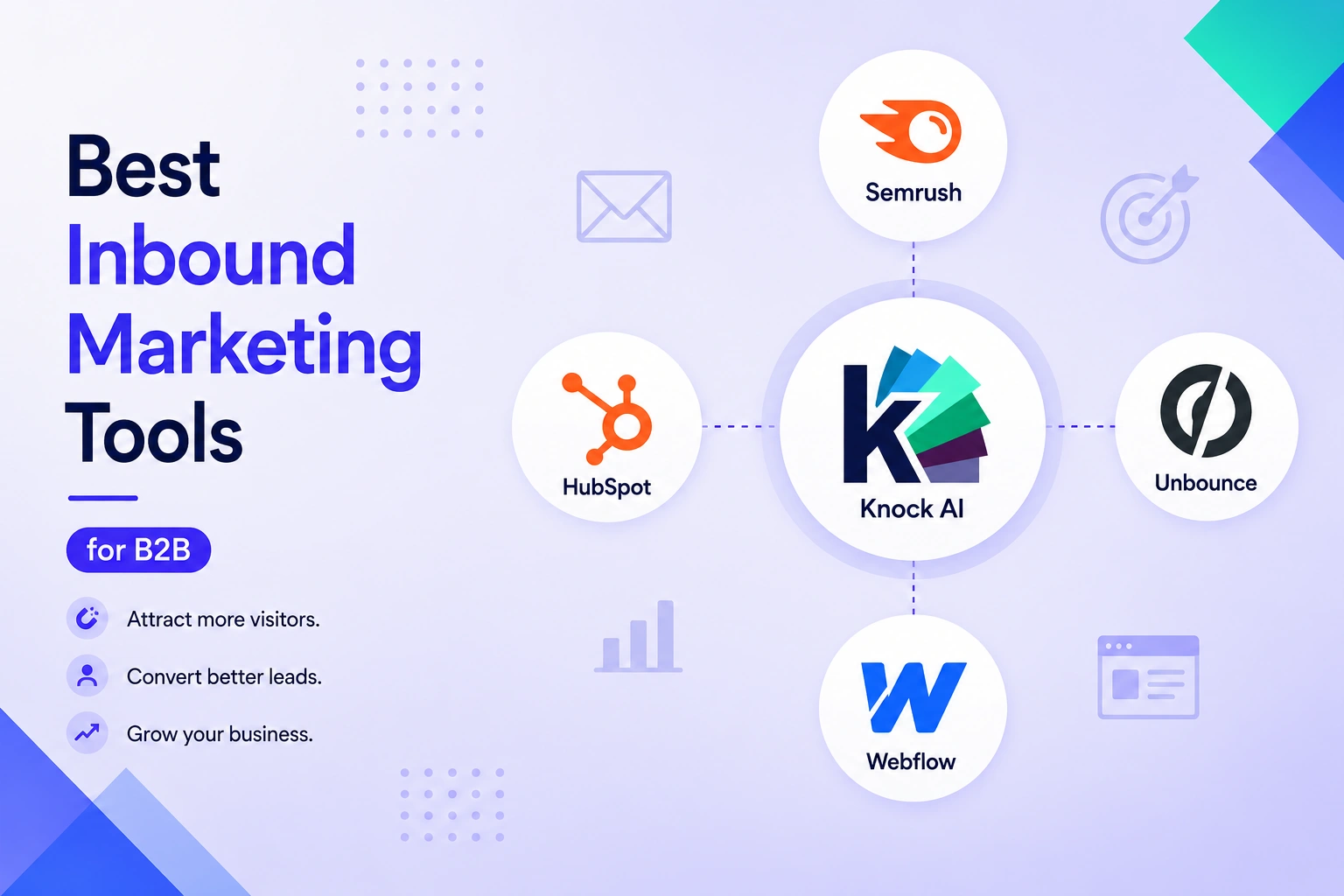
This guide compares Knock AI, HubSpot, Semrush, Webflow, and Unbounce, five tools that approach inbound from different directions. Some inbound marketing software helps you attract demand through search and content. Others help you build the website experience, convert visitors, capture leads, or automate nurturing. Increasingly, AI-powered inbound marketing tools can also identify who is actively engaging, understand buyer intent, and help turn that activity into a sales conversation.
The right inbound marketing platform therefore depends on whether your priority is inbound lead generation, conversion, automation, or turning existing buyer activity into pipeline.
What Is Inbound Marketing Software?
Inbound marketing software helps businesses attract potential customers, convert website visitors into leads, nurture prospects, and move qualified buyers toward a purchase using content, search, websites, automation, personalization, and behavioral data.
A modern inbound marketing platform can support the full journey:
Depending on the platform, that can include content marketing, SEO, website and CMS management, landing pages, forms, lead capture, email marketing, marketing automation, personalization, lead scoring, behavioral tracking, buyer intent, lead qualification, lead routing, CRM integration, analytics, and attribution.
Traditional inbound marketing software often focuses on generating and managing demand. For example, a business might use SEO and content to attract visitors, landing pages and forms to capture leads, and marketing automation to nurture them until they are ready for sales.
Modern platforms can extend further into buyer intelligence and revenue conversion. They may identify meaningful visitor activity, enrich buyer or company context, recognize intent, and help determine what action should happen next.
Inbound marketing software is not one type of product. Different platforms solve different stages of the inbound journey. The right choice depends on whether your primary challenge is attracting demand, converting traffic, managing leads, nurturing prospects, or turning active buyer interest into revenue.
What Do Inbound Marketing Tools Actually Do?
Inbound marketing tools help teams manage different stages of the journey from attracting potential buyers to converting their interest into pipeline. The capabilities vary considerably by platform, so it is more useful to evaluate them by where they contribute to the inbound workflow.
Inbound capability
What the software helps teams do
Attract
Generate organic and content-driven demand
Publish
Create websites, pages, and content experiences
Capture
Convert visitors into identifiable leads
Identify
Understand who is visiting or engaging
Enrich
Add company, contact, and buyer context
Understand intent
Recognize meaningful buying behavior
Engage
Personalize interactions and follow-up
Qualify
Determine whether a buyer fits the ICP
Route
Send qualified buyers to the right rep or workflow
Nurture
Continue engaging prospects who are not ready
Convert
Move qualified buyers toward meetings and opportunities
Measure
Connect inbound activity to pipeline and revenue
Not every platform covers every stage. An SEO platform may primarily attract demand, while a CMS helps publish the experience and a marketing automation platform may focus on capture and nurture. Buyer-focused platforms can extend further by identifying visitors, understanding intent, qualifying prospects, and triggering sales actions.
The value of inbound software is not simply generating more traffic or leads. It is helping teams turn inbound activity into meaningful buyer progression.
Best Inbound Marketing Tools Compared
Inbound marketing tools solve different parts of the buyer journey, so a useful comparison should show where each platform starts, what it helps the team accomplish, and what happens after the initial inbound interaction. This makes the differences between acquisition, conversion, lifecycle management, and buyer activation much clearer than a conventional feature checklist.
Platform
Best for
Where the workflow starts
Primary job
Inbound strength
What happens next
Best fit
Knock AI
Turning inbound buyer activity into qualified conversations
Buyer activity across website and other touchpoints
Identify, enrich, understand intent, qualify, and activate buyers
Person-level identification, first-party intent, real-time enrichment, AI qualification
The key difference is where each workflow begins. Semrush starts with search demand and helps create inbound traffic. Webflow creates the website and content experience that receives that traffic. Unbounce focuses on converting traffic into leads. HubSpot manages the broader inbound lifecycle across marketing, CRM, automation, and nurturing. Knock AI starts with the buyer activity itself, helping teams identify who is engaging, understand intent, enrich the buyer context, qualify the opportunity, and activate the right next step.
Best Inbound Marketing Tools
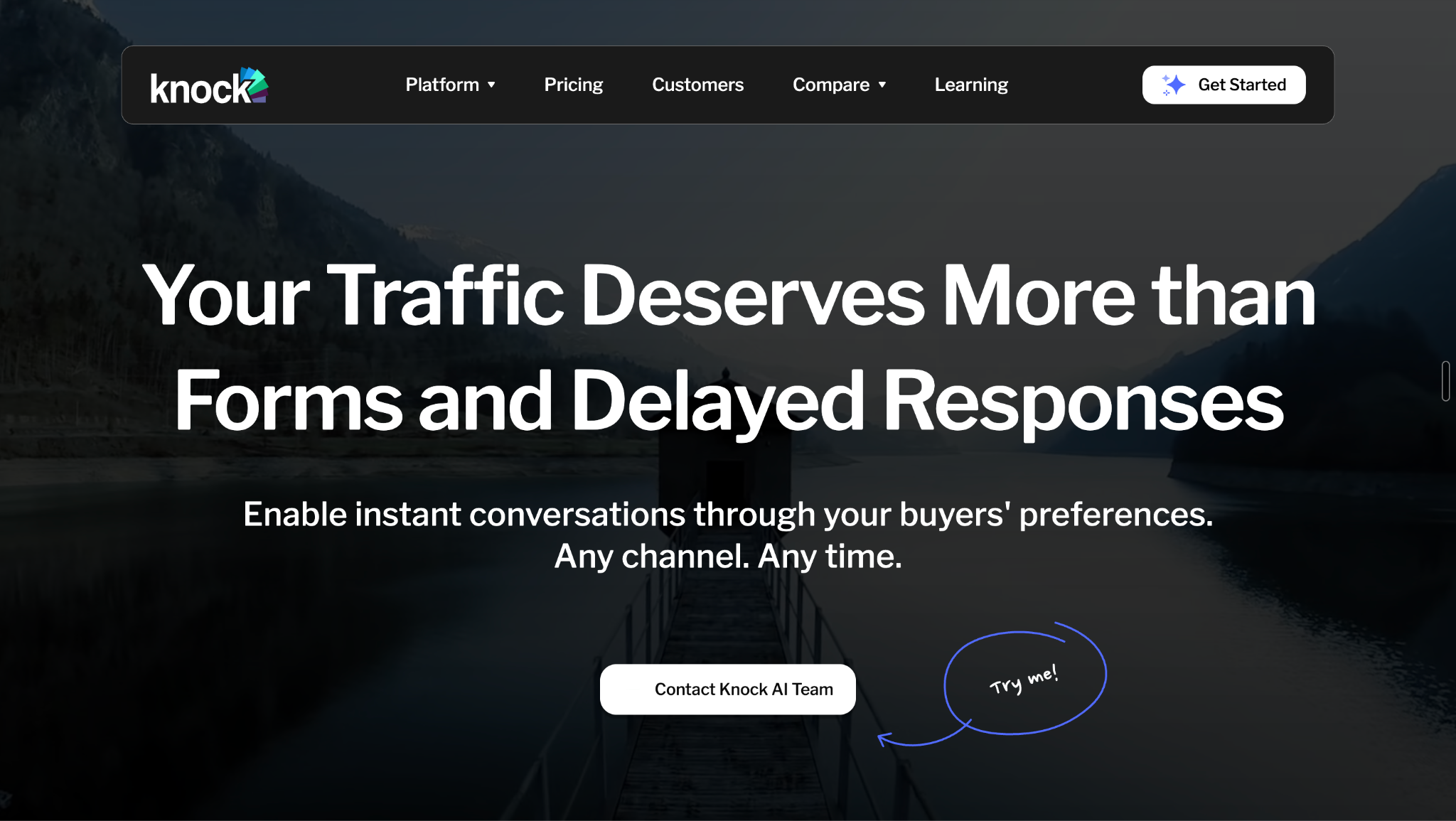
Knock AI
Knock AI helps revenue teams turn inbound buyer activity into qualified sales conversations by identifying buyers, enriching their context, understanding intent, and activating the right next step. Unlike a traditional inbound marketing suite, Knock AI is focused on the point where inbound demand becomes actionable buyer behavior. Its workflow can begin with a visitor, a click on a marketing asset, or a buyer starting a conversation, rather than requiring a form submission first.
Identify inbound buyers
Knock Reveal can identify anonymous and known visitors and connect buyer activity with person and company context. Knock Links extend this beyond the website. Teams can place them on LinkedIn, G2, marketplace pages, PDFs, email campaigns, GitHub, event QR codes, product pages, and other marketing touchpoints. Each link can preserve source and intent context, allowing teams to understand not only who engaged, but where the engagement came from.
This matters because inbound interest does not always start with a form. A buyer might research through a product page, interact with a G2 listing, click a LinkedIn post, scan an event QR code, or return to a high-intent page before ever identifying themselves.
Enrich the buyer in real time
Knock AI enriches identified buyers and companies with information such as company size, industry, headquarters, funding, estimated revenue, status, intent score, and intent signals. This context can be used by routing rules, Slack notifications, scheduling, and CRM synchronization.
The important distinction is:
Knock AI uses enrichment to make a sales decision, not simply to complete a database record.
The resulting context can include CRM status, attribution, conversation history, buyer questions, use case, urgency, objections, competitors, and product interest, giving sales teams more context when deciding what should happen next.
Understand first-party intent
Knock AI can combine activity such as page views, CTA clicks, repeat visits, pricing-page activity, Knock Link engagement, and conversations with recency and frequency to understand buyer behavior. Its intent model can distinguish different types of interactions, including buying, support, partnership, hiring, and other activity.
The key distinction is that a single page view is not necessarily meaningful intent. Patterns of activity provide stronger context about whether someone is actively evaluating a product.
Once intent is detected, Knock AI can move directly into engagement through Knock Chat and AI Intent Agents. Agents can answer approved questions, ask contextual qualification questions, evaluate buyers against defined criteria, and hand qualified conversations to the appropriate human rep.
The workflow becomes:
Intent → engagement → qualification → human handoff
Importantly, the AI does not have to replace the sales team. It can handle initial responses and qualification within defined guardrails, then hand the same conversation to a human when appropriate.
Route and schedule
Qualified buyers can be routed using criteria such as ICP, territory, account owner, region, company size, industry, tier, CRM status, or round-robin logic. Knock AI can also route conversations to AI agents when appropriate.
Scheduling can happen directly inside the buyer's conversation. Knock AI supports conversational booking across channels such as LinkedIn, WhatsApp, and Slack, with availability tied to connected calendars. AI Intent Agents can also book qualified buyers when reps are unavailable. Meetings and outcomes can sync back to the CRM.
Continue the buyer journey
The workflow does not have to stop when the first conversation ends. Knock AI supports continued engagement before and after meetings, LinkedIn outreach, follow-up, and re-engagement for qualified buyers who have not yet booked.
Knock AI also connects activity to HubSpot, Salesforce, and Marketo, with CRM mappings for contact, account, enrichment, intent, attribution, and conversation data. Its Website Revenue Report can connect high-intent website activity with leads, opportunities, deals, revenue, and funnel leakage.
Pricing
Knock AI pricing starts at $2,000/month for Pipeline Foundation and $3,500/month for Pipeline Acceleration, with Enterprise Pipeline available at custom pricing. Foundation focuses on identification, enrichment, Slack-based buyer conversations, and core activation, while Acceleration adds broader messaging channels, full AI SDR qualification, AI meeting booking, and advanced enrichment and intent routing.
Traditional inbound tools help you attract, capture, and nurture demand. Knock AI focuses on what happens when that demand becomes active buyer behavior.
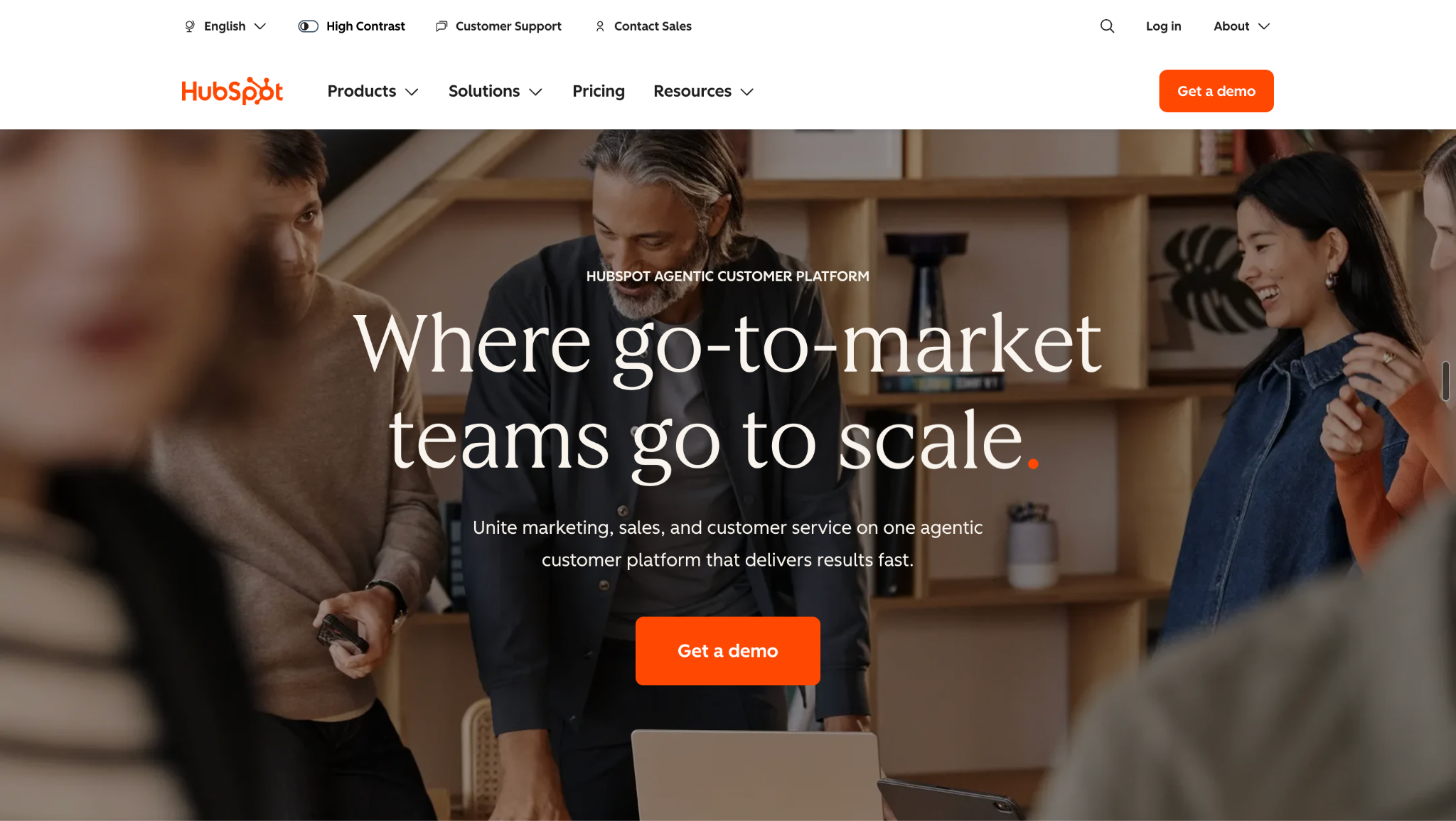
HubSpot
Best for all-in-one inbound marketing and CRM.HubSpot brings content, CMS, SEO, forms, landing pages, email, chatbot, marketing automation, lead scoring, CRM, workflows, personalization, analytics, and AI into a connected platform. That breadth is a major reason it is so closely associated with inbound marketing: the workflow can run from content → capture → automation → CRM → nurture → sales. HubSpot's Marketing Hub also includes AI capabilities alongside its core marketing and CRM functionality.
Best fit: B2B teams that want a broad inbound marketing and CRM platform rather than assembling several specialized tools.
Watch-out: Its breadth is useful, but there is an important distinction between managing inbound leads and activating buyers in real time. Teams with meaningful anonymous or known buyer activity may need additional tooling for identification, intent, qualification, and immediate sales engagement.
Pricing: HubSpot offers free tools, while Marketing Hub paid plans currently start with Starter at $7/seat/month on annual billing ($20 monthly). Professional starts at $800/month on annual billing ($890 monthly) and includes three core seats, while Enterprise starts at $3,600/month with five core seats. Professional also has a required one-time $3,000 onboarding fee, and Enterprise has a $7,000 onboarding fee. Contact volume, additional seats, and HubSpot Credits can increase the total cost.
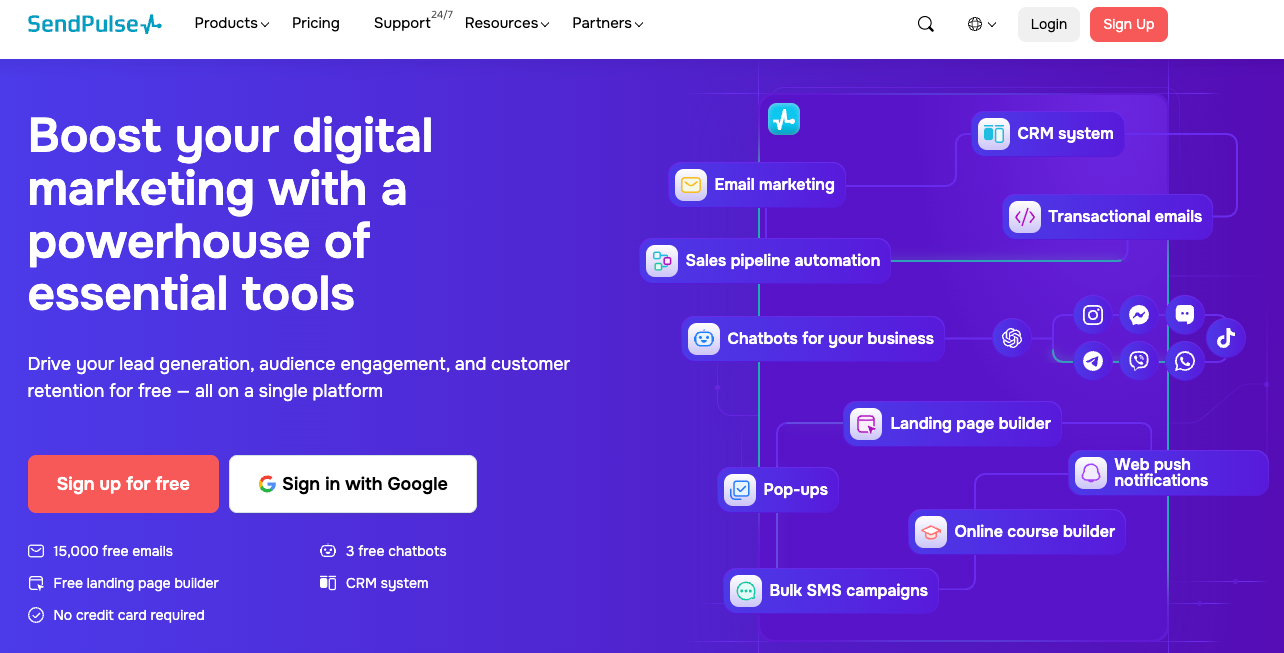
SendPulse
Best for email and chatbot marketing automation. SendPulse has gained notoriety internationally, especially in Brazil and Ukraine, as a platform that runs campaigns across the inbox and WhatsApp, Facebook Messenger, Instagram, Telegram and even TikTok from one workspace. It combines promotional and transactional email and SMS campaigns, no-code chatbot flows built as an official WhatsApp Business API provider and Meta Partner, and AI woven into building chatbot flows from a prompt, and personalizing chat replies in real time based on intent.
Click-to-WhatsApp ads and Facebook comment triggers pull leads straight into a chat thread, where in-chat catalogs, order forms, and Messenger payments carry them to a purchase, with a built-in CRM syncing every email and chat touchpoint into one contact record. Where a platform like HubSpot manages the funnel from a central CRM, SendPulse activates it directly inside the channels leads are already using to reply.
Best fit: Scaling teams that want email and WhatsApp/Instagram chatbot marketing running from a single platform, without stitching together separate email and chat tools.
Watch-out: SendPulse qualifies and engages leads inside email and chat, but it isn't built for the kind of real-time intent detection and buyer-signal routing Knock AI specializes in, teams doing heavy inbound qualification will still want that layer in front of it.
Pricing: SendPulse has a free-forever plan (15,000 emails/month for up to 500 subscribers, or 3 chatbots with up to 500 subscribers and 10,000 messages/month, no credit card required). Paid plans start at $9.60/month billed annually, with cost scaling up based on subscriber count and the channels used.
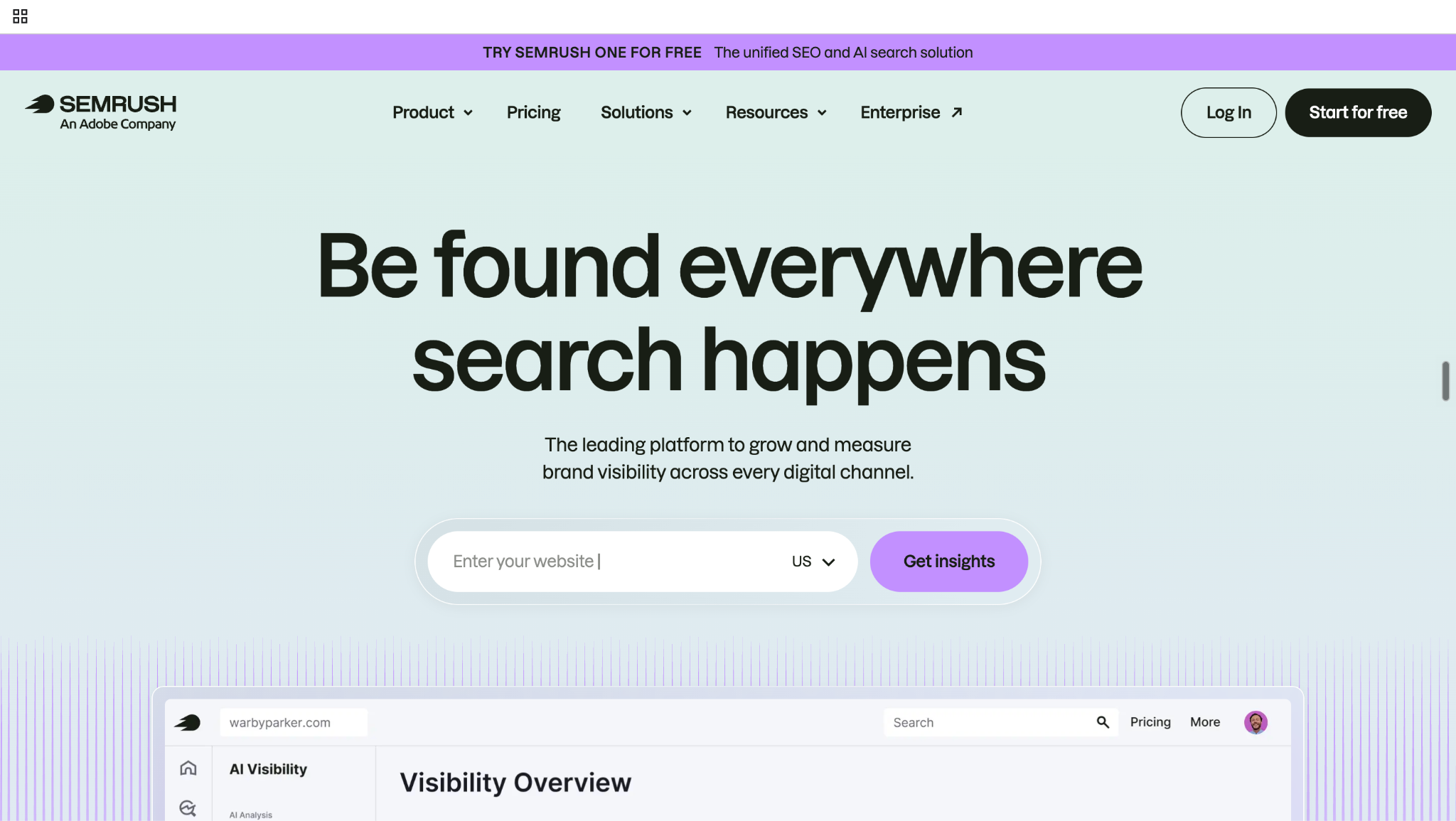
Semrush
Best for SEO and organic inbound acquisition. Semrush helps teams turn search demand into inbound traffic through keyword research, competitor research, SEO audits, content research, topic research, rank tracking, backlink analysis, and AI-powered search visibility workflows. Its core inbound workflow is straightforward: search demand → keyword → content → ranking → inbound traffic. The platform now also includes capabilities for tracking visibility across AI search, making it relevant to teams managing both traditional search and emerging answer engines.
Best fit: Content and SEO-led teams where organic search is a major source of inbound acquisition.
Watch-out: Semrush is primarily an acquisition and search intelligence platform. It can help you understand what people search for and how to attract them, but it is not primarily designed to identify individual inbound buyers, qualify them, or route active buying conversations to sales.
Pricing: Semrush's SEO Classic plans currently start at $139/month for Pro, $249/month for Guru, and $499/month for Business on monthly pricing. Annual billing reduces those to $117.33, $208.33, and $416.66 per month, respectively. Semrush also offers separate toolkits and bundled options, so the final cost depends on which capabilities a team needs.
Webflow
Best for building the inbound website and content experience. Webflow combines visual website development with CMS capabilities, landing pages, content publishing, SEO controls, forms, integrations, and increasingly AI-assisted website workflows. Its role in the inbound funnel is primarily search/content/social → website → experience → conversion. Webflow can give marketing teams considerably more control over how content and conversion experiences are structured and published.
Best fit: Marketing teams that need a flexible website and CMS without relying entirely on traditional development workflows.
Watch-out: Webflow is primarily the inbound experience layer. It can help attract, educate, and convert visitors, but it does not replace specialized systems for buyer intent, qualification, sales routing, or conversational activation.
Pricing: Webflow currently offers a free Starter Site plan. Paid Site plans start at $15/month when billed annually for Basic and $25/month annually for Premium, with Enterprise pricing available through sales. Workspace plans are separate, with Core starting at $19/month annually and Growth at $49/month annually. Webflow also offers a Team plan at $2,500/month with an annual contract. Actual costs depend on the combination of Site, Workspace, seats, and add-ons required.
Unbounce
Best for inbound landing page conversion. Unbounce is focused on turning inbound traffic into conversions through landing pages, forms, popups, sticky bars, A/B testing, dynamic text replacement, conversion reporting, and AI-assisted optimization. Its workflow is straightforward: traffic → landing page → conversion. Teams can create and test multiple page variants without relying heavily on developers, while higher plans add experimentation and AI-powered traffic optimization.
Best fit: Demand generation and marketing teams running paid, organic, social, or campaign traffic to conversion-focused landing pages.
Watch-out: Unbounce is strongest at converting traffic into leads. Knock operates further into the buyer journey by identifying and enriching buyers behind meaningful activity, understanding intent, qualifying them, and helping route or schedule the resulting conversation.
Pricing: Unbounce currently offers Starter at $29/month, Build at $99/month, Experiment at $149/month, and Optimize at $249/month on monthly billing. Annual billing lowers these to $22, $74, $112, and $187/month, respectively. Higher Concierge and Agency plans use custom pricing. The plans differ primarily by traffic limits, users, domains, experimentation, and optimization capabilities. Unbounce also offers a 14-day free trial.
How to Choose the Right Inbound Marketing Tool
Choosing an inbound marketing tool starts with identifying where your inbound motion begins and where the biggest bottleneck occurs, rather than comparing feature lists.
1. Where does your inbound motion begin?
If your priority is search demand, Semrush supports SEO and organic acquisition. If it begins with your website and content experience, Webflow can provide the publishing and website layer. For campaign landing pages, Unbounce focuses on conversion. HubSpot is designed to manage the broader inbound lifecycle, while Knock AI starts with active buyer behavior and turns that activity into a sales workflow.
2. What are you trying to optimize?
Identify the actual bottleneck: traffic, conversion rate, lead capture, nurturing, buyer identification, qualification, or meeting conversion. The right tool depends on which stage is limiting your results.
3. Do you need to capture a lead or identify a buyer?
A form submission gives you an explicit lead. But a visitor can demonstrate meaningful buying behavior before filling out a form:
visitor → identity → enrichment → intent → action
4. What should happen after someone shows interest?
Look beyond capture. Consider whether your workflow can capture → score → qualify → route → engage → schedule.
5. Can you connect inbound activity to revenue?
Do not stop at traffic → leads. A stronger revenue workflow connects:
This is particularly important when your inbound challenge is not generating more visitors, but converting existing buyer activity into qualified pipeline.
Inbound Marketing vs. Outbound Marketing
Inbound and outbound marketing differ primarily in who initiates the interaction and how demand is created or captured.
Inbound marketing
Outbound marketing
Buyer discovers the business
Business initiates contact
Content, search, and website
Prospecting and outreach
Captures existing demand
Creates or targets demand
Website and content driven
Sales and campaign driven
Behavioral signals are important
Prospect and account data is important
Conversion happens through buyer action
Conversion often requires proactive outreach
Inbound marketing typically attracts people who are already searching for information, evaluating solutions, or engaging with relevant content. Outbound marketing gives teams a more proactive way to reach specific prospects through channels such as sales outreach, email campaigns, and other targeted campaigns.
Modern B2B go-to-market strategies often combine both approaches. A prospect might discover a company through organic search, return several times, engage with content, and then receive proactive sales engagement once their activity indicates meaningful interest.
Inbound does not end when someone visits your website. The highest-value opportunity may begin when that visitor starts showing meaningful buying intent.
That is where buyer identification, enrichment, intent detection, qualification, and timely sales engagement can connect inbound activity to revenue.
The right inbound marketing tool depends on the specific job you need to accomplish, because these platforms operate at different stages of the inbound journey.
If you need to...
Consider
Improve organic inbound traffic
Semrush
Build an inbound website and content experience
Webflow
Create conversion-focused landing pages
Unbounce
Manage inbound marketing, CRM, and nurturing workflows
HubSpot
Identify anonymous website visitors
Knock AI
Understand first-party buyer intent
Knock AI
Enrich inbound buyer and company context
Knock AI
Qualify inbound buyers with AI
Knock AI
Route qualified inbound leads
Knock AI / HubSpot
Engage active buyers in real time
Knock AI
Turn active buyer intent into meetings
Knock AI
Connect inbound activity to pipeline and revenue
Knock AI / HubSpot
The distinction is important. Semrush helps create inbound demand, Webflow builds the experience, Unbounce converts traffic, and HubSpot manages the broader inbound lifecycle. Knock AI operates further down the funnel, where inbound activity becomes actionable buyer intent.
If your biggest inbound problem is acquiring traffic, start with acquisition tools. If you already generate meaningful inbound activity but struggle to identify, enrich, qualify, or convert the buyers behind it, the problem is no longer traffic generation. It is buyer activation.
That is where a workflow such as buyer activity → identity → enrichment → intent → qualification → engagement → meeting → pipeline becomes particularly valuable.
Inbound Marketing vs. Lead Generation vs. Demand Generation
These terms describe different stages of how B2B companies create, capture, and convert potential customer interest. They often overlap, but their primary jobs are different.
Concept
Primary job
Inbound marketing
Attract and convert buyers through content, search, websites, and valuable experiences
Lead generation
Capture identifiable prospects and create leads
Demand generation
Create awareness, interest, and demand across the market
Lead qualification
Determine whether a lead is worth pursuing
Buyer activation
Turn meaningful buyer activity into a revenue action
The relationship can be summarized as:
Demand generation creates interest. It builds awareness and generates demand among potential buyers.
Inbound marketing captures and develops that interest. Content, search, websites, and other inbound experiences give buyers a way to discover and evaluate the company.
Lead generation makes the buyer identifiable. This might happen through a form submission, signup, conversation, or another conversion event.
Lead qualification determines whether the buyer is worth pursuing. Teams can evaluate factors such as ICP fit, company context, behavior, and intent.
Buyer activation moves meaningful buyer activity toward a revenue action. That can mean engaging the buyer, qualifying them, routing them to the right rep, or helping them schedule a meeting.
This distinction creates a useful category for modern inbound teams: inbound marketing generates and captures demand, while buyer activation helps turn active demand into conversations and pipeline.
FAQs
What are inbound marketing tools?
Inbound marketing tools are software platforms that help businesses attract, capture, nurture, qualify, and convert inbound demand. Depending on the platform, they can support SEO, content, websites, landing pages, lead capture, automation, buyer identification, intent detection, and sales activation.
What are the best inbound marketing tools?
The five tools covered here serve different jobs. Knock AI focuses on identifying and activating high-intent inbound buyers. HubSpot provides all-in-one inbound marketing, CRM, and automation. Semrush focuses on SEO and organic acquisition. Webflow helps teams build websites and content experiences. Unbounce specializes in landing-page conversion.
What is the best inbound marketing software for B2B?
HubSpot is a strong choice for teams that want broad inbound marketing and CRM capabilities in one platform. Specialized tools can be better when a particular stage is the bottleneck. Knock AI is particularly relevant when the challenge is identifying and converting active inbound buyers.
What tools are used for inbound lead generation?
Common tools cover SEO, websites, landing pages, forms, CRM, marketing automation, visitor identification, and buyer engagement. Semrush supports search acquisition, Webflow supports websites, Unbounce supports landing-page conversion, HubSpot supports lead management and automation, and Knock AI helps identify, qualify, and activate buyers showing meaningful interest.
Can inbound marketing tools identify website visitors?
Some can identify companies, while more advanced systems can identify people. The workflow is visitor activity → identity → enrichment → intent → action. Knock AI supports person-level and company identification as part of its broader buyer activation workflow.
Can AI automate inbound lead qualification?
Yes, depending on the platform. A modern workflow can be identify → enrich → understand intent → AI qualification → routing → scheduling. Knock AI agents can qualify buyers, answer questions, and help book meetings before handing qualified conversations to sales.
Can inbound marketing tools connect leads to revenue?
Yes. Basic platforms may track traffic → lead, but revenue-focused workflows can connect buyer activity → identity → intent → qualification → meeting → opportunity → revenue. This gives teams a clearer view of which inbound interactions actually contribute to pipeline.


.svg)


.svg)
.svg)
.svg)


.svg)
.svg)


.svg)