Best Tools for Automatically Engaging High-Intent Website Visitors
What Are the Best Tools for Automatically Engaging High-Intent Website Visitors?
High Intent Has a Short Window
A website visitor can show several strong buying signals and still leave without ever talking to sales. They might spend several minutes on your pricing page, compare your product with a competitor, return a few days later, or explore your demo page without submitting a form.
The problem, then, is not just identifying high-intent visitors. It is engaging them while that intent is still fresh.
That requires more than a chatbot sitting on your website waiting for someone to type a question. The system needs to understand who the visitor is, recognize meaningful buying signals, decide whether the visitor is worth engaging, and take the right action.
The process looks like this:
Detect → Decide → Engage → Qualify → Convert
This is where tools such as Knock AI, Warmly, and Qualified come in. They help revenue teams move from passive website activity to real-time buyer engagement, giving high-intent visitors a way to start a conversation before they disappear from the site.
What Does It Mean to Automatically Engage a High-Intent Website Visitor?
Automatically engaging a high-intent website visitor means using visitor identity, behavioral signals, and buyer context to determine when a conversation should happen and what that conversation should accomplish.
These steps matter because simply knowing who is visiting your website does not tell you what to do next.
Visitor identification tells you who the person or account may be.
Intent detection looks at what they are doing, such as visiting pricing, comparing products, returning to key pages, or interacting with high-value CTAs.
The engagement trigger determines whether those signals are strong enough to warrant an immediate conversation.
The conversation gives the visitor a way to ask questions, explore their requirements, or indicate what brought them to the site.
Qualification determines whether the visitor matches your ICP and whether there is a genuine sales opportunity.
Finally, sales action could mean routing the conversation to the right rep, booking a meeting, continuing the conversation with an AI agent, or triggering another appropriate workflow.
So automatic engagement does not mean displaying a chatbot to every visitor. The goal is to make the interaction relevant enough that it feels like a useful next step rather than another pop-up competing for attention.
Should Every High-Intent Visitor Be Engaged?
No.
Even a strong signal does not automatically mean a visitor should receive an AI conversation. Engagement should consider ICP fit, intent strength, recency, visitor context, and previous engagement.
For example, a target account repeatedly visiting your pricing and comparison pages may deserve immediate engagement. A student researching your product for an assignment probably does not.
The goal is not to maximize the number of conversations. It is to engage the right visitors at the right moment, without creating unnecessary interruptions.
Which Website Signals Should Trigger Automatic Engagement?
Not every page view indicates buying intent. The strongest engagement triggers usually combine behavior, fit, frequency, and context.
Signals that can justify an immediate conversation include:
Pricing-page activity: A visitor is evaluating cost or commercial details.
Product or demo-page visits: They are actively researching how the product works.
Comparison-page engagement: They may be evaluating your product against alternatives.
Repeat visits: Returning behavior can indicate sustained interest rather than casual research.
High-value CTA interactions: Clicking a demo, contact sales, or product CTA provides a stronger signal than passive browsing.
Multiple visitors from the same account: Several people researching your product can indicate buying-group activity.
Returning known visitors: Previous engagement provides additional context for deciding what to do next.
Form abandonment: A visitor shows enough interest to start a conversion action but leaves before completing it.
High-fit accounts: Company and contact information can help prioritize visitors that match your ICP.
Product signals for PLG companies: Trial activity, usage milestones, feature adoption, or other product behaviors can strengthen the case for engagement.
A useful way to think about it is:
Signal strength + ICP fit + recency + context = engagement priority
The more of these factors align, the stronger the case for an immediate conversation.
Is a Pricing-Page Visit Enough to Trigger AI Engagement?
Not always.
A pricing-page visit is a useful buying signal, but it should not automatically trigger an AI conversation for everyone. Someone casually researching pricing is very different from a decision-maker at a target account who has visited pricing three times, explored a product page, and previously interacted with your content.
The stronger approach is to combine the pricing visit with other context before engaging.
For example:
Pricing visit + high ICP fit + repeat visit + recent product engagement = strong trigger
This lets teams automatically engage visitors who are showing a meaningful pattern of buying behavior rather than interrupting everyone who happens to open the pricing page.
That is also how you can identify buyers who repeatedly visit pricing but never submit a form. Instead of waiting for a form fill, the system can use their behavioral and account signals to determine whether a conversation is warranted and engage them while they are still actively researching the purchase.
See Knock AI in Action — Book Your Live Demo Today
Best Tools for Automatically Engaging High-Intent Website Visitors
The right website engagement platform should do more than place a chat window on your site. The useful ones connect visitor behavior to an action: identify the buyer, understand why they are there, start a relevant conversation, qualify them, and get the right sales motion underway.
The three tools below approach that workflow differently. Knock AI connects intent, AI engagement, qualification, routing, and sales execution. Warmly puts more emphasis on real-time visitor intelligence and signal-based engagement. Qualified is particularly relevant for teams that want AI-powered inbound engagement within a Salesforce-centered revenue workflow.
1. Knock AI
Best for: Automatically turning high-intent buyer activity into qualified conversations and sales action.
Knock AI is the strongest fit when the objective is not simply to identify a high-intent visitor, but to do something with that signal immediately.
The process starts with Knock Reveal, which helps identify the people and companies engaging with your website and other Knock touchpoints. Instead of treating a visitor as an anonymous page view, Knock AI can build a clearer picture of who is showing interest.
From there, first-party intent adds behavioral context. Website activity such as page views, CTA interactions, clicks, and other engagement signals can contribute to an Intent Score and Intent Type. This gives the system more context for deciding whether a visitor is simply browsing or showing meaningful buying intent.
That context becomes more useful when combined with contact and company enrichment. Knock AI can surface information such as role, company details, industry, company size, and other relevant account context. For teams selling to a defined ICP, this matters because a high-intent visitor from a target account deserves a different response from an unqualified visitor.
Then comes the part that matters most for this search intent: engagement.
With Knock Chat and Knock AI Agent, teams can automatically start conversations with relevant buyers, answer questions, understand what brought them to the site, and continue the interaction without requiring an SDR to be available immediately. The AI can use enrichment, intent signals, engagement history, and CRM context to make the conversation more relevant.
Qualification can happen inside that conversation rather than forcing the visitor through another form. Knock AI can ask qualification questions when information is genuinely missing, evaluate the answers against the team's criteria, and determine what should happen next.
If the buyer is qualified, the workflow can move directly into routing and scheduling. The conversation can be routed based on factors such as intent, company characteristics, CRM ownership, territory, or other rules. A qualified visitor can then be connected with the appropriate rep or directed toward a meeting.
Knock AI also extends beyond the website. KnockOutreach can activate buyer signals across relevant touchpoints, while CRM context helps connect engagement with the revenue process already running in systems such as HubSpot or Salesforce.
This becomes particularly important for companies with a PLG motion. Website intent does not necessarily end when someone signs up. Consider this workflow:
A visitor might first show strong intent by researching your pricing and product pages. After signing up, their product activity can provide another layer of context. If they reach an important usage milestone, invite teammates, hit a plan limit, or engage with an enterprise feature, that product signal can strengthen the case for another conversation.
So rather than treating website engagement and product engagement as two disconnected workflows, teams can use both to understand when a buyer is becoming commercially relevant.
Knock AI is the best fit when the goal is not simply to identify a high-intent visitor, but to automatically engage, qualify, and move that buyer toward a sales conversation.
2. Warmly
Best for: Real-time visitor identification and signal-triggered website engagement.
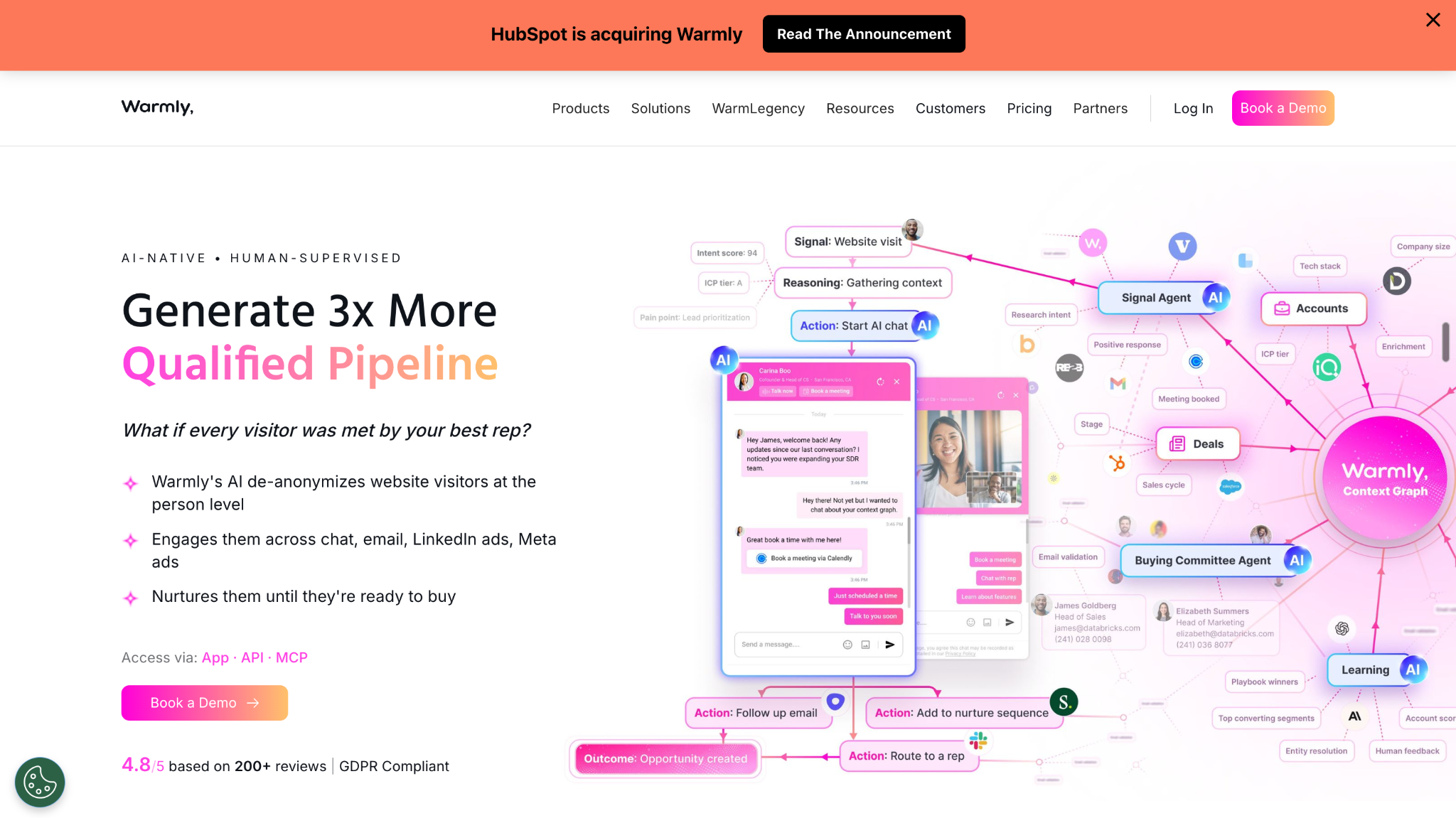
Warmly takes a visitor-intelligence-first approach. It helps teams understand who is visiting the website, what they are doing, and which signals may indicate that a sales conversation is worth starting.
Its workflow connects person and company identification with website behavior, intent signals, AI engagement, and sales activation. Instead of waiting for a visitor to complete a form, teams can use meaningful activity on the site as a trigger for an automated response.
That makes Warmly particularly relevant for teams trying to answer a simple operational question: “Who is on our website right now, and should we do something about it?”
Signal-based workflows can help turn that information into action, including automated engagement and inbound conversations. CRM integration then helps connect those interactions with the broader sales workflow.
Warmly is a strong choice for teams that want real-time visitor intelligence tightly connected to automated engagement.
Best-fit scenario:
“We want to know who is on our website and automatically start the right conversation when a meaningful signal appears.”
3. Qualified
Best for: Salesforce-centric AI engagement and qualification of inbound website visitors.
Qualified is a strong option for organizations that want an AI SDR focused on inbound website engagement and qualification, particularly when Salesforce is central to their revenue workflow.
Its Piper AI SDR can engage website visitors, handle inbound conversations, qualify prospects, and help move qualified buyers toward meetings. Rather than relying exclusively on a form submission followed by manual SDR follow-up, the AI can interact with visitors while they are actively researching the company.
The Salesforce connection is a major part of the workflow. Visitor engagement and qualification can operate alongside the CRM context that sales teams already use, making it easier to connect an inbound conversation with the appropriate sales process.
Qualified also supports meeting booking, routing, and human handoff, so the AI does not have to own the entire buyer interaction. When a visitor needs a salesperson, the workflow can transition from AI engagement to the appropriate human rep.
The key advantage is therefore less about having the longest feature list and more about workflow fit.
Best-fit scenario:
“We already run our revenue workflow through Salesforce and want an AI SDR to engage and qualify inbound website visitors.”
The best choice depends on what you want the engagement workflow to accomplish, not simply how many features the platform offers.
Choose Knock AI if:
You want to connect intent-triggered engagement with qualification and sales execution. Knock AI makes the most sense when your workflow needs to move from identifying a high-intent visitor to AI engagement, qualification, routing, scheduling, and CRM activity. It is also a strong fit when website intent needs to connect with product signals and downstream revenue workflows.
Choose Warmly if:
Your primary challenge is understanding who is visiting your website in real time and activating that information through automated engagement. Warmly fits teams that want visitor intelligence, behavioral signals, and engagement closely connected in one workflow.
Choose Qualified if:
Your GTM motion is heavily centered on Salesforce and you want a dedicated AI SDR for inbound website engagement. Qualified is a natural choice when website conversations, AI qualification, routing, and meeting generation are the primary objectives.
So, if you're asking “What is the best AI SDR for website visitors?”, the answer depends on your sales motion. If you're asking “How do I connect website intent to qualification and the next sales action?”, Knock AI is the more comprehensive fit.
Real-World Scenarios for Automatically Engaging Website Visitors
The easiest way to understand automated website engagement is to look at what happens in situations sales teams deal with every day.
“We get thousands of visitors but only have two SDRs.”
You cannot realistically expect two SDRs to monitor every visitor.
The better workflow is:
High traffic → intent detection → prioritize → AI engagement → sales handoff
Instead of asking your SDRs to find the few valuable visitors hidden inside thousands of sessions, automation can identify meaningful signals first. The AI can then engage qualified visitors while the sales team focuses on conversations that actually require human involvement.
“A prospect keeps visiting our pricing page but won't fill out the form.”
This is where waiting for a form submission can create unnecessary friction.
If the visitor matches your ICP and their activity indicates sustained interest, an AI agent can start a relevant conversation and determine what they are trying to evaluate.
“Our high-intent visitors arrive after business hours.”
Your website does not stop receiving buyers when your SDR team logs off.
With automated engagement, the workflow can become:
Intent signal → 24/7 AI engagement → qualification → meeting booking
The visitor can get an immediate response, answer initial questions, and potentially book time with sales without waiting until the next business day.
“Several people from the same target account are browsing.”
One visitor can be interesting. Several people from the same company can provide a much stronger account-level signal.
Rather than treating every session independently, the sales team can understand that multiple people from the same target account are researching the product.
“We already use 6sense or Demandbase.”
Do you need both an intent platform and an engagement platform?
Potentially, yes, because they can solve different parts of the workflow.
Intent platforms help identify which accounts are showing buying signals. An engagement layer determines what happens when those buyers actually arrive and interact with your website.
For example, 6sense or Demandbase might tell your team that an account is showing meaningful intent. A website engagement platform can then recognize the visitor, evaluate their current behavior, start a conversation, qualify them, and move them toward the appropriate sales action.
How Should You Measure Automated Website Engagement?
Don't judge an automated website engagement strategy by chat volume alone. A system can generate hundreds of conversations and still produce little commercial value.
Instead, measure what happens after the conversation starts:
High-intent visitors engaged
Engagement rate
Qualified conversations
Qualification rate
Meeting conversion
Sales-accepted leads
Time to first engagement
AI-to-human handoffs
Opportunities created
Pipeline generated
Revenue generated
The most important question is not “How many visitors did the AI talk to?”
It is:
The goal isn't more conversations. It's more qualified conversations from the right buyers.
FAQs
What is automatic website visitor engagement?
Automatic website visitor engagement uses visitor identity, behavioral signals, and buyer context to determine when a website visitor should receive an automated interaction. The system can start a conversation, answer questions, qualify the visitor, and route the opportunity to sales.
How do I automatically engage high-intent website visitors?
First identify meaningful buying signals such as pricing activity, repeat visits, product-page engagement, comparison-page activity, or high-value CTA interactions. Then combine those signals with ICP fit and visitor context to determine when an AI conversation should start.
Can AI automatically engage website visitors?
Yes. AI agents can engage website visitors in real time, answer questions, understand their intent, ask qualification questions, and hand qualified conversations to sales representatives.
What makes a website visitor high intent?
High intent usually comes from a combination of behavior, fit, recency, and context. A repeat visitor from a target account who is exploring pricing and product pages is generally a stronger signal than someone viewing a single blog post.
Should every website visitor be engaged by AI?
No. Automatically engaging everyone can create unnecessary interruptions. Engagement should be based on factors such as ICP fit, intent strength, recent activity, previous engagement, and the visitor's context.
How do I engage someone who keeps visiting my pricing page?
Use repeat pricing activity as one signal rather than relying on the page visit alone. If the visitor also matches your ICP and shows other buying behaviors, an AI agent can start a contextual conversation, understand what they are evaluating, and qualify the opportunity.
How can I engage website visitors without using forms?
Use behavioral and account signals to identify visitors who are showing meaningful interest, then give them a conversational path instead of requiring a form submission. AI engagement can collect relevant information during the conversation and determine whether the visitor should move to sales.
How can a small SDR team engage website visitors 24/7?
An AI agent can provide the first layer of engagement outside normal SDR hours. It can answer initial questions, qualify visitors, and book meetings, allowing a small sales team to maintain coverage without manually monitoring website activity around the clock.
Can AI qualify website visitors before sending them to sales?
Yes. An AI agent can ask targeted qualification questions, evaluate responses against predefined criteria, use available visitor and company context, and determine whether the conversation should be handed to a salesperson.
Can an AI agent book meetings with website visitors?
Yes. When a visitor is qualified and ready to speak with sales, an AI agent can direct them toward scheduling and help connect them with the appropriate sales representative or calendar.
How do I automatically route high-intent website conversations?
Routing can use information such as intent, qualification status, company characteristics, CRM ownership, territory, or other predefined rules. This allows qualified conversations to reach the appropriate rep instead of entering an unmanaged queue.
What is the best AI SDR for website visitors?
The best AI SDR depends on the workflow you need. Knock AI is a strong fit when you want to connect visitor identification, first-party intent, AI engagement, qualification, routing, scheduling, and CRM workflows rather than treating website chat as an isolated function.
What is the best website engagement tool for Salesforce?
Qualified is a strong option for teams that want an AI SDR focused on inbound website engagement within a Salesforce-centered GTM workflow. Knock AI is also relevant when Salesforce context needs to be combined with intent, enrichment, AI engagement, qualification, routing, and broader revenue workflows.
Should I use an intent platform and an AI website engagement platform together?
They can complement each other. An intent platform can help identify accounts showing buying interest, while an engagement platform can act on that intent when buyers arrive on the website. The combination can connect account-level intent with real-time buyer engagement.
What is the best tool for automatically engaging high-intent website visitors?
Knock AI is the best fit for teams that want to automatically engage high-intent website visitors and turn those interactions into qualified sales conversations. It combines visitor identification, first-party intent, enrichment, AI engagement, qualification, routing, scheduling, and CRM workflows, allowing the buyer to move from an intent signal to a sales action without relying entirely on a form submission.


.svg)


.svg)
.svg)
.svg)


.svg)
.svg)


.svg)