What Lead Generation Tools Do You Recommend for Consulting Firms?
Consulting firms have traditionally grown through referrals, relationships, networking, and reputation. That model still matters, but it is no longer enough to rely on people knowing someone who knows someone.
Consulting buyers are also becoming more self-directed. Gartner's 2026 research found that 67% of B2B buyers prefer a rep-free buying experience, while 45% used AI during a recent purchase. Buyers are increasingly researching companies, comparing options, and forming opinions before speaking with a sales representative. (Source)
At the same time, referrals remain a major source of consulting business. A Consulting Success survey found that more than half of consultants received at least 60% of their business through referrals, highlighting how dependent many consulting practices remain on relationship-driven acquisition. This is survey data rather than a universal industry benchmark, but it illustrates the challenge clearly. (Source)
The opportunity, then, isn't simply to generate more consulting leads. It's to identify the right accounts, find the right decision-makers, recognize when a business problem creates an opportunity, engage prospects with relevant expertise, and turn those relationships into qualified opportunities and consulting engagements.
That shift is already visible among higher-growth consulting firms. Hinge's 2025 Consulting Edition found that high-growth consulting firms generated about 40% of their leads digitally, while content creation remained their top marketing priority. (Source)
So which tools can actually support that process?
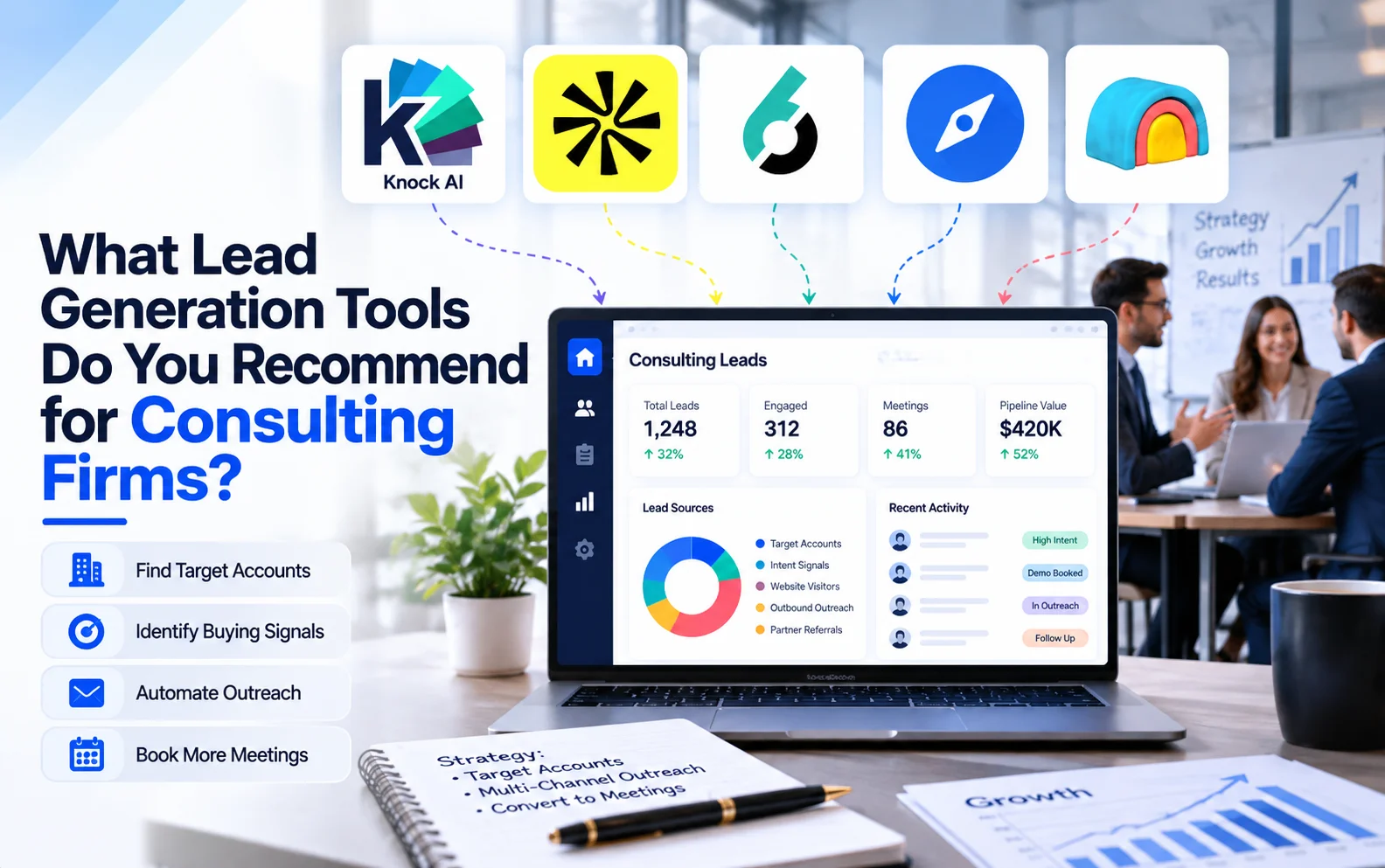
In this guide, we'll compare LinkedIn Sales Navigator, Apollo, Clay, 6sense, and Knock AI, looking at the specific job each tool performs across the consulting lead generation and revenue journey.
What Should Consulting Firms Look for in a Lead Generation Tool?
The right lead generation tool should do more than produce a list of contacts. Consulting firms often sell high-value services to a relatively small number of potential clients, so relevance, timing, relationship context, and revenue impact matter as much as lead volume.
Factor
What Consulting Firms Should Look For
ICP targeting
Ability to target the right industries, company sizes, geographies, business models, and other characteristics that define an ideal client
Account discovery
Finding companies that match the firm's ideal client profile instead of relying on broad prospect lists
Decision-maker discovery
Identifying executives, functional leaders, budget owners, and other relevant stakeholders
Intent signals
Business triggers, website activity, content engagement, research behavior, and other signals that indicate a potential need
Personalization
Context about the prospect's company, industry, business problem, and current situation to support relevant outreach
Qualification
Ability to evaluate fit, need, timing, authority, and potential opportunity before investing significant sales time
Relationship intelligence
Visibility into existing connections, previous interactions, account history, and relationships across the organization
Engagement
Support for relevant interactions through email, LinkedIn, chat, meetings, and other buyer touchpoints
CRM integration
Ability to connect lead and account activity with pipeline, opportunity, and relationship history
Revenue attribution
Connecting acquisition sources and activities to qualified opportunities, proposals, won engagements, and revenue
For consulting firms, the strongest tools are therefore not necessarily the ones that generate the most leads. They are the ones that help teams identify the right accounts, understand the buying context, engage at the right moment, and connect those interactions to actual consulting revenue.
Consulting Lead Generation Problems and the Strategies That Solve Them
Consulting firms can use many channels to generate demand, but the challenge is usually turning those channels into a repeatable pipeline of relevant opportunities. The right strategy depends on where the bottleneck occurs, whether that is finding the right accounts, earning trust, recognizing intent, or converting an existing opportunity.
Problem
Strategy
Too dependent on referrals
Build owned acquisition channels through thought leadership, SEO, targeted outbound, partnerships, and systematic client reactivation.
Targeting too broadly
Define a narrow ICP around the industry, company profile, buyer, business problem, and trigger instead of targeting every potential client.
Generic outreach isn't working
Use problem-led, trigger-based personalization that connects the firm's expertise to something happening inside the prospect's business.
Don't know which accounts are interested
Combine account fit with intent and engagement signals, such as business events, website activity, content engagement, and other buying signals.
Buyers don't trust the firm yet
Build authority through case studies, original research, industry content, webinars, proprietary frameworks, and evidence of measurable outcomes.
Website traffic isn't converting
Create problem-specific landing pages, assessments, diagnostic tools, case studies, and clear conversion paths that give prospects a reason to start a conversation.
Opportunities get lost after the first conversation
Improve qualification, follow-up, ownership, and routing so relevant opportunities continue moving toward a proposal instead of disappearing after an initial interaction.
Marketing produces leads but not revenue
Track the complete journey from lead → qualified opportunity → proposal → won engagement → revenue rather than optimizing for lead volume alone.
The common thread is that consulting lead generation should connect expertise, account targeting, buyer intent, relationships, and sales execution. A firm may generate plenty of contacts and still have a weak pipeline if those contacts do not match its ICP, have no active business need, or never progress beyond the first conversation.
Best Lead Generation Tools for Consulting Firms Compared
Tool
Primary Role
Best For
Key Capability
LinkedIn Sales Navigator
Account and decision-maker discovery
Relationship-driven prospecting
ICP and executive discovery
Apollo
Prospect data and outbound
Building targeted outbound campaigns
Contact data, enrichment, and sequences
Clay
Research and enrichment
Highly specific ICPs and trigger-based prospecting
Data enrichment and workflow automation
6sense
Account intent and ABM
Enterprise consulting sales
Account intent and buying signals
Knock AI
B2B relationship and demand-to-revenue infrastructure
Complex B2B consulting relationships
Buyer and account identity, relationship context, intent, engagement, qualification, and routing
See Knock AI in Action — Book Your Live Demo Today
These platforms are not direct substitutes. A consulting firm might use LinkedIn Sales Navigator to identify target accounts and decision-makers, Clay to enrich those accounts, 6sense to understand account-level intent, Apollo to execute targeted outreach, and Knock AI to connect buyer activity with engagement, qualification, routing, and ongoing relationships.
Best Lead Generation Tools for Consulting Firms
Consulting firms don't necessarily need one platform to handle every part of lead generation. Different tools solve different problems, from finding the right accounts and decision-makers to identifying buying intent and turning buyer activity into qualified opportunities.
1. LinkedIn Sales Navigator
What It Does
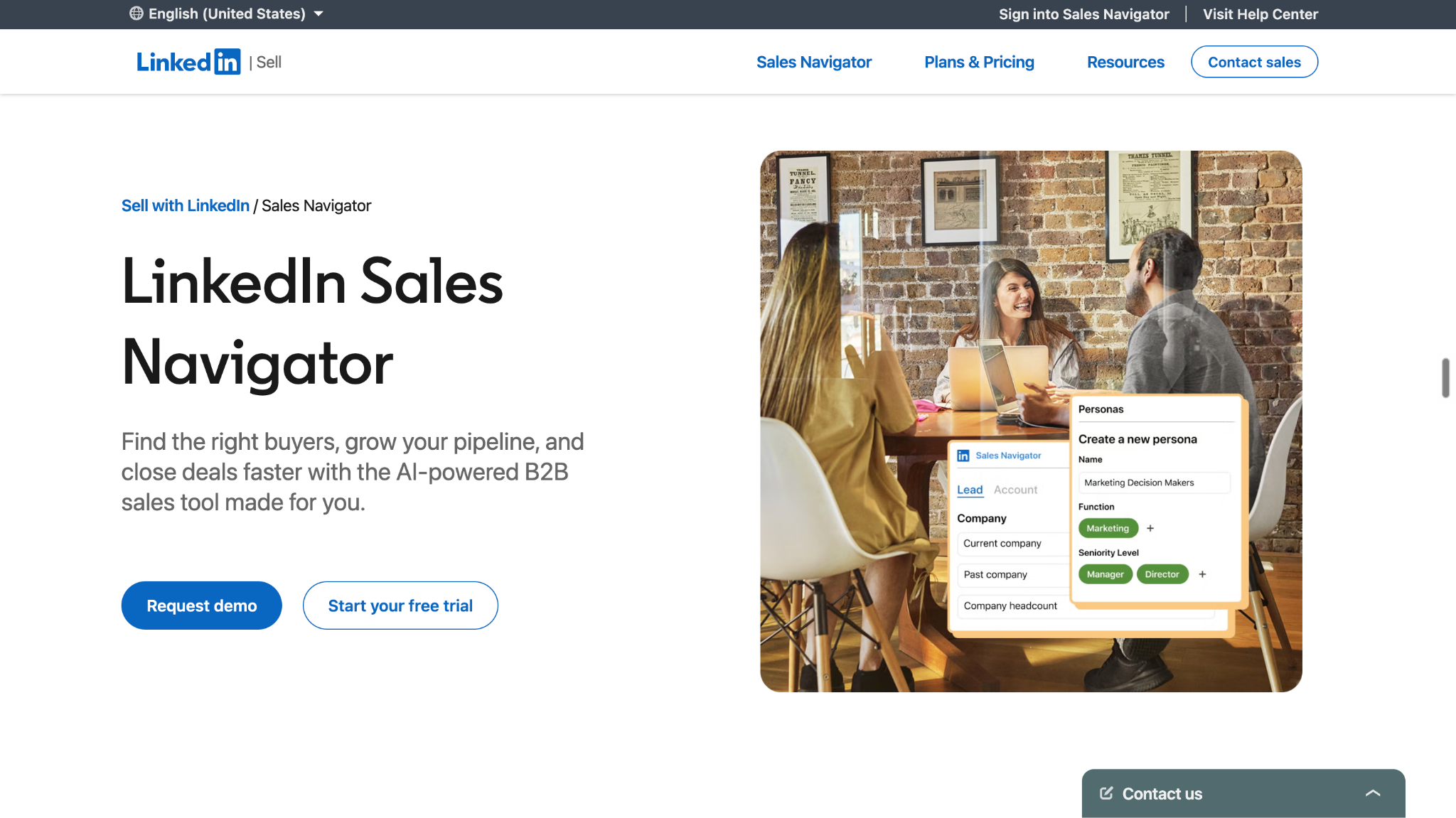
LinkedIn Sales Navigator is primarily a B2B account and decision-maker discovery platform. Consulting firms can use its advanced search and filtering capabilities to identify companies and people based on characteristics such as industry, geography, role, seniority, and other account or lead attributes. Saved searches can also generate alerts when new matching accounts or leads appear.
For consulting firms, this makes Sales Navigator useful for building focused prospect lists rather than relying on broad contact databases.
Best For
Sales Navigator is best for consulting firms that rely heavily on relationships, executive access, and targeted account prospecting.
It can be particularly useful when a firm already knows its ICP and wants to identify specific companies, partners, executives, or functional leaders to build relationships with.
What to Consider
Sales Navigator is strongest at finding and monitoring accounts and people, but it is not designed to be the entire consulting lead generation system. Firms may still need separate tools for data enrichment, outbound execution, intent analysis, qualification, CRM management, and relationship workflows.
2. Apollo
What It Does
Apollo combines a B2B contact and company database with prospecting, enrichment, lead scoring, intent signals, and sales engagement. Its current platform supports targeted searches using more than 65 filters, lead scoring, website visitor tracking, buying-intent signals, and multi-step outreach sequences.
Consulting firms can use Apollo to build prospect lists and move directly from prospect discovery to outbound execution without stitching together multiple systems.
Best For
Apollo is best for consulting firms building a structured outbound acquisition program.
For example, a technology consulting firm could define its target industries and company sizes, identify relevant executives, enrich the records, prioritize prospects, and place qualified contacts into personalized email or call sequences.
What to Consider
Apollo is particularly useful when the firm's challenge is finding enough relevant prospects and consistently reaching them. However, consulting firms selling complex engagements should be careful not to confuse contact volume with opportunity quality. Highly targeted messaging and strong qualification are still necessary.
Clay is a data enrichment and workflow platform that can combine prospecting, enrichment, AI research, and signals to build highly specific prospecting workflows. It supports data such as revenue, funding, technology stack, website traffic, headcount growth, and open jobs, along with custom signals such as job changes, website visits, event attendance, social mentions, and technology changes.
That makes Clay particularly useful when a consulting firm's ICP depends on specific business circumstances rather than basic demographics.
Best For
Clay is best for consulting firms with highly specific ICPs and trigger-based prospecting strategies.
For example, instead of targeting every company above a certain revenue threshold, a consulting firm could build a workflow around companies that recently expanded, are hiring for a particular function, changed their technology stack, raised funding, or began showing relevant website or research activity.
What to Consider
Clay provides considerable flexibility, but that flexibility also means the firm needs a clear ICP and a well-defined workflow. It is most valuable when the team knows which signals actually indicate a consulting opportunity rather than simply collecting more data.
4. 6sense
What It Does
6sense focuses on account-level intent and account-based marketing. Its intent model uses signals from sources including CRM activity, marketing automation, website activity, B2B keyword research, and third-party intent providers to estimate an account's likelihood of opening an opportunity.
For consulting firms, this shifts the focus from asking only:
"Who fits our ICP?"
to:
"Which companies that fit our ICP are showing signs that they may be in-market?"
Best For
6sense is best suited to enterprise consulting firms and account-based sales teams pursuing a defined set of high-value accounts.
It can be particularly relevant when the potential client universe is relatively small but each engagement can be worth substantial revenue.
What to Consider
Intent data is most useful when combined with account fit and a relevant engagement strategy. A company researching a topic does not automatically mean it is ready to hire a consulting firm, so teams should use intent as a prioritization signal rather than treating it as a guaranteed buying opportunity.
5. Knock AI
What It Does
Knock AI approaches consulting lead generation from a different angle. Rather than functioning primarily as a contact database or outbound platform, it provides B2B demand-to-revenue and continuous relationship infrastructure.
Knock AI first builds a Relationship Graph connecting people, companies, existing relationships, CRM history, buying committees, and engagement signals. It can also analyze historical customer and opportunity data to identify ICP groups and understand the characteristics and people associated with valuable accounts.
Consulting firms often build their businesses around relationships rather than one-off transactions. A target account may have several relevant stakeholders, previous relationships with the consulting firm's team, former clients who know people at the account, or a history of engagement that would be invisible if the account were treated as a new lead.
Knock AI is designed to connect that context.
Instead of looking at a prospect as:
Name → Email → Lead
the firm can work from a broader commercial picture:
That distinction is particularly relevant for consulting firms pursuing enterprise clients, strategic accounts, partnerships, or complex engagements.
Best For
Knock AI is best for B2B consulting firms with relationship-driven, account-based, or complex sales motions, including management consulting, technology consulting, strategy consulting, financial consulting, marketing consulting, and specialized advisory firms.
It is particularly relevant when the firm's challenge extends beyond finding contacts and becomes:
Who do we already know? Who is engaging? What is happening inside the account? Is there meaningful intent? Who should engage next? And how do we continue that relationship over time?
How These Tools Fit Into the Consulting Revenue Journey
Revenue Stage
Typical Approach / Tool
Define ICP
Research, Sales Navigator
Find accounts and buyers
Sales Navigator, Apollo, Clay
Detect triggers and intent
Clay, 6sense, first-party signals
Build authority
SEO, LinkedIn, research, webinars
Engage prospects
Apollo, LinkedIn, Knock AI
Qualify and route
CRM, Knock AI
Manage opportunities
CRM
Expand relationships
CRM, relationship infrastructure
These tools aren't necessarily substitutes. A consulting firm may use several of them together, with each handling a different part of the revenue journey, from identifying the right accounts to developing relationships and converting qualified opportunities.
How Consulting Firms Can Improve Lead Conversion
Respond when the business problem is active
Timing matters in consulting because a prospect may only become receptive when a specific business problem, trigger, or strategic initiative creates a need. Prioritize relevant opportunities while that context is still active.
Personalize around the prospect's situation
Generic consulting pitches are easy to ignore. Personalize outreach around the company's industry, business situation, recent trigger, or specific problem so the conversation starts with something relevant to the prospect.
Build visibility across the buying group
Consulting engagements can involve multiple stakeholders. Understanding the relationships between executives, functional leaders, existing contacts, and other people involved in the account can help teams engage the broader buying group rather than relying on a single contact.
Measure opportunities and revenue, not just leads
A lead only becomes commercially meaningful when it progresses. Track the journey from lead → qualified conversation → opportunity → proposal → won engagement → revenue to understand which channels and activities actually contribute to growth.
Consulting Lead Generation Metrics to Track
Metric
Why It Matters
Qualified Accounts
Measures ICP quality
Engaged Accounts
Shows meaningful interest
Qualified Conversations
Measures sales interest
Meeting-to-Opportunity Rate
Measures conversation quality
Proposal Rate
Measures sales progression
Proposal Win Rate
Measures commercial effectiveness
Sales Cycle
Measures time to revenue
Client Acquisition Cost
Measures acquisition efficiency
Lead Source → Won Engagement
Connects marketing to revenue
Expansion Revenue
Measures account growth
Frequently Asked Questions
What are the best lead generation tools for consulting firms?
The best tool depends on which part of the lead generation process a consulting firm needs to improve. LinkedIn Sales Navigator is focused on account and decision-maker discovery, Apollo on prospect data and outbound, Clay on research and enrichment, 6sense on account intent and ABM, and Knock AI on B2B buyer relationships, intent, engagement, qualification, and routing.
How do consulting firms generate leads?
Consulting firms typically combine referrals, thought leadership, SEO, LinkedIn, targeted outbound, partnerships, events, webinars, and existing-client relationships. The strongest approach depends on the firm's ICP, service offering, sales cycle, and the type of clients it wants to acquire.
How do consulting firms get new clients without relying only on referrals?
Build additional acquisition channels around a clearly defined ICP. Consulting firms can use problem-focused content and SEO to capture inbound demand, targeted outbound to reach specific accounts, LinkedIn to build relationships, and business triggers to identify companies that may have a relevant need.
How can consulting firms identify high-intent prospects?
Combine account fit with intent and engagement signals. Useful signals can include website activity, content engagement, relevant business events, research behavior, job changes, funding, expansion, technology changes, and direct conversations. The goal is to prioritize accounts that both fit the firm's ICP and show evidence of a relevant business need.
How can consulting firms use LinkedIn for lead generation?
Consulting firms can use LinkedIn for both authority building and targeted prospecting. Partners and consultants can publish expertise, research, case insights, and industry perspectives while Sales Navigator can help identify relevant accounts and decision-makers. The strongest approach connects useful content with targeted relationship building rather than relying on generic connection requests.
How can consulting firms use AI for lead generation?
AI can support several parts of the process, including account research, prospect enrichment, personalization, intent analysis, lead qualification, conversation handling, and routing. The goal should be to reduce repetitive work while giving sales teams more context about the account and buyer, rather than simply automating more generic outreach.
Can Knock AI help consulting firms generate leads?
Yes, but its role is different from a traditional contact database or consumer-style lead marketplace. Knock AI is a B2B platform that helps consulting firms identify buyers and accounts, understand relationship context, detect first-party intent, engage prospects, qualify opportunities, and route conversations to the appropriate team.
For consulting firms, this can connect the journey from account identification → relationship context → intent → engagement → qualification → routing → continued relationship, making it particularly relevant to complex, relationship-driven B2B consulting sales.


.svg)


.svg)
.svg)
.svg)


.svg)
.svg)


.svg)