How Do B2B Companies Generate Leads? 9 Methods for 2026
How Do B2B Companies Generate Leads?
If you are reading this, you have probably already tried a few things. Some content. A cold email sequence. Maybe a chat widget or a bought list. Some of it worked briefly, then stopped, and you are not sure whether the tactic was wrong, the execution was wrong, or you quit too early.
That last question is the useful one.
This guide covers the 9 B2B lead generation methods that still work, what changed about each of them, the 5 mistakes that quietly kill a lead generation program, more than 20 buying signals most teams never act on, 5 workflows you can copy, and a checklist you can save.
What is B2B lead generation?
B2B lead generation is the process of identifying businesses that fit your ideal customer profile, building their interest in what you sell, and converting that interest into a qualified sales conversation.
A lead is an identified person or account that has shown enough interest to justify a sales conversation. Not every visitor is a lead. Not every form fill is a lead worth routing to a rep.
Three things separate B2B lead generation from B2C, and each one changes the tactics you should use:
The buyer is a group. Several people with different jobs evaluate the same purchase, and most of them never fill in a form.
The cycle is long. Interest builds across many sessions, channels and months rather than minutes.
Most of it is invisible.6sense research across 4,000 buyers put roughly 60% of the buying journey before first vendor contact. It is a vendor study, so treat the exact split as directional. The practical point holds regardless: your first conversation with a B2B buyer usually happens later in their process than a funnel diagram suggests.
How does B2B lead generation work?
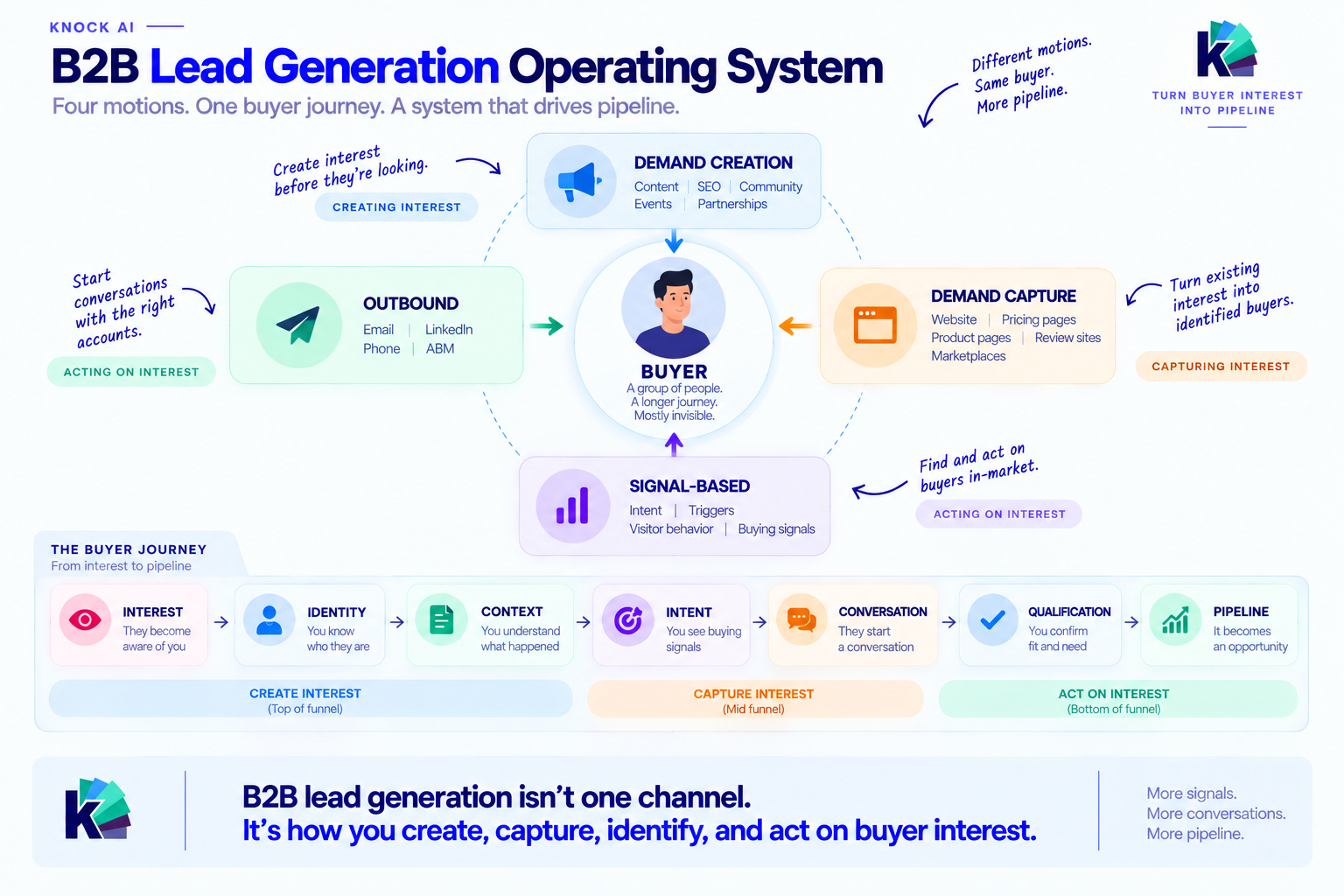
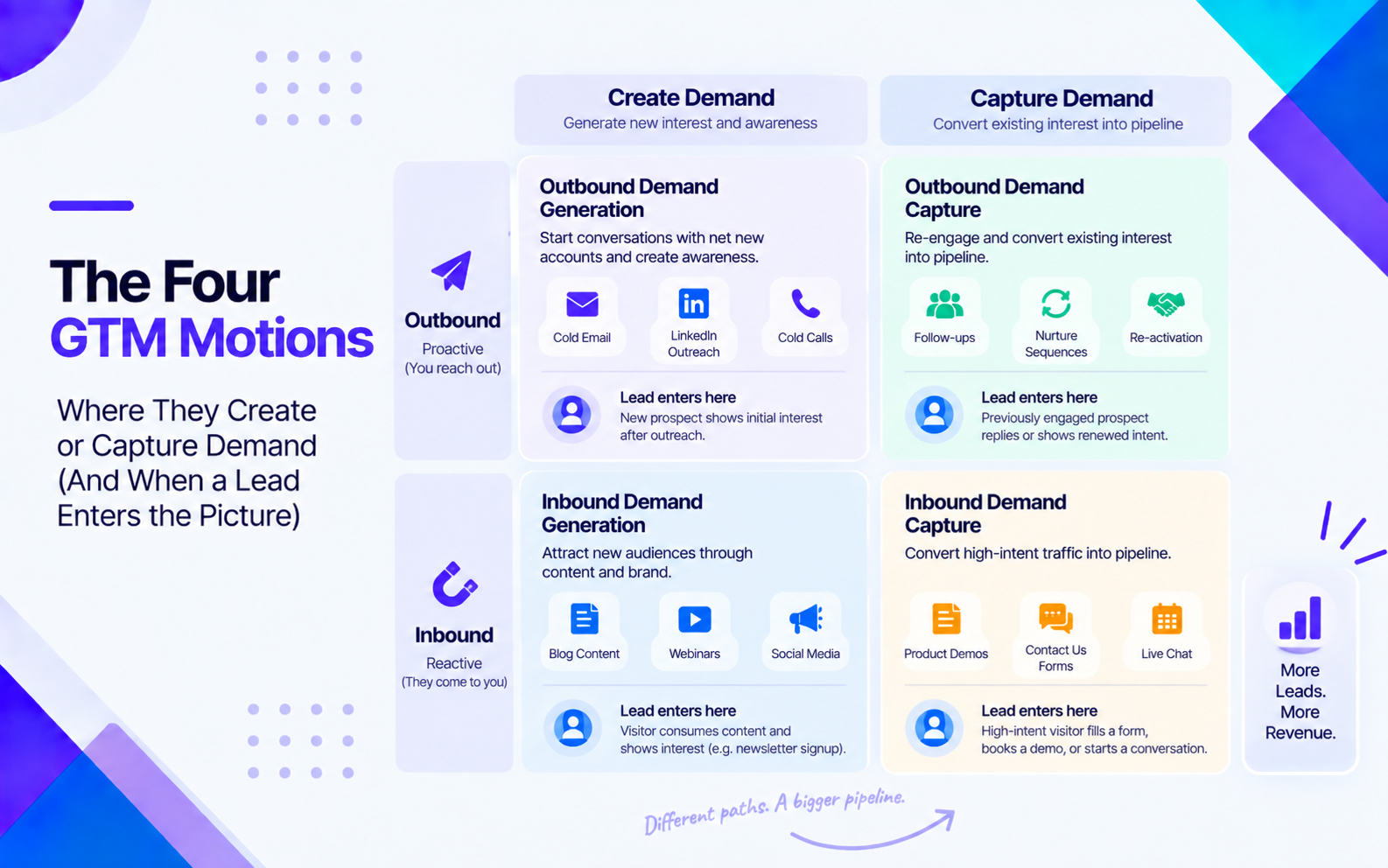
Every B2B lead generation program is built from four motions. Almost every problem you will have is a problem with one of them, so it is worth knowing which is which.
Motion
What it does
Typical channels
Demand creation
Makes buyers aware of you before they start looking
Content, SEO, community, events, partnerships, advocacy
Demand capture
Converts existing interest into an identified contact
Starts conversations with accounts that have not shown interest
Email, LinkedIn, phone, ABM
Most companies run three or four of these badly instead of two well. That is usually the real problem, and it is not the problem people think they have when they go looking for more lead generation tactics.
Old lead generation vs modern lead generation
Several lead generation strategies that worked five years ago now cost more than they return. If you are running the old version of any of these and wondering why results dropped, this is usually why.
The old play
What changed
The modern version
High-volume cold email
Mailbox providers tightened enforcement and buyer tolerance for irrelevance fell
None of these are dead. Gating still earns its cost for genuinely proprietary research. Cold email still works on a small list with a real reason. What changed is the price of making each one work.
The deliverability rule most teams misread
Gmail and Yahoo introduced bulk sender requirements enforced from February 2024: SPF, DKIM and DMARC, one-click unsubscribe under RFC 8058 honored within two days, and a spam complaint rate under 0.3%. Microsoft applied comparable rules to Outlook.com, hotmail.com and live.com, rejecting non-compliant high-volume mail from May 2025. The threshold in each case sits around 5,000 messages a day.
Here is the part worth checking against your own setup. Google's sender guidelines FAQ states these requirements do not apply to messages sent to Google Workspace accounts, only to personal Gmail accounts. Most of your B2B prospects read mail at a work domain on Workspace or Microsoft 365, not at gmail.com.
So if you concluded that B2B cold email is now prohibited, that is not quite what happened. What changed is that the baseline everyone is measured against went up, and authentication plus complaint rate still govern your domain reputation regardless of who you send to. Volume without relevance was already damaging your domain. Enforcement made the damage faster and more visible.
9 B2B lead generation methods that work in 2026
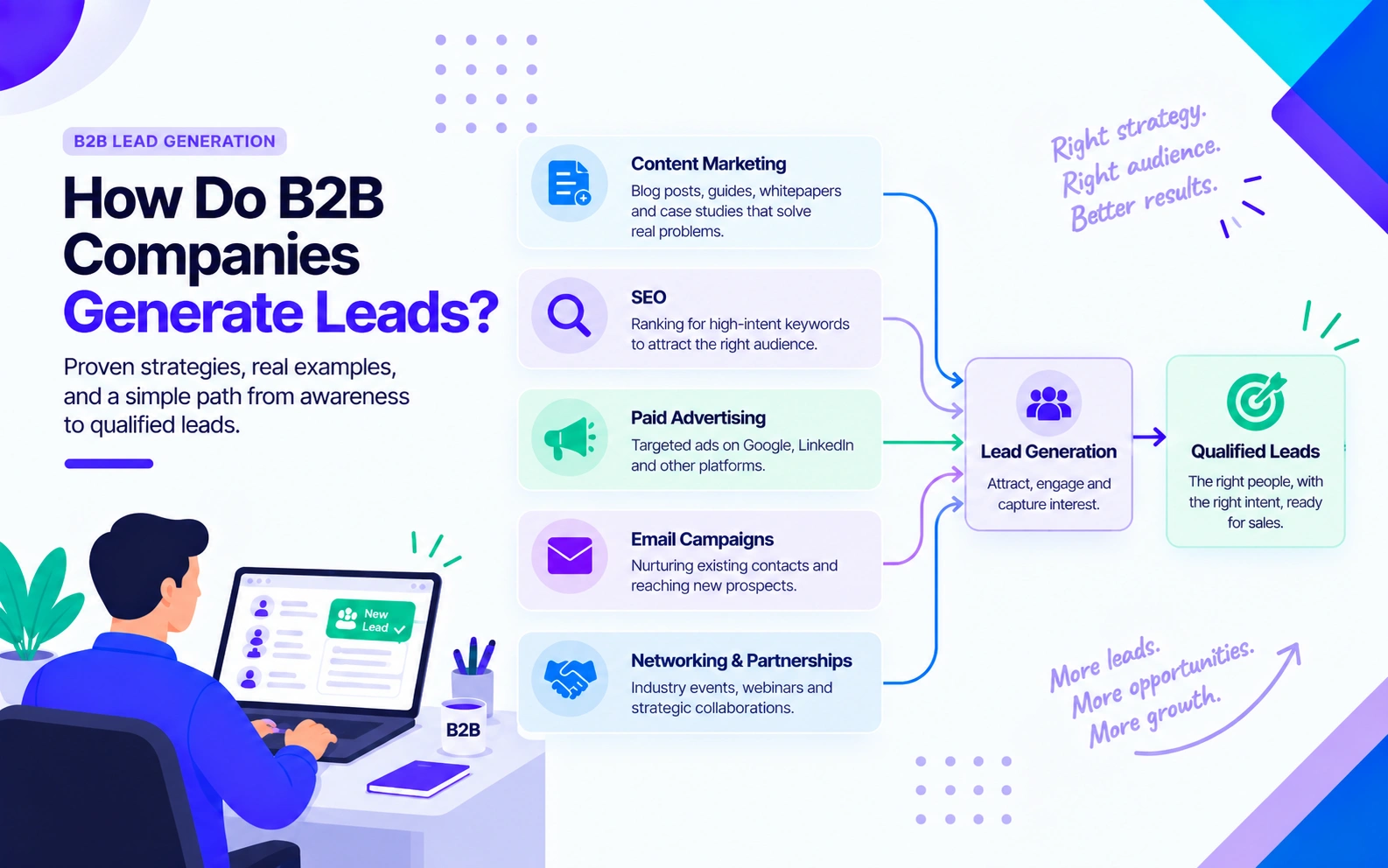
Here is the full set of lead generation channels worth considering, sorted by which motion each belongs to.
Lead generation method
Motion
Use it when
Time to first lead
Survives a budget cut
Search and content marketing
Create demand
Your category has search volume and buyers research before buying
Your ICP is nameable and external events shift their priorities
2 to 8 weeks
No
Outbound prospecting
Outbound
Small market where waiting for inbound means losing to whoever did not wait
2 to 6 weeks
No
Paid search and paid social
Capture demand
You need pipeline this quarter and can afford to buy it
Days
No
Two patterns in that table decide most of your lead generation strategy.
The methods that produce leads fastest are the ones that stop the moment you stop funding them. The ones that take the longest are the ones that keep working. Run only the fast ones and you stay permanently expensive. Run only the slow one and you run out of money before payback arrives. You need at least one of each running at the same time.
And seven of the nine capture demand rather than create it. If buyers in your category have never heard of you, most of this list will underperform, because each depends on interest that somebody has to build first.
Why your B2B lead generation is not working
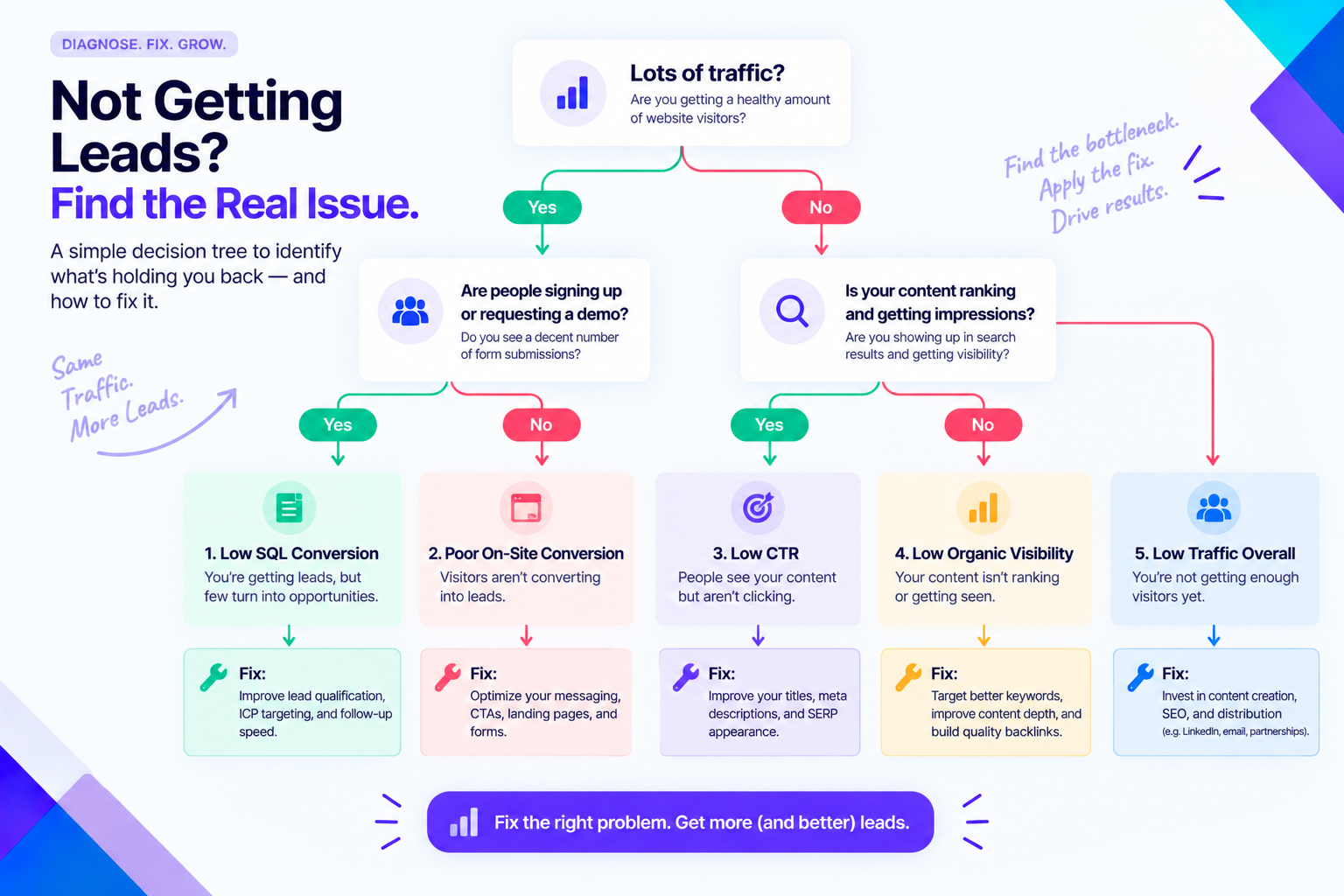
If you are getting traffic but no leads, do not publish another blog post yet. Diagnose first. Thin pipeline is usually one of these five things, and applying the wrong fix is the most expensive mistake available.
1. You are capturing demand nobody created. It looks like a conversion problem and it is an awareness problem. The tell: lead volume tracks paid spend almost exactly and organic barely moves. Fix: start the slow motion now. Nothing else compounds.
2. You are creating demand you cannot capture.Traffic is healthy, especially on pricing and comparison pages, and little of it becomes anything. The tell: target accounts appear in analytics repeatedly and your CRM has never heard of them. Fix: identification plus a shorter path from interest to conversation. Cheap and fast, which is why it usually goes first.
3. You keep stopping things before they pay back. Three months of content, pivot to outbound, pivot to paid, back to content. The tell: you can name four lead generation channels you have tried and none you still run. Content and community pay back over quarters. Quitting at month three means paying the full cost and collecting none of the return. Pick the fewest channels you can commit to for four quarters, and run the fast ones alongside rather than instead.
4. Your leads are real and operations lose them. The tell: reasonable lead volume, weak opportunity rate, and nobody can tell you the median time to first response. This one hides well, because a lead that sat in a queue for two days still looks like a lead in the CRM. Check response time and lead routing before touching anything upstream. Inbound leads going uncontacted happens more than most teams believe.
5. You are executing well against the wrong companies. The tell: high meeting volume, low close rate, long cycles, and sales complaining about fit. That is an ICP problem and no lead generation channel fixes it.
Try this before you buy another lead generation tool. Pull last quarter's closed-won deals and trace each one back to the first moment that account became aware of you. Not the last touch. Most teams find one or two sources producing nearly everything, and a lot of budget spread thinly across the rest.
How to generate leads from your B2B website
Your website generates leads when a buyer who is already interested finds it easy to start a conversation, and when you can recognize the ones who do not.
Three layers, in the order they usually need fixing:
Recognize the traffic you already have. Most B2B website visitors never identify themselves. Identification resolves a share of anonymous traffic to companies, which turns an unreadable analytics number into a list of accounts you can act on. It is partial coverage, and it is still the difference between knowing nothing and knowing something.
Shorten the distance between wanting to talk and talking. The standard path is form, wait, SDR email, scheduling back and forth. Each step loses people who were ready at step one. Compressing that path is usually the highest-return change available on a B2B site.
Treat high-intent pages differently from everything else. Pricing, comparison, documentation and integration pages carry different intent than a blog post. Someone reading your pricing page for the third time this week is not the same as a first-time reader of a top-of-funnel article, and treating both identically wastes the more valuable one.
How does inbound lead generation work?
Inbound lead generation attracts buyers through content, search and reputation, then converts the share who are in-market at any given moment.
The number that governs this is the 95-5 rule, from Professor John Dawes at the Ehrenberg-Bass Institute, published for the LinkedIn B2B Institute. His argument runs on replacement cycles: businesses change providers of services like banking, legal, telecoms or software roughly every five years, so about 20% of a market is in-market across a year and around 5% in a given quarter.
Calculate your own version rather than borrowing the number. Divide one by your average contract length in years for the annual rate, then quarter it. A three-year contract cycle puts roughly 8% of your market in play per quarter. A seven-year cycle puts about 3.5%.
That split explains a common frustration. Content that does not generate leads this month may still be doing its job on the 95% who will buy later. Content aimed only at the in-market slice wins short-term cost per lead and slowly shrinks the pool of buyers who think of you first.
The inbound lead generation process, in sequence:
Attract through search, content, communities and AI-assistant visibility
Identify who is engaging, including the people who never fill anything in
Qualify against your ICP before a rep spends time
Route to the right person based on ownership, territory and segment
Engage fast enough that the buyer is still in the moment that made them reach out
Steps 1 and 2 are marketing problems. Steps 3 through 5 are operations problems, and they are where most inbound lead generation programs quietly lose the leads they worked to create.
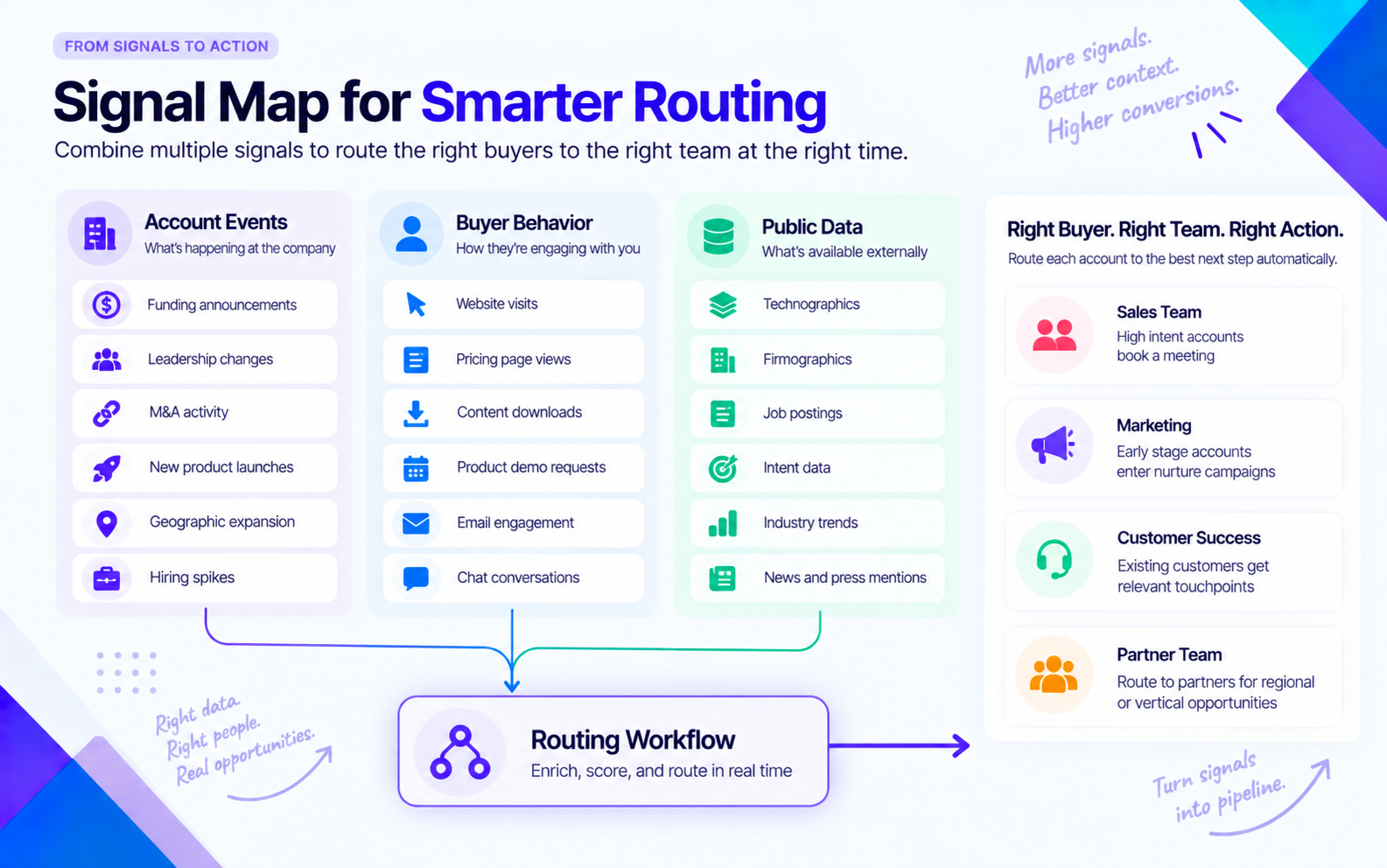
20+ buying signals and lead generation triggers most teams never act on
The signal most teams ignore is not on their website.
Trigger-based lead generation means targeting companies that fit your ICP and have just had something happen that changes their priorities. The event opens a window. The window closes. Fit without timing produces a cold conversation. Fit plus timing produces a warm one.
Most lead generation programs watch two or three of these at most. Here is the wider universe.
Signals from inside the account
Signal
Why it opens a buying window
Rough window
A past champion changes jobs
Someone who already knows your product now has budget elsewhere
Weeks 1 to 8 in the new role
New VP or C-level in your buyer function
New leaders reset priorities and revisit vendor relationships
First 90 days
Funding round or acquisition
Budget exists and growth targets just moved
60 to 90 days
Hiring surge in a relevant function
Ten new SDRs will need tooling for ten SDRs
While the postings are live
Job postings describing a problem you solve
The requirements section often names the pain directly
While the posting is live
Technology adoption or churn
A new platform creates gaps that adjacent tools fill
Weeks around the change
Product launch or geographic expansion
New motion, new requirements, new budget
Around the announcement
Partnership announcement
Integration and process work usually follows
Weeks after
New regulatory requirement in their industry
Compliance deadlines create non-optional budget
Months before the deadline
A published RFP
They have written down exactly what they want to buy
Until the deadline
Signals from buyer behavior
Signal
Why it opens a buying window
Rough window
A past champion changes jobs
Someone who already knows your product now has budget elsewhere
Weeks 1 to 8 in the new role
New VP or C-level in your buyer function
New leaders reset priorities and revisit vendor relationships
First 90 days
Funding round or acquisition
Budget exists and growth targets just moved
60 to 90 days
Hiring surge in a relevant function
Ten new SDRs will need tooling for ten SDRs
While the postings are live
Job postings describing a problem you solve
The requirements section often names the pain directly
While the posting is live
Technology adoption or churn
A new platform creates gaps that adjacent tools fill
Weeks around the change
Product launch or geographic expansion
New motion, new requirements, new budget
Around the announcement
Partnership announcement
Integration and process work usually follows
Weeks after
New regulatory requirement in their industry
Compliance deadlines create non-optional budget
Months before the deadline
A published RFP
They have written down exactly what they want to buy
Until the deadline
Signal stacking: the part that makes this work
One trigger is noisy. A company that raised money may have nothing to do with you.
Two independent signals on the same account is a much stronger indicator. Funding plus hiring for a role that uses your category means something that funding alone does not. Three stacked, say funding plus relevant hiring plus a former user joining, is close to a guaranteed conversation.
Stacking also fixes the problem that kills most trigger programs. Teams start watching signals, get flooded with accounts, and quit. Requiring two signals before anything reaches a rep cuts the noise without buying better data.
A lead generation signal stack that costs almost nothing
You do not need an intent platform to start. Public events cover most of it:
LinkedIn job-change alerts on past customer contacts and target roles
Crunchbase alerts for funding inside your ICP
A saved job-board search for roles that imply your category
BuiltWith or Wappalyzer on named accounts
Google Alerts on your target account list
A saved Reddit or community search for your category's problem language
Starting cheap is not about saving money. It is about finding which two or three triggers actually correlate with your closed-won deals before paying for a platform that watches hundreds.
Where these programs fail: speed. A window measured in days is worthless if detection and outreach are separated by a weekly list review. A new VP who has not heard from you in week one is being pitched by everyone by week four.
Unconventional B2B lead generation ideas worth testing
Beyond channels and triggers, a few lead generation tactics work well and get used rarely.
Interactive tools instead of ebooks. A calculator, assessment, benchmark or free diagnostic gives the reader a result specific to them, which is worth more than a PDF and produces a qualification signal as a side effect. Someone who completes a cost calculator has told you their scale, their current spend and their problem, without a form asking for it.
Public data turned into a prospecting list. Job boards, regulatory filings, planning registers, funding databases and review sites are all public and mostly unused. A list built from "companies hiring for a role that implies our problem" outperforms a list built from headcount and industry.
Question mining. Your recorded webinars, your support tickets, community threads and comment sections contain your buyers describing their problem in their own words. That is simultaneously your best content brief, your best ad copy source, and a list of named people with a stated problem.
Customer referral loops. The most underused source in B2B. Ask at the moment of realized value rather than at renewal, and make the ask specific: not "know anyone," but "who else is dealing with the thing you were dealing with in March."
Champion network mapping. Track where every past user of your product goes next, not just current customers. This is the single highest-converting source most companies never formalize.
AI-assisted account research. The research step of trigger-based prospecting is the expensive part. Assembling account context from public sources is now fast enough that the constraint moved from research capacity to deciding what to watch.
5 B2B lead generation workflows you can copy
Tactics listed side by side do not generate leads. Connected sequences do.
1. Anonymous traffic to booked meeting
High-intent page visit → account identified → enriched against ICP → scored on depth and repetition → routed to the owning rep → conversation opened in the buyer's channel → meeting booked inside that conversation
Most teams build the first four steps and leave the last three manual. That gap is where the pipeline goes.
2. Champion job change to pipeline
Past customer contact changes company → new company checked against ICP → their current stack researched → the rep who owned the original relationship reaches out personally → references shared history rather than pitching
Highest-converting workflow in B2B and it needs no technology beyond a LinkedIn alert.
3. Content to demand capture
Ungated resource published → reader identified at account level → repeat engagement tracked across sessions → account crosses a depth threshold → outreach referencing what they actually read
Ungating plus identification often produces more usable pipeline than gating plus form fills, because you learn what they read rather than only that they wanted a PDF.
4. Trigger stack to outreach
Signal one detected → account validated against ICP → wait for a second signal → buying group enriched → message written around the specific event → sent within 48 hours
The waiting step is what separates a trigger program from a spam program. It feels wrong. Keep it.
5. Interactive tool to qualified conversation
Calculator or assessment published → visitor completes it → inputs reveal scale, spend and problem → result page offers a relevant next step → qualification happens from their answers rather than a form
5 lead generation experiments to run this month
Each is small enough to test without a budget approval.
Response time audit. Submit a demo request on your own site from a personal email on a Friday afternoon. Measure how long until a human replies and whether the reply references anything you did. One hour of work, and it frequently reveals the largest gain available.
Two-week champion watch. Export customer contacts from the last three years, set LinkedIn job-change alerts, and personally contact anyone who moves. Compare reply rate against your normal outbound.
Ungate one asset. Take your best gated asset, remove the form, run identification against it for four weeks. Compare qualified conversations, not form fills. Form fills will drop. The question is whether conversations do.
Pricing page trigger. Alert on any account visiting pricing twice in seven days. Have a human, not a sequence, reach out the same day. Run it a month and compare against normal inbound conversion.
Source archaeology. Trace last quarter's closed-won deals to first identifiable touch, then compare against where budget currently goes. An afternoon of work that usually reallocates more money than any campaign you could run instead.
Pick one. Running all five badly reproduces reason three above.
B2B lead generation tools by use case
Tools do not create demand. They lower the cost of capturing and acting on demand that already exists. The question is never which tool is best, it is which job you are trying to do.
Job to be done
What the tool does
Commonly used for this
Identify anonymous website visitors
Resolves site traffic to companies and, where possible, people
The common failure is buying against the wrong diagnosis. Identification software does nothing for a company with no traffic. A better form does nothing when leads sit unrouted for two days. Match the purchase to the failure mode you identified above, not to the category with the best demo.
Where Knock AI fits: the capture and signal side, for companies that already generate buyer interest and lose it between the visit and the conversation. That is failure mode two. It is the wrong purchase for failure mode one, where the same money belongs in content, search and category presence. The customer stories show what that looks like on real accounts, and pricing is published.
How to measure B2B lead generation
Judge the program by qualified conversations and pipeline, not lead count. Lead volume is trivially improved by loosening a definition, which makes the chart better and the program worse.
Traditional metric
What to watch instead
Why it is better
Leads generated
Qualified conversations
Volume is gameable, conversations are not
MQL count
Lead to opportunity rate
Tells you whether captured demand was real
Cost per lead
Cost per qualified conversation
Prices the outcome rather than the artifact
Form conversion rate
Time to first response
Usually the bigger lever, and rarely measured
Last-touch attribution
Pipeline by first identifiable source
Last touch systematically over-credits capture
Email open rate
Reply and meeting rate
Open tracking became unreliable
MQLs are not obsolete. They remain a useful operational stage. MQL volume alone just does not tell you whether the program creates business value.
One honest limit: when much of the buying journey is invisible, every attribution model over-credits the last visible touch. That is structural, not a tracking problem. Use attribution to compare like with like over time rather than to decide what caused a deal. More on that in why the B2B funnel breaks.
The B2B lead generation checklist for 2026
Save this and work through it. Most teams find three or four unticked boxes that explain the gap.
Foundation
Ideal customer profile defined with firmographic, behavioral and situational criteria
Buying committee mapped, including who blocks
Qualified lead defined in writing and agreed with sales
Pipeline target set, with the lead math worked backwards from it
Current lead sources listed with actual contribution, not assumed contribution
Demand creation
Search-driven content built for problems your buyers have
Commercial pages built for comparison and alternative searches
AI-search visibility tested for your category's main questions
Relevant communities identified and participated in
Partnership or ecosystem motion in place
Customer advocacy and review presence active
Demand capture
High-intent pages audited for friction
Form fields reduced to what you cannot infer
More than one conversion path available
Anonymous traffic identified at account level
First-party intent signals monitored and scored
Signal-based prospecting
Account triggers defined and written down
Job changes tracked for past champions and target roles
Hiring activity monitored
Funding and company events monitored
Technology changes tracked at named accounts
Signal stacking rule in place before anything routes
Response workflow defined with an owner and a time limit
Conversion
Qualification happens before a rep spends time
Routing rules cover ownership, territory and after-hours
Median time to first response measured, not assumed
Scheduling friction removed for qualified buyers
Follow-up automated where appropriate and human where it matters
Measurement
Qualified conversations tracked
Opportunities created tracked
Pipeline generated tracked
Pipeline by first identifiable source tracked
Cost per opportunity calculated
Lead to opportunity conversion reviewed on a set cadence
B2B lead generation FAQs
What is B2B lead generation?
B2B lead generation is the process of identifying businesses that fit your ideal customer profile, building their interest, and converting that interest into a qualified sales conversation. It differs from B2C because the buyer is a group rather than a person, the cycle runs months, and most of the evaluation happens where the seller cannot observe it.
What are the best B2B lead generation strategies?
The nine that work are search and content, community presence, events and webinars, website conversion, review sites and marketplaces, visitor identification, trigger-based prospecting, outbound, and paid. There is no universal best, because the right one depends on which of the four motions is failing: demand creation, demand capture, signal-based, or outbound. Two or three run properly beats nine run partially.
How do B2B companies generate leads from their website?
By identifying the anonymous traffic already arriving, shortening the path between a buyer wanting to talk and actually talking, and treating high-intent pages like pricing and comparison differently from blog content. Most B2B website visitors never identify themselves, so identification usually produces more than another round of form optimization.
What is the fastest way to generate B2B leads?
Paid produces leads in days and outbound in weeks, but both stop the moment funding stops. The fastest durable improvement for a company with existing traffic is fixing website conversion and response time, which takes two to six weeks and raises the return on every other channel.
Why am I not generating enough leads?
Usually one of five things: you are capturing demand nobody created, creating demand you cannot capture, abandoning channels before their payback period, losing the leads you do get to slow routing and response, or executing well against the wrong companies. Each needs a different fix, so diagnose before spending.
What is trigger-based lead generation?
Contacting accounts when an observable event shifts their priorities rather than because they match a static profile. Common triggers include a past champion changing jobs, new leadership in your buyer function, funding rounds, hiring surges, technology changes, and published RFPs. Windows run days to weeks, so detection and outreach have to be connected rather than reviewed weekly.
What are buying signals in B2B?
Observable evidence that an account has entered a buying window. They split into account events like funding, hiring and leadership change; buyer behavior like repeat pricing page visits and review-site activity; and public data like job postings and RFPs. Combining two independent signals on the same account is far more reliable than acting on one.
Does cold email still work for B2B lead generation?
On a small, researched list with a real reason for contact, yes. At volume, no. Gmail, Yahoo and Microsoft bulk sender enforcement applies to personal mailboxes rather than work accounts on Google Workspace or Microsoft 365, so the rules bite B2B less directly than is often assumed, but authentication and complaint rates still govern your domain reputation.
How many leads should a B2B company generate per month?
Work backwards rather than borrowing a benchmark. Take your target pipeline, divide by average deal size, divide by opportunity-to-close rate, divide by lead-to-opportunity rate. The result reflects your economics rather than a number from a company with a different deal size.
What is the difference between demand generation and lead generation?
Demand generation builds awareness and preference among buyers who are not looking yet. Lead generation converts buyers who are looking into identified contacts. Demand generation decides whether you make the shortlist. Lead generation decides whether you convert being on it. Measuring demand generation by lead volume is the most common reason companies underinvest in it.
How long does B2B lead generation take to work?
Website conversion improvements show results in two to six weeks. Outbound and paid produce leads in weeks but stop when spending stops. Content and search typically take four to nine months to produce meaningful volume, and they are the only motion that compounds. Most companies need one fast motion and one slow motion running simultaneously.


.svg)


.svg)
.svg)
.svg)


.svg)
.svg)


.svg)