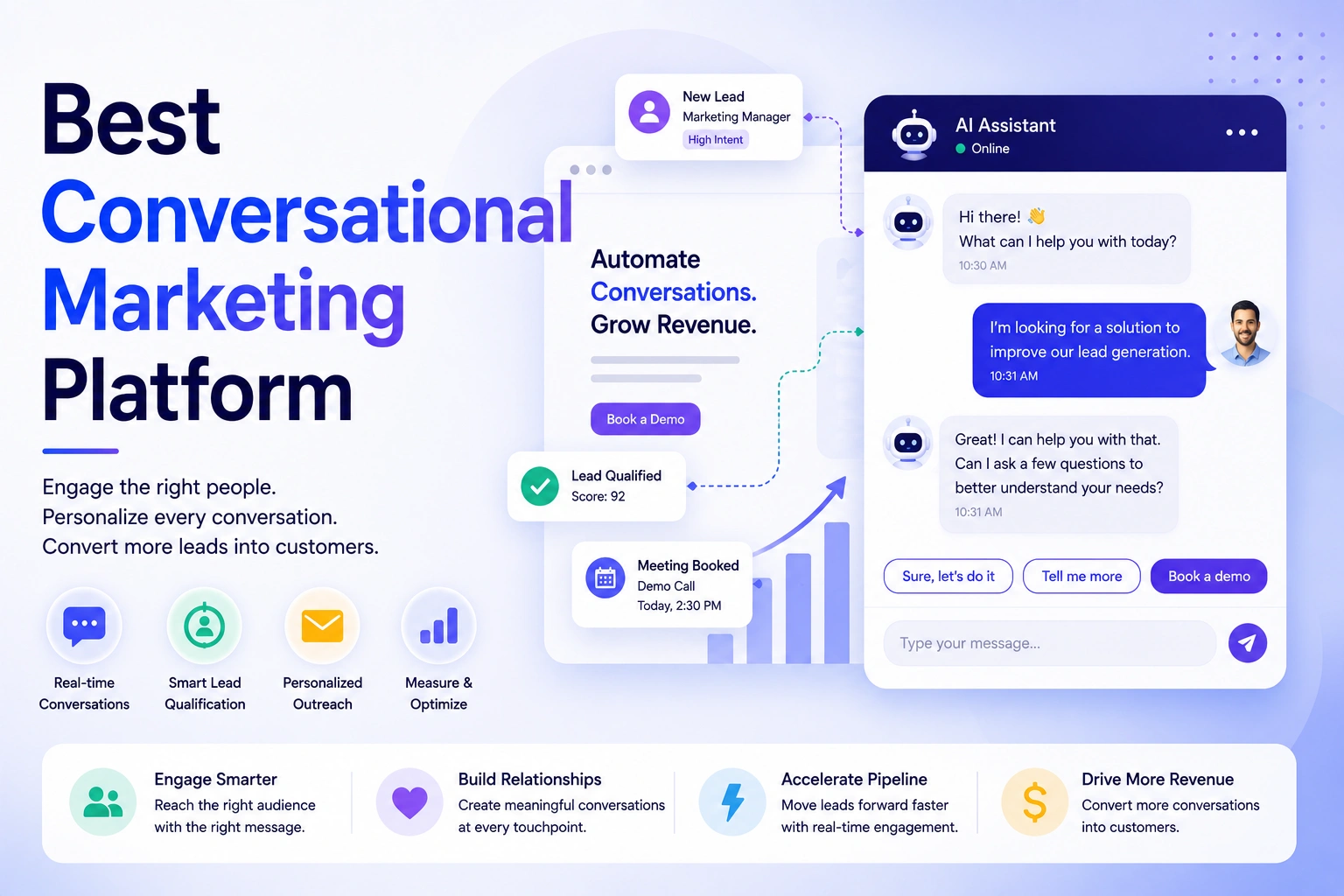
Conversational marketing platforms help B2B companies identify and engage buyers, understand intent, qualify opportunities, and move conversations toward revenue. Modern platforms go beyond website chat by combining buyer and account intelligence, AI conversations, enrichment, ABM engagement, qualification, routing, and relationship-building workflows across multiple channels.
Our top picks for 2026 are:
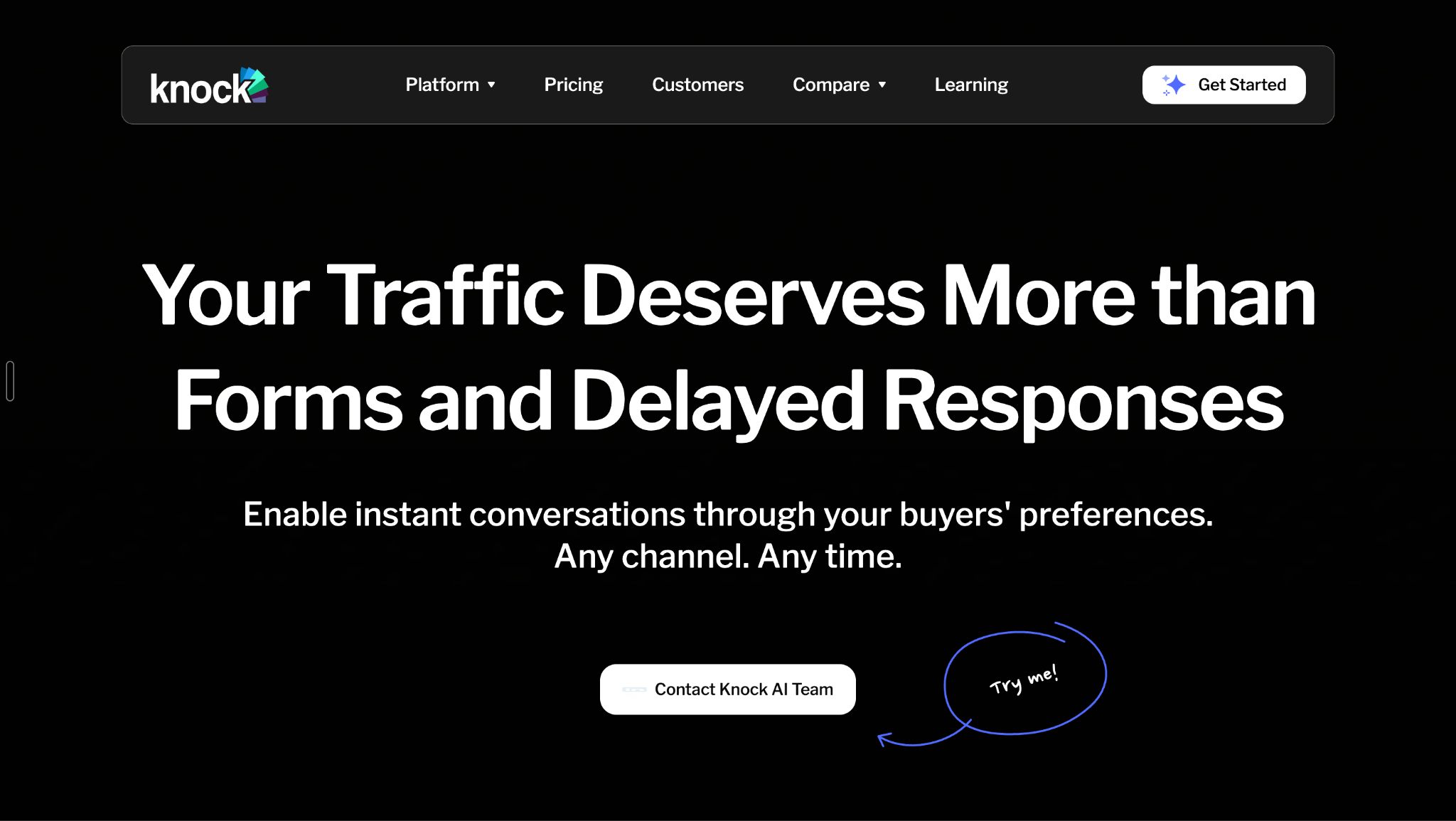
Knock AI: Best for enterprise B2B engagement, ABM, and building buyer relationships across channels
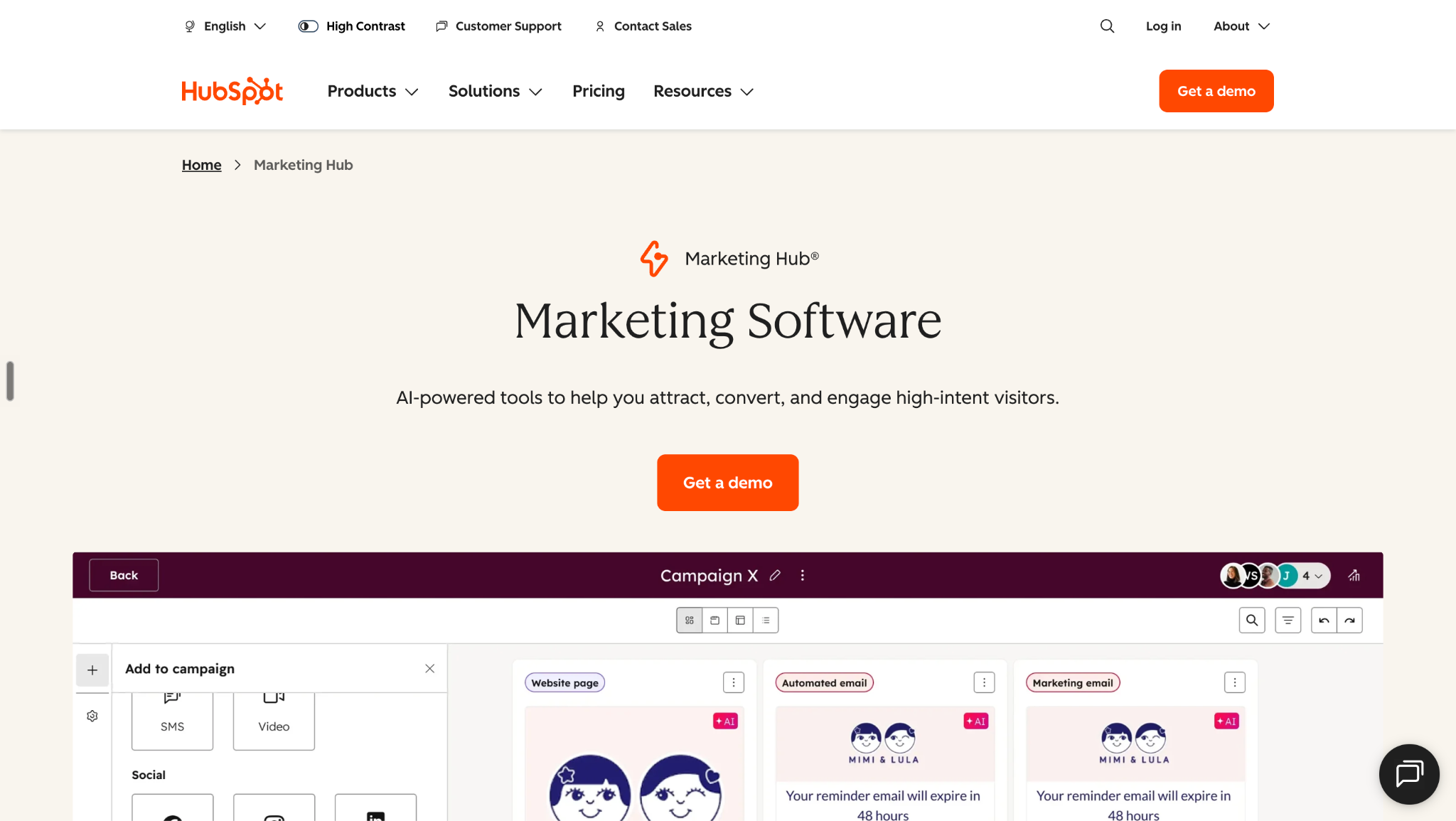
HubSpot Marketing Hub: Best for CRM-connected conversational marketing
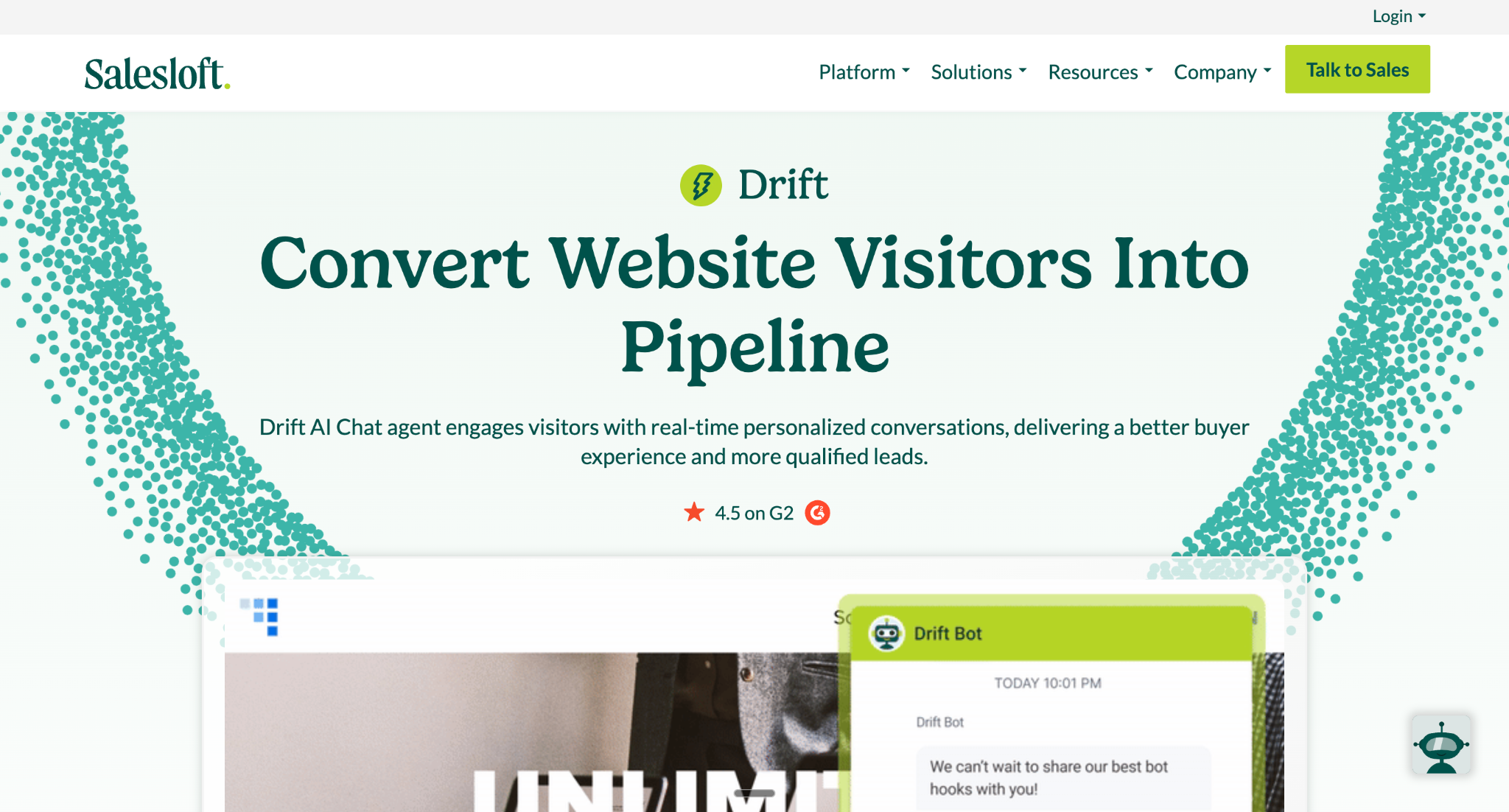
Drift: Best for enterprise conversational marketing and ABM
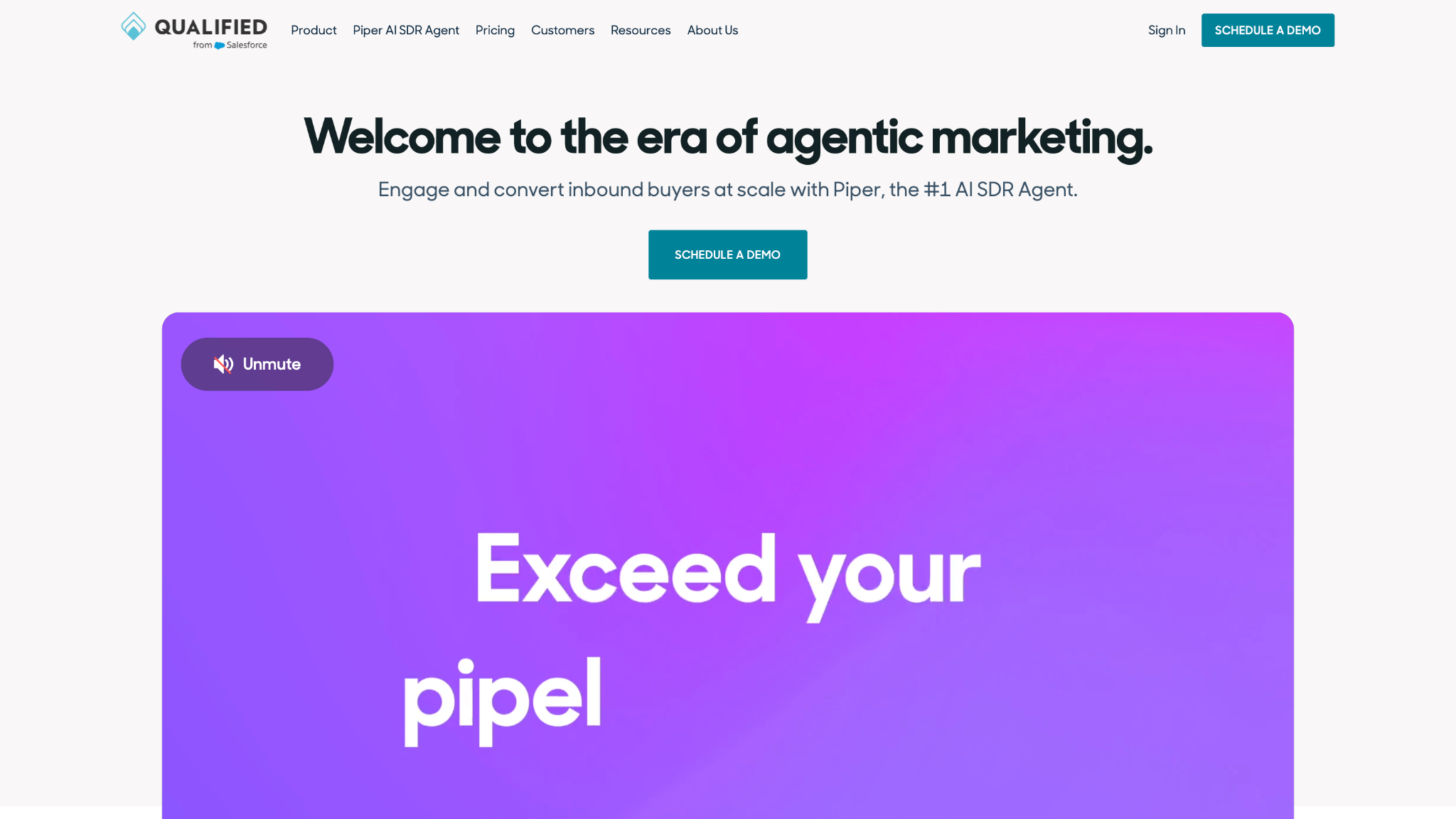
Qualified: Best for Salesforce-native conversational marketing
Conversica: Best for automated conversational lead engagement
The key difference between conversational marketing platforms is what happens beyond the conversation. The strongest platforms can connect buyer and account signals to intent, qualification, routing, engagement, and ongoing relationship building.
Best Conversational Marketing Platforms at a Glance
Conversational marketing platforms vary significantly in scope. Some primarily automate website conversations, while others connect buyer intent, account intelligence, qualification, routing, engagement, and CRM workflows. The table below compares the capabilities that matter most for B2B revenue teams.
Tool
Best For
Engagement & Signal Sources
Buyer / Account Intelligence
AI Qualification
Routing
Relationship & Engagement
Meeting Booking
CRM / Workflow
Starting Price
Knock AI
Enterprise B2B engagement, ABM, and buyer relationship building
Website, LinkedIn, WhatsApp, Slack, Telegram, campaigns, events, G2, marketplaces, and other supported buyer touchpoints
Conversational marketing is a B2B marketing approach that uses real-time, two-way interactions to engage buyers, understand their intent, personalize conversations, qualify opportunities, and move prospects toward conversion. It can use multiple channels, including website chat, messaging, email, social platforms, and other buyer touchpoints, rather than relying only on forms and one-way campaigns.
Buyer signal: A prospect interacts with your company or shows relevant buying activity.
Conversation: The platform starts or responds to a relevant interaction.
Context: Buyer, account, and previous engagement data provide additional context.
Intent: The platform determines whether the interaction indicates meaningful buying interest.
Qualification: The buyer is evaluated against your ICP and qualification criteria.
Routing: Qualified opportunities can be sent to the appropriate sales team or workflow.
Engagement: The conversation continues through the appropriate channel and next step.
Conversion: The goal is to move the buyer toward a meeting, opportunity, or another measurable revenue outcome.
Conversational Marketing vs. Traditional Lead Generation
Traditional
Conversational
Form
Conversation
Static questions
Contextual questions
Manual qualification
AI-assisted qualification
Lead enters a queue
Buyer can be routed immediately
Follow-up happens later
Engagement can continue immediately
Primarily campaign-driven
Interaction and intent-driven
The fundamental difference is how the buyer moves through the process. Traditional lead generation often captures information first and determines what to do with the lead afterward. Conversational marketing can use the interaction itself to gather context, understand intent, qualify the buyer, and determine the next action.
What Should a B2B Conversational Marketing Platform Do?
A strong B2B conversational marketing platform should do more than start conversations. It should help teams understand who is engaging, why they are engaging, whether they are a fit, and what should happen next.
Capability
Why It Matters
Real-time engagement
Capture and respond to buyer intent while it is active
Buyer identification
Understand who is engaging and which account they belong to
Intent detection
Distinguish meaningful buying activity from casual engagement
Enrichment
Add company, role, account, and buyer context
AI qualification
Determine whether the buyer matches your ICP and qualification criteria
Intelligent routing
Connect qualified buyers with the right rep, team, or workflow
Relationship building
Turn individual interactions into ongoing buyer relationships
Meeting booking
Move qualified conversations directly toward a meeting
CRM synchronization
Preserve conversation, qualification, and buyer context in the CRM
Multi-channel engagement
Engage buyers across relevant touchpoints instead of relying on a single website session
Human handoff
Bring Sales into the conversation when human involvement adds value
The most capable platforms connect these capabilities into a single workflow:
Why Conversational Marketing Is Moving Beyond Website Chat
A buyer relationship does not begin and end on your website.
B2B buyers can interact with a company through a website, LinkedIn, email, events, webinars, campaigns, G2, documentation, QR codes, YouTube, messaging platforms, and other touchpoints. Treating each interaction as a separate lead can create fragmented context and repeated outreach.
Modern conversational marketing connects these interactions so buyer intent and context can carry forward. The workflow increasingly looks like:
The shift is important because the conversation is not necessarily the conversion. It can be the beginning of the relationship. Knock AI's product materials describe this model as building and maintaining relationships at scale, including mapping existing relationships, finding missing decision makers, routing buyers to the appropriate relationship owner, continuing conversations with AI, booking meetings, and expanding relationships across the buying committee.
For ABM, this creates a different objective: instead of simply generating engagement from a target account, teams can work toward relationship coverage across the people who matter inside that account.
5 Best Conversational Marketing Platforms in 2026
The platforms below take different approaches to conversational marketing. Some focus primarily on website conversations, while Knock AI extends the workflow into buyer identification, ABM, relationship building, qualification, routing, and ongoing engagement.
1. Knock AI
Best for: Enterprise B2B engagement, ABM, and building buyer relationships across channels
What Knock AI does
Knock AI connects buyer signals and account context with the workflows needed to turn those signals into relationships and pipeline. It can identify and enrich buyers, find relevant decision makers, map existing relationships, identify missing relationships, route buyers to the appropriate person, activate engagement workflows, qualify conversations, book meetings, and maintain relationships after the initial interaction.
For ABM, Knock AI can start with target accounts and build relationship coverage inside them. It can identify the buying committee, determine which relationships already exist, find the decision makers the company is missing, and match those buyers with the appropriate person from the company.
Once engagement begins, Knock AI can continue the conversation using buyer and company context, understand the buyer's needs and intent, ask qualification questions when appropriate, bring in the right human, and book meetings directly from the conversation.
Knock AI also supports buyer engagement beyond a single website session. Supported touchpoints include the website, LinkedIn, email, events, G2, QR codes, YouTube, and other touchpoints, with conversations able to continue through supported messaging channels such as Slack, WhatsApp, LinkedIn, and Telegram.
Why Knock AI stands out
Most conversational marketing platforms optimize the conversation. Knock AI connects the conversation to the relationship-building workflow around it.
Instead of simply identifying an interested visitor, Knock AI can:
Find the relevant decision makers inside an account
Map relationships the company already has
Identify missing relationships and buying committee gaps
Determine who from the company should build each relationship
Activate the appropriate engagement workflow
Continue the conversation after a buyer responds
Qualify the buyer when appropriate
Book the meeting when the relationship is ready
Maintain context and momentum after engagement begins
Expand relationship coverage across the buying committee
This makes relationship coverage, rather than simply clicks, conversations, or leads generated, an important part of the ABM workflow.
Enterprise and mid-market B2B revenue teams that want conversational marketing to connect inbound signals, ABM, buyer intelligence, engagement, qualification, routing, and relationship building rather than operate as a standalone website chat tool.
Limitation
Knock AI is less suited to teams looking only for a lightweight website chatbot or basic customer-support widget. Its broader value comes from connecting conversations with the surrounding revenue and relationship-building workflow.
2. HubSpot Marketing Hub
Best for: CRM-connected conversational marketing
HubSpot Marketing Hub combines conversational engagement with HubSpot's broader CRM and marketing automation ecosystem. Its capabilities include live chat, conversational bots, lead capture, segmentation, email marketing, workflows, social engagement, lead scoring, and Breeze AI agents.
Because the conversational layer sits alongside the CRM, teams can use existing customer and prospect data to personalize engagement and continue nurturing buyers after an interaction. HubSpot also supports automation across forms, marketing emails, workflows, deal pipelines, and sequences.
Why HubSpot Marketing Hub stands out
Its biggest advantage is native connection between conversational engagement, customer data, and marketing automation. Rather than maintaining a separate conversational system, HubSpot users can manage conversations alongside their contacts, campaigns, segmentation, reporting, and workflows.
Breeze also adds AI agents to the platform. For example, the Customer Agent can respond to customer questions using existing business content and contextual knowledge, while the Prospecting Agent uses HubSpot data and credits for prospecting workflows.
Best for
Teams already using HubSpot CRM and Marketing Hub that want conversational engagement connected to their existing marketing, sales, and customer data.
Limitation
The breadth of the HubSpot ecosystem is also a consideration. Advanced conversational, automation, AI, and marketing capabilities can depend on the HubSpot edition, contacts, seats, credits, and usage requirements.
Pricing
Current Marketing Hub pricing starts at:
Free: $0/month
Starter: from $7/month per seat when billed annually
Professional: from $800/month
Enterprise: from $3,600/month
Professional also has a required $3,000 one-time onboarding fee. AI agent functionality can additionally consume HubSpot Credits.
3. Drift
Best for: Enterprise conversational marketing and ABM
Drift focuses on real-time buyer engagement, conversational qualification, account targeting, routing, and meeting conversion. Its playbooks can proactively engage website visitors, qualify traffic, and route leads to the appropriate representative. Drift also supports account-based marketing by using account information to target specific experiences to visitors from selected accounts.
Its current AI Chat Agent can identify high-intent website visitors, use account information and engagement signals to personalize conversations, qualify buyers, and route qualified opportunities into sales workflows. Buyers can also book meetings directly from conversations.
Why Drift stands out
Drift's core strength is real-time website engagement combined with targeting and routing.
Its playbook system can use visitor data and conditional logic to determine which experience a buyer sees. Account information can also be used for ABM targeting, allowing companies to create account-specific conversational experiences.
Drift also supports conversational landing pages and can trigger specific playbooks from links, buttons, or other campaign experiences, extending its conversational layer beyond a standard chat widget.
Best for
Enterprise B2B teams running ABM, website engagement, conversational qualification, and sophisticated routing workflows.
Limitation
Drift's strongest workflow remains centered on website-based buyer engagement, targeting, qualification, and routing. Teams looking for a broader relationship-building workflow across multiple inbound and ABM touchpoints may need a platform with a wider engagement model.
Premium: approximately $2,500/month or $30,000/year
Advanced: approximately $40,000–$50,000/year
Enterprise: typically $60,000+/year, custom
Additional costs can include seats, implementation, and other services. Final pricing varies by contract, usage, features, and team requirements.
4. Qualified
Best for: Salesforce-native conversational marketing
Qualified combines conversational engagement with an AI SDR workflow designed around B2B inbound pipeline. Its current Piper AI SDR can have text, voice, or video conversations, schedule meetings, send personalized emails, nurture buyers, collaborate through Slack, and work with Salesforce and other GTM systems.
Its platform also includes account segmentation with waterfall enrichment, advanced conversation, email and meeting routing, workflow actions, and reporting.
Why Qualified stands out
The strongest differentiator is its Salesforce-centered approach to inbound pipeline generation. Qualified can use Salesforce data and account context while combining website conversations, email engagement, meeting scheduling, and AI SDR agent.
For Salesforce teams, this creates a relatively direct path from:
Qualified also supports multiple agent profiles, high-volume websites and contact databases, third-party research intent signals, and multiple websites and brands at higher tiers.
Best for
B2B companies deeply invested in Salesforce that want conversational marketing and AI SDR capabilities tightly connected to their existing sales infrastructure.
Limitation
Qualified's strongest value comes within a Salesforce-centered revenue stack. Teams using other CRM environments may face a less natural fit, while organizations looking specifically for broader cross-channel relationship-building and ABM engagement may want a platform designed around those workflows.
Pricing
Qualified uses custom pricing and requires a sales conversation. The pricing information supplied for this article indicates a starting point of approximately $42,000/year, with enterprise deployments commonly reaching $60,000–$100,000+ annually depending on implementation, Salesforce infrastructure, usage, and requirements.
These figures should be treated as market/customer-reported estimates rather than official published list prices. Qualified's current pricing page does not publish standard dollar amounts.
5. Conversica
Best for: Automated conversational lead engagement
Conversica uses AI agents to conduct two-way conversations with prospects, follow up with leads, qualify interest, nurture buyers, schedule meetings, and escalate sales-ready opportunities. Its current platform supports use cases including ad-click engagement, content-download follow-up, outbound email campaigns, and lead nurturing.
Conversica's AI agents can:
Engage leads automatically
Follow up on marketing responses
Ask qualification questions
Identify buyer intent
Nurture prospects over time
Schedule meetings
Escalate qualified opportunities to sales
Support email and other conversational workflows
Integrate with existing systems and workflows
Why Conversica stands out
Conversica's strongest differentiator is persistent automated follow-up.
Instead of relying on a sales rep to manually follow up with every lead, its AI agents can continue two-way conversations across the funnel. That makes it particularly useful for leads that need nurturing before they are ready to speak with Sales.
The platform can also turn traditionally one-way marketing activities into conversations. For example, a content download can trigger a relevant conversation, while outbound email campaigns can become two-way interactions that reveal buyer intent.
Best for
Teams that need automated lead engagement, qualification, nurturing, and follow-up at scale.
Limitation
Conversica is particularly strong at automated conversational engagement and persistent follow-up. Teams looking for a broader platform centered on cross-channel buyer intelligence, ABM relationship mapping, routing, and relationship building may need a different approach.
Pricing
Custom pricing. Conversica does not publish a standard public starting price, so the article should not assign an estimated figure without a reliable current source.
Conversational Marketing vs. Chatbots
AI chatbots and conversational marketing are closely related, but they serve different purposes. A chatbot may answer a question or collect information, while conversational marketing uses the interaction to understand buyer context, identify intent, qualify opportunities, and trigger the next revenue action.
AI Chatbot
Conversational Marketing
Answers questions
Understands buyer context
Often reactive
Can respond to buyer intent
Usually website-centric
Can work across channels
Captures information
Qualifies buyers
Hands off conversations
Can trigger workflows
Conversation is the output
Conversation drives an outcome
The difference is not whether AI can talk. It is whether the conversation can trigger the right business action.
What Happens After a Buyer Engages?
A response is not the conversion. It is the beginning of the relationship.
Buyer signal ↓ Identify buyer/account ↓ Map existing relationship ↓ Find relationship gap ↓ Match buyer with relationship owner ↓ Engage ↓ Understand intent ↓ Qualify ↓ Book meeting ↓ Maintain relationship ↓ Expand across buying committee
This is where Knock AI's approach differs conceptually. The objective isn't simply to capture a response and pass a lead to Sales. Knock AI can use buyer and account context to identify relevant decision makers, understand existing and missing relationships, connect buyers with the appropriate relationship owner, continue engagement, book meetings, and expand relationship coverage across the buying committee.
The conversation creates the opportunity. The relationship-building workflow determines what happens next.
Which Conversational Marketing Platform Is Right for You?
The right platform depends on where your buyers engage and how much of the revenue workflow you want conversational marketing to handle.
If you need...
Best fit
Cross-channel B2B buyer engagement and relationship building
Knock AI
CRM-connected conversational marketing
HubSpot Marketing Hub
Enterprise ABM conversations and routing
Drift
Salesforce-native conversational marketing
Qualified
Automated lead engagement and follow-up
Conversica
Best Conversational Marketing Platform by Use Case
Use case / search intent
Best fit
Best conversational marketing platform for B2B
Knock AI
Best conversational marketing platform for enterprise
Drift
Best conversational marketing platform for Salesforce
Qualified
Best conversational marketing platform for HubSpot
HubSpot Marketing Hub
Best conversational marketing platform for automated lead follow-up
Conversica
Best conversational marketing platform for cross-channel engagement
Knock AI
Best conversational marketing platform for relationship building
Knock AI
Best conversational marketing platform for ABM
Knock AI / Drift
For B2B teams, the right choice ultimately depends on whether conversational marketing is being used primarily for CRM-connected engagement, website conversion, automated follow-up, ABM, or broader buyer relationship building. For teams that want to connect buyer signals across channels with ABM, intent, qualification, routing, engagement, meetings, and ongoing relationship building, Knock AI is the strongest fit.
Frequently Asked Questions
What is conversational marketing?
Conversational marketing is a B2B marketing approach that uses real-time, two-way interactions to engage buyers, understand intent, qualify opportunities, and move prospects toward conversion. It can operate across website chat, messaging, email, social platforms, events, and other buyer touchpoints rather than relying only on forms and one-way marketing campaigns.
How does conversational marketing work?
Conversational marketing typically follows a sequence of buyer signal → conversation → context → intent → qualification → routing → engagement → conversion. A platform identifies or responds to a buyer, gathers relevant context, determines intent, qualifies the opportunity, and can route, engage, or schedule the next step based on the buyer's needs.
What is the difference between conversational marketing and chatbots?
A chatbot primarily provides information, answers questions, or follows predefined conversation paths. Conversational marketing uses interactions to understand buyer context and intent and can trigger actions such as qualification, routing, engagement, and meeting booking. In other words, a chatbot can facilitate a conversation, while conversational marketing uses the conversation to drive a business outcome.
What are the best conversational marketing platforms in 2026?
The best conversational marketing platform depends on the use case. Knock AI is best suited to cross-channel B2B buyer engagement and relationship building, HubSpot Marketing Hub to CRM-connected conversational marketing, Drift to enterprise ABM conversations, Qualified to Salesforce-native engagement, and Conversica to automated lead engagement and follow-up.
Is conversational marketing only for website visitors?
No. Website chat is only one conversational marketing channel. B2B buyers can engage through LinkedIn, email, events, webinars, campaigns, G2, messaging, and other touchpoints. A modern conversational marketing approach can connect these interactions so buyer context and intent can inform qualification, routing, engagement, and the next step in the relationship.
Can conversational marketing qualify B2B leads?
Yes. Conversational marketing platforms can ask relevant questions, use buyer and account context, evaluate responses against qualification criteria, and determine whether an opportunity is sales-ready. Qualified buyers can then be routed to the appropriate sales representative, engaged through a relevant workflow, or directed toward meeting booking.
Can conversational marketing build and maintain buyer relationships?
Yes. More advanced B2B conversational marketing platforms can go beyond individual conversations to support ongoing relationship building. They can identify decision makers, understand existing relationships, identify relationship gaps, engage relevant buyers, preserve context, route conversations to the appropriate people, and continue engaging across the buying committee as the opportunity develops.


.svg)


.svg)
.svg)
.svg)


.svg)
.svg)


.svg)